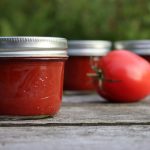
Canning Tomato Paste
This recipe yields a richly flavored and tomato-dense paste, perfect for canning in small jars so you can enjoy the taste of summer-fresh tomatoes all year round.
Servings: 128 servings, makes 8 to 9 half-pint jars
Equipment
Ingredients
- 14 lbs. Tomatoes Roma or Paste Type
- 1 tsp. citric acid mandatory, do not substitute
- 2 large bay leaves
- 1 tsp. canning salt
- 1 clove garlic optional
Instructions
- Wash the tomatoes, remove the stems, and trim away any bruised or discolored parts.
- Working with about a pound at a time, quarter the tomatoes and add them to a large stockpot over high heat.
- Crush the tomatoes with a potato masher as they heat, bringing them to a boil.
- Keep quartering and adding tomatoes, crushing as you go, until all of them are in the pot. Stir often to prevent sticking.
- Reduce the heat and simmer uncovered for about 1 hour, until the volume has reduced by half. Stir frequently.
- Press the cooked tomatoes through a food mill or fine sieve to remove the skins and seeds. Do not use a blender or food processor.
- Return the sieved tomatoes to the stockpot. Stir in the citric acid until fully dissolved and evenly distributed.
- Stir in the salt, bay leaves, and garlic clove if using.
- Cook uncovered over medium heat until the paste is thick enough to round up on a spoon, about 2 1/2 hours. Stir frequently, and almost constantly toward the end.
- As the paste nears done, prepare a boiling water canner, half-pint jars, and two-part lids.
- Remove and discard the bay leaves and garlic clove.
- Ladle the hot paste into hot half-pint jars, leaving 1/2 inch headspace.
- Slide a nonmetallic tool between the paste and the jar wall to release air bubbles, then adjust the headspace.
- Wipe the rims clean, center the lids, and screw the bands to fingertip tight.
- Process in a boiling water canner for 45 minutes, adjusting for altitude (see notes).
- Turn off the heat and let the jars rest in the canner 5 minutes before removing with a jar lifter.
- Set the jars on a towel or rack with an inch of space around each, and leave undisturbed 12 to 24 hours.
- Remove the rings and check the seals. Refrigerate any jar that didn't seal and use it first.
- Label with contents and date. Sealed jars hold quality on the pantry shelf for 12 to 18 months. Refrigerate after opening.
Notes
Yield ~ This recipe makes 8 to 9 half-pint jars. Watery slicing tomatoes, heirlooms, and cherry tomatoes all yield less from the same weight and take longer to reduce.
Jar Size ~ This recipe has only been tested in half-pint jars. Tomato paste is dense and heat moves through it slowly, so do not use pint or quart jars. Quarter-pint jars are safe at the same 45 minute processing time.
Acidifying Tomato Paste ~ The citric acid has to be stirred into the sieved tomatoes before they are cooked down, not added to the jars. Finished paste is too thick to distribute acid evenly, and the ratio of citric acid to pounds of tomatoes has to stay consistent. This recipe was tested with citric acid only and does not include a bottled lemon juice option.
Pressure Canning ~ This recipe has not been tested in a pressure canner. Use the boiling water canner method.
Scaling Down ~ You can halve or quarter this recipe as long as you keep the citric acid proportional to the weight of tomatoes. Smaller batches scorch more easily, so stir more often.
Don't Overreduce ~ Home canned paste is softer than commercial paste. Stop when it rounds up on a spoon. Reducing further slows heat penetration during processing.
Altitude Adjustments (half pint jars)
- 45 minutes for altitudes below 1,000 feet
- 50 minutes for altitudes of 1,001 to 3,000 feet
- 55 minutes for altitudes of 3,001 to 6,000 feet
- 60 minutes for altitudes of 6,001 feet and higher
Nutrition
Calories: 9kcal | Carbohydrates: 2g | Protein: 0.4g | Fat: 0.1g | Saturated Fat: 0.01g | Polyunsaturated Fat: 0.04g | Monounsaturated Fat: 0.02g | Sodium: 17mg | Potassium: 118mg | Fiber: 1g | Sugar: 1g | Vitamin A: 413IU | Vitamin C: 7mg | Calcium: 5mg | Iron: 0.1mg
