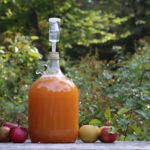
Cyser (Apple Mead or Apple Honey Wine)
A traditional 1-gallon recipe for cyser, the apple mead made by fermenting fresh-pressed cider with honey. Yields about 4 standard wine bottles.
Servings: 20 glasses, makes 1 gallon, or about 4 bottles
Equipment
Ingredients
- 1 gallon fresh apple cider see notes
- 2 to 2 1/2 lbs honey see notes
- 1 tsp yeast nutrient
- 1/2 tsp acid blend
- 1 tsp pectic enzyme
- 1/8 to 1/4 tsp tannin powder
- 1 packet wine yeast Lalvin ICV-D47 suggested, see notes
Instructions
- Remove about 1 quart of cider from the gallon and save it in the freezer for topping off in secondary.
- Dissolve all the ingredients except the yeast in the remaining 3 quarts of cider. Heating it gently can help, but don't let it boil.
- Pour the mixture into the fermentation vessel, and let it come back to room temperature if you heated it.
- Dissolve the wine yeast in about 1/4 cup of unchlorinated water and let it rehydrate for about 10 minutes. One packet works for anywhere from 1 to 5 gallons, so use the whole packet.
- Add the yeast to the fermentation vessel.
- Top off the vessel with some of the cider you set aside, up to the base of the neck, leaving 2 to 3 inches of headspace so the mixture has room to bubble.
- Cap with a rubber bung and a water-filled airlock, and let it ferment in primary for about 7 to 10 days. Fermentation is very active and may bubble up into the airlock. If it does, clean the airlock and put it back on.
- After primary fermentation, siphon the cyser into a clean fermentation vessel, leaving the sediment behind.
- Cap again with the airlock, and let it ferment in a cool, dark place in secondary for at least 6 weeks, and preferably 4 to 6 months.
- When fermentation is complete, bottle the cyser and let it age in the bottle for at least a month before drinking. For a sweeter cyser, stabilize and backsweeten before bottling (see notes).
Notes
Apple cider: Use unpasteurized fresh-pressed cider from a local orchard if you can, since it has the brightest aromatics. Pasteurized refrigerated cider works too. Avoid anything labeled "apple juice" or anything with potassium sorbate or sodium benzoate, since those preservatives inhibit the yeast.
Honey: Most cyser recipes call for 1 3/4 to 2 1/2 pounds of honey per gallon. With D47 yeast, 1 3/4 pounds finishes very dry, 2 pounds semi-dry to semi-sweet, and 2 1/2 pounds sweet without being cloying.
Yeast choices: Lalvin ICV-D47 is the standard for cyser. It brings out fruity, floral aromas and tops out at 15% alcohol. Lalvin QA23 ferments clean for a slightly drier finish. Lalvin K1-V1116 tolerates 18% alcohol, so use it with 2 1/2 to 3 pounds of honey. Lalvin EC-1118 is a champagne yeast that ferments dry.
Stabilizing and backsweetening: If the cyser tastes too dry at the end of secondary, let it finish fermenting and rack it off the sediment. Then add 1 Campden tablet and 1/2 teaspoon potassium sorbate, and wait 24 to 48 hours before adding honey. They don't kill the yeast, but together they keep any remaining yeast from multiplying. Sweeten to taste, starting small, and let it rest another week before bottling.
Aging: Cyser is drinkable after about a month in the bottle, and it gets smoother and more complex with time. Six months makes a noticeable difference, and a full year is even better.
Nutrition
Calories: 259kcal | Carbohydrates: 68g | Protein: 0.4g | Fat: 0.2g | Saturated Fat: 0.04g | Polyunsaturated Fat: 0.1g | Monounsaturated Fat: 0.01g | Sodium: 10mg | Potassium: 221mg | Fiber: 0.5g | Sugar: 65g | Vitamin A: 2IU | Vitamin C: 2mg | Calcium: 19mg | Iron: 0.5mg
