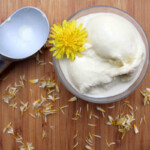
Dandelion & Honey Ice Cream
Dandelion petals infuse a custard ice cream base sweetened with light clover honey for a rich, floral spring dessert. Makes about 1 quart.
Servings: 8 servings, 1 quart
Equipment
Ingredients
- 2 cups heavy cream
- 1 cup whole milk
- 1/2 cup honey
- 1 cup dandelion petals yellow parts only
- 1 pinch sea salt
- 6 large egg yolks
Instructions
- Add heavy cream, milk, honey, salt and dandelion petals to a saucepan. Slowly bring to a simmer without scorching and then remove from heat. Allow dandelions to infuse in the cream for at least 30 minutes.
- Strain the dandelion blossoms from the cream. Pour the cream into another container and rinse out the saucepan to cool it. This is important because egg yolks will scramble if added to a hot pan.
- Add 6 egg yolks to a clean, cooled saucepan. Whisking constantly, slowly add the cream mixture. If the cream is warm enough, the egg mixture will thicken to form a custard.
- Once all the cream mixture is added, continue whisking for another few minutes. If the mixture doesn't thicken to coat the back of a spoon, turn the heat on low and whisk until it thickens. If you have an instant-read thermometer, cook until 175 degrees f.
- Remove from heat and pour into a bowl to chill. Chill the custard mixture in the refrigerator for at least 4 hours before processing in an ice cream maker.
Notes
Dandelion picking: Use only pesticide-free lawns or organic pastures. Pick on a sunny, dry morning after dew has lifted. Remove all green parts of the flower — the milky sap in the calyx is bitter and will ruin the batch. One packed cup of yellow petals per batch.
Honey selection: Use a mild, light honey like clover, wildflower, or orange blossom. Strong dark honeys (buckwheat, manuka) will overpower the delicate dandelion flavor.
No ice cream maker substitute: Pour the chilled custard into a freezer-safe container. Every 2 hours, beat vigorously with a stand mixer paddle or hand mixer to break up ice crystals. Repeat 3-4 times, then let firm up.
Dairy-free version: Substitute 3 cups of coconut cream (or your favorite non-dairy cream blend) for the heavy cream and milk. Keep the dandelion infusion step. Non-dairy versions skip the egg yolk custard; follow your preferred non-dairy ice cream technique instead.
Storage: Keeps 2-3 months in the freezer. Press parchment directly onto the surface before sealing to prevent ice crystals. Stays remarkably soft and scoopable thanks to the egg yolks.
Custard temperature: Cook the custard to 175°F (79°C) on an instant-read thermometer, or until it coats the back of a spoon and holds a line when you run your finger across it. Don't exceed 180°F or the eggs will scramble.
Nutrition
Serving: 1grams | Calories: 326kcal | Carbohydrates: 21g | Protein: 5g | Fat: 26g | Saturated Fat: 15g | Polyunsaturated Fat: 2g | Monounsaturated Fat: 7g | Cholesterol: 209mg | Sodium: 39mg | Potassium: 127mg | Fiber: 0.04g | Sugar: 21g | Vitamin A: 1108IU | Vitamin C: 0.5mg | Calcium: 95mg | Iron: 0.5mg
