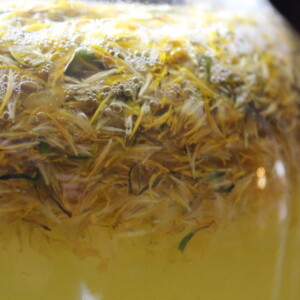
Dandelion Wine
Dandelion wine captures summer in a bottle with its sweet, floral flavor and subtle honey notes. My recipe is adapted from the Foxfire Books, and I've been making it for 15 years.
Servings: 20 glasses (1 gallon, about 4 bottles)
Equipment
Ingredients
- 3 quarts water approximate, more to fill
- 3 pounds sugar roughly 5 to 6 cups
- 1 quart cleaned dandelion petals packed, from roughly 3-4 quarts blossoms
- 3 medium oranges juice and zest
- 1 medium lemons juice and zest
- 1 tsp yeast nutrient
- 1 packet wine yeast see notes
Instructions
- Bring the water and sugar to a boil in a saucepan. Stir to dissolve the sugar and cool to lukewarm.
- Place the dandelion petals, citrus juice and zest into a one-gallon fermentation vessel. Add the yeast nutrient and pour the lukewarm sugar water over the top.
- Dissolve a packet of champagne yeast or other wine yeast in lukewarm water. Allow it to stand for 5 minutes to rehydrate and then pour it into the wine. Top off with a bit of extra water to fill the carboy, but be sure to leave at least an inch of headspace.
- Cap with an airlock and ferment for 10 to 14 days, or until fermentation slows significantly.
- Scoop off the floating dandelion petals, then siphon the wine into a clean container, leaving the sediment behind. Allow the wine to ferment in secondary for at least 6 to 8 weeks, checking the water lock periodically to ensure the water hasn't evaporated.
- Bottle the dandelion wine in corked wine bottles for longer storage, or flip-top Grolsch bottles for small batches you're not planning on storing long.
- Allow the wine to age in the bottle at least 2 months before drinking, ideally 6 months or more. During aging, keep bottles somewhere cool like a basement or closet on the north side of the house (65 to 68 degrees F is ideal, but room temp is fine).
Notes
Choosing Yeast: Different yeasts produce different flavors and sweetness levels. Red Star Cote des Blancs is my top pick for dandelion wine because it's a slow fermenter that preserves delicate floral notes and has a lower alcohol tolerance (12-14%), leaving more residual sweetness. Lalvin D47 adds fruity and floral character with hints of spice (15% tolerance). For a drier wine, use Lalvin EC-1118 champagne yeast (18% tolerance). One packet treats 5 gallons, so use about 1 teaspoon per gallon. Never use bread yeast.
Cleaning Dandelion Petals: Only use the yellow petals. The green sepals underneath have a bitter, milky sap that will ruin the delicate flavor of your wine. This is tedious work, but it's absolutely essential. Plan on about an hour to clean a quart of petals. Freeze cleaned petals if collecting over multiple days.
Small Batch Option: Divide the recipe by 4 for a one-quart batch using a mason jar and fermentation kit. Use only 1/4 packet of yeast for a quart batch.
Mead Variation: Substitute 3 pounds of honey for the sugar to make dandelion mead. Honey takes longer for yeast to digest, so expect 2 to 4 months in secondary instead of 6 to 8 weeks. The finished mead will have more body and complexity than the sugar-based wine.
Backsweetening: If your finished wine is too dry, you can backsweeten it. First stabilize the wine with 1 Campden tablet and 1/2 teaspoon potassium sorbate per gallon to prevent refermentation. Wait 24 hours, then add simple syrup to taste. Rack again before bottling.
Cold Infusion Method: This recipe uses a cold infusion, meaning the sugar water is cooled to lukewarm before adding to the petals. This preserves more of the delicate floral flavor than making a hot dandelion tea first.
Aging: Dandelion wine tastes rough when young. Give it at least 2 months in the bottle, though 6 months or longer is ideal. Store bottles somewhere cool and dark, like a basement or closet on the north side of the house.
Yield: Makes approximately 1 gallon (4 standard wine bottles, about 20 glasses).
Nutrition
Serving: 1glass | Calories: 166kcal | Carbohydrates: 8g | Protein: 0.4g | Fat: 0.04g | Saturated Fat: 0.01g | Polyunsaturated Fat: 0.01g | Monounsaturated Fat: 0.005g | Sodium: 10mg | Potassium: 177mg | Fiber: 1g | Sugar: 4g | Vitamin A: 45IU | Vitamin C: 13mg | Calcium: 26mg | Iron: 1mg
