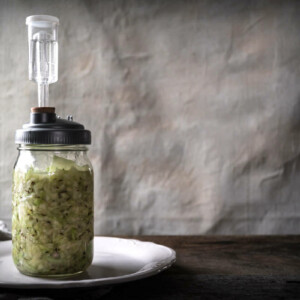
Homemade Sauerkraut
Learn how to make sauerkraut in a mason jar with just cabbage and salt. Slice, salt, and pound the cabbage, pack it under its own brine, and let it ferment into tangy, crunchy kraut full of live cultures.
Servings: 12 servings, makes about 1 quart
Equipment
- Mandoline Slicer optional
- Digital Scale optional
Ingredients
- 1 1/2 lbs green cabbage see notes
- 1 Tbsp canning salt or fine Redmond's Real Salt see notes
- 1 Tbsp caraway seeds optional
- 5 whole juniper berries optional
Instructions
- Pull any damaged outer leaves off the cabbage and rinse it in cold water if you like. Quarter it and cut out the core.
- Slice the cabbage into thin shreds, about the thickness of a quarter, with a sharp knife or mandoline.
- Toss the cabbage with the salt in a large bowl until it's evenly mixed.
- Massage, squeeze, or pound the cabbage until it softens and releases enough juice to pool in the bottom of the bowl.
- Mix in the caraway seeds and juniper berries, if using.
- Pack the cabbage into a wide-mouth quart jar a handful at a time, pressing each layer down firmly, and pour in all the juice from the bowl. Leave a few inches of space at the top.
- If the juice doesn't cover the cabbage, let it sit for a few hours to release more. If the juice still doesn't cover it by the next day, top it off with salt brine (see notes).
- Lay a cabbage leaf over the top and add a fermentation weight, so the cabbage sits at least 1 inch below the brine.
- Cover the jar with an airlock lid or a clean cloth, and set it on a plate to catch any overflow.
- Ferment at room temperature, between 60 and 75°F and out of direct sun, pressing the cabbage back under the brine if any floats up. Start tasting after a week (see notes).
- When it's as sour as you like, remove the weight, cap the jar with a regular lid, and refrigerate.
Notes
Yield: 1 1/2 pounds of cabbage, about half of an average head, fills a wide-mouth quart jar with a few inches to spare.
Salt: Use canning or pickling salt or fine Redmond's Real Salt by the spoonful. A tablespoon weighs about 17 to 18 grams, roughly 2.5 percent of 1 1/2 pounds of cabbage, close to Penn State Extension's 3 1/2 tablespoons per 5 pounds for jars. Kosher salts weigh less by the spoonful (Diamond Crystal about half as much), so weigh any other pure salt instead: you need about 17 to 18 grams. For crocks, the USDA uses 3 tablespoons per 5 pounds of cabbage.
Brine: If the cabbage hasn't released enough juice to cover itself by the next day, top it off with brine made from 1 1/2 tablespoons of salt per quart of water, boiled and cooled (National Center for Home Food Preservation).
Fermentation time: At 70 to 75°F, sauerkraut is fully fermented in about 3 to 4 weeks, and at 60 to 65°F in about 5 to 6 weeks. Below 60°F it may not ferment, and above 75°F it can turn soft. It's done when the bubbling stops, but you can refrigerate it sooner if you like the taste.
Keep it submerged: Anything above the brine can mold. Skim off a flat white film (kahm yeast), but throw out the whole batch if you see fuzzy or colored mold.
Storage: Keep finished sauerkraut tightly covered in the refrigerator, pressed under its brine. Fully fermented kraut keeps for several months.
Nutrition
Serving: 0.25cup | Calories: 14kcal | Carbohydrates: 3g | Protein: 1g | Fat: 0.1g | Saturated Fat: 0.02g | Polyunsaturated Fat: 0.01g | Monounsaturated Fat: 0.01g | Sodium: 592mg | Potassium: 97mg | Fiber: 1g | Sugar: 2g | Vitamin A: 56IU | Vitamin C: 21mg | Calcium: 23mg | Iron: 0.3mg
