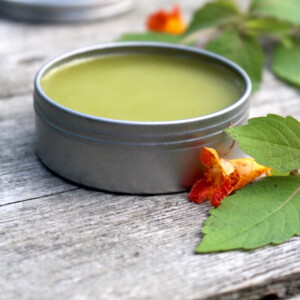
Jewelweed Salve
This herbal salve is ideal for poison ivy, stinging nettle burns, and itchy bug bites!
Equipment
Ingredients
Instructions
- Harvest the leafy upper portions of jewelweed plants on a dry day, after the morning dew has burned off.
- Chop the leaves and softer stems roughly with garden shears or kitchen scissors.
- Pack the chopped jewelweed firmly into a clean pint mason jar, leaving about an inch of headspace.
- Pour oil over the leaves until they're fully covered, still leaving a little room at the top.
- Leave the lid loose or off so moisture from the fresh leaves can escape during the infusion.
- Hold the jar at 110 to 120°F for 24 to 48 hours. A dehydrator set to 115°F, a yogurt maker, or an Instant Pot on yogurt mode holds the temperature without attention. On the stovetop, set the jar on a trivet in a pot with an inch of water and cycle the heat.
- Strain the warm oil through a cheesecloth-lined mesh strainer into a clean heatproof bowl. Do not squeeze the cheesecloth. Let it drain on its own. Measure the strained jewelweed infused oil. From a single batch starting with 1 1/4 cup, you should have about 1 cup strained oil as some is always lost to tools and straining.
- Set the bowl over an inch of simmering water, add the beeswax, and stir until melted and smooth.
- Pour into tins or small glass jars immediately.
- Leave uncovered for at least 30 minutes before putting lids on.
Notes
Yield ~ Makes about 12 oz of finished salve, enough to fill six 2-oz tins.
Beeswax ratio ~ One ounce of beeswax for the full batch gives a soft, easily spreadable salve. For something firmer, work up toward 1 ounce per cup of oil. Test by dropping a spoonful on a plate from the freezer and letting it set 30 seconds. Too soft, rewarm and add beeswax a teaspoon at a time. Too hard, rewarm and add oil a tablespoon at a time. The beeswax scales with the oil, so a triple batch takes 3 oz.
Substituting oils ~ Olive oil is what I use most. Grapeseed is light and non-comedogenic, sweet almond is mild, and jojoba absorbs fastest. Coconut oil firms up on its own at room temperature, so back off the beeswax slightly if you use it.
Infusion methods ~ Hold the jar at 110 to 120°F for 24 to 48 hours. A dehydrator, yogurt maker, or Instant Pot on yogurt mode is the most hands-off. A slow cooker works only as an insulated water bath, never as a direct heat source, since even keep-warm runs around 170°F and will cook the leaves. Above 140°F you lose potency.
Watery orange layer ~ If you see a rust-colored liquid under the infused oil, that's water squeezed out of the fresh plant material. Pour the clear oil off the top and leave the sludge behind. Water in a finished salve invites mold.
Shelf life ~ About a year in a cool, dark, dry place. A few drops of vitamin E oil stirred in with the beeswax extends it. Discard if it smells rancid or shows mold.
For sensitive skin ~ Patch test on a small area first, and stop using it if irritation worsens.
Plant prep note ~ No need to separate flowers from leaves. Use the whole upper portion of the plant. It works out to roughly 98% leaves anyway. Don't wash the plant material unless it's genuinely dirty, and if you do, dry it completely first.
Vegan version ~ Substitute candelilla wax for beeswax at roughly half the amount. See the vegan herbal salve recipe for ratios.
What this salve isn't for ~ Skip it on deep cuts, punctures, serious burns, or infected skin.
Tried this recipe?Let us know how it was!
