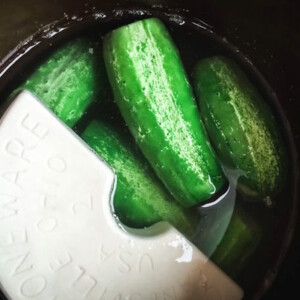
Lacto-Fermented Dill Pickles
Crisp, tangy, probiotic-rich lacto-fermented pickles made with just cucumbers, salt, and water. No vinegar and no canner required, so it's an easy way to preserve a small cucumber harvest right on the counter.
Servings: 8 pickles
Equipment
- Half Gallon Mason Jar
Ingredients
- 1.5 to 2 lbs pickling cucumbers about 8, 4 to 6 inches long
- 4 cups water unchlorinated
- 2 Tbsp pickling salt or other pure, additive-free salt
- 2 whole dill flower heads or 2 tablespoons dill seed
- 4 to 6 cloves garlic peeled and gently smashed
- 2 tsp black peppercorns
- 1 tsp mustard seed optional
- 1 whole bay leaf optional
- 1 handful grape leaves or oak, horseradish, or blackcurrant leaves, for crispness
Instructions
- Rinse the cucumbers but don't peel them. Trim about a quarter inch off the blossom end of each cucumber to remove the softening enzyme there. If you can't tell which end is the blossom end, trim a thin slice off both ends.
- For extra crispness, soak the trimmed cucumbers in a bowl of ice water while you prepare everything else. This step is optional.
- Make the brine by stirring the salt into the water until fully dissolved. Let the brine cool completely before using it. Warm brine can partly cook the cucumbers and lead to soft pickles.
- Lay the tannin leaves in the bottom of a clean jar or crock, then add the garlic and spices.
- Pack the cucumbers in snugly, standing them upright so they hold their place once the brine is added.
- Pour the cooled brine over the cucumbers until they're fully submerged, leaving some headspace at the top of the jar.
- Add a fermentation weight to keep the cucumbers below the surface of the brine. Anything exposed to air can mold. Loose spices floating on top are fine.
- Cover with an airlock lid or loosely with a regular lid, and set the jar out of direct sunlight to ferment. In a warm kitchen above 77°F, the pickles are usually done in 3 to 5 days. In a cooler room they'll take 7 to 10 days.
- Start tasting around day three. The pickles are ready when they're as sour as you like and the interiors have turned from opaque white to translucent. A thin white film (kahm yeast) is harmless and can be skimmed off. Discard the batch if you see fuzzy colored mold or it smells rotten.
- Once they taste right, move the jar to the refrigerator or a spot below 60°F, keeping the pickles in their brine. They'll keep for several months.
Notes
Salt: Use a pure salt with no iodine or anti-caking agents. Canning and pickling salt or a mineral salt like Redmond Real Salt both work well. Iodized table salt can cloud the brine and interfere with fermentation.
Brine strength: This makes roughly a 3.5% salt brine (about 2 tablespoons of salt per quart of water), which is standard for a quick half-sour dill pickle.
Full-sour version: For a deep, fully cured full-sour pickle, use a stronger brine of about 1/4 cup (4 tablespoons) salt per quart of water, and ferment for 3 to 4 weeks at 70 to 75°F (or 5 to 6 weeks at 55 to 65°F). Keep the crock below 80°F to avoid soft pickles, keep everything submerged, and skim surface scum several times a week. The pickles are fully sour when they've turned translucent all the way through. Discard the batch if it ever becomes soft, slimy, or develops an off odor.
Keeping pickles crisp: The three keys to crunch are fresh cucumbers, trimming the blossom end, and adding a tannin source (grape, oak, horseradish, or blackcurrant leaves, or a tablespoon of loose black tea). A pinch of Ball Pickle Crisp also works.
Water: Chlorine slows fermentation. Use filtered, spring, or well water, or leave city water out uncovered overnight before using.
Whole vs. sliced: Whole cucumbers stay crispest but ferment more slowly. Spears and coins ferment faster but soften a bit sooner. Cutting a shallow slit down a whole cucumber speeds things up while keeping most of the crunch.
Storage: Fermented pickles are not water-bath canned. Canning would kill the beneficial bacteria. Store them cold, in their brine, and they'll keep for several months in the refrigerator.
Nutrition
Calories: 18kcal | Carbohydrates: 3g | Protein: 1g | Fat: 0.3g | Saturated Fat: 0.04g | Polyunsaturated Fat: 0.1g | Monounsaturated Fat: 0.1g | Sodium: 1746mg | Potassium: 140mg | Fiber: 1g | Sugar: 1g | Vitamin A: 110IU | Vitamin C: 3mg | Calcium: 23mg | Iron: 0.4mg
