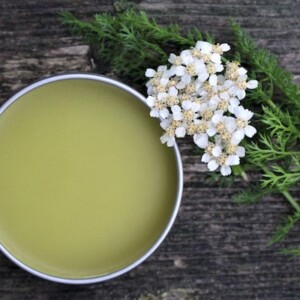
Yarrow Salve
A homemade yarrow salve for cuts, scrapes, burns, bug bites, and skin irritation. Made by infusing fresh or dried yarrow leaves into oil, then thickening with beeswax. Yields about 8 oz of finished salve and keeps for about a year.
Equipment
Ingredients
- 1 1/2 to 2 cups fresh yarrow leaves packed, finely chopped; or about 1/2 pint dried
- 1 to 1 1/2 cups olive oil or coconut, sweet almond, jojoba, or grapeseed
- 1 ounce bees wax pellets or grated from a block (8:1 oil-to-beeswax ratio by weight)
Instructions
- Chop fresh yarrow leaves coarsely with garden shears or sharp kitchen scissors.
- Pack the chopped leaves into a pint mason jar fairly densely.
- Cover the herb with olive oil, leaving about an inch of headspace at the top.
- Warm infusion (fresh herb): leave the jar lid loose and keep the jar at 110 to 120°F for 24 to 48 hours. A dehydrator set to 115°F or an Instant Pot on yogurt mode work best. A warm water bath in a bowl works if you refresh the water every few hours. Avoid a slow cooker as a direct heat source.
- Cold infusion (dried herb): cap the jar and set it on a shelf out of direct sunlight for 3 to 6 weeks, shaking every few days.
- Strain the infused oil through a cheesecloth-lined fine mesh strainer into a clean heat-proof container. Squeeze the cheesecloth gently to release the last of the oil, then compost the spent yarrow.
- Return the strained oil to a small saucepan or double boiler. Add the beeswax (1 oz per cup of oil).
- Warm gently over low heat, stirring constantly, until the beeswax has melted completely and the mixture is smooth.
- Pour the finished salve into 2 oz tins or small glass jars.
- Let cool undisturbed for at least 30 minutes before putting lids on or using.
Notes
Yield ~ This recipe makes about 8 oz of finished salve, enough to fill four 2-oz tins.
Beeswax ratio ~ 1 oz beeswax per cup of infused oil produces a medium-firm salve that softens on contact with skin. Use about 3/4 oz per cup for a softer balm, or 1 1/4 oz per cup for a harder, stick-style salve. Coconut oil is solid at room temperature, so use slightly less beeswax (about 3/4 oz per cup) if you substitute it for olive oil.
Substituting oils ~ Olive oil is what I use most often. Coconut, sweet almond, jojoba, and grapeseed all work. Skip almond oil if anyone using the salve has a nut allergy. Avoid oils with strong scents that compete with the yarrow.
Leaves vs. flowers ~ Leaves carry the strongest topical properties and are the main ingredient. Flowers can be included if you have them, but they're better suited to tincture and tea.
Wild white vs. colored yarrow ~ Wild white yarrow (Achillea millefolium) has the most clinical study behind it. Garden cultivars in yellow, pink, or red were selected off the wild type and likely retain medicinal value, though it hasn't been measured precisely. If the crushed leaves smell strongly herbal, the plant is probably usable.
Asteraceae allergy ~ Yarrow is in the same family as ragweed, daisies, marigolds, and sunflowers. If you're allergic to any of those, patch test on a small area before using yarrow salve broadly.
Don't use on puncture wounds ~ Yarrow closes wounds quickly, which is great for scrapes and cuts but the wrong choice for puncture wounds (which need to drain) or for deep, contaminated, or severe wounds.
Shelf life ~ Stored in a cool, dark, dry place, this salve keeps its potency for about a year. A few drops of vitamin E oil stirred in with the beeswax can extend shelf life further.
Vegan version ~ Substitute candelilla wax for beeswax. Candelilla is harder, so use about half the amount (1/2 oz per cup of oil instead of 1 oz).
Tried this recipe?Let us know how it was!
