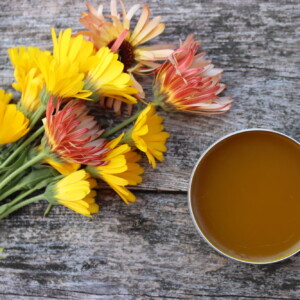
Calendula Salve
The soothing herbal salve for scrapes, cuts, poison ivy, acne, eczema, and other minor wounds and other irritations.
Equipment
Ingredients
Instructions
- Harvest calendula flowers mid-morning, after the dew has dried. Clip the stem just below the flower head. Sticky fingers mean the flowers are resin-rich.
- Roughly chop the whole flower heads with scissors or a knife to open up surface area, then pack them firmly into a pint mason jar until it's nearly full.
- Cover the flowers with olive oil until they're fully submerged, leaving the jar uncapped.
- Set the jar on a trivet, folded dish towel, or stack of canning rings inside a saucepan or slow cooker, then add about an inch of water around it.
- Warm the water slowly to 110 to 120°F and hold that range for 24 to 48 hours. A dehydrator set to 115°F or a multicooker on yogurt mode is the most hands-off. On the stovetop, bring the water up to temperature, turn the heat off, and cover the pot with a towel, repeating as it cools. Never use a slow cooker as direct heat, since even "keep warm" runs around 170°F and will cook the flowers.
- Strain the warm oil through a cheesecloth-lined fine mesh strainer, wringing the cloth to release the last of the oil.
- Measure the strained oil and return it to a small saucepan or heatproof container over simmering water. Add beeswax at 1 oz per cup of oil. Starting with about 1 1/4 cup will yield about 1 cup strained, as some is always lost to tools/cheesecloth in the process.
- Warm gently over low heat, stirring constantly, until the beeswax has melted completely and the mixture looks smooth.
- Pour the finished salve into 2 oz tins or small glass jars.
- Let the salve cool undisturbed for at least 30 minutes before putting lids on or using.
Notes
Yield ~ This recipe makes about 8 oz of finished salve, enough to fill four 2-oz tins.
Beeswax ratio ~ 1 oz beeswax per cup of strained infused oil produces a medium-firm salve that softens on contact with skin. Measure the oil after straining, not before, since the flowers and cheesecloth absorb some of what you started with. Use about 3/4 oz per cup for a softer balm, or 1 1/4 oz per cup for a firmer lip balm or stick. If the consistency comes out wrong, gently rewarm the salve and adjust before it sets.
Fresh or dried flowers ~ Fresh calendula needs the warm rapid infusion described here, since the water in fresh plant material will spoil an oil left to sit for weeks. Dried flowers can use either the warm method or a traditional cold infusion of three to six weeks. Dried calendula is much more concentrated by volume, so a jar packed with dried flowers holds considerably more plant material than the same jar packed with fresh.
Whole flowers, not petals ~ Use the entire flower head. The sticky green base holds a large share of the resin that carries calendula's medicinal value. Petals alone are the right choice for tea, salad, and dye, but not for salve.
Choosing your plants ~ Calendula's potency comes from resin, and many newer ornamental cultivars have been bred for appearance rather than resin content. Varieties like Resina are selected for herbal use. Judge a harvest by how sticky your fingers get.
Substituting oils ~ Olive oil is what I use most often. Sweet almond, grapeseed, coconut, and jojoba all work. Coconut produces a slightly firmer salve at room temperature; jojoba absorbs fastest and is the usual pick for anything going on the face.
Infusion methods ~ Keep the jar at 110 to 120°F for 24 to 48 hours. That's Fahrenheit, not Celsius. The easiest hands-off options are a dehydrator set to 115°F or a multicooker on yogurt mode. A warm water bath works if you refresh it periodically. A slow cooker can be used as an insulator with warm water around the jar, but never as a direct heat source.
Shelf life ~ Stored in a cool, dark, dry place, this salve keeps its potency for about a year. Freezing extends it further, and a few drops of vitamin E oil stirred in with the beeswax works as a natural antioxidant. Discard any salve that smells rancid or shows mold.
For sensitive skin ~ Always patch test on a small area first, especially if you have ragweed, daisy, or other Asteraceae family allergies.
Vegan version ~ Substitute candelilla wax for beeswax at roughly the same ratio. See the vegan herbal salve recipe for details. Cocoa butter also works, though you'll need slightly more of it.
What this salve isn't for ~ Skip it on deep cuts, punctures, serious burns, or infected skin. It's meant for minor burns, scrapes, eczema, chapping, and everyday skin irritation.
Tried this recipe?Let us know how it was!
