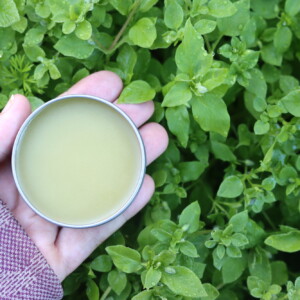
Chickweed Salve
A cooling chickweed salve for eczema, rashes, bug bites, and dry irritated skin, made with olive oil infused with fresh spring chickweed and set with beeswax.
Equipment
Ingredients
- 1 to 2 cups fresh chickweed leaves stems and flowers or 1/2 to 1 cup dried
- 1 1/4 cups of olive oil or neutral oil of your choice, strained to 1 cup in the finished salve
- 1 ounce beeswax 1 oz per cup of strained oil
Instructions
- Chop fresh chickweed with scissors as you harvest and pack it firmly into a pint mason jar, leaving about an inch of headspace.
- Pour oil over the chickweed until it is fully covered, leaving at least half an inch of headspace at the top of the jar.
- Add about an inch of water to a double boiler. Pour in the oil and herbs, or set the mason jar on a trivet, canning ring, or folded cloth inside a small pot.
- Warm the water to 110 to 120°F over gentle heat, then turn the burner off. Do not let it get hotter, since overheated plant material makes a weaker salve.
- Reheat each time the temperature drops and turn the burner off again, holding that range for 24 to 48 hours. At bedtime, warm it once more and wrap the setup in a towel to hold heat overnight. Top up the water as needed.
- Strain the infused oil through a cheesecloth-lined fine mesh strainer, squeezing gently to release the last of it. Compost the spent chickweed.
- Return the clean oil to the double boiler over simmering water and stir in the beeswax until completely smooth.
- Pour the warm salve into tins or small jars.
- Let the salve cool undisturbed for at least 30 minutes before putting lids on or using.
Notes
Yield ~ This recipe makes about 10 oz of finished salve, enough to fill five 2-oz tins.
Beeswax ratio ~ 1 oz beeswax per 1 to 1 1/4 cups of infused oil gives a soft salve that melts quickly on skin. For a firmer salve, use 1 oz per cup of oil. For a stick or lotion bar, go to about 1 1/4 oz per cup. If the consistency comes out wrong, gently rewarm the salve and adjust before it sets.
No scale? ~ One heaping tablespoon of beeswax pellets is roughly equivalent to one ounce of solid beeswax.
Substituting oils ~ Olive oil is what I use most often. Almond, coconut, grapeseed, and jojoba all work. Coconut produces a slightly firmer salve at room temperature; jojoba absorbs the fastest into skin.
Infusion methods ~ Keep the jar at 110 to 120°F for 24 to 48 hours. A dehydrator set to 115°F or an Instant Pot on yogurt mode is the most hands-off. A slow cooker can be used as an insulator with warm water around the jar, refreshed every 12 hours, but never as a direct heat source, since even its low setting runs around 165 to 180°F and will cook the chickweed.
Shelf life ~ Stored in a cool, dark, dry place, this salve keeps its potency for about a year. A few drops of vitamin E oil stirred in with the beeswax can extend it further. Discard any salve that smells rancid or shows mold.
For sensitive skin ~ Always patch test on a small area first, especially if you have carnation family (Caryophyllaceae) allergies.
Chickweed prep note ~ Use the whole aerial portion, stems included. Chop it rather than packing it whole, since the increased surface area is what lets the oil pull the good stuff out. Use it fresh the same day you cut it.
Vegan version ~ Substitute candelilla wax for beeswax. See the vegan herbal salve recipe for ratios.
What this salve isn't for ~ Skip it on deep cuts, punctures, serious burns, or infected skin.
Tried this recipe?Let us know how it was!
