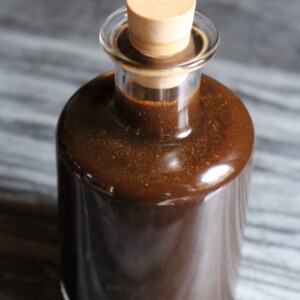
Homemade Worcestershire Sauce
A deeper, more rounded Worcestershire sauce than anything you can buy — full of real umami from whole anchovies, fruity tartness from tamarind, and warmth from cardamom and fresh ginger. Active time 30 minutes; ages on the shelf for at least one month.
Servings: 48 servings, About 3 cups
Ingredients
- 1/4 cup raisins
- 1/4 cup boiling water
- 1/2 cup un-sulfured molasses
- 1/4 cup tamarind paste
- 2- ounce can anchovies
- 1 large onion coarsely chopped
- 1 inch fresh ginger peeled & chopped
- 6-8 cloves garlic crushed
- 2 cups white vinegar divided
- 2 whole cardamom pods
- 2 Tbsp. kosher or canning salt
- 2 Tbsp. brown sugar or maple syrup
- 1 Tbsp. crushed red pepper flakes
- 1 Tbsp. dry mustard
- 1 tsp. whole cloves
- 1 tsp. black peppercorns
- 1/2 tsp ground cinnamon
Instructions
- Soak raisins: Pour boiling water over raisins in a small bowl and let stand 15 minutes to soften. Drain and discard water.
- Blend the base: In a food processor, combine softened raisins, molasses, tamarind paste, anchovies (with their oil), onion, ginger, garlic, and 1 cup of the vinegar. Process until smooth.
- Combine and boil: Pour the puree into a saucepan. Add the remaining 1 cup vinegar and all spices (cardamom, salt, sugar/syrup, red pepper flakes, mustard, cloves, peppercorns, cinnamon). Bring to a boil over medium-high heat, then immediately remove from heat.
- Jar and age: Cool slightly, then pour into a 1-quart canning jar. Cap with a plastic lid (vinegar will corrode metal). Store in a cool, dark pantry for at least 1 month. 3 months is better.
- Strain: Pour the aged sauce through a fine mesh sieve into a clean jar. Reserve the strained-out solids. They're great stirred into soups by the spoonful, or dehydrated into Worcestershire powder.
Notes
Equipment. A food processor or high-powered blender is essential for smoothly puréeing the anchovies, raisins, and aromatics — a regular blender will work but expect to scrape the sides several times. You'll also need a fine-mesh sieve for straining (cheesecloth-lined gives clearer sauce; bare sieve gives you more flavor compounds in the final product). Use a quart-sized canning jar with a plastic storage lid — the high vinegar content will corrode metal canning lids over months of aging.
Ingredient substitutions. This recipe accommodates many substitutions — see the full Substitutions and Variations section above. Quick notes: blackstrap and unsulphured molasses both work; maple syrup or honey can replace brown sugar 1:1; dried anchovies work if rehydrated in boiling water; asafoetida powder (¼ tsp per garlic clove) replaces alliums for those with allergies. Don't substitute fresh anchovies for canned — they're too mild — and don't skip the tamarind, which provides the signature fruity-tart note.
Aging timeline. One month is the minimum. Three months is noticeably better. Six months to a year is what traditional cask-aged Worcestershires were designed for, and yes, you can take it that far if you have the patience. The flavors continue to integrate and mellow throughout. A jar opened at 6 months will taste deeper and more rounded than one opened at 1 month.
Yield and scaling. This recipe makes one quart (solids and liquid combined, or about 3 cups sauce), which is about three times the size of a standard 10-oz bottle of commercial Worcestershire. That sounds like a lot, but a splash here and a teaspoon there adds up — most households who use Worcestershire regularly will work through a quart in 6–12 months. The recipe doubles cleanly if you want to make more (and aging time is the same).
Storage. Pantry-stable for one year in a sealed jar. Refrigerated, indefinitely (2+ years easily). If you've reduced the salt or vinegar from the recipe as written, refrigerate to be safe. The sauce will continue to develop flavor in the refrigerator, just more slowly than at room temperature.
Adapted from The All New Ball Book of Canning and Preserving, page 257. The original recipe specified 1 tsp anchovy paste; I've increased that to a full 2-oz can of whole anchovies for far more umami depth in the finished sauce.
Nutrition
Serving: 1Tbsp | Calories: 25kcal | Carbohydrates: 5g | Protein: 1g | Fat: 0.3g | Saturated Fat: 0.04g | Polyunsaturated Fat: 0.1g | Monounsaturated Fat: 0.1g | Cholesterol: 1mg | Sodium: 285mg | Potassium: 81mg | Fiber: 0.3g | Sugar: 4g | Vitamin A: 2IU | Vitamin C: 0.5mg | Calcium: 16mg | Iron: 0.3mg
