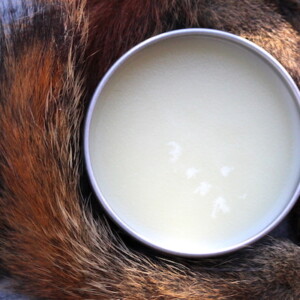
Making Fatwax (Animal Fat Salve)
A simple two-ingredient salve made from rendered tallow, lard, or wild game fat thickened with beeswax. Works on chapped skin, leather boots, and hand tools, and takes herbs beautifully if you want a medicinal version.
Equipment
Ingredients
- 1 cup rendered fat
- 1 ounce beeswax
- Herbs to Infuse optional
Instructions
- Start with fat that has been fully rendered, strained clean, and cooled. Any leftover meat solids or water will cause the finished salve to spoil early.
- To make a plain conditioning salve, skip ahead to melting in the beeswax.
- To infuse herbs, pack a pint mason jar loosely with dried herbs. Melt the fat and pour it over the herbs until they are covered, leaving a little headspace.
- Hold the jar warm at 110 to 120°F for 24 to 48 hours. A dehydrator set to 115°F or an Instant Pot on yogurt mode both hold temperature without babysitting. Avoid a slow cooker as a direct heat source, since even the keep-warm setting runs near 170°F.
- Strain the warm fat through a cheesecloth-lined fine mesh strainer, squeezing gently to release the last of it. Compost the spent herbs.
- Combine the fat and beeswax in the top of a double boiler. Warm over low heat, stirring occasionally, until the wax has melted completely and the mixture looks clear.
- Test the consistency by dropping a spoonful onto a plate from the freezer and letting it set for 30 seconds. Adjust with more fat or more wax before pouring.
- Pour into tins right away, before the edges begin to set.
- Leave the tins uncovered and undisturbed for about 2 hours, until fully firm, then cap them.
Notes
Yield ~ This recipe makes about 8 oz of finished salve, enough to fill four 2-oz tins.
Beeswax ratio ~ 1 oz beeswax per cup of fat gives a medium-firm salve. Animal fats vary widely in firmness on their own, so treat this as a starting point. Hard tallow often needs slightly less, and soft or liquid fats need slightly more. Use about 1 1/4 oz per cup for a hard stick or leather conditioning bar.
Choosing a fat ~ Beef and sheep tallow set up hard and hold their shape in summer heat. Lard and bear grease land in the middle. Squirrel and some other wild fats stay liquid at room temperature and produce a very soft, spreadable salve.
Fresh vs. dried herbs ~ Use dried herbs for a fat infusion. Fresh plant material carries water into the fat, and water is what causes a salve to spoil.
Shelf life ~ Stored cool, dark, and dry, this salve keeps about a year. A few drops of vitamin E oil stirred in with the beeswax extends it further. Discard any salve that smells sharp or rancid.
Essential oils ~ Stir in 10 to 15 drops per cup off the heat, just before pouring. They also help mask the faint meaty note some fats carry.
Vegan version ~ Substitute a plant oil for the fat and candelilla wax for the beeswax, using about half as much. See the vegan herbal salve recipe for ratios.
For sensitive skin ~ Patch test first. Oleic acid, which makes up a large share of most animal fats, disrupts the skin barrier for some people, particularly those with eczema or acne-prone skin.
What this salve isn't for ~ Skip it on deep cuts, punctures, serious burns, or infected skin. A fat salve seals a wound rather than letting it drain.
Tried this recipe?Let us know how it was!
