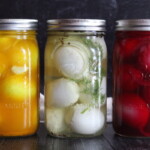
Pickled Eggs
Pickled eggs are the perfect salty tangy snack, and an easy way to preserve eggs for months at a time. I've given you four pickled egg recipes — beet, bread and butter, dill, and spicy jalapeño — using the same simple method. Active time 30 minutes; ready in 24 hours; best at 1–2 weeks, keeps 3-4 months refrigerated.
Servings: 10 Servings (Makes One Quart or 9-10 eggs)
Equipment
- Plastic Mason Jar Lid (Wide Mouth) Ball's Leak Proof Storage Lids work great
- Stockpot for steaming eggs
- Steamer Basket for steaming eggs
- Small Saucepan for cooking brine
Ingredients
Beet Pickled Eggs
- 9-10 whole hard-boiled eggs peeled
- 1 cup white vinegar
- 1 cup beet juice or beet cooking water
- 1/2 small onion
- 2 Tbsp. sugar
- 2 Tbsp. salt
- 6-8 whole cloves
- 4-5 whole allspice berries
- 1 whole cinnamon stick
Bread and Butter Pickled Eggs
- 9-10 whole hard-boiled eggs peeled
- 2 cups white vinegar
- 1/2 small onion sliced
- 3-4 cloves garlic
- 2 Tbsp. salt
- 1/2 cup sugar
- 1 tsp mustard seeds
- 1 tsp celery seed
- 1 tsp ground turmeric
Dill Pickled Eggs
- 9-10 whole hard-boiled eggs peeled
- 1 cup white vinegar
- 1 cup water
- 1/2 small onion sliced
- 3-4 cloves garlic
- 2 Tbsp. sugar
- 2 Tbsp. salt
- 1 tsp mustard seeds
- 1 tsp celery seed
- 1 tsp coriander seed
- 1 tsp dill seed
- 2 Small Fresh dill sprigs if available
Spicy Jalapeño Pickled Eggs
- 9-10 whole hard-boiled eggs peeled
- 1 1/2 cups white vinegar
- 1/2 cup water
- 2 Tbsp. salt
- 1 Tbsp. sugar
- 1 or 2 medium Jalapeños sliced
- 1/2 small onion sliced
- 3-4 cloves garlic
- 2-4 whole bay leaves
- 1 tsp coriander seeds
- 3-4 whole cloves
- 3-4 whole allspice berries
Instructions
- Choose Variation: This recipe makes four different variations. Choose your recipe from above before you start. All four types have the same instructions.
- Steam the eggs: Bring 1 inch of water to a boil in a stockpot. Place eggs in a steamer basket above the water (water should not touch the eggs). Cover and steam for 12 minutes. Transfer immediately to an ice bath until cold.
- Peel the eggs: Tap and roll on a counter to crack the shell, then peel under cool running water for easiest removal.
- Jar Eggs: Pack into wide-mouth quart jars. 9–10 eggs per quart. Don't overpack.
- Make the brine: In a small saucepan, combine the liquids (vinegar plus water or beet juice), salt, and sugar. Heat gently over medium until salt and sugar dissolve completely. Remove from heat.
- Season: Add aromatics and spices directly to the jar with the eggs (sliced onion, garlic, jalapeño, whole spices, dill, etc.).
- Add Brine: Pour the warm brine over the eggs, leaving ¼ inch headspace. Make sure all eggs are submerged.
- Lid Jars: Cap with a plastic lid (not a metal canning lid). Allow to cool slightly, then refrigerate.
- Pickling Time: Wait at least 24 hours before eating. For best flavor, wait 1–2 weeks. Flavors continue to develop for up to a month.
Notes
Equipment. Wide-mouth quart mason jars are ideal because they're easy to pack with whole eggs and easy to fish them out one at a time. Half-pint and pint jars work for half-recipes. The single most important equipment note: use a plastic storage lid, not a metal canning lid. The vinegar in the brine will corrode metal over weeks of refrigerator storage, which affects both flavor and seal integrity. The Ball brand grey plastic storage lids are inexpensive and worth buying a six-pack — they hold up to vinegar much better than the standard metal lids.
Steaming vs boiling. The 12-minute steam method (instead of boiling) is the single best change you can make to your pickled egg process. Boiled eggs — especially fresh-from-the-coop farm eggs — are notoriously hard to peel; steamed eggs peel in seconds. For large batches, stack two or three steamer baskets in a single stockpot and steam several dozen eggs at once.
The 4 variations are independent recipes. You're not making all four at once unless you want to (though it's a fun project for a Saturday afternoon — about an hour of active time gets you four quart jars). Pick whichever sounds best to you and start there.
Brine ratios are flexible but never go below 50% vinegar. The acidity is what keeps the eggs safe in the refrigerator for 3–4 months. Above 50% is personal preference: more vinegar = sharper, firmer eggs; less vinegar = milder, softer eggs.
Pickling time and texture. Eggs absorb the brine slowly. At 24 hours, only the outer layer of the white is fully pickled and the yolk still tastes mostly like hard-boiled. At one week, the white is fully infused. At two weeks, the brine has reached the center of the yolk. Beet pickled eggs need at least a week for the color to penetrate dramatically. After 4–6 weeks, the texture starts to firm up significantly — for some people that's the sweet spot, for others it's overdone.
Yield and scaling. Each recipe makes one quart, which is 9–10 eggs. The recipes scale linearly — double the brine for a half-gallon jar, halve everything for a pint. If you have a serious egg surplus in late spring, you can comfortably make 4–6 quarts at once and have pickled eggs all summer.
Do not can these. This bears repeating in the recipe card: there is no safe tested method for canning pickled eggs at home. They must be stored in the refrigerator. The 3–4 month shelf life in the fridge is plenty of time to enjoy them; canning would only risk botulism without meaningfully extending shelf life.
Adapted from twenty years of experimentation with our spring-overflow eggs. The bread and butter variation is based on our bread and butter pickle recipe; the dill variation echoes our dill pickle canning recipe flavor profile.
Nutrition
Serving: 1egg | Calories: 95kcal | Carbohydrates: 4g | Protein: 6g | Fat: 5g | Saturated Fat: 2g | Polyunsaturated Fat: 1g | Monounsaturated Fat: 2g | Cholesterol: 187mg | Sodium: 1209mg | Potassium: 67mg | Fiber: 0.2g | Sugar: 4g | Vitamin A: 261IU | Vitamin C: 0.03mg | Calcium: 32mg | Iron: 1mg
