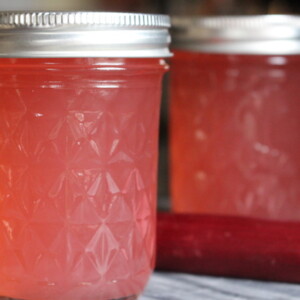
Rhubarb Jelly
Homemade rhubarb jelly is a smooth, sweet-tart spring preserve made from the bright juice of fresh rhubarb stalks. Adapted from the Ball Complete Book of Home Preserving, this recipe uses Sure-Jell or Ball Classic powdered pectin for a quick reliable set with no gel-stage testing.
Servings: 96 servings, 6 half pint (8 oz) jars
Ingredients
Rhubarb Juice
- 2 lbs rhubarb chopped into 1'' pieces, 2 pounds is about 8 cups
- 4 cups water
For Full Sugar Rhubarb Jelly
- 4 cups rhubarb juice
- 6 cups sugar
- 1 box Powdered Pectin 1.75 ounces or 6 Tbsp, such as Sure Jel
Instructions
Extract the Juice
- Trim the leaves and woody bottom ends from the rhubarb. Chop stalks into 1-inch pieces. Compost the leaves; rhubarb leaves are toxic and should never be used.
- Place chopped rhubarb in a heavy-bottomed pot with the water. Bring to a boil over medium-high heat, then reduce to a simmer for about 20 minutes, until the rhubarb has completely fallen apart and the liquid has turned bright pink.
- Transfer the cooked mixture to a dampened jelly bag or a strainer lined with several layers of dampened cheesecloth set over a deep bowl. Let it drip undisturbed for at least 2 hours, or up to 4 to 6 hours for more juice. Don't squeeze the bag; squeezing clouds the finished jelly. Measure 4 cups of strained juice for the next stage.
Make the Jelly
- Prepare half-pint canning jars by washing in hot soapy water, rinsing, and keeping warm. Have lids and rings ready.
- Pour the rhubarb juice into a heavy-bottomed jam pot. Whisk in the powdered pectin until fully dissolved.
- Bring to a hard rolling boil over high heat, stirring frequently. Add the sugar all at once and stir constantly until fully dissolved. Return to a hard rolling boil that can't be stirred down, and boil hard for exactly 1 minute.
- Remove from heat and quickly skim off any foam.
Canning Rhubarb Jelly
- Ladle the hot jelly into prepared half-pint jars, leaving 1/4 inch headspace. Wipe rims clean and apply two-piece canning lids fingertip tight.
- Process the filled jars in a boiling water bath canner for 10 minutes (adjust for altitude — see notes).
- When the timer goes off, turn off the heat and let the jars sit in the canner for another 5 minutes before lifting them out. This helps prevent siphoning.
- Cool on a towel for 12 to 24 hours, check seals, and refrigerate any unsealed jars. Sealed jars keep on the pantry shelf for 12 to 18 months.
Notes
Yield: About 6 to 7 half-pint (8 oz) jars.
Altitude adjustment: Process 10 minutes at 0 to 6,000 feet, 15 minutes above 6,000 feet.
No lemon juice needed. Rhubarb is naturally acidic (pH 3.1 to 3.3), which is well within the safe range for water bath canning and acidic enough to help the pectin gel reliably.
Don't double the recipe. Larger batches don't heat evenly and may not set properly. Make two single batches back-to-back instead.
Don't squeeze the jelly bag. Squeezing releases solids that cloud the finished jelly and the extra yield isn't worth it.
Be patient with setting. Pectin can take 24 to 48 hours to fully set, and some batches may take up to a week before declaring failure.
Toxic leaves: Rhubarb leaves contain oxalic acid and are not safe to eat. Always remove the leaves at harvest and compost them. Use only the stalks.
Pectin alternatives: For a low-sugar version, use Sure-Jell Low Sugar (pink box) or Ball Flex Batch Low Sugar with reduced sugar, following the package directions. Pomona's Universal Pectin works with any sugar level (or honey or maple syrup) but produces a softer set.
Rhubarb variety affects color: Red-stalked varieties like Crimson Cherry or Canada Red give the deepest pink color. Green-stalked rhubarb still tastes wonderful, but the finished jelly comes out more amber than pink.
Nutrition
Serving: 1Tbsp | Calories: 65kcal | Carbohydrates: 15g | Protein: 0.1g | Fat: 0.1g | Saturated Fat: 0.01g | Polyunsaturated Fat: 0.02g | Monounsaturated Fat: 0.01g | Sodium: 2mg | Potassium: 43mg | Fiber: 0.2g | Sugar: 14g | Vitamin A: 14IU | Vitamin C: 2mg | Calcium: 10mg | Iron: 0.1mg
