
Affiliate disclosure: This post may contain affiliate links. Please see our Privacy Policy.
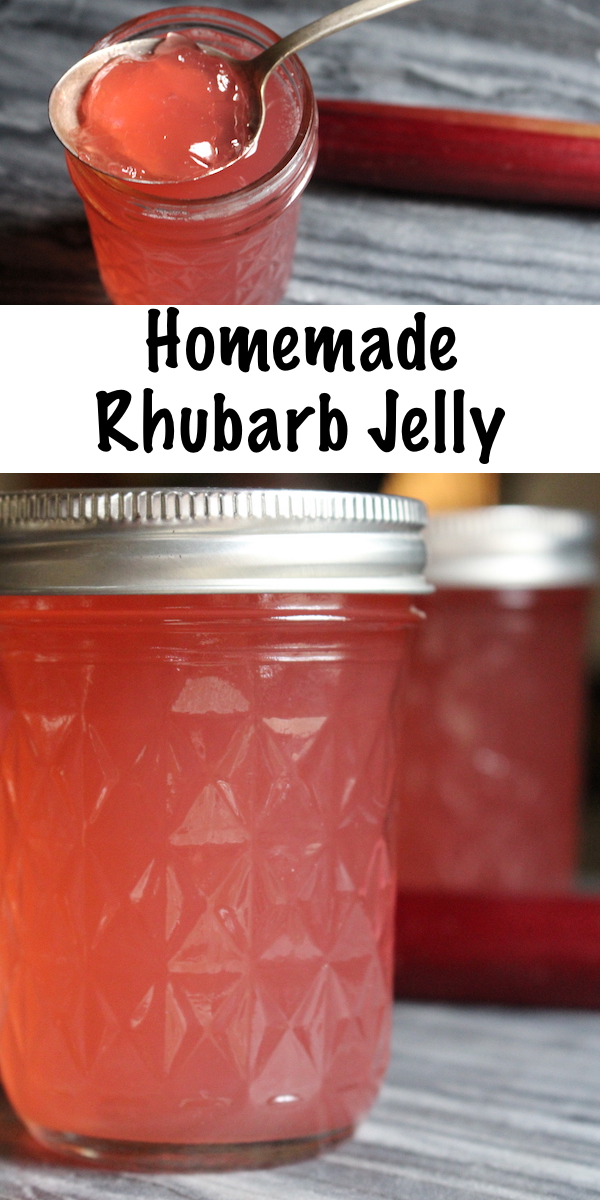
Rhubarb jelly is a smooth, sweet-tart spring preserve made from the bright juice of fresh rhubarb stalks. This recipe uses powdered pectin for a quick reliable set with no gel-stage testing.
Rhubarb is naturally low in pectin and naturally acidic, so the recipe works with just three ingredients (rhubarb juice, sugar, and pectin) and produces a clear blush-pink jelly.
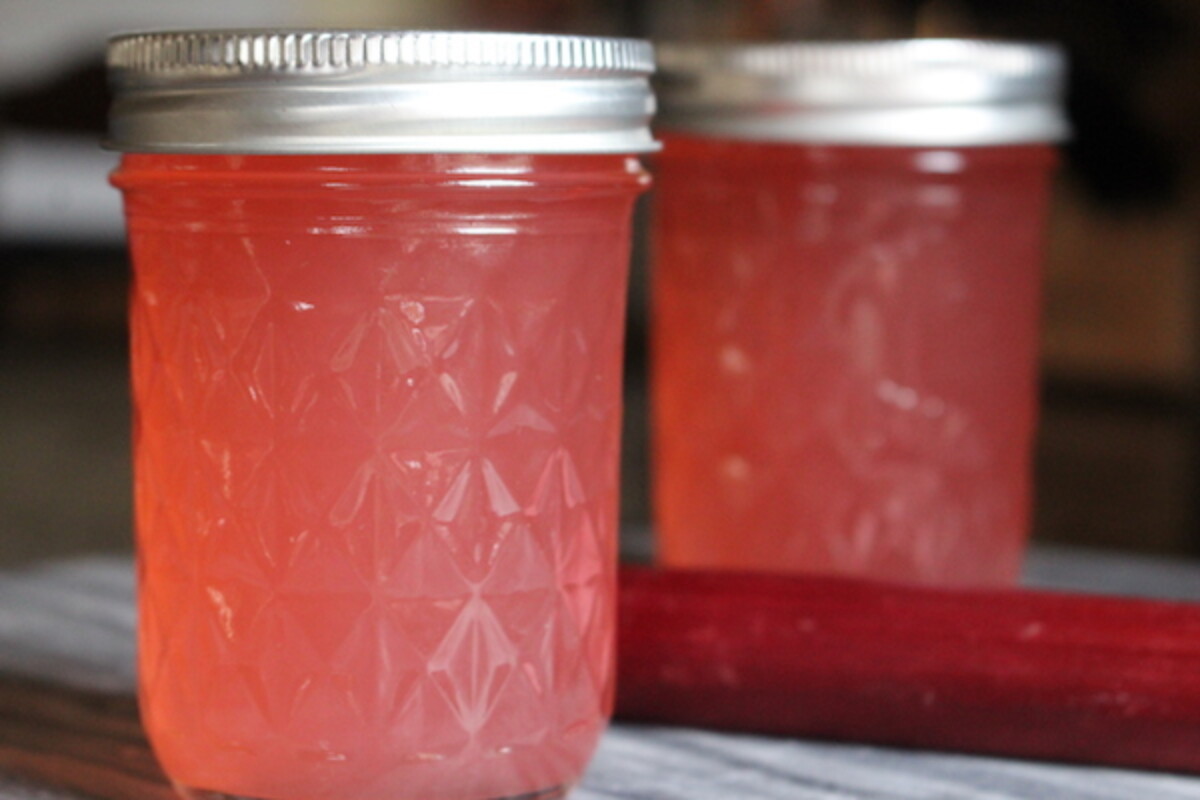
Table of Contents
- Notes from My Kitchen
- Ingredients for Rhubarb Jelly
- How to Make Rhubarb Jelly
- Don’t Overcook Pectin Jelly
- Canning Rhubarb Jelly
- Altitude Adjustments
- Yield Notes
- Storage Options
- Recipe Tips
- Pectin Options
- Rhubarb Jelly Variations
- Ways to Use Rhubarb Jelly
- Rhubarb Jelly FAQs
- Ways to Preserve Rhubarb
- Rhubarb Jelly Recipe
- Jelly Recipes
Adapted from the Ball Complete Book of Home Preserving, this recipe relies on Sure-Jell or Ball Classic powdered pectin for a reliable gel. Rhubarb is technically a vegetable we treat as a fruit, and it doesn’t contain any meaningful amount of pectin on its own, so commercial pectin is essential here. Juice extraction is straightforward: simmer chopped rhubarb in water until it falls apart, then strain through a jelly bag for a few hours.
Rhubarb is one of the earliest things to come up in our Vermont garden, so a few jelly batches in May and June get me set for the rest of the year.
For other ways to use a spring rhubarb harvest, try old-fashioned rhubarb jam with chunky pieces of fruit, strawberry rhubarb jam for the classic flavor combo, or homemade rhubarb wine for something a little different.
Notes from My Kitchen

Most years I’m all about chunky jams with big hunks of fruit. My little ones though, they love jelly. I tried to convert them, but I found myself eating my own batches of chunky low sugar jam while they begged for full sugar smooth jelly. I’m not complaining; I’m happy to have a full batch of rhubarb jam and another of strawberry rhubarb jam to myself, but with more rhubarb coming in from the garden, it’s time to make a kid-approved batch of smooth rhubarb jelly.
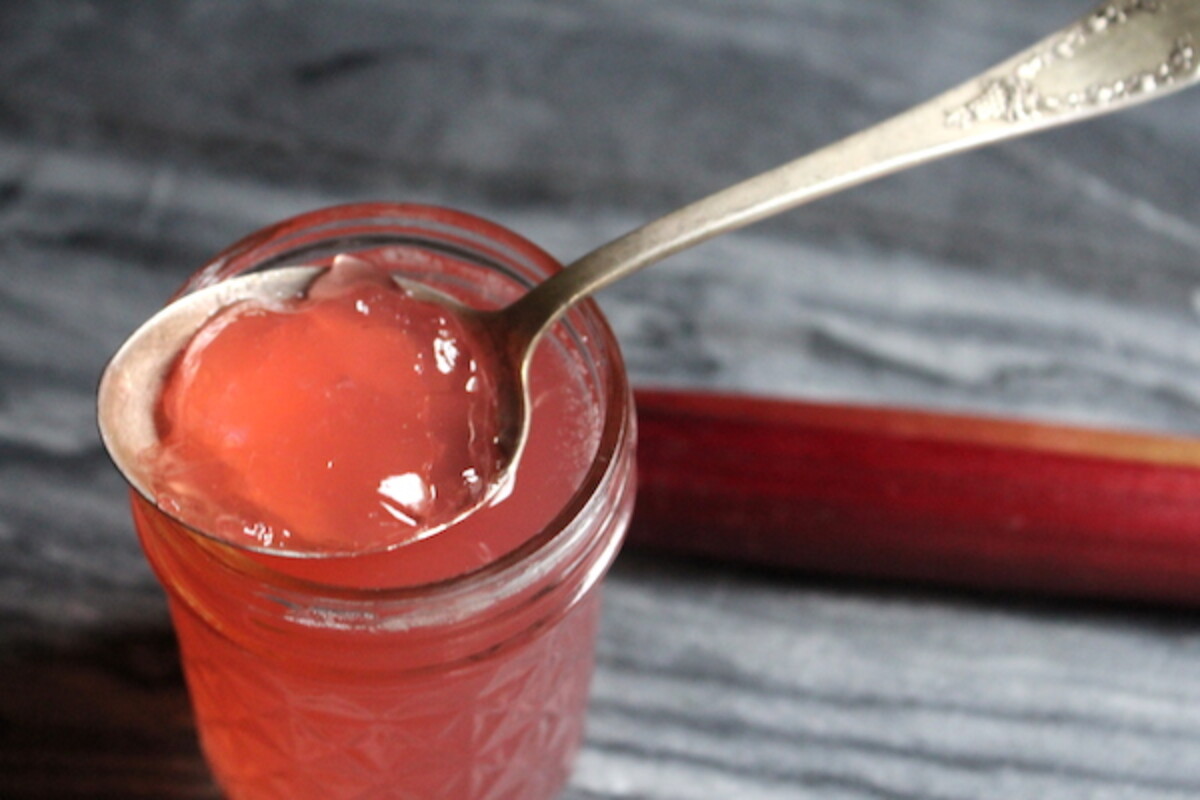
Rhubarb jelly is also a beautiful spring preserve. The juice extracts a clear pale pink that deepens to rose once you cook it down with the sugar. Varieties with deep red stalks like Crimson Cherry or Canada Red give the most vivid color, but green-stalked rhubarb still tastes wonderful; the jelly just comes out more amber than pink.
Ingredients for Rhubarb Jelly
This rhubarb jelly recipe yields about 6 to 7 half-pint jars and uses just three ingredients:
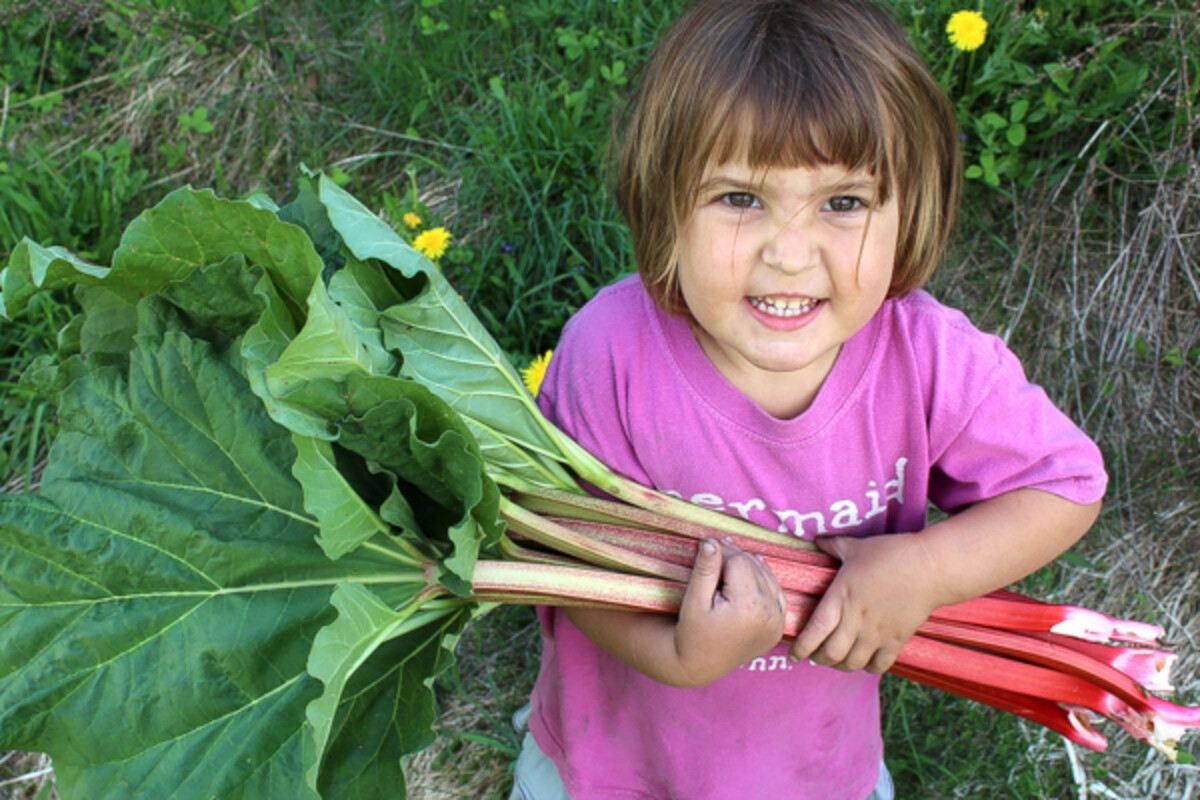
- Rhubarb juice: Extracted from fresh rhubarb stalks (instructions below). Use any rhubarb variety, red-stalked or green. Frozen rhubarb works too and actually breaks down more easily during juice extraction. The redder the stalks, the deeper pink your finished jelly.
- 1 box (1.75 oz) powdered fruit pectin: Use Sure-Jell (yellow box) or Ball Classic regular powdered pectin. Rhubarb has no meaningful natural pectin, so commercial pectin is essential for this recipe. Don’t substitute liquid pectin, which requires different ratios. For a low-sugar version, see Pectin Options below.
- Granulated sugar: Rhubarb is very tart with no meaningful natural sugar of its own, so this recipe uses the full sugar amount called for with regular powdered pectin. Don’t reduce the sugar with regular Sure-Jell; the jelly won’t gel and the result will taste sour. The recipe card has the specific amount.
No lemon juice is needed because rhubarb is naturally acidic (pH 3.1 to 3.3, more acidic than most berries), which is well within the safe range for water bath canning and acidic enough to help the pectin gel reliably.
How to Make Rhubarb Jelly
Rhubarb jelly comes together in two stages: extracting the juice from the chopped rhubarb (which takes most of the time, mostly hands-off as the juice strains through a jelly bag), and then cooking the jelly itself, which only takes about 15 minutes once the juice is ready.
Extracting Rhubarb Juice
Trim the leaves and the woody bottom ends from the rhubarb stalks, then chop the stalks into 1-inch pieces. Rhubarb leaves are toxic and should always go straight to the compost. Place the chopped stalks in a heavy-bottomed pot with about 2 cups of water per pound of rhubarb. Bring to a boil over medium-high heat, then reduce to a simmer and cook for about 20 minutes, until the rhubarb has completely fallen apart and the liquid has turned bright pink.
Transfer the cooked rhubarb mixture to a dampened jelly bag or a strainer lined with several layers of dampened cheesecloth set over a deep bowl. Let it drip undisturbed for at least 2 hours, or up to 4 to 6 hours for more juice.
Don’t squeeze the bag, even though it’s tempting; squeezing releases solids that cloud the finished jelly and the extra yield isn’t worth it. Measure the juice for the recipe (the recipe card has the specific amount).
Cooking the Jelly
Order matters with powdered pectin. Pour the strained rhubarb juice into a heavy-bottomed jam pot. Whisk in the powdered pectin until fully dissolved. Bring to a hard rolling boil over high heat, stirring frequently.
Add the sugar all at once and stir constantly until fully dissolved. Return to a hard rolling boil that can’t be stirred down, and boil hard for exactly 1 minute. Remove from heat and quickly skim off any foam. Ladle the hot jelly into prepared half-pint jars, leaving 1/4 inch headspace, wipe rims clean, and apply two-piece canning lids fingertip tight.
Don’t Overcook Pectin Jelly
Pectin jelly works on chemistry, not on cooking time. A few things to know:
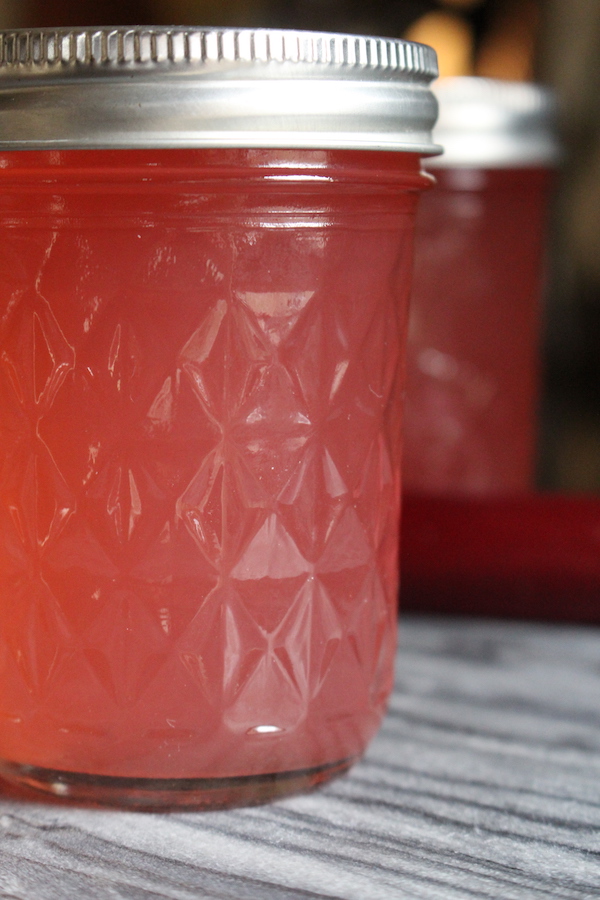
- The jelly looks thin in the pot when you take it off the heat, and that’s normal. Pectin sets as the jelly cools, not while it’s boiling.
- Trust the timing. A hard rolling boil for exactly 1 minute after the sugar fully dissolves is all you need.
- Skip the thermometer and freezer plate test. Those are for old-fashioned no-pectin jellies. Pectin recipes set on chemistry, not on temperature.
- Give the jars 24 to 48 hours to fully set before declaring failure.
Canning Rhubarb Jelly
Rhubarb is naturally acidic (pH 3.1 to 3.3), which makes rhubarb jelly safe for water bath canning with no pressure canner required. If you’re new to canning, start with my beginner’s guide to water bath canning before you fire up the canner.
Process the filled jars in a boiling water bath canner for 10 minutes (adjusting for altitude). When the timer goes off, turn off the heat and let the jars sit in the canner for another 5 minutes before lifting them out (this helps prevent siphoning). Cool on a towel for 12 to 24 hours, check seals, and refrigerate any unsealed jars. Sealed jars keep on the pantry shelf for 12 to 18 months.
Altitude Adjustments
Processing time depends on your elevation:
- 0 to 6,000 feet: 10 minutes
- Above 6,000 feet: 15 minutes
Yield Notes
Here’s what you can expect from this recipe:
- 1 pound chopped rhubarb + 2 cups water = about 2 cups of strained juice
- 2 pounds chopped rhubarb + 4 cups water = about 4 cups of strained juice (one batch)
- 4 cups rhubarb juice + 1 box pectin + 6 cups sugar = about 6 to 7 half-pint (8 oz) jars
- Don’t double the recipe. Larger batches don’t heat evenly and may not set properly. Make two single batches back-to-back instead.
Storage Options
Not committed to water bath canning? You have several options:
- Refrigerator jelly: Let jars cool to room temperature, then store in the fridge. Keeps for 3 to 4 weeks.
- Freezer jelly: Use freezer-safe straight-sided jars and leave 1/2 inch headspace for expansion. Lasts up to 12 months frozen.
- Canned jelly: Water bath processed jars keep for 12 to 18 months in a cool, dark pantry. This is what I prefer because it means rhubarb jelly in February when the snow is piling up and the garden is months away.
Recipe Tips
- Trim rhubarb leaves carefully. Rhubarb leaves are toxic and should never be added to jelly, jam, or anything else you’re going to eat. Compost the leaves and use only the stalks.
- Use a deep pot. Rhubarb jelly foams quite a bit when it reaches a rolling boil. A deep pot prevents overflows.
- Strain longer for more juice. A 2-hour drip works, but 4 to 6 hours gives you noticeably more juice for the same amount of fruit. Just don’t squeeze the bag.
- Save the rhubarb pulp. The leftover cooked pulp from the jelly bag is delicious folded into muffin or pancake batter, swirled into yogurt, or stirred into oatmeal. You can also freeze it for smoothies.
- Be patient with setting. Rhubarb jelly can take 24 to 48 hours to fully set. Some batches may take up to a week. Don’t call it a failure until you’ve given it time. If it’s still not set after that, read through my guide to troubleshooting an unset jelly.
Pectin Options
Standard powdered pectin (this recipe): Requires the full sugar amount in the recipe card. Use Sure-Jell (yellow box) or Ball Classic regular powdered pectin. UK readers can substitute Certo, which is the equivalent regular powdered pectin available there.
Low sugar pectin: Sure-Jell Low Sugar (pink box) or Ball Flex Batch Low Sugar let you reduce sugar significantly, or substitute honey or maple syrup. Follow the directions on the box, since amounts differ from regular pectin.
Pomona’s Universal Pectin: Pomona’s works with any amount of sugar (or none at all). The set is softer, more like Jello. Read how to use Pomona’s Pectin first, since the process is different.
Liquid pectin: Not recommended. Requires more sugar for the same volume of juice and the texture is inconsistent.
Rhubarb Jelly Variations
Rhubarb juice is a flexible base for flavor twists. Once you’ve made the basic recipe, try one of these:
- Strawberry Rhubarb Jelly: Replace half the rhubarb juice with strawberry juice (extracted the same way as for strawberry jelly). The strawberry sweetens and softens the tartness of the rhubarb, and the color comes out a deep coral pink.
- Rhubarb Vanilla Jelly: Split a vanilla bean and scrape the seeds into the rhubarb juice before cooking, or stir in pure vanilla extract right after removing the jelly from heat. Vanilla rounds out the tartness beautifully.
- Rhubarb Ginger Jelly: Add a 2-inch piece of fresh ginger (sliced thin) to the rhubarb while extracting the juice. Strain it out with the pulp. The ginger adds a warm, slightly spicy note that pairs especially well with cheese.
- Rhubarb Rose Jelly: Steep a small handful of dried rose petals (food-grade, no pesticides) in the hot rhubarb juice for 10 minutes before adding pectin, then strain them out. The rose adds a delicate floral note.
- Rhubarb Apple Jelly: Replace half the rhubarb juice with fresh-pressed apple cider or apple juice. The apple adds natural sweetness and pectin, so you may get a slightly firmer set.
- Spiced Rhubarb Jelly: Add a cinnamon stick and 4 to 6 whole cloves to the rhubarb while extracting the juice. Strain them out with the pulp. Lovely for the holiday gift basket.
Ways to Use Rhubarb Jelly
Rhubarb jelly is a kitchen workhorse. Spread it on toast, biscuits, scones, and English muffins, fold it into peanut butter sandwiches, swirl it into plain yogurt or oatmeal, or use it as the filling for thumbprint cookies. It also melts down nicely as a glaze for pork tenderloin or roasted duck, and a spoonful stirred into a glass of seltzer makes a quick rhubarb soda.
For more inspiration, I have a guide to 100+ ways to use up a jar of jam or jelly. And while you’re already in rhubarb-preserving mode, try small batch rhubarb mead, rhubarb upside down cake, or classic strawberry rhubarb pie.
Rhubarb Jelly FAQs
No, rhubarb has no meaningful natural pectin. Rhubarb is technically a vegetable that’s treated like a fruit, and unlike high-pectin fruits such as apples or crabapples, the stalks contain almost none. To make rhubarb jelly, you need to add commercial pectin (Sure-Jell, Ball Classic, Pomona’s, or Certo). Without it, you’ll just get sweet rhubarb syrup instead of a true gel.
The most common causes are not boiling long enough after adding sugar (it needs a full rolling boil for exactly 1 minute), adding sugar at the wrong time, doubling the recipe, or using expired pectin. Pectin also takes 24 to 48 hours to fully set, and some batches take up to a week. If still runny after several days, you can reprocess it with additional pectin following the directions on the pectin box.
Rhubarb jelly is made from strained rhubarb juice, so it’s smooth, seedless, and translucent with no fruit pieces. Rhubarb jam is made from chopped or whole pieces of rhubarb cooked with sugar, so it has fruit texture and is more opaque. Jelly spreads more smoothly and shows off the bright pink color, while jam has more body and a fuller fruit flavor with the rhubarb stringiness still present.
Yes, frozen rhubarb works well for jelly and actually breaks down more easily during juice extraction because freezing damages the cell structure. No need to thaw before cooking; just add an extra few minutes to the simmer time. Use the same weight of frozen rhubarb as the recipe calls for in fresh.
Refrigerator jelly keeps for 3 to 4 weeks in a sealed jar. Freezer jelly lasts up to 12 months in freezer-safe containers with adequate headspace. Water bath canned and properly sealed jars keep for 12 to 18 months in a cool, dark pantry. Once a sealed jar is opened, it should be refrigerated and used within 3 to 4 weeks.
Ways to Preserve Rhubarb
If you tried this Rhubarb Jelly recipe, or any other recipe on Practical Self Reliance, leave a ⭐ star rating and let me know what you think in the 📝 comments below!
And make sure you stay in touch with me by following on social media!
Rhubarb Jelly
Ingredients
Rhubarb Juice
- 2 lbs rhubarb, chopped into 1'' pieces, 2 pounds is about 8 cups
- 4 cups water
For Full Sugar Rhubarb Jelly
- 4 cups rhubarb juice
- 6 cups sugar
- 1 box Powdered Pectin, 1.75 ounces or 6 Tbsp, such as Sure Jel
Instructions
Extract the Juice
- Trim the leaves and woody bottom ends from the rhubarb. Chop stalks into 1-inch pieces. Compost the leaves; rhubarb leaves are toxic and should never be used.
- Place chopped rhubarb in a heavy-bottomed pot with the water. Bring to a boil over medium-high heat, then reduce to a simmer for about 20 minutes, until the rhubarb has completely fallen apart and the liquid has turned bright pink.
- Transfer the cooked mixture to a dampened jelly bag or a strainer lined with several layers of dampened cheesecloth set over a deep bowl. Let it drip undisturbed for at least 2 hours, or up to 4 to 6 hours for more juice. Don’t squeeze the bag; squeezing clouds the finished jelly. Measure 4 cups of strained juice for the next stage.
Make the Jelly
- Prepare half-pint canning jars by washing in hot soapy water, rinsing, and keeping warm. Have lids and rings ready.
- Pour the rhubarb juice into a heavy-bottomed jam pot. Whisk in the powdered pectin until fully dissolved.
- Bring to a hard rolling boil over high heat, stirring frequently. Add the sugar all at once and stir constantly until fully dissolved. Return to a hard rolling boil that can’t be stirred down, and boil hard for exactly 1 minute.
- Remove from heat and quickly skim off any foam.
Canning Rhubarb Jelly
- Ladle the hot jelly into prepared half-pint jars, leaving 1/4 inch headspace. Wipe rims clean and apply two-piece canning lids fingertip tight.
- Process the filled jars in a boiling water bath canner for 10 minutes (adjust for altitude — see notes).
- When the timer goes off, turn off the heat and let the jars sit in the canner for another 5 minutes before lifting them out. This helps prevent siphoning.
- Cool on a towel for 12 to 24 hours, check seals, and refrigerate any unsealed jars. Sealed jars keep on the pantry shelf for 12 to 18 months.
Notes
Nutrition
Nutrition information is automatically calculated, so should only be used as an approximation.
Jelly Recipes
Find the perfect recipe
Searching for something else? Enter keywords to find the perfect recipe!










If making the rhubarb strawberry jelly, do I need to adjust the acid with lemon juice?
Also with the added sweetness of the strawberries, would this make the lower sugar more of an option as the strawberry would help with the rhubarb tartness?
Same question for the apple rhubarb jelly.
And help is appreciated.
Good questions, and you’re thinking about this the right way. On the lemon juice: no, you don’t need to add any. Rhubarb is naturally high in acid, which is exactly why it’s safe to water bath can without lemon. Strawberries and apples are both acidic too, so none of these combinations need added acid for safety. The lemon in some recipes is just there for flavor or a little set help, not safety.
On lower sugar, yes, that’s an option, but let me untangle it a little. In these high-acid jellies, sugar is about set and flavor, not safety, so reducing it doesn’t make the jelly unsafe. The catch is that regular pectin needs a lot of sugar to gel, so if you just cut the sugar with regular pectin, it won’t set. To go lower sugar and still get a good set, use a low-sugar pectin like Pomona’s or Sure-Jell Low Sugar and follow that pectin’s instructions. You’re right that the strawberries help balance the rhubarb’s tartness, so a lower-sugar batch will taste really nicely balanced. Just know it’s the low-sugar pectin doing the heavy lifting on the set, not the strawberries.
Same answers for the apple rhubarb version. Apples are acidic too, so no lemon needed, and the same low-sugar-pectin approach works if you want to cut the sugar. One handy rule of thumb from this recipe: aim for about 4 cups total juice or puree to one box of pectin, whichever fruit mix you go with. Hope this helps, and happy canning!
We love everything rhubarb and this is the recipe I reach for at the end of the season when the rhubarb is starting to get stringy. You filter everything out, so it’s perfect for when you want a bit more rhubarb flavor in your pantry but the summer heat is starting to toughen up the stalks.