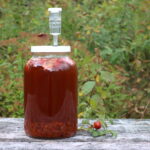
Rosehip Wine
Rosehip wine is a refreshing delight for sipping during spring and summer, and is quite simple to make.
Servings: 20 glasses, makes 1 gallon, or about 4 bottles
Equipment
Ingredients
- 2 to 3-½ lbs fresh rosehips or 1/2 to 1 lb dried
- 2 1/2 lbs cane sugar or honey for mead
- 1 tsp yeast nutrient
- 1 tsp acid blend
- 1/2 tsp Pectic Enzyme
- wine yeast Lalvin 71B, K1-V1116, or EC-1118; see notes
- Optional ~ Campden Tablet and Potassium Sorbate for stabilizing only needed for backsweetening
Instructions
- Wash the rosehips, trim off the stems and blossom ends, and chop coarsely. If you like, pack them into a mesh straining bag and tie it closed. There is no need to remove seeds or hairs for wine.
- Place the rosehips in a wide-mouth vessel and add the sugar on top. Pour boiling water over them and stir until the sugar dissolves. Cool to room temperature.
- Once cool, stir in the acid blend, pectic enzyme, and yeast nutrient. Add the wine yeast last, rehydrating dry yeast first if needed.
- Top up with cool water, leaving 2 to 3 inches of headspace, and seal with an airlock. Ferment in primary for 8 to 10 days, stirring loose fruit daily.
- Lift out the bag and squeeze, or siphon off the top. Rack into a clean narrow-neck carboy, top up with water, and seal with an airlock.
- Ferment in secondary about 6 weeks, then rack again into a clean vessel. Continue about 3 more months, racking as sediment collects, until the wine clears. Mead needs 2 to 6 months.
- Taste before bottling. To backsweeten, rack into a clean vessel, stir in a crushed Campden tablet and potassium sorbate, and wait 24 hours. Then stir in cooled simple syrup a little at a time to taste. Rest 1 to 2 weeks and confirm no new airlock activity.
- Siphon into sanitized bottles and cork or cap. Bottle age 18 to 24 months in a cool, dark place before drinking.
Notes
Amount of Fruit
You can use anywhere from 2 lbs to 3-½ pounds of fruit for this recipe. Dried rose hips can be used as well, but they should be crushed and soaked in water overnight to rehydrate first. About half a pound of dried rose hips should be enough for 1 gallon of rosehip wine.
Yeast
For rosehip wine, select a wine yeast with a moderate to high alcohol tolerance that ferments clean or adds light fruit character. Lalvin 71B softens the tartness and brings out fruit, K1-V1116 is a reliable all-purpose choice, and EC-1118 champagne yeast gives a drier, crisper wine. About ⅕ of a packet is enough for a single gallon. Never use bread yeast.
Stabilizing and Back Sweetening
If your wine tastes too dry at the end of secondary, you can backsweeten it, but you have to stop the yeast first or the new sugar will ferment in the bottles and they may burst. Start by racking the wine into a clean vessel, then stir in 1 crushed Campden tablet and ½ teaspoon potassium sorbate per gallon and wait 24 hours for the yeast to settle.
Once the wine is stabilized, make a simple syrup by dissolving equal parts sugar and water and letting it cool. Stir it into the wine about ½ cup at a time, tasting as you go, until it reaches the sweetness you want.
Finally, let the wine rest for a week or two and keep an eye on the airlock. Because the yeast is stabilized it will not start fermenting again, so once you see no fresh bubbling it is safe to bottle.
Nutrition
Serving: 1glass | Calories: 218kcal | Carbohydrates: 56g | Protein: 0.001g | Fat: 0.2g | Sodium: 1mg | Potassium: 1mg | Fiber: 0.001g | Sugar: 57g | Vitamin A: 0.01IU | Vitamin C: 0.1mg | Calcium: 1mg | Iron: 0.03mg
