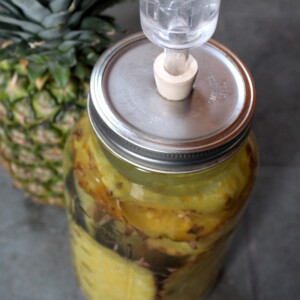
Tepache Recipe (Fermented Pineapple Drink)
Turn pineapple peels and cores into a fizzy, lightly fermented Mexican drink in about three days. Adapted from the All New Ball Book of Canning and Preserving and scaled to a half gallon mason jar. Halve it for a quart jar batch.
Servings: 6 servings (about 6 cups strained)
Equipment
- Half Gallon Mason Jar
Ingredients
- 1 to 1 1/4 cups piloncillo or brown sugar, raw cane sugar also works
- Peels and cores from 1 to 2 pineapples washed and scrubbed thoroughly
- 6 cups warm water filtered or dechlorinated, under 110F
- 1 cinnamon stick optional
- 2 whole cloves optional
Instructions
- Prep the pineapple. Scrub the outside of the pineapple under running water with a vegetable brush. Cut off the top and bottom, stand the fruit up, and slice down the sides to remove the peel in strips. Quarter the fruit and cut out the fibrous core. Set the fruit aside for eating or preserving, since tepache uses only the scraps.
- Pack the jar. Place the pineapple peels and cores into a clean wide mouth half gallon mason jar. Add the cinnamon stick and cloves if you are using them.
- Add sugar and water. Dissolve the sugar in warm water, not hot, since water above about 110F will kill the wild yeast. Pour it over the pineapple scraps, leaving at least 1 inch of headspace.
- First ferment. Attach a fermentation lid or airlock and let the jar sit at room temperature for 24 to 72 hours. Bubbles and a layer of foam should appear within the first day. Start tasting after 24 hours and move on when the balance of sweet and tart suits you. Warm kitchens finish much faster than cool ones.
- Strain. Remove the lid and strain the liquid through a fine mesh strainer or cheesecloth. Discard the spent peels or reserve them for a second batch.
- Second ferment. Pour the strained tepache into flip-top or swing-top bottles rated to hold pressure, leaving 1 to 2 inches of headspace. Let them sit at room temperature for 12 to 48 hours to build carbonation. Do not use a sealed mason jar for this step. If a mason jar is your only option, leave the ring loose and burp it once or twice a day.
- Store and serve. Once the tepache is lightly fizzy, move the bottles to the refrigerator. Open chilled bottles slowly and over the sink. Serve cold over ice.
Notes
Yield: One half gallon jar makes about 6 cups of finished tepache once strained.
Bottling safety: The second ferment builds real pressure. Use flip-top bottles, swing-top bottles, or heavy glass bottles saved from store bought kombucha. Standard canning jars are not rated for pressure and can fail during a warm second ferment. If a mason jar is all you have, keep the ring loose and burp it daily.
Alcohol content: Tepache is lightly alcoholic. A two to three day ferment generally comes in under 1 percent alcohol by volume, similar to kombucha. Longer fermentation raises it. Keep the ferment short if you are serving it to children or to anyone avoiding alcohol.
Reusing the peels: Add fresh sugar water to the same scraps for a second or even third batch. Each round comes out lighter in color and flavor than the one before.
No added yeast: This is a wild ferment powered by the yeast naturally present on the pineapple skin. You can pitch a wine yeast for more predictable results, but it is not required.
Mold versus kahm yeast: A flat white film on the surface is usually kahm yeast, which is harmless and can be skimmed off. Fuzzy growth with visible texture in blue, green, black, or gray is mold, and that batch should be discarded.
Freezing scraps: Pineapple peels keep for months in the freezer, so you can build up a jar's worth over several pineapples.
Serving: Serve cold over ice, cut it with sparkling water for a lighter drink or a squeeze of lime if your batch came out sweet, or use it as a mixer with tequila, mezcal, or light rum.
Storage: Keep refrigerated. Two weeks is the window where it tastes as intended, though sealed bottles keep considerably longer. Finish an opened bottle within a few days. Tepache is not shelf stable and cannot be canned.
Nutrition
Serving: 1cup | Calories: 178kcal | Carbohydrates: 43g | Protein: 0.03g | Fat: 0.01g | Saturated Fat: 0.01g | Polyunsaturated Fat: 0.01g | Monounsaturated Fat: 0.003g | Sodium: 0.2mg | Potassium: 3mg | Fiber: 0.3g | Sugar: 42g | Vitamin A: 2IU | Vitamin C: 0.02mg | Calcium: 20mg | Iron: 0.4mg
