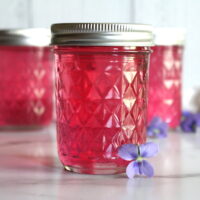
Violet Jelly
Violet jelly is a delicious floral treat with the surprising flavor of fresh berries. Enjoy a fresh jelly with these wild spring flowers, long before actual berries come into season! A single batch yields 6 half-pint jars, set with standard powdered pectin and water bath canned for shelf-stable storage.
Servings: 96 servings, Makes 6 Half Pint (8 oz) Jelly Jars
Ingredients
- 2 cups Wild Violet Flowers
- 4 Cups Water
- 1/4 Cup Lemon Juice bottled if canning, or citric acid, see notes
- 1 box Powdered pectin 1.75 oz Pectin or 6 Tbsp. (Such as Sure-Jell)
- 4 Cups Sugar
Instructions
- Pack the wild violet flowers loosely into a quart mason jar. Pour the boiling water over the flowers, cover, and let steep for at least 4 hours or overnight. The tea will turn a striking turquoise or blue-green color.
- Strain the violet tea through a fine-mesh strainer into a measuring cup, pressing gently on the flowers to extract all the liquid. You should have about 4 cups of violet tea. If you're slightly short, top up with cool water.
- Pour the strained violet tea into a deep saucepan and stir in the bottled lemon juice. The color will immediately shift from turquoise to pink. Whisk in the powdered pectin until fully dissolved.
- Bring the mixture to a hard rolling boil that you can't stir down, then add all the sugar at once, stirring constantly until it dissolves.
- Return to a hard rolling boil and boil for exactly 1 minute. Remove from heat and skim off any foam from the surface.
- Ladle the hot jelly into prepared half-pint jars, leaving 1/4 inch headspace. Wipe rims clean, apply two-part canning lids.If canning, process in a boiling water bath for 10 minutes (15 minutes above 6,000 feet elevation).
- Once the processing time is up, turn off the heat and let the jars rest in the canner for 5 minutes before lifting them out to cool on a towel-lined counter. Check seals after 24 hours.
- For refrigerator jelly (no canning): Ladle the hot jelly into clean jars, cap, and refrigerate once cool. Keeps 3 to 4 weeks in the refrigerator. The jelly will fully set within 24 to 48 hours of cooling.
Notes
Yield ~ This recipe makes 6 half-pint (8 oz) jars, or about 6 cups of finished jelly.
Altitude Adjustment ~ Process for 10 minutes at elevations below 6,000 feet, or 15 minutes above 6,000 feet.
Doubling ~ Don't double this recipe. Larger batches of pectin jelly don't heat evenly and often fail to set. Make two single batches back-to-back instead if you want a larger total yield.
Low Sugar Variation ~ For a reduced-sugar version, use Sure-Jell Low Sugar Pectin (pink box) or Ball Flex Batch Low Sugar Pectin and follow the instructions inside the box (typically 2 cups sugar). For an even lower-sugar version, use Pomona's Universal Pectin, which sets with calcium water and works with as little as 3/4 cup sugar per batch (or honey or maple syrup as a substitute). Follow Pomona's mint jelly directions when adapting this recipe.
Citric Acid Substitution ~ If you'd prefer a pure violet flavor without the lemon, substitute 1 teaspoon of citric acid powder for the 1/4 cup of bottled lemon juice. The acid is still required for safe canning and triggers the color change from turquoise to pink.
Lime Juice Substitution ~ Bottled lime juice can replace the bottled lemon juice at the same volume. Acidity is comparable and the result is just as safe to can.
White Violet Variation ~ White wild violets make a pale golden jelly with honey-like notes instead of the berry flavor you get from purple violets. A mix gives you something in between, with a softer pink color.
Yellow Violets ~ Stick to purple, white, or Johnny jump-ups. Some sources note that yellow wild violets can cause mild digestive upset.
Lemon Juice ~ Bottled lemon juice is preferred over fresh in canning recipes because the acidity is standardized. Flowers are not naturally acidic the way fruit is, so the lemon juice (along with the citric acid in the pectin) is what brings the pH down to a safe canning level. The amount in this recipe is generous, and the pectin itself contains additional citric acid as backup. Still, don't skip the lemon juice if canning.
Nutrition
Serving: 1Tbsp | Calories: 83kcal | Carbohydrates: 21g | Protein: 0.01g | Fat: 0.1g | Saturated Fat: 0.001g | Polyunsaturated Fat: 0.002g | Sodium: 97mg | Potassium: 2mg | Fiber: 0.1g | Sugar: 20g | Vitamin A: 50IU | Vitamin C: 1mg | Calcium: 0.4mg | Iron: 0.05mg
