
Affiliate disclosure: This post may contain affiliate links. Please see our Privacy Policy.
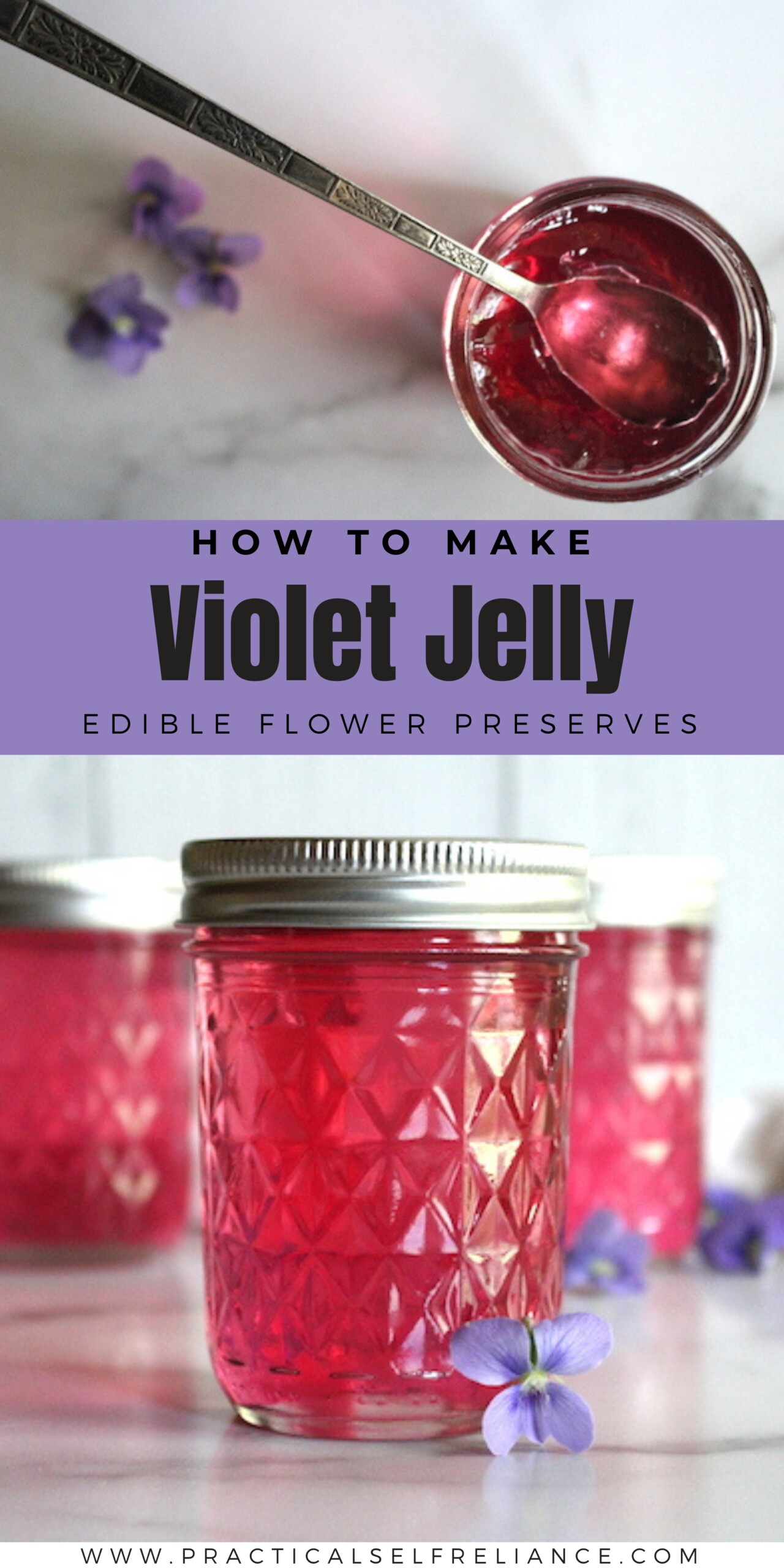
Violet jelly is an easy homemade flower jelly that will add stunning color to your toast, biscuits, and scones. Believe it or not, these bright spring blooms taste like fresh berries, making an exceptionally jelly long before the first fruit harvest of the season.
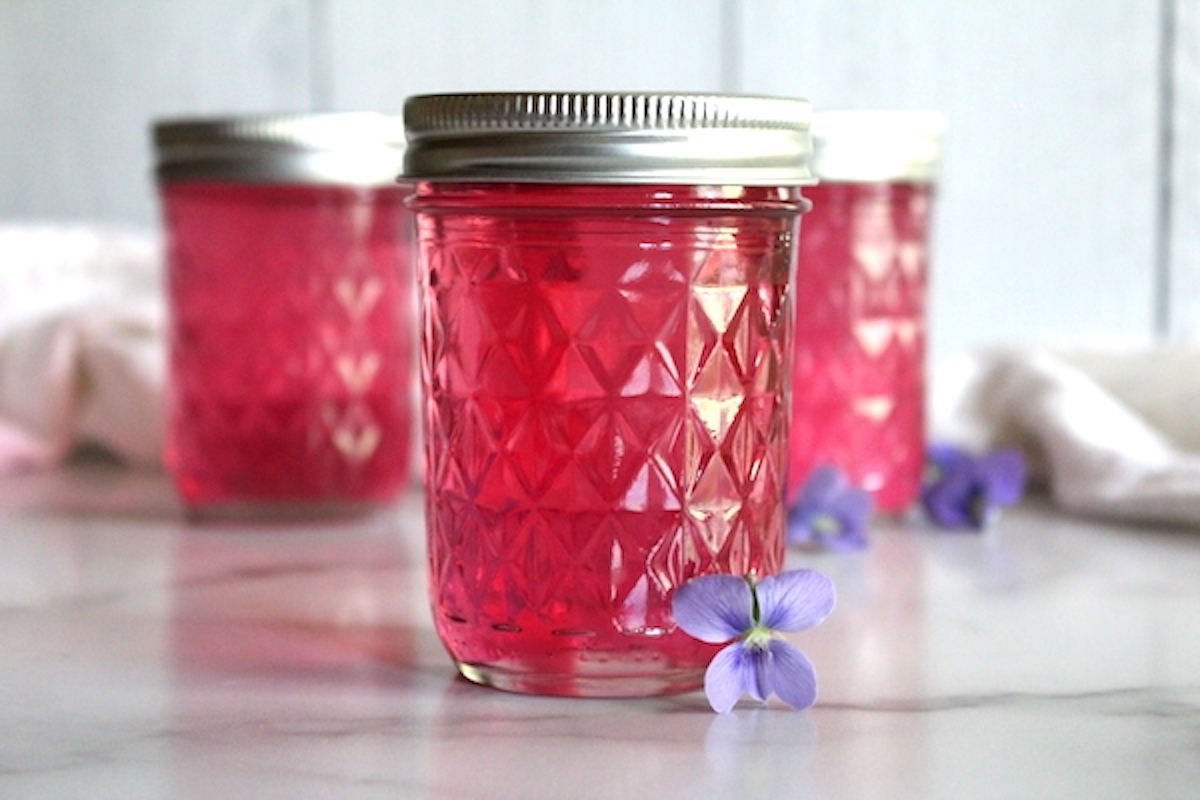
Table of Contents
- Notes from My Kitchen
- What Does Wild Violet Jelly Taste Like?
- Identifying and Harvesting Wild Violets
- Ingredients for Wild Violet Jelly
- How to Make Wild Violet Jelly
- Don’t Overcook Pectin Jelly
- Canning Wild Violet Jelly
- Altitude Adjustments
- Yield Notes
- Storage Options
- Recipe Tips
- Pectin Options
- Ways to Use Wild Violet Jelly
- Violet Jelly FAQs
- Ways to Use Wild Violets
- Violet Jelly Recipe
Wild violets are one of the first things to bloom on our Vermont homestead each spring, and they grow in such abundance along our woods’ edges that the kids and I can fill a quart jar with flowers in about an hour. That single jar is enough for a full batch of violet jelly, and the whole project has become one of our regular spring foraging rituals.
This is essentially a flower jelly. We started making them with dandelion jelly, and the success of that batch kicked off a whole season of experimenting with nearly every edible flower we could get our hands on. Some were underwhelming, but violets stand out. The technique works with most flowers once you’ve got it down, but the flavor here is genuinely surprising, more like fresh berries than anything floral.
The wild violets we use are the common purple ones in the Viola genus that grow in lawns and along woods’ edges across most of North America. They’re not the same plant as the African violets you’d buy as a houseplant, so it’s worth confirming you’ve got the right one before you start picking. Wild violets are easy to identify once you know what to look for, and both the leaves and flowers are edible.
Notes from My Kitchen

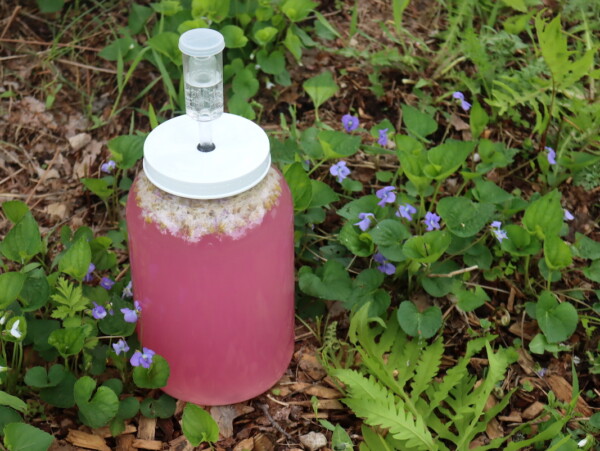
The first year I made this jelly, my kids were two and four, and I put them to work harvesting flowers. They sat in the violet patch for the better part of an hour, perfectly content, picking blossoms one at a time and dropping them into a mason jar. It was the kind of slow, low-pressure foraging that’s hard to beat with little ones, and they were absolutely delighted when the turquoise violet tea turned bright pink the moment we added lemon juice.
We’ve made this jelly every spring since, and I genuinely look forward to the first violets pushing up through the leaf litter each May. It’s become one of those rituals that marks the start of the foraging season here in Vermont, alongside ramps, fiddleheads, and the first dandelions opening in the lawn.
What Does Wild Violet Jelly Taste Like?
Wild violet jelly doesn’t taste anything like the perfumed violet candies you might find at a candy shop. Instead, it tastes surprisingly like fresh berries, with bright notes of blueberry and raspberry layered over a gentle floral sweetness. The same plant compounds that give wild violets their purple color also give blueberries and blackberries theirs, and that family resemblance carries through into the finished jelly.
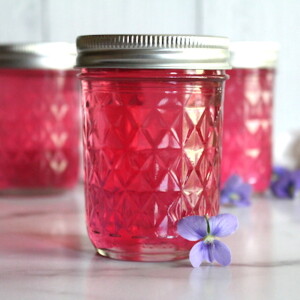
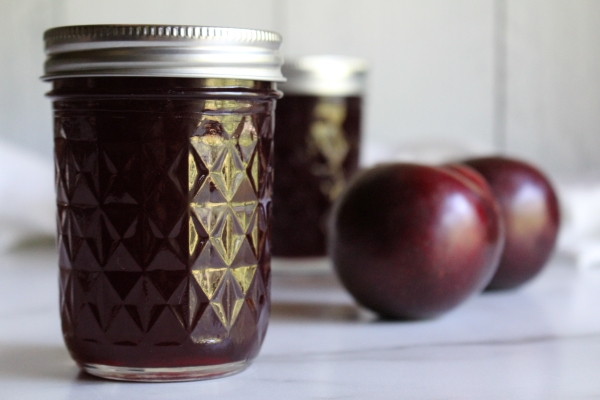
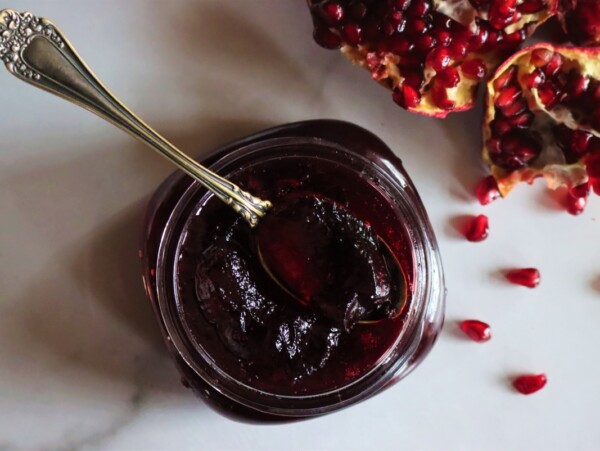
The texture is smooth and spreadable, with a clear pink-to-magenta color that catches the light beautifully on a breakfast table. If you use predominantly white violets, the flavor leans more toward honey and the finished jelly takes on a pale golden color instead. A mix of purple and white violets gives you something in between, with both berry and honey notes.
Identifying and Harvesting Wild Violets
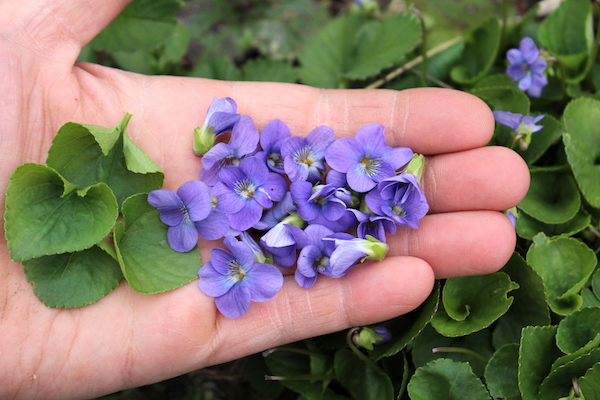
Wild violets in the Viola genus are easy to identify and incredibly common. The leaves are heart-shaped with a slightly serrated edge, and the flowers have five petals in a rough star shape. Color ranges from deep purple to violet, white, or a combination, depending on the variety and growing conditions. They prefer moist, shady spots and are often tucked along woods’ edges, under trees, or on the north side of buildings.
Here in Vermont, wild violets bloom from late April through June. In warmer climates like the Pacific Northwest, they can start blooming as early as February, and in mild parts of California they’ll bloom right through winter. Look for fresh, fully open flowers without any wilting or browning. Pick only the blossoms, leaving the stems and leaves behind for the next round of blooms.
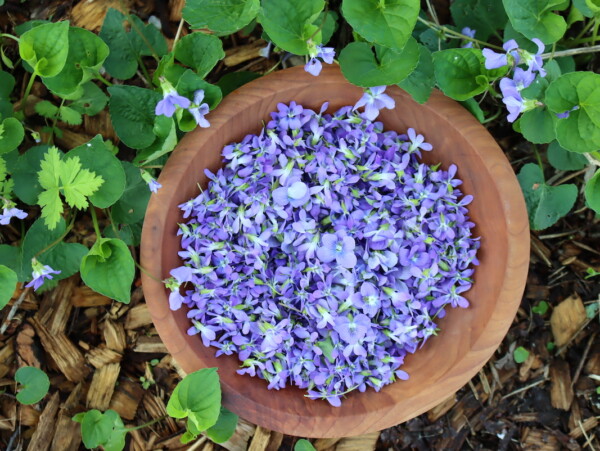
You’ll need about two cups of loosely packed violet flowers for a single batch of jelly. If you fill a quart mason jar about halfway with flowers, that’s roughly the right amount. The flowers are small and it takes a while to gather enough, but kids are surprisingly good at this job. A bigger harvest opens up plenty of other options too, from candied flowers and syrups to violet wine and dozens of other ways to use wild violets.

Ingredients for Wild Violet Jelly
This recipe is essentially a floral tea set with pectin. The flowers are steeped in boiling water to extract their color and flavor, then lemon juice, pectin, and sugar transform the strained tea into a vibrant pink jelly.
- Wild violet flowers: Just the flowers, no stems or leaves. Fresh flowers give the brightest color and the strongest flavor, but you can also keep harvested flowers in the fridge for a day or two if you need to batch your picking sessions.
- Water: Used to make the violet tea. Filtered or spring water works well, since heavily chlorinated tap water can mute the floral flavor.
- Bottled lemon juice: This serves several roles. It brings the pH down to a safe level for water bath canning (flowers aren’t naturally acidic the way fruit is), it triggers the dramatic color change from turquoise to pink, and it brightens the flavor. Bottled is recommended over fresh for predictable acidity in canning recipes.
- 1 box (1.75 oz) powdered pectin: Standard powdered pectin like Sure-Jell or Ball Classic works perfectly here. Don’t substitute liquid pectin, which uses a completely different method and requires much more sugar. See the Pectin Options block below for low-sugar alternatives.
- Granulated sugar: Plain white granulated sugar is what works with standard pectin. The sugar both sweetens the jelly and helps the pectin set, so don’t try to reduce it without switching to a low-sugar pectin formulated for that purpose.
If you only have a small handful of violets, you can scale the recipe down by harvesting the same ratio of flowers to water and adjusting the rest proportionally. Just don’t try to double the batch, since larger batches of pectin jelly often fail to set properly.
“I made wild violet jelly for the first time 3 years ago. I made it to gift for Mother’s Day. People are shocked a little flower jelly can be so good and it’s always requested of me! This year I plan to make scones and clotted cream for Mother’s Day brunch to serve with this. Thanks for the recipe!”
How to Make Wild Violet Jelly
The process has two main stages: steeping the violet flowers in boiling water to make a strong tea, and then cooking that tea with lemon juice, pectin, and sugar to set it into jelly. Total hands-on time is under half an hour, with a long passive steep in the middle.
Making the Violet Tea
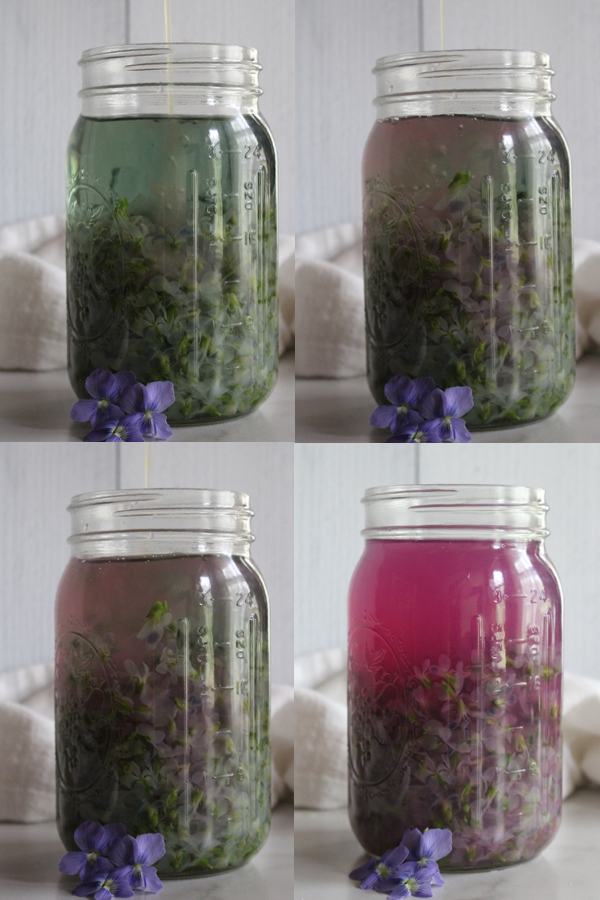
Pack the violet flowers loosely into a quart mason jar. Pour freshly boiled water over the flowers, cover the jar, and let it steep for at least four hours or overnight. The longer the steep, the deeper the flavor and color extraction. The tea will be a startling turquoise or blue-green color at this stage, which is completely normal.
Once the tea has steeped, strain out the flowers and squeeze them gently to extract every bit of liquid. The flowers will look bleached and limp at this point, having given up their color to the tea. If you have a few extra fresh violets, you can add them right at the end of the steep for an extra burst of color.
If you can’t make the jelly right away, the strained violet tea will keep in the refrigerator for three to four days. Several readers have asked about this because foraging the flowers and making the jelly on the same day can be a lot, and splitting it across two days works just fine.
Cooking the Jelly
Pour the strained violet tea into a deep saucepan and add the bottled lemon juice. The color will immediately shift from turquoise to pink, which is one of those small kitchen miracles that never gets old. Whisk in the powdered pectin and bring the mixture to a hard rolling boil that you can’t stir down.
Once it’s at a hard boil, add all the sugar at once, stirring constantly until it dissolves. Return the mixture to a hard rolling boil and let it boil for exactly one minute, then remove it from the heat. Skim off any foam from the surface, since it won’t dissolve back in and can leave a cloudy layer on top of the jars otherwise.
Don’t Overcook Pectin Jelly
Pectin jellies set as they cool, not while they’re cooking. If you’ve made no-pectin jams before, you might be tempted to cook this longer or test for gel stage with a freezer plate or thermometer, but neither of those tests applies to pectin recipes.
- Follow the box-pectin method exactly: hard boil with pectin and lemon, add sugar, hard boil one minute, then off the heat.
- The hot jelly will look thin and watery when you ladle it into jars. That’s exactly right.
- The set develops over 24 to 48 hours as the jars cool. Don’t open or test a jar before then to check if it set.
- Cooking the jelly longer than one minute after adding sugar can actually break the pectin and prevent setting.
Canning Wild Violet Jelly
Canning is optional, but it lets you enjoy violet jelly year-round and pack jars away as shelf-stable gifts. If you’d rather skip water bath canning entirely, just ladle the jelly into clean jars, cap them, and store in the refrigerator (good for three to four weeks) or freezer (six months).
Ladle the hot jelly into prepared half-pint jars, leaving 1/4 inch of headspace. Wipe the rims clean, apply two-part canning lids, and process in a boiling water bath for 10 minutes. Once the processing time is up, turn off the heat and let the jars rest in the canner for five minutes before lifting them out to cool. Check seals after 24 hours and store any unsealed jars in the refrigerator. A basic set of canning supplies (a canner, jar lifter, funnel, and half-pint jars with two-part lids) is all you need for this recipe.
Altitude Adjustments
Adjust processing time based on your elevation:
- Below 6,000 feet: Process for 10 minutes.
- Above 6,000 feet: Process for 15 minutes.
Yield Notes
A few specifics on the finished batch:
- One batch yields about 6 half-pint (8 oz) jars of finished jelly, or 6 cups total.
- Two cups of loosely packed violet flowers and 4 cups of water makes enough tea for one batch.
- Don’t double this recipe. Larger batches of pectin jelly often fail to set because the boiling action isn’t strong enough to activate the pectin evenly. Make two single batches back-to-back instead.
“This is the third year I’ve made this jelly. My daughter is named Violet and I make this every year in honor of her. Thanks for sharing this recipe!”
Storage Options
How you store violet jelly depends on whether you’ve canned it or not:
- Refrigerator: 3 to 4 weeks in a sealed jar, whether canned or not.
- Freezer: Up to 6 months in freezer-safe jars (leave 1 inch of headspace for expansion).
- Canned and shelf-stable: 12 to 18 months in a cool, dark pantry. Once opened, refrigerate and use within 3 to 4 weeks.
Recipe Tips
A few notes from years of making this jelly:
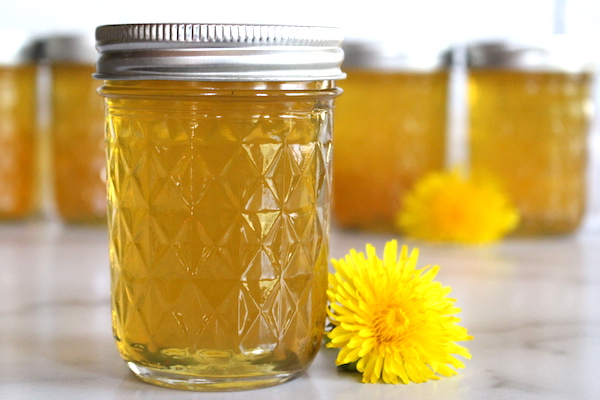
- White violet variation: White wild violets are also edible and make a pale golden jelly with honey notes instead of berry flavor. A mix of white and purple gives you a beautiful in-between color and flavor.
- Johnny jump-ups and garden violas: Both work in place of wild violets. Same family, similar flavor. Avoid yellow wild violets, since some sources note they can cause mild digestive upset.
- Citric acid substitution: If you’d prefer a “pure” violet flavor without the lemon, you can substitute 1 teaspoon of citric acid powder for the 1/4 cup of bottled lemon juice. The acid is still needed for safe canning and for the color change.
- Lime juice swap: Bottled lime juice can replace the lemon juice if that’s what you have on hand. Acidity is similar, and the result is just as safe to can.
- Don’t double the recipe: This is the most common cause of jelly that doesn’t set. Make two single batches back-to-back if you want a larger total yield.
- If your jelly doesn’t set: Give it the full 48 hours first. Most “didn’t set” jelly turns out to be jelly that just needed more time. If it really didn’t set, you can re-batch it with fresh pectin following the directions inside the pectin box.
Pectin Options
Standard powdered pectin like Sure-Jell or Ball Classic Pectin is what this recipe is written for. One 1.75 oz box per batch, with 4 cups of sugar. Several long-time readers have noted that Sure-Jell seems to give the brightest pink color in the finished jelly, though both brands produce a properly set product.
For a lower-sugar version, use Sure-Jell Low Sugar Pectin (pink box) or Ball Flex Batch Low Sugar Pectin. Each comes with its own instructions inside the box, and you can typically reduce sugar to 2 cups or substitute with a sugar replacement like Splenda.
Pomona’s Universal Pectin works differently from standard pectins and uses calcium water to trigger the set, allowing you to use as little as 3/4 cup of sugar per batch. Follow Pomona’s directions for mint jelly when adapting this recipe, since both are herbal teas set into jellies. Their pectin is also the right choice if you want to sweeten with honey or maple syrup instead of granulated sugar.
I don’t recommend liquid pectin for this recipe. It requires nearly a 2-to-1 ratio of sugar to liquid and follows a different method (sugar in first, pectin at the end). The end result is sweeter and stickier than a standard pectin jelly, and most flower jelly recipes are written for powdered pectin anyway.
Ways to Use Wild Violet Jelly
The most obvious use is on toast, biscuits, scones, or English muffins, where the bright pink color is half the appeal. It’s also lovely spooned onto cream cheese with crackers, swirled into Greek yogurt, or melted as a glaze for shortbread cookies or a wheel of brie. A spoonful stirred into hot tea or sparkling water makes a quick floral drink, and a thin layer between cake layers turns a simple pound cake into something that feels distinctly special.
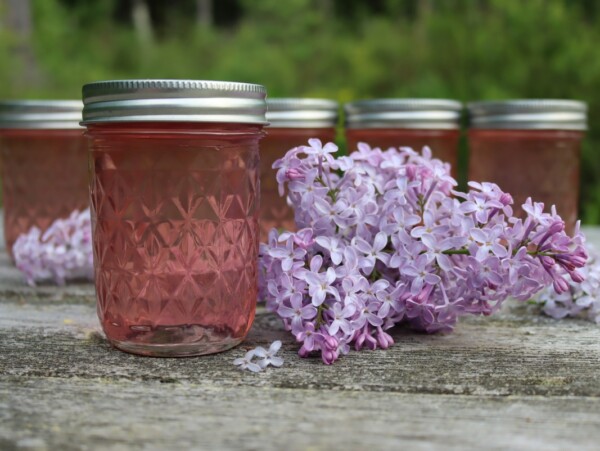
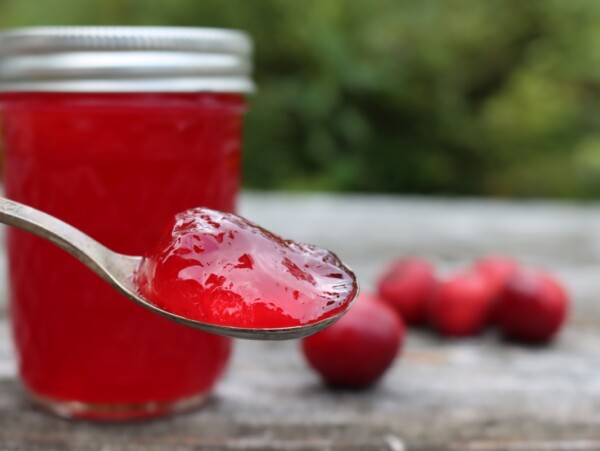
On a homemade jelly shelf, violet sits beautifully alongside spring’s lilac jelly, early summer’s strawberry jelly, and fall’s elderberry jelly. Each has its own moment, and there are plenty more once you start working through jam and jelly recipes.
Violet Jelly FAQs
You need about 2 cups of loosely packed wild violet flowers for a single batch of jelly. Filling a quart mason jar about halfway with flowers gets you to the right amount. The flowers are small, so plan on spending an hour or so harvesting unless you have a really prolific patch.
Pectin jelly sets as it cools, typically over 24 to 48 hours after canning. The jelly will look thin and watery in the jars right after processing, which is completely normal. Don’t open or test a jar to check the set before the full 48 hours have passed, since opening the seal too early can cause it to fail.
Yes, white wild violets are edible and make a pale golden jelly with honey-like flavor instead of the berry notes you get from purple violets. A mix of purple and white violets gives you a finished jelly somewhere in between, with both flavor profiles and a softer pink color.
The most common reasons pectin jelly doesn’t set are doubling the recipe, adding sugar before the pectin has come to a full hard boil, not maintaining a hard rolling boil for the full one minute after adding sugar, or using pectin that’s past its expiration date. Give the jelly a full 48 hours to set before declaring it a failure, since pectin jellies sometimes need the full window. If it still hasn’t set, walk through the steps for troubleshooting jellies that didn’t set and re-batch with fresh pectin.
No, don’t double pectin jelly recipes. Larger batches don’t heat evenly and the boil action isn’t vigorous enough across the whole pot to activate the pectin properly. The most reliable way to get a larger total yield is to make two single batches back-to-back rather than one double batch.
Ways to Use Wild Violets
If you tried this Violet Jelly Recipe, or any other recipe on Practical Self Reliance, leave a ⭐ star rating and let me know what you think in the 📝 comments below!
And make sure you stay in touch with me by following on social media!
Violet Jelly
Ingredients
- 2 cups Wild Violet Flowers
- 4 Cups Water
- 1/4 Cup Lemon Juice, bottled if canning, or citric acid, see notes
- 1 box Powdered pectin, 1.75 oz Pectin or 6 Tbsp. (Such as Sure-Jell)
- 4 Cups Sugar
Instructions
- Pack the wild violet flowers loosely into a quart mason jar. Pour the boiling water over the flowers, cover, and let steep for at least 4 hours or overnight. The tea will turn a striking turquoise or blue-green color.
- Strain the violet tea through a fine-mesh strainer into a measuring cup, pressing gently on the flowers to extract all the liquid. You should have about 4 cups of violet tea. If you’re slightly short, top up with cool water.
- Pour the strained violet tea into a deep saucepan and stir in the bottled lemon juice. The color will immediately shift from turquoise to pink. Whisk in the powdered pectin until fully dissolved.
- Bring the mixture to a hard rolling boil that you can’t stir down, then add all the sugar at once, stirring constantly until it dissolves.
- Return to a hard rolling boil and boil for exactly 1 minute. Remove from heat and skim off any foam from the surface.
- Ladle the hot jelly into prepared half-pint jars, leaving 1/4 inch headspace. Wipe rims clean, apply two-part canning lids.If canning, process in a boiling water bath for 10 minutes (15 minutes above 6,000 feet elevation).
- Once the processing time is up, turn off the heat and let the jars rest in the canner for 5 minutes before lifting them out to cool on a towel-lined counter. Check seals after 24 hours.
- For refrigerator jelly (no canning): Ladle the hot jelly into clean jars, cap, and refrigerate once cool. Keeps 3 to 4 weeks in the refrigerator. The jelly will fully set within 24 to 48 hours of cooling.
Notes
Nutrition
Nutrition information is automatically calculated, so should only be used as an approximation.
Jelly Recipes
Find the perfect recipe
Searching for something else? Enter keywords to find the perfect recipe!








Tastes amazing!
Love this recipe, easy to follow instructions and the jelly came out perfect.
So glad to hear it turned out well! Violet jelly is one of my spring favorites. Enjoy!
Recipe for violet jelly is very well done; very clear directions. Thank you!!
Looking forward to finally making violet jelly. However, I am dealing with back issues so my stamina is significantly decreased. Is it possible to pick the flowers and make the tea and store in frig to make jelly the next day? Thank you!
Yes definitely! Once you have the flowers, you do want to make the tea immediately as they start to degrade quickly, but you can keep the tea in the fridge for 3 to 4 days if need be before making the jelly. Enjoy!
I’m sitting here thinking the same thing! I hope your back is better this spring!
Can I use lime juice in place of the lemon juice?
Yes! You can always use lime juice in place of lemon juice in canning recipes, just be sure to stick with bottled lime juice (the same as you would use bottled lemon juice). Enjoy!
Quick question … should the just-picked violets be rinsed before pouring the boiling water over them? Maybe I missed it but it seems as if they should be cleaned somehow. Can’t wait to try this jelly! Thanks!
That’s up to you. Ours are pretty clean, and we pick over them by hand, but you can rinse them if you’d like.
Just found your website and enjoying all your ideas , recipes and blog. I live in England and have a lot of rhubarb and violets growing in my back garden. Please could you give me the metric conversion to the quarts/ cups as when I look online, I am not getting the same conversion… Do you put the filled jars into a large saucepan and boil for X time? Sterilize jars in the oven too?. Thank you Nicky
I’m sorry but we don’t have metric conversions. I would just use the information that you find online. It should be accurate enough. If you end up with a jar that isn’t completely full you can simply put it in the fridge to use up immediately. The jars do not need to be sterilized as long as the processing time is over 10 minutes. We do have a post here for beginner waterbath canning. https://practicalselfreliance.com/water-bath-canning-beginners/ It is not necessary to use a water bath canner as long as you have a pot that is large enough to cover the jars appropriately and you want to be sure to not put the jars directly on the bottom of the pot.
Thanks for the Violet Jelly recipe Ashley. Our violets are ready here in East TN (late March) and I whipped up a delicious batch. Your recipe is most appreciated and delicious. Best regards from the DoubleD Farm in New Tazewell, TN.
You’re very welcome. So glad you enjoyed the recipe.
I believe there’s a typo: Could you please consider correcting the notes for this excellent and easy recipe to state 1 teaspoon of citric acid? Thank you.
Yes we will try to get that corrected. Thank you.
Thanks for this recipe! I’m going out to pick violets now.
Question: if I’m using citric acid, do I still need to add the volume of 1/4 cup water that would normally be part of the lemon juice? Thanks for this delicious, old-time recipe.
No it’s not necessary.
Hi Ashley
Thanks for al the wonderful knowledge that you are. I am starting a homestead here in France [but I am from the Netherlands] and love to read your blog though plants differ but the idea behind all this certainly not. About the violet jelly. I wonder if you can use agar agar to make the jelly? With many greetings
I’m not familiar with that plant. Do you have a scientific name?
Can you tell me if the flowers can be frozen, and if so how to do that.
Thanks,
Bridgett
If I were going to freeze them, I would probably put them in a little water first and then freeze that.
Just made this jelly for the first time last night. It tastes delicious! My color is fainter than your picture’s, and the jelly is less translucent than yours. Any idea what might have caused that? I did use low-sugar pectin. It is still gorgeous and delicious, just curious why it would have turned out different. Thank you!
It may be the pectin. I have heard several people say that the brand of pectin can affect the final color.
The relentless storms here in California have brought about the most amazing show of wild violets.
I just made this jelly today, after years of thinking about doing it.
Thanks for the recipe.
You’re very welcome. So glad you enjoyed the recipe.
This is the third year I’ve made this jelly. I just wanted to say to make sure to use the sure-jell pectin as I’ve tried it with the Ball pectins and it doesn’t retain the color, one of the best things about this jelly. My daughter is named Violet and I make this every year in honor of her. Thanks for sharing this recipe.
You’re welcome. We’re so glad you enjoyed the recipe.
Hi Ashley,
I accidentally canned with fresh lemon juice vs. bottled. Is this batch safe to consume? Or should I eat it within a certain time frame? I’m so sad about this.
In this particular case, fresh lemon juice should be totally fine for canning. There is more than enough lemon juice in there to bring the pH down, and even if by chance it’s not quite as acidic as bottled (which happens occasionally, but not all the time), it’d still be perfectly fine. Pectin actually has citric acid added in to correct for this as well, so many recipes say you don’t need the lemon juice at all for safe canning. That’s just a bonus for extra caution, and given that, fresh is totally fine.
Made this jelly yesterday and it looks beautiful. How long does it usually take for yours to set? Mine has been sitting for about 16 hours and is still liquid.
It can sometimes take 24 to 48 hours to set.
I tried this recipe this weekend and honestly who knew the jelly would be so delicious. I mean bees make honey from flowers and that is yummy. So why wouldn’t this jelly taste good? It’s honestly so very sad how disconnected we are from the Earth. I’m trying to find my way back to it and your writing is helping me explore. Thank you for the wonderful information, great recipe, and helping me live completely in this world and not just on it.
You’re very welcome. We’re so glad you enjoyed the jelly. I agree with you that it is sad but hopefully we can all do our part to change that.
Can you add fresh blossoms to each jar before sealing and processing to make it look pretty?
Thank you, Margie
That sounds like a great idea. I haven’t ever actually tried it but I am guessing that they won’t stay very pretty through the canning process but let us know if you decide to try it.
Mine didn’t set up, but it was sure pretty to look at
I’m so sorry it didn’t set up for you.