
Affiliate disclosure: This post may contain affiliate links. Please see our Privacy Policy.
Strawberry jelly captures the bright, candy-sweet flavor of summer strawberries in a smooth seedless preserve. Strawberries are naturally low in pectin, so this recipe uses powdered fruit pectin for a quick reliable set, with a splash of bottled lemon juice to brighten the flavor and help the gel along.
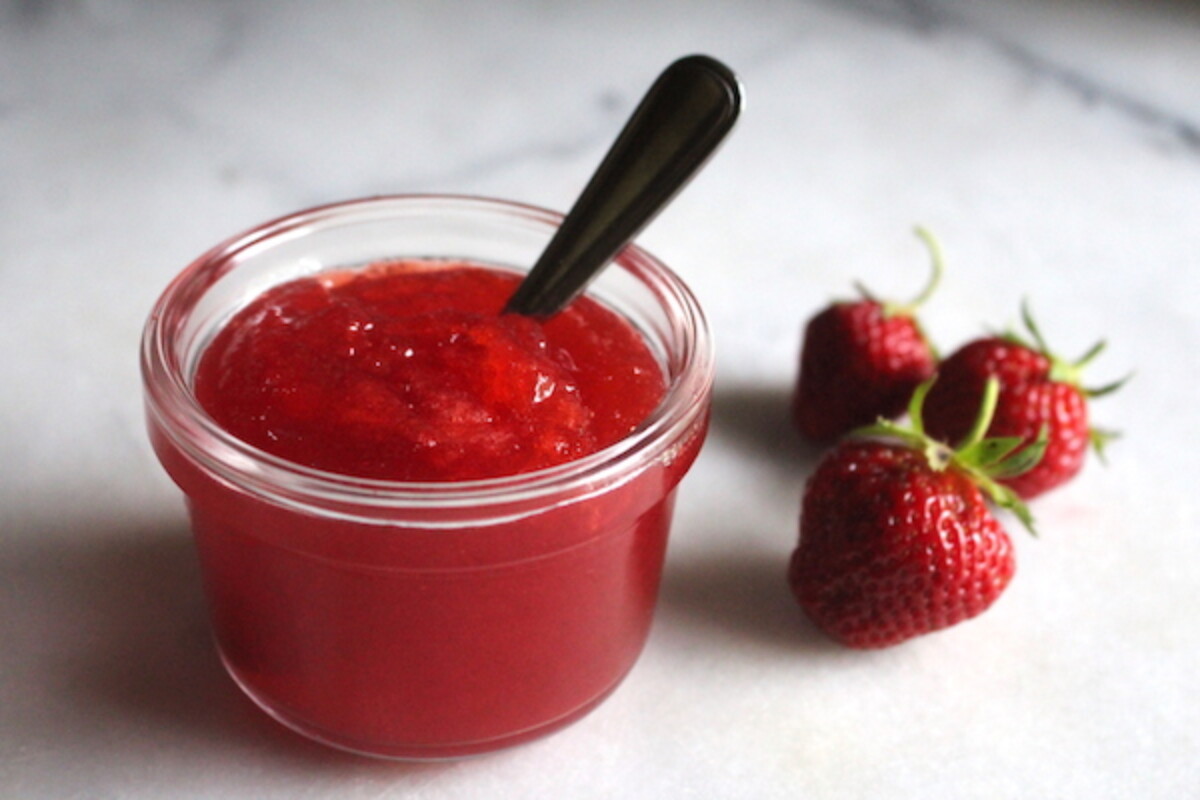
Table of Contents
- Notes from My Kitchen
- Ingredients for Strawberry Jelly
- How to Make Strawberry Jelly
- Don’t Overcook Pectin Jelly
- Canning Strawberry Jelly
- Altitude Adjustments
- Yield Notes
- Storage Options
- Recipe Tips
- Pectin Options
- Strawberry Jelly Variations
- Ways to Use Strawberry Jelly
- Strawberry Jelly FAQs
- Ways to Preserve Strawberries
- Strawberry Jelly Recipe
- Jelly Recipes
Adapted from the Ball Complete Book of Home Preserving, this recipe relies on Sure-Jell or Ball Classic powdered pectin for a reliable gel. Strawberries don’t give up much juice easily; you’ll need about 4 quarts of fresh strawberries to extract 4 cups of juice. But the cooking time is short, and the result is bright, intensely flavored without the seeds and pulp of jam.
Strawberries are also one of the more flexible juice bases for variations. The basic recipe takes well to a splash of balsamic vinegar, chamomile tea, champagne, or vanilla, and the technique scales easily for whatever harvest you bring home from the patch.
If you have a bumper crop of berries, you can also try my low sugar strawberry jam, strawberry rhubarb jam, or canning whole strawberries.
Notes from My Kitchen

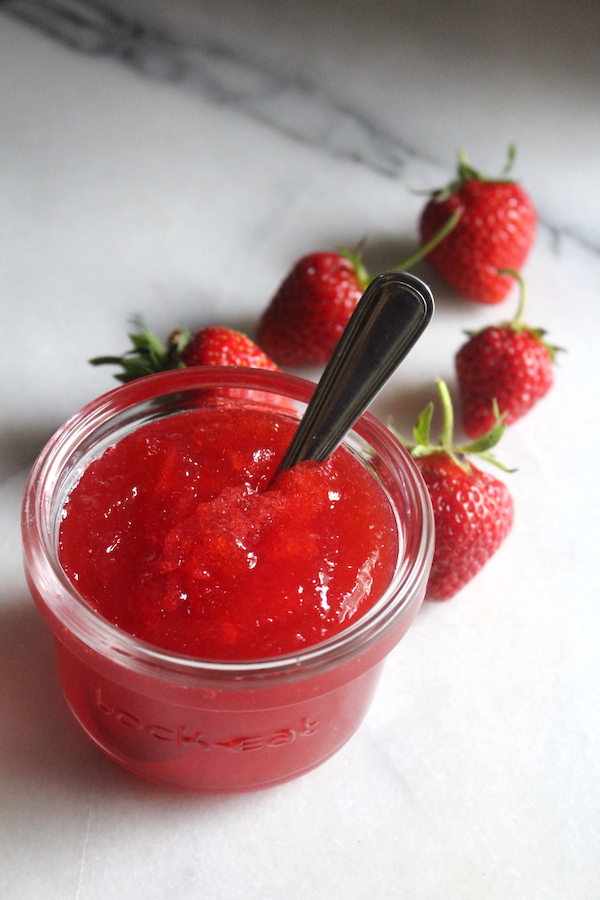
My little ones love all things jam and jelly, but strawberry preserves are at the top of the list. When strawberry season rolls around in Vermont, they’re on duty full-time in our strawberry patch picking berries, and they take the job seriously knowing where those buckets are headed. We grow two main varieties on our homestead: standard summer-bearing strawberries that produce one big crop in late spring, and everbearing strawberries that trickle berries all summer and into fall.
For me personally, my go-to strawberry preserve is low sugar strawberry jam, which leans tart and chunky. The kids though, they want all the sugar and none of the chunks. Smooth, sweet, ruby-red strawberry jelly is what they ask for, and I’m happy to make it for them because the cooking time is much shorter than jam. I cook the berries down, get them into the jelly bag, and I can be back outside playing in the sun with the littles while the juice strains overnight.

Ingredients for Strawberry Jelly
This strawberry jelly recipe yields about 6 half-pint jars and uses just four ingredients:
- Strawberry juice: Extracted from fresh ripe strawberries (instructions below). Use the most fragrant, ripest berries you can find. Any variety works, including wild strawberries (you’ll just need a lot more of them). Frozen strawberries also work but yield slightly less juice and a less vibrant color.
- Bottled lemon juice: Brightens the flavor of the finished jelly and helps the pectin gel reliably. Strawberries are acidic enough for safe water bath canning on their own, so the lemon is for flavor, not preservation. Bottled lemon juice has a consistent acid level, which matters more here than fresh.
- 1 box (1.75 oz) powdered fruit pectin: Use Sure-Jell or Ball Classic regular powdered pectin. Strawberries are naturally very low in pectin, so commercial pectin is essential for a reliable gel. Don’t substitute liquid pectin, which requires different ratios.
- Granulated sugar: Don’t reduce the sugar with regular powdered pectin; it won’t gel. To use less sugar (or honey or maple syrup), see Pectin Options below. The recipe card has the specific amount.
How to Make Strawberry Jelly
Strawberry jelly comes together in two stages: extracting the juice from the strawberries (which takes most of the time, mostly hands-off as the juice strains through a jelly bag), and then cooking the jelly itself, which only takes about 15 minutes once the juice is ready.
Extracting Strawberry Juice
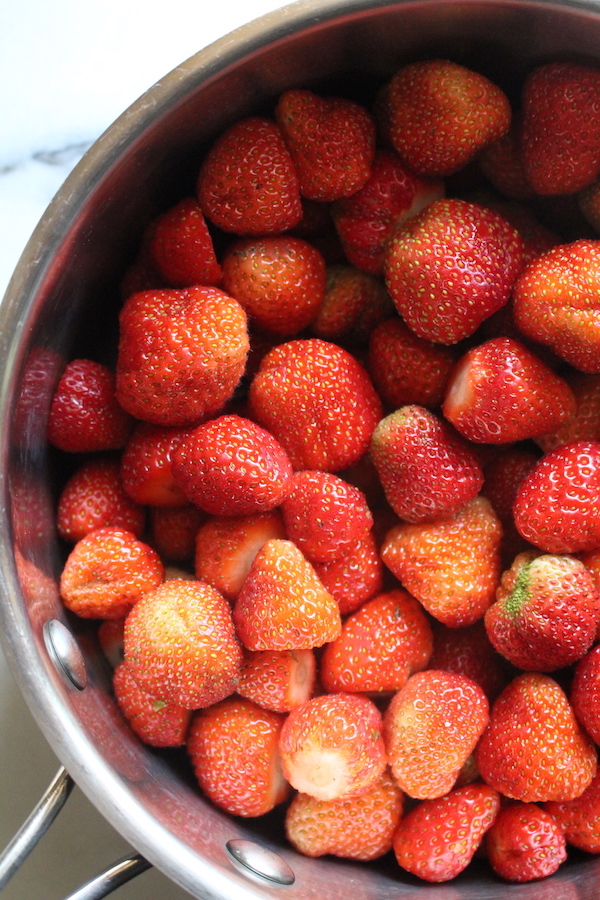
Hull the strawberries (no need to chop) and place them in a heavy-bottomed saucepan with a bit of bottled lemon juice. Crush them lightly with a potato masher to release some juice, then bring to a boil over medium-high heat. Reduce heat and simmer for about 10 minutes, mashing occasionally, until the berries are completely soft and have given up most of their juice.
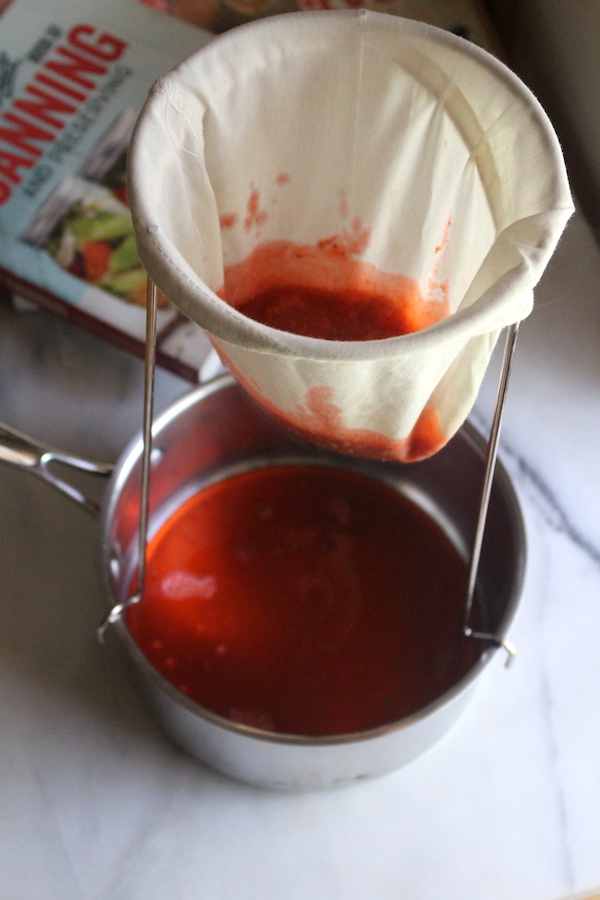
Transfer the cooked strawberry mixture to a dampened jelly bag or a strainer lined with several layers of dampened cheesecloth set over a deep bowl. Let it drip undisturbed for at least 2 hours, or overnight for more juice.
Don’t squeeze the bag, even though it’s tempting; squeezing releases solids that cloud the finished jelly. Measure the juice for the recipe (the recipe card has the specific amount).
Cooking the Jelly
Order matters with powdered pectin. Combine the strawberry juice and bottled lemon juice in a heavy-bottomed jam pot. Whisk in the powdered pectin until fully dissolved. Bring to a hard rolling boil over high heat, stirring frequently.
Add the sugar all at once and stir constantly until fully dissolved. Return to a hard rolling boil that can’t be stirred down, and boil hard for exactly 1 minute. Remove from heat and quickly skim off any foam. Ladle the hot jelly into prepared half-pint jars, leaving 1/4 inch headspace, wipe rims clean, and apply two-piece canning lids fingertip tight.
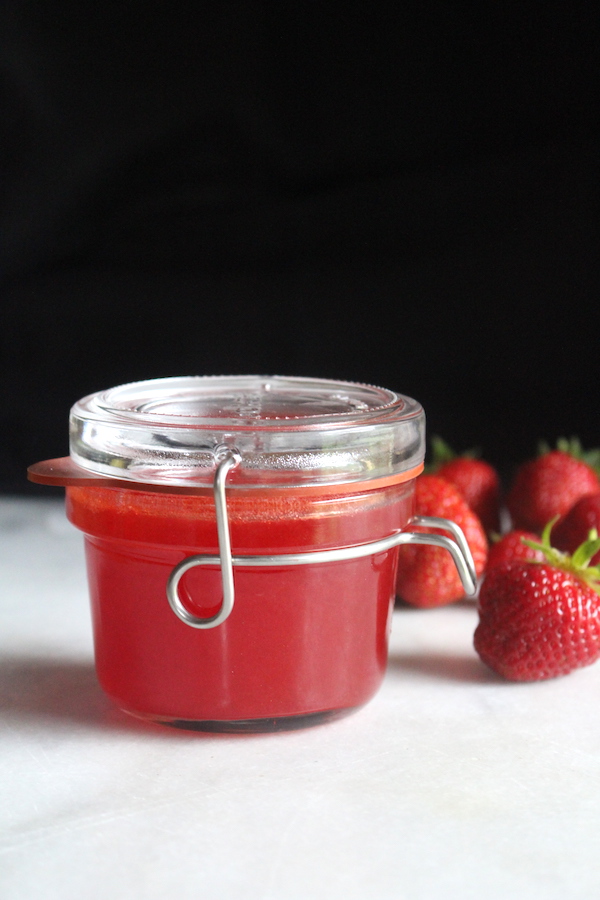
Don’t Overcook Pectin Jelly
Pectin jelly works on chemistry, not on cooking time. A few things to know:
- The jelly looks thin in the pot when you take it off the heat, and that’s normal. Pectin sets as the jelly cools, not while it’s boiling.
- Trust the timing. A hard rolling boil for exactly 1 minute after the sugar fully dissolves is all you need.
- Skip the thermometer and freezer plate test. Those are for old-fashioned no-pectin jellies. Pectin recipes set on chemistry, not on temperature.
- Give the jars 24 to 48 hours to fully set before declaring failure.
Canning Strawberry Jelly
I always can my strawberry jelly so I have shelf-stable jars year-round, but canning is optional. You can also store the finished jelly in the fridge for several weeks or in the freezer for up to a year (use freezer-safe straight-sided jars if you’re freezing). If you’re new to canning, start with my beginner’s guide to water bath canning before you fire up the canner.
Process the filled jars in a boiling water bath canner for 10 minutes (adjusting for altitude). When the timer goes off, turn off the heat and let the jars sit in the canner for another 5 minutes before lifting them out (this helps prevent siphoning). Cool on a towel for 12 to 24 hours, check seals, and refrigerate any unsealed jars. Sealed jars keep on the pantry shelf for 12 to 18 months.
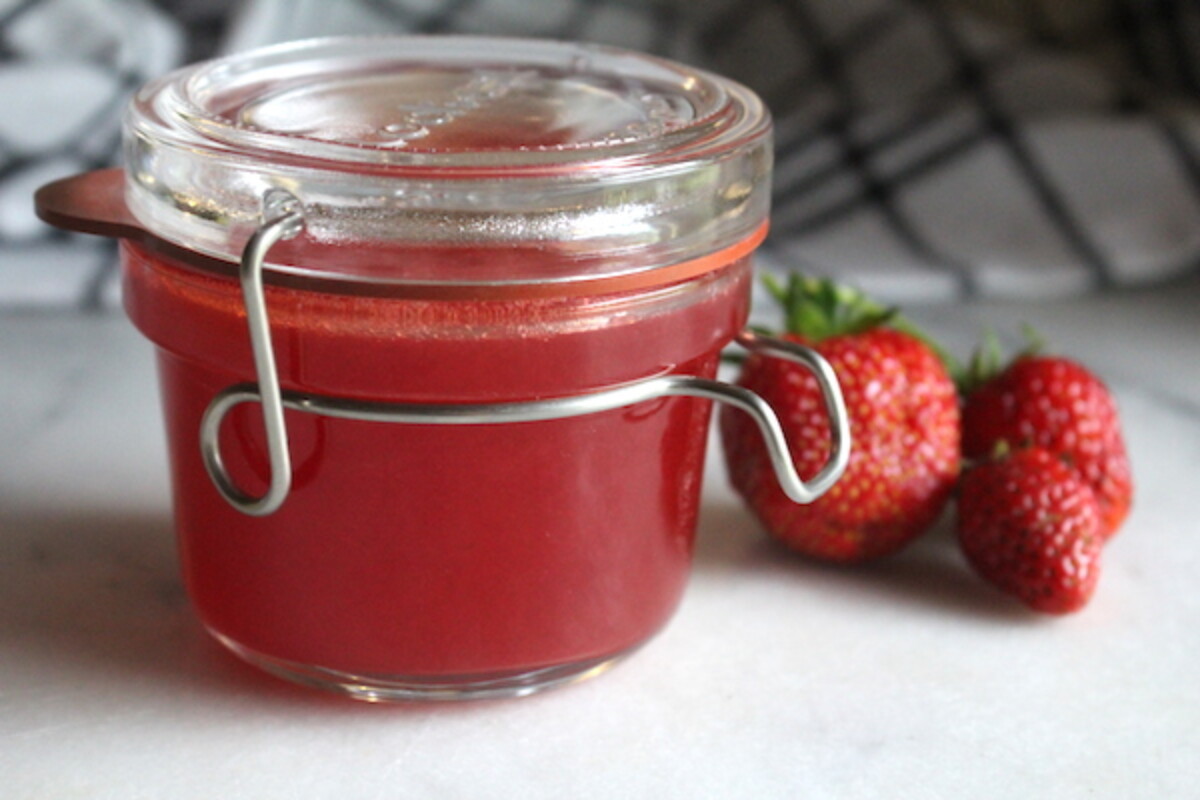
Altitude Adjustments
Processing time depends on your elevation:
- 0 to 6,000 feet: 10 minutes
- Above 6,000 feet: 15 minutes
Yield Notes
Here’s what you can expect from this recipe:
- 1 quart whole strawberries (about 1 1/2 lbs) = about 1 1/2 cups crushed
- 3 1/2 cups hulled strawberries = about 1 cup of strained juice
- 4 quarts strawberries = about 4 cups strawberry juice (one batch)
- 4 cups strawberry juice + 2 Tbsp lemon + 1 box pectin + 4 cups sugar = about 5 half-pint (8 oz) jars
- Don’t double the recipe. Larger batches don’t heat evenly and may not set properly. Make two single batches back-to-back instead.
Storage Options
Not committed to water bath canning? You have several options:
- Refrigerator jelly: Let jars cool to room temperature, then store in the fridge. Keeps for 3 to 4 weeks.
- Freezer jelly: Use freezer-safe straight-sided jars and leave 1/2 inch headspace for expansion. Lasts up to 12 months frozen.
- Canned jelly: Water bath processed jars keep for 12 to 18 months in a cool, dark pantry. This is my preferred method because it means strawberry jelly in February when the snow is piling up.
Recipe Tips
- Don’t skip the lemon juice. While not required for safety (strawberries are acidic enough for canning on their own), the lemon adds noticeable brightness and helps the pectin gel reliably.
- Use a deep pot. Strawberry jelly foams quite a bit when it reaches a rolling boil. A deep pot prevents overflows.
- Strain overnight if you can. A 2-hour drip works, but overnight gives you noticeably more juice for the same amount of fruit.
- Save the strawberry pulp. The leftover cooked pulp is delicious folded into muffin or pancake batter, swirled into yogurt, or stirred into oatmeal. You can also use it for strawberry syrup or freeze it for smoothies.
- Be patient with setting. Strawberry jelly can take 24 to 48 hours to fully set. Some batches may take up to a week. Don’t call it a failure until you’ve given it time. If it’s still not set after that, read through my guide to troubleshooting an unset jelly.
Pectin Options
Standard powdered pectin (this recipe): Requires the full sugar amount in the recipe card. Use Sure-Jell (yellow box) or Ball Classic regular powdered pectin.
Low sugar pectin: Sure-Jell Low Sugar (pink box) or Ball Flex Batch Low Sugar let you reduce sugar significantly, or substitute honey or maple syrup. Follow the directions on the box, since amounts differ from regular pectin.
Pomona’s Universal Pectin: Pomona’s works with any amount of sugar (or none). The set is softer, more like Jello. Read how to use Pomona’s Pectin first, since the process is different.
Liquid pectin: Not recommended. Requires more sugar for the same volume of juice and the texture is inconsistent.
Strawberry Jelly Variations
Strawberry juice is a flexible base for flavor twists. Once you’ve made the basic recipe, try one of these:
- Strawberry Vanilla Jelly: Split a vanilla bean and scrape the seeds into the strawberry juice before cooking, or stir in pure vanilla extract after removing the jelly from heat.
- Strawberry Balsamic Jelly: Replace some of the strawberry juice with good-quality balsamic vinegar (start with a tablespoon or two and adjust to taste). The book Preserving with Pomona’s Pectin has a nice version of this.
- Roasted Strawberry Chamomile Jelly: Roast hulled strawberries on a sheet pan at 400°F for about 30 minutes to concentrate the flavor. While roasting, brew strong chamomile tea on the stove. Cook the roasted berries in the chamomile tea, strain through a jelly bag, then proceed with the recipe. The All New Ball Book of Canning and Preserving has a tested version.
- Strawberry Champagne Jelly: Replace up to 1 cup of the strawberry juice with champagne or dry white wine. The alcohol cooks off and leaves a subtle floral note.
- Strawberry Lemon Jelly: Increase the lemon juice and add finely grated lemon zest along with the sugar for a bright, citrus-forward version.
- Wild Strawberry Jelly: Substitute foraged wild strawberries for cultivated. Wild strawberries are tinier but more intensely flavored, and they make a remarkable jelly. See my wild strawberry jam for sourcing notes.
Ways to Use Strawberry Jelly
Strawberry jelly is a kitchen workhorse. I spread it on toast, biscuits, scones, and English muffins, fold it into peanut butter sandwiches for the kids, swirl it into plain yogurt or oatmeal, and use it as the filling for thumbprint cookies. It also melts down nicely as a glaze for pork tenderloin or roasted duck, and a spoonful stirred into a glass of seltzer makes a quick strawberry soda.
For more inspiration, I have a guide to 100+ ways to use up a jar of jam or jelly. And while you’re already in strawberry-preserving mode, you might enjoy rounding out your pantry with strawberry rhubarb jam or these 30+ creative ways to can strawberries.
Strawberry Jelly FAQs
No, strawberry jelly is seedless. The whole point of jelly (versus jam) is that the cooked fruit is strained through a jelly bag, leaving a smooth, clear preserve with no seeds, skins, or pulp. This recipe also uses pectin (not gelatin), so the texture is firm and spreadable rather than the wobbly Jell-O texture of gelatin desserts.
Strawberry jelly made with powdered pectin typically takes 24 to 48 hours to fully set at room temperature. Some batches may take up to a week. Strawberries are naturally low in pectin, so a slightly slower set is normal. Don’t call it a failure until you’ve given it at least 48 hours to firm up.
Yes, frozen strawberries work for jelly. Freezing breaks down some of the cell structure, which can actually help juice extraction, but the color and flavor are often slightly less vibrant than fresh. No need to thaw before cooking; just add an extra few minutes to the simmer time. Use the same volume of frozen as the recipe calls for in fresh.
Strawberry jelly is made from strained strawberry juice, so it’s smooth, seedless, and translucent with no fruit pieces. Strawberry jam is made from chopped or mashed whole strawberries, so it has fruit texture, includes the seeds and skins, and is more opaque. Jelly spreads more smoothly on toast and shows off the bright red color, while jam has more body and a fuller fruit flavor.
You’ll need about 4 quarts of fresh strawberries (roughly 5 to 6 pounds) to extract 4 cups of juice for one batch. Strawberries are stingy with their juice; about 3 1/2 cups of hulled berries yields just 1 cup of strained juice. If you’re short on berries, the recipe scales down: just measure your juice and adjust the pectin and sugar proportionally.
Ways to Preserve Strawberries
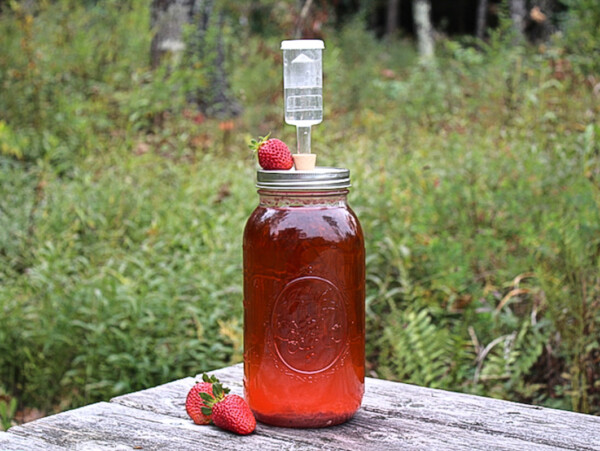
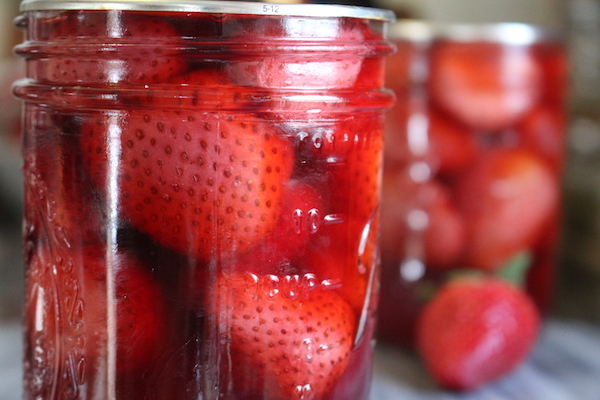
If you tried this Strawberry Jelly recipe, or any other recipe on Practical Self Reliance, leave a ⭐ star rating and let me know what you think in the 📝 comments below!
And make sure you stay in touch with me by following on social media!
Strawberry Jelly
Ingredients
For Strawberry Juice
- 4 quarts strawberries
For Making Strawberry Jelly
- 4 cups strawberry Juice
- 2 tbsp lemon juice, optional, fresh or bottled
- 1 box Powdered Pectin, 1.75 ounces, such as Sure Jel or ball classic, 6 Tbsp if using bulk pectin
- 4 cups sugar
Instructions
Extract the Juice
- Hull the strawberries (no need to chop) and place them in a heavy-bottomed saucepan. Crush lightly with a potato masher to release some juice.
- Bring to a boil over medium-high heat. Reduce heat and simmer for about 10 minutes, mashing occasionally, until the berries are completely soft and have given up most of their juice.
- Transfer the cooked strawberry mixture to a dampened jelly bag or strainer lined with several layers of dampened cheesecloth set over a deep bowl. Let drip undisturbed for at least 2 hours, or overnight for more juice. Don’t squeeze the bag; squeezing releases solids that cloud the jelly.
- Measure 4 cups of juice for the recipe.
Make the Jelly
- Prepare canning jars, lids, and water bath canner.
- Combine the strawberry juice and lemon juice in a heavy-bottomed jam pot. Whisk in the powdered pectin until fully dissolved.
- Bring to a hard rolling boil over high heat, stirring frequently. Boil 1 minute.
- Add the sugar all at once and stir constantly until fully dissolved. Return to a hard rolling boil that can’t be stirred down, and boil hard for exactly 1 minute.
- Remove from heat and quickly skim off any foam.
Can the Jelly
- Ladle the hot jelly into prepared half-pint jars, leaving 1/4 inch headspace. Wipe rims clean with a damp cloth and apply two-piece canning lids fingertip tight.
- Process jars in a boiling water bath canner for 10 minutes (15 minutes above 6,000 feet elevation).
- When the timer goes off, turn off the heat and let jars sit in the canner for 5 minutes before lifting them out.
- Cool on a towel for 12 to 24 hours, check seals, and refrigerate any unsealed jars. Sealed jars keep on the pantry shelf for up to 18 months.
Notes
Nutrition
Nutrition information is automatically calculated, so should only be used as an approximation.
Jelly Recipes
Find the perfect recipe
Searching for something else? Enter keywords to find the perfect recipe!











When letting the fruit drop overnight, should I refrigerate it?
You don’t have to, but you can if you’d like. Letting it drip overnight on the counter is standard for jelly and perfectly fine. The juice is already cooked, strawberries are naturally high in acid, and the whole thing gets boiled again with the pectin and sugar before canning, so a room temperature drip isn’t a problem. That said, if your kitchen runs warm or you’d just feel better about it, you can set the whole strainer and bowl in the fridge overnight instead. Either way works. Hope this helps!
For the Strawberry Lemon Jelly
How much will I increase the lemon by and how much zest should I use?
Good news, I’ve actually got a full Strawberry Lemonade Jelly recipe up on my dedicated canning site now, so you don’t have to guess at the amounts. Here it is: https://creativecanning.com/strawberry-lemonade-jelly/. The short version: use 1 lemon for a subtle citrus note, or 2 for a more pronounced lemonade flavor. That works out to about 3 tablespoons of juice from one lemon, or 5 to 6 from two. For the zest, use a vegetable peeler to take wide strips from those same 1 to 2 lemons, avoiding the white pith. The zest strips go in with the strawberries while everything simmers and steeps, then get strained out with the rest of the solids, so no zest actually stays in the jar. That keeps it from turning bitter. You’re aiming for 4 cups of strained juice before adding the pectin and sugar. Hope this helps, and happy canning!
Can I use the mashed strawberries in the jelly recipe.
Yes, of course.
Do you use the whole box of sure jell or just one packet when making this recipe?? I have a 3 lb container of powdered fruit pectin so I’m not sure how much of that to use.
You want to use one package of sure jell. A standard package of sure gel is 1.75 oz.
All I use is strawberries and sugar and boil the heck out of it. Stir often so it doesn’t scorch until it gets thick .
sample occasionally to check for thickness. If it doesn’t get thick enough for jam/jelly you can always use as ice cream topping.
I follow the rule of boiling the juice, pectin, and lemon juice until it reaches between 210 to 220 degrees Fahrenheit and then adding sugar. Always sets now.
Can you turn the leftover strawberry pulp into Jam once you’ve drained the juice??
I haven’t ever tried it before but I did find a recipe from Mother Earth News with a recipe. https://www.motherearthnews.com/real-food/jam-from-jelly-pulp-recipe-zerz1807zpop/ Let us know if you give it a try.
Can this recipe be made with frozen strawberries? If so – are you aware of any alterations that would need to be made (perhaps additional pectin)?
Frozen strawberries should work just fine.
Can you use frozen strawberries with this recipe?
Frozen strawberries should work just fine.
I would like to know how to use apple seeds, etc. to make jams/jellies without added pectin. Would you put the seed in some kind of porous bag? and how many seed to how much juice or fruit?
Here is an article that talks about using citrus seeds for pectin. https://practicalselfreliance.com/citrus-pectin/ I am not sure about using the apple seeds in the same way but apples are used frequently. There is a link in the citrus seed post that talks about using apples to make pectin but it uses the whole apple and cooks it down to extract the pectin rather than just using the seed.
Thanks a bunch!
You’re welcome.
Always use the cold spoon test. You will get real good at it and always pick the best gell point.
I made jelly for the first time yesterday It actually took me two days. One day to decap 8 quarts of berries, cook them down, puree them with a hand blender, and filter the puree through jelly bags. I clothspinned the bags to the top of 1/2 gallon Mason jars for the whole day. I then combined all the juice and placed it in the fridge. The yield was 6 cups pure strawberry juice.
My wife and I calculated there would be approximately 12 cups yield. I heated the juice and began adding the sugar slowly while constantly stirring. We determined the amount of sugar by taste. When we agreed it was sweet enough I stopped adding sugar.
My water bath canner wasn’t going to hold 12 jelly jars so I substituted two pint jars. When the sugar was all dissolved I added 3/8 cup of lemon juice and then 3 bags liquid CERTO. The jelly was boiling but not heavily. I used the cold spoon method to test the gell point. It took about half an hour and reached a temperature of 118 degrees F. I was removing the foam the entire time. At gell we began filling the jars which had been sterilized in the water bath. The yield was exactly 10 cups. Right to the shoulder on every jar. Two pints and eight jelly jars. I love it when a plan comes together.
Today I removed the rings and tested the seals. All is good. I tipped the jars and it looks like a soft spreadable jelly. I can’t see through the jars but they are obviously free of seed and pulp. Yes, with some extra effort and time you too can make jelly. Good Luck.
I am so glad to have found a good strawberry jelly recipe. I am of the same mind as you where most recipes are entirely too sweet. It overpowers the flavor of the berries. I don’t want to put 4 cups of sugar so what would you recommend, maybe backing off to 3 cups? Have you tried less sugar with this particular recipe? Thank you!
If you are wanting to make a jam with low sugar, feel free to try this one. https://practicalselfreliance.com/low-sugar-strawberry-jam/
Great! Would I follow the same steps in this jam recipe for a jelly recipe? I have ordered the Pomona’s Pectin and jelly bag you mentioned and should receive today!
Yes you can follow those same steps.
I would suggest that you taste the jelly as you add sugar. It’s always worked for me. The sugar, lemon juice and pectin all work toward the gelling point. Add sugar to taste and then add your lemon and pectin. I have always found the cold spoon method of reaching a gell point to be a great indicator. Don’t cook fast. Have patience and let chemistry do its job. You will be well rewarded. Signed: A retired chemist.
Hi, Nice article thank you. Do you know why strawberries need to be hulled? What happens if the leaves are left on when the fruit is going to be strained through a jelly bag anyway?
You know, that’s a really good question…and I’d honestly never thought about it. I have a friend who uses the strawberry hulls to make a tea, and strawberry leaves are edible in general. I imagine cooking them with the greens would put some strawberry green flavor into the finished jam, but that may not be a bad thing.
I’m going to make it without hulling them this coming year when strawberries come back into season and see how it tastes. That sure would save a lot of work!
I just found your site and I think I’ve found a kindred spirit. Plus I’ve got green beans coming out my ears, and this sounds like a delicious way to eat them up. Thanks!!