
Affiliate disclosure: This post may contain affiliate links. Please see our Privacy Policy.
Reishi Mushroom Tinctures are an easy way to extract the medicinal benefits of these abundant wild mushrooms. Reishi mushrooms have been shown to be Analgesic, Anti-inflammatory, Anti-bacterial, Anti-viral, Anti-oxidant, Anti-allergenic, and Anti-tumor.
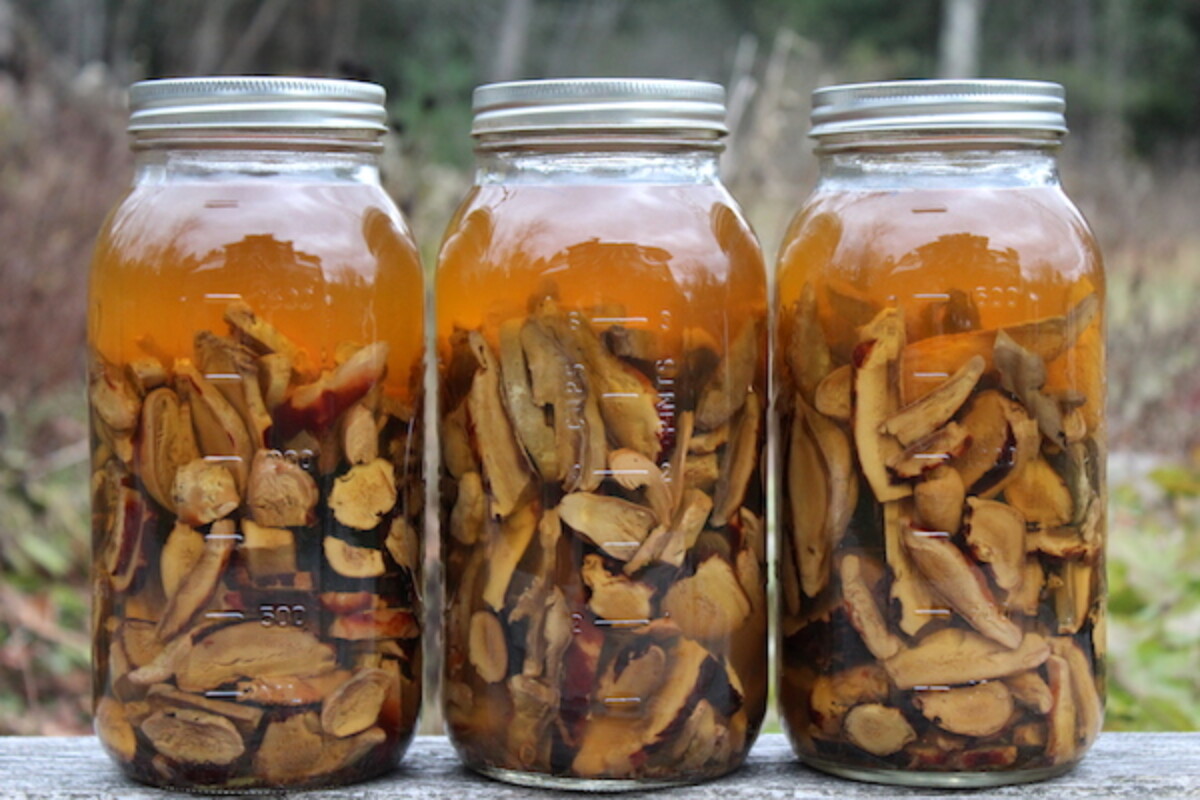
The term “medicinal mushroom” used to draw snickers and knowing glances, but these days science is recognizing legitimate medicinal uses for mushrooms. Reishi mushrooms have been used for centuries in traditional Chinese medicine, and western science is just beginning to explore their many uses.
Medicinal mushrooms such as reishi, chaga, maitake, turkey tail and shiitake contain both water-soluble components, known as polysaccharides and alcohol-soluble components known as triterpenes. For this reason, medicines made from reishi mushrooms often include a double extraction. This two-step process combines alcohol and water extracts to maximize the medicinal benefits.
Benefits of Reishi Mushroom Tincture
Reishi’s water-soluble polysaccharides have been shown to boost immune response, especially in relation to cancer cells. Studies show that “The polysaccharides from G. lucidum are believed to trigger an indirect antitumor mechanism in which the host immune system is altered to target the tumor cells.”
Specifically, a type of polysaccharide in reishi mushrooms know as beta-glucans “has the ability to induce both innate and adaptive immune responses…triggering a series of molecular pathways…which in turn, activate the host immune response for immune cell proliferation.”
Reishi’s alcohol-soluble triterpenes go a step further. Science has found that alcohol extracts from reishi mushrooms are “the only known source of a particular group of triterpenes, also known as ganoderic acids, which have been found to have direct cancer cell cytotoxicity on a wide variety of cancer cell lines, such as murine Lewis lung carcinoma (LLC) and Meth-A, and many of them have been suggested to counter angiogenesis and metastasis.”
What does all that mean? Water extracts boost your immune system and help your body combat cancer, while alcohol extracts combat cancer directly. Talk about a one-two punch!
Some traditional reishi preparations involve making a decoction by simmering the mushrooms for 2 hours. This preparation misses the benefits of the alcohol-soluble constituents.
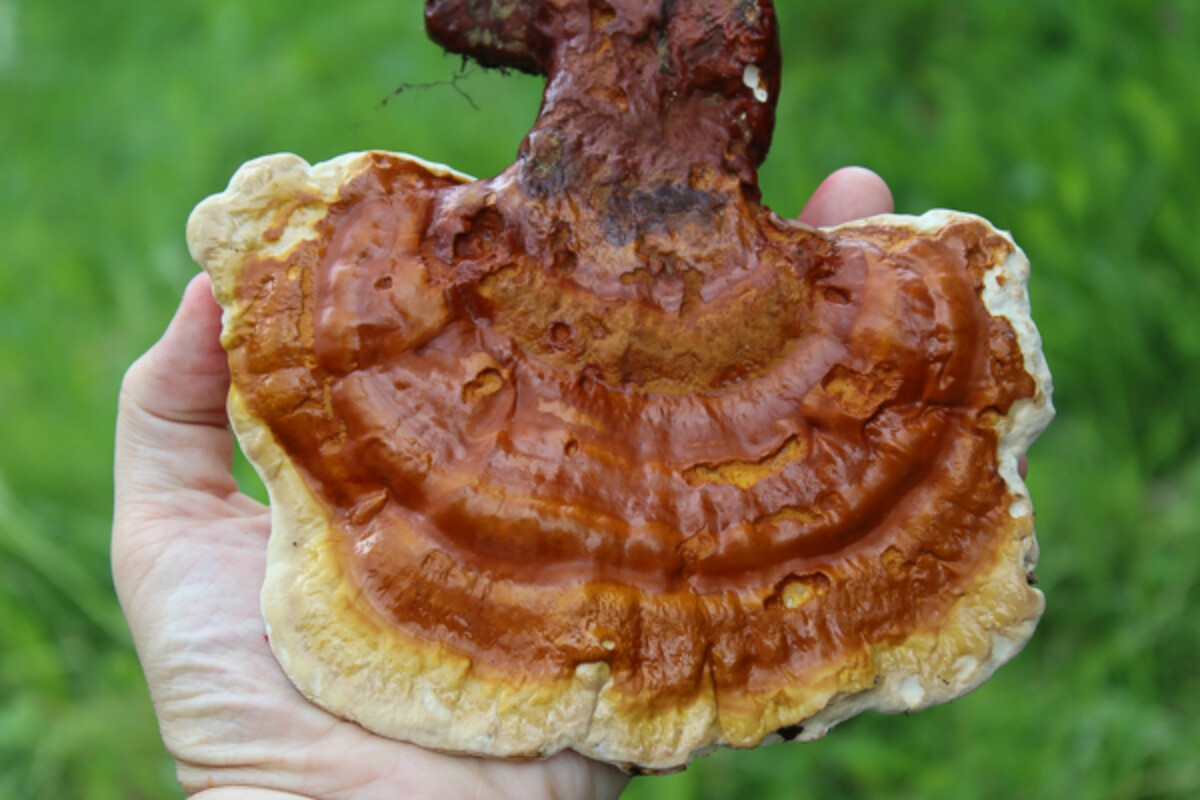
As a whole, western science has proven reishi mushroom extracts to be:
- Analgesic
- Anti-inflammatory
- Anti-bacterial
- Anti-viral
- Anti-oxidant
- Anti-allergenic
- Anti-tumor
Reishi mushrooms have also been shown to reduce blood pressure, blood cholesterol, blood sugar and reduce platelet aggregation that results in blood clots. Its effects on blood sugar were significant enough that it has been successfully used in the treatment of diabetes.
The antioxidant activity of compounds found in reishi mushrooms seems to target free radicals responsible for aging, and reishi helped reverse the effects of aging in lab mice. Reishi works to protect and strengthen the liver and has been successfully used for the treatment of chronic hepatitis B.
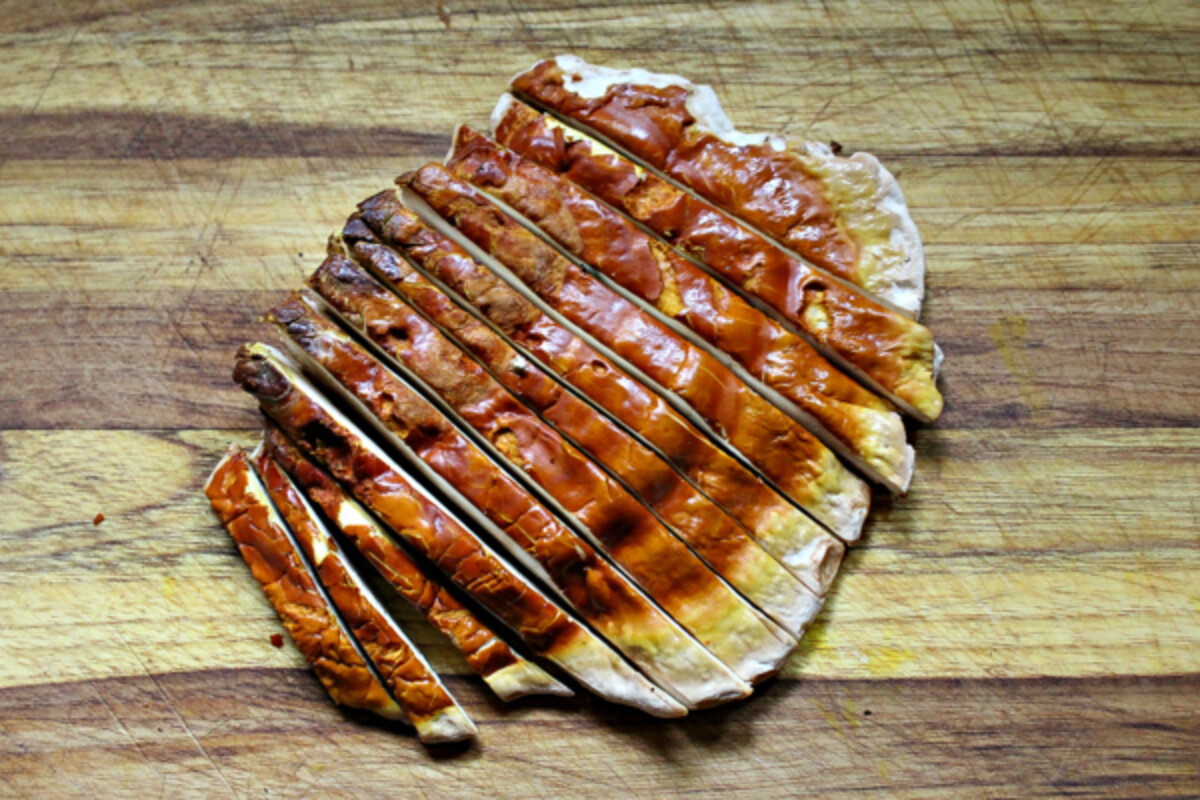
Disclaimer: I’ve written this article based on my own research and experience, but I am not a medical professional. Please do your own research and/or consult a healthcare professional to be sure a reishi tincture is right for you.
How to Make a Reishi Mushroom Tincture
Ingredients
- Thinly sliced Reishi Mushroom (either purchased dried or wild foraged)
- 80 proof alcohol, such as vodka
- Fresh spring water (or chlorine-free water of any sort)
Equipment
- Mason jar (pint, quart or a half-gallon depending on your batch size)
- Cooking pot
- Filtering equipment: funnel and mesh strainer or cheesecloth
- Tincture bottles for storage
Instructions
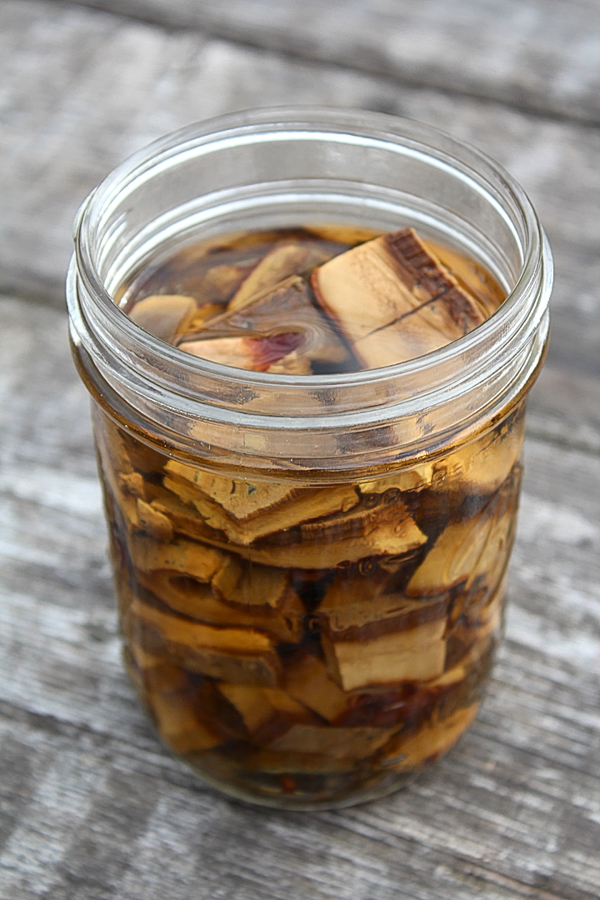
Fill a mason jar about halfway with dried reishi mushrooms. Dried mushrooms will expand, and need a bit of extra space. If you’re using fresh reishi mushrooms that you were able to collect yourself, fill the jar 2/3 full.
Cover the mushrooms with 80 proof alcohol, filling the jar to within an inch of the top rim.
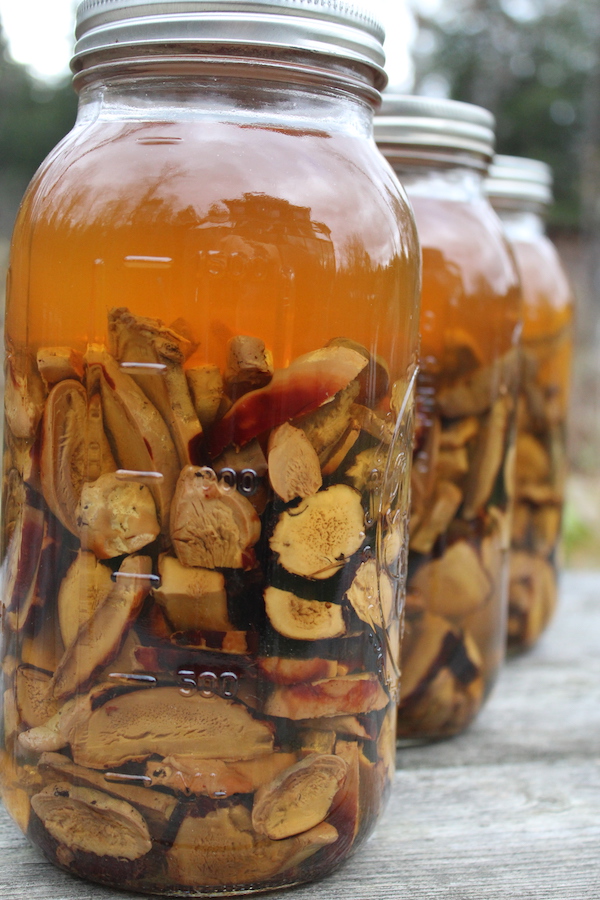
Let the mixture extract for 4 to 6 weeks. Ideally, it should be kept in a cool dark location like a pantry. To maximize extraction, shake the jar as often as you remember (daily would be ideal).
After the alcohol extraction is complete, strain through a fine-mesh strainer and set the alcohol aside. Measure how much alcohol extract you had remaining and make a note of it.
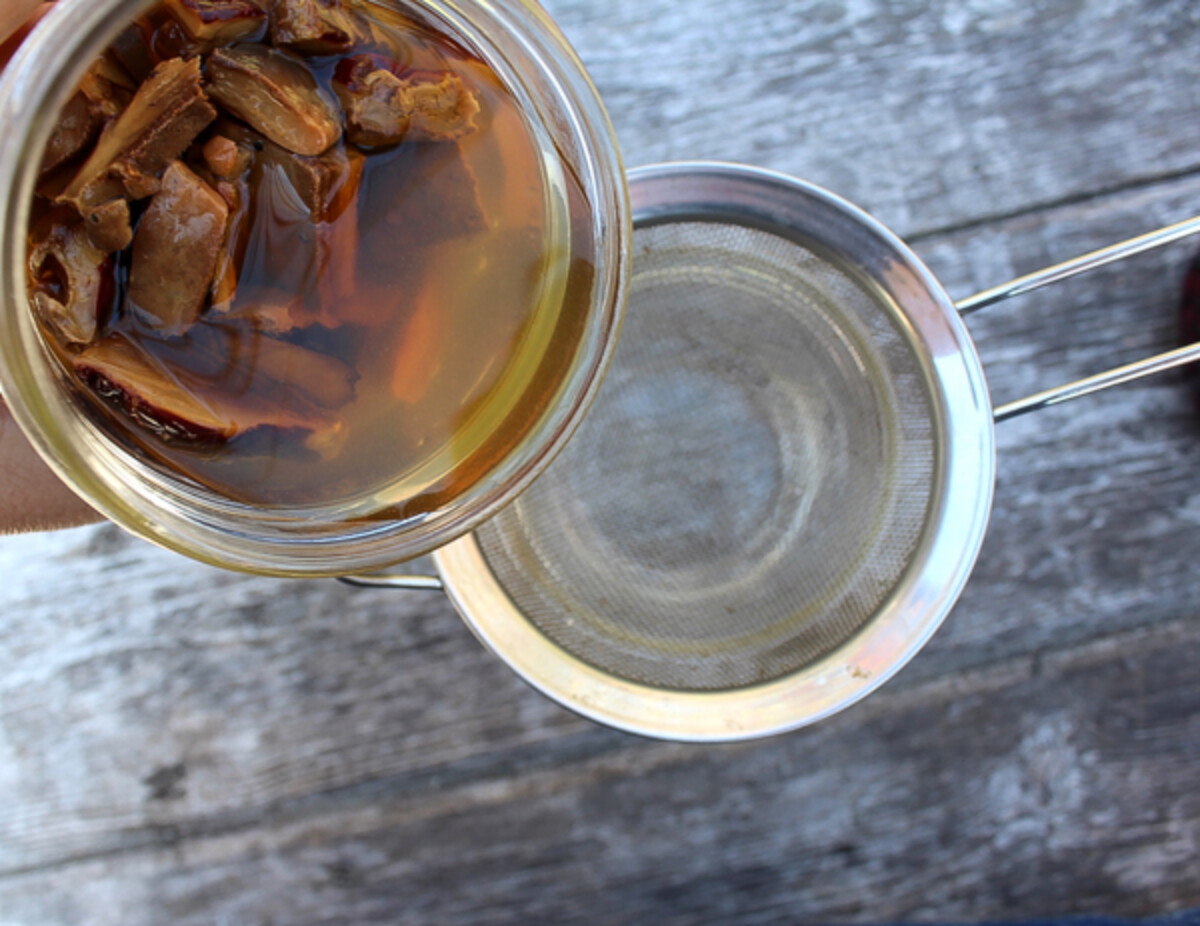
Place the strained mushrooms into a pot, and add about a half-gallon of water for every 2 cups of mushrooms. Simmer the mushrooms on low for 2 hours, keeping an eye on the water level. Do not let it boil dry.
The water extract should be reduced to about 1/3 of the quantity of alcohol extract. For example, if your strained alcohol extract was a total of 24 ounces (3 cups), you’ll want to reduce your water extract to 8 ounces (1 cup).
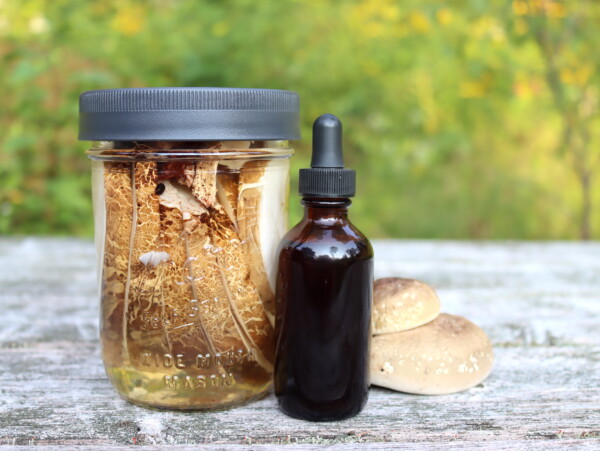
This 3 to 1 ratio will ensure that your final extract has a high enough alcohol percentage to be shelf-stable. Once the water extract has cooled, mix it with the alcohol extract and bottle in an amber tincture bottle.
Store in a cool, dark place. The dosage for reishi tincture is generally 1 full dropper per day but can vary based on your particular circumstance.
Medicinal Mushroom Tinctures
The beneficial properties of medicinal mushrooms are often best preserved in tinctures, where both the alcohol and water-soluble portions are extracted at the same time.
Reminder: I’ve written this article based on my own research and experience, but I am not a medical professional. Please do your own research and/or consult a healthcare professional to be sure a reishi tincture is right for you.









Does a pill form of the mushrooms work as well. I found one on Amazon that has 4 of these mushrooms. I don’t have time to make extract, since a family member has rare adenocarcinoma of gall bladder. She can’t do immunotherapy because her mutations don’t match. We are willing to try anything, Please, give me you opinion, nothing to loose except gain hope perhaps.
Good question…and I’m honestly not totally sure. I’ve read good things about the mushroom powders and extracts from host defense, and the guy who runs that company is on the front lines of medicinal mushroom research. He uses mycelium powder (a bit different than whole mushroom powder) and I seem to remember there’s a reason for that because it’s more available in capsule or powder form? Personally, if there was no other options for treatment I’d do it. Couldn’t hurt? But I’m definitely not a doctor or a health professional, so that’s just my unprofessional opinion.
Their mushroom powders are here: https://amzn.to/2Zmg9r2
And capsules here: https://amzn.to/2Zgafrr
If it were me (or my family member) that’s what I’d try. Best of luck and I hope for the best.
How to make tincture rom shiitake mushrooms, thank you
You can follow the exact same process for Shiitake. Good luck!
As i can read in many articles online, the usual dosage is 2 to 9 grams of dried reishi mushroom per day. For the sake of this example i will consider a 5 gram dose as the average. I made a double extraction starting with 35 grams of dried reishi. The alcohol was covering the reishi and on top there was 1 cm of extra alcohol (i mean, that looked clear free of reishi which was resting below), i mean, i used the minimun alcohol possible, when i strained i obtained 800 cm3 of alcohol. According to the dosage, if i wanna take the equivalent of 5 grams of dried reishi per day, and, as i started with 35 g, i would have to split the final 800 cm3 of extract in 7 parts, so i should drink 115 cm3 per day! That’s a lot of alcohol! How do people get to a an extract from which they drink a few drops per day? I thought about letting it evaporate, but anyways… all that process and money to end up having a solution for only 7 days? Am i missing something? I checked if the sources were refferring to 5 grams of raw mushroom instead of dried, but no, they specify dry..¿?
The dosage for dried mushrooms and mushroom tinctures are different because when you make a tincture you’re extracting things that aren’t particularly bioavailable in the powdered form. Usually, people consider the dosage for a tincture to be around 1 dropper full, but I’m not a medical professional, so you’d have to consult a doctor, herbalist or naturopath for something specific to you.
Amazing! Thank you for sharing. I will surely try this because making them into tinctures gives them more versatility.
We can bring them anywhere and add to almost anything we want to eat and drink. Longer shelf life too. Thank you for the wonderful idea.
Thanks, Ashley, for the inspiration. I’m giving it a try. I’d love to check out your familystead some time. I moved to Poultney in May, where I’m just starting such a stead . . . In the meantime, thrive on!
Nice! Good luck with your move =)
I’ll soon be making more Reishi tincture, and one from lion’s mane, as well. So I wanted to ask you about this:
Breaking the dried mushroom into a powder to increase surface area for extraction sounded like a good idea. When I used a coffee grinder to do so for lion’s mane some months back, what was left after I poured the “medicinized” alcohol into my dropper-bottles was a wet brick of lion’s-mane-mush, with an ethyl-fungal aroma. Do you have any idea what’s left in that? Is it good for weaker medicine, cooking, compost?
I only recently found your blog, and love it! Thank you!
Brendan
Hey Brendan, Good question and honestly I can only guess. I would think that it would still contain weaker medicine, and it might be worth drying it out and putting it into capsules. Even if there’s nothing left, it shouldn’t cause any harm to take them, but if there is medicine still in there it’d be a shame to waste it.
After a double extraction, with weeks in alcohol and then hours of boiling, the mush should be pretty well extracted of everything but fiber, but I don’t know for sure honestly, and there may well be still goodness in there.
Can you tell me the amount to be taken each day?
I’m not a medical professional, and the dosage varies based on your situation. That said, most sources I’ve found suggest a dosage of 1 dropper full (roughly 40 drops) per day.
Hello you are interested in medicinal mushrooms, I am looking for a partner to develop and commercialize cordyceps militaris and cordyceps sinesis all wild
Can’t help you with that one, unfortunately.
Thanks for your reply Ashley! I used 80 proof Vodka, I don’t recall the brand. I wasn’t sure if the final product was suppose to have a strong alcohol smell, but glad to know that this is normal.
Hi Ashely,
I just made my first reishi tincture, although I let my alcohol tincture set for about 12 weeks before straining it. Is that too long? The tincture smells strongly of drinking alcohol and I did use a little more water to dilute it in my second reishi/water boiling extraction. So it is about 2 parts reishi alcohol/tincture and 2 parts reishi water/tincture. In my second extraction, I let the water/mushroom mixture boil for about 2 hours and then let it set overnight with the mushrooms before straining it and reboiling it again with only liquid. Then, I mixed it with the alcohol tincture. However, the smell is still very strong. Do you have suggestions for reducing the strong alcohol smell and do you think this tincture will have medicinal properties since it has 2 parts water and 2 parts alcohol? Thank you!
The extra time should be completely fine, and we often forget about ours for months. What proof of alcohol did you use? Did you pick something with a harsh taste? If you started with something really strong or really harsh to begin with, that will come out in the final product. I tend to use a mid-shelf vodka like Smirnoff and it has a very neutral taste in the finished tincture.
Most tinctures have a strong alcohol smell and taste, largely because that’s what they are. This one, since it’s a double extraction and you’re mixing in water, should actually have a lower alcohol content than most and thus less alcohol taste. It does have a strong flavor though, and reishi mushrooms do not have a particularly pleasant taste.
The only thing to be careful of is look at the original proof on the alcohol you used and make sure that your final tincture will have a 30% alcohol content once you’ve added the water extract. If it doesn’t add more alcohol to make sure it’ll keep without spoiling. Given the taste you mention, that likely isn’t a problem, but that’s the main thing to watch for in this tincture.
Dear Ashley,
I followed your directions to make the Reishi Mushroom tinctures. And then I stored the tinctures in a cool dark place. After a few weeks I noticed that stuff is growing in the amber tincture bottles. What is it? And should it be there? I have a house with passive solar and sometimes it gets warm. Do you think the Reishi got too warm? Should I store it in my refrigerator? Thanks
Hi Katy,
Good question. I did quite a bit of research to try to answer this one. I haven’t had a reishi tincture spoil myself, but I have had other commercially purchased tinctures grow “mold” or something similar on top above the water level. While I’ve been told by some that tinctures keep indefinitely, and that shouldn’t be possible, I’ve seen it happen myself so I know something must be happening here. In my case, it’s always happened above the top of the tincture on the glass, and I wonder if the moisture condensing above the alcohol on the glass is causing something to grow? Again, these were commercially prepared tinctures, and in theory, they should keep forever, and all my research online says that’s just “not possible.”
In the process of researching this though, I did come across something that was new knowledge to me (and I will update the post above). If you’re using fresh herbs or mushrooms, rather than dried, the moisture level in the mushroom itself can lower the alcohol level, and when you’re adding water into the mix with a double extraction tincture it may incorporate too much water into the mix. The recipe here has you combine two parts alcohol extract with 1 part water extract, which puts you just a few percents above the “safe” line for alcohol preservation in a tincture.
For safety’s sake, I’m going to amend the recipe to be 3 parts alcohol tincture to 1 part water extract for an abundance of caution. That way, whether you’re using fresh or dried mushrooms, the finished tincture should stay well above the minimum alcohol % for preservation. That should just mean cooking down the water a bit further, but still getting the same amount of extracted constituents just in a more concentrated form.
I have been using fresh mushrooms for mine, and I haven’t had issues, but I have a very cold house, so perhaps that’s saved mine from what happened to yours. If yours was made with dried mushrooms, then I’m out of ideas and it’s in the same boat as my commercially prepared tincture that molded when it shouldn’t have been possible.
Hi there, I had the same issue after using the 3:1 alcohol to water ratio. I was asking around on one of my Facebook medicinal herbs and mushrooms group and someone was saying something about “glycosides” growing in some of their tinctures. Could this be what is growing? I was thinking mycilium as well but didn’t think any viable mushroom parts would survive a few months under alcohol, and 2 hours of boiling. I can’t really find anything about the glycosides in tinctures online. What do you think?
There might be something to that now that you mention it. When you’re making a burdock or dandelion tincture, you do get a good bit of precipitate in teh bottle which is inulin (a starch from the roots). It honestly didn’t occur to me that it might actually be something in the reishi itself that’s precipitating out (rather than “mold” as people are describing). That makes a lot more sense than something with a 30% alcohol content molding, which really shouldn’t be even remotely possible.
Doing a bit of research though, I can’t find any specific answers that’d confirm or deny this though. If you do ever find something conclusive, do please let me know.
I have tinctured my mushrooms in high alcohol content grain alcohol. Is it ok to just dilute the alcohol down to 80% before adding the water, or have I already damage the polysaccharides? Thank you. I love your blog!
If a high alcohol was going to damage the constituents, then yes, the damage is done. There’s some debate about that, and I’m not sure that there’s anything conclusive as to whether or not high alcohol really does damage it. It might, but I don’t know that it’s been thoroughly tested. Since it’s done, I wouldn’t worry about it. There are so many medicinal compounds in the reishi, so I wouldn’t worry about a chance that one or two are weakened or removed. The rest will still be there.
To answer the other part, if you’re going to dilute it down, I would dilute it down with more boiled reishi extraction (rather than plain water). Since you used a high alcohol content, it’ll still keep if you use a bit more water extraction in the mix, but you don’t have to. A bit higher alcohol in the finished tincture isn’t a big deal, but it does give you the option of adding more water extraction without it spoiling from being over diluted.
Actually it is best to dilute higher proof alcohol to a lower percentage with water and leave the water content there. Adding water after you have made a tincture is pointless. I also recommended you cut or slightly powder the Reishi in order to allow the menstrum (alcohol and water or lower proof alcohol) to absorb the constituents properly. Also note that after studies have been done we herbalists have discovered that allowing a tincture to sit for two days and then pressing is optimal for extraction of constituents. After a longer time the plant matter begins to reabsorb the medicines you are looking to benefit from.
As an alternative you may use 40-60% alcohol to tincture. Some of the best herbalists use only 40% alcohol with incredible results.
For a fresh folk tincture, it is not recommended to jam the jar full and cover the herbs with alcohol to the rim of the jar. Ratios matter immensely, and with a folk tincture you should never add water as the fresh herb/plant/fungi contains water in it already. Only use alcohol here.
It is best to go with your gut, or you’re not sure what your gut is telling you and you are new to herbal medicine to loads of research and please do not take advice on making your own medicines from non professionals. There is far too much misinformation available and blindly believing someone because they have thousands of followers can put you and your family in a dangerous situation,
Hello, From N.H I wonted to ask do you have a printable version about working with the mushroom brew.
? Thank you. You are very good at what you do.
I don’t have a printable version, unfortunately. I’ll look into getting a plugin for the website that converts pages to a printable version though. Glad it was helpful, even if you couldn’t print it…
Thank you for a wonderfully informative article! I was lucky enough to find some on my walk today and I have a question. How do you clean the mushrooms? Should I just brush off the surface dirt and trim away the blades of grass that the fungi grew around?
Yes, just dust them off and trim out any vegetation. Wetting them in water will degrade them quickly, so don’t actually “wash” them. If you’re making a tincture, they need to be chopped anyway, so just chop off the dirtiest parts if they won’t dust clean.
Thank you!
Hello, I am very happy to know your blog because I feel very interested in articles about Reishi mushrooms
Dear Tu,
If you like to read about mushroom science and health you might like to know the work of PAUL STAMETS. He is an expert. He has U-Tube presentations. He also produces high quality mushroom products. We could save the ecology of the planet with fungii if only humankind would wake up!
I also am very happy to have found this excellent blog. Thanks Ashley!
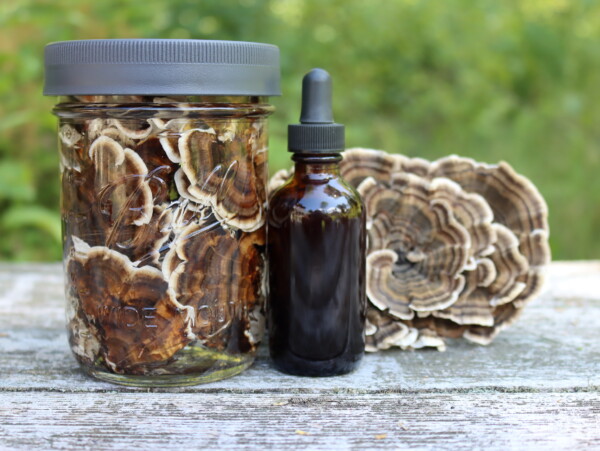
Thank you for sharing useful information, the mushrooms in the picture I see is not mature enough. As the mushroom grows darker and there is no white flecks around the mushroom ears. Should use mushrooms mature, then the mushroom will be in the best state.
That’s true for Ganoderma lucidum but not the eastern hemlock reishi we have here (Ganoderma tsugae). Hemlock reishi has a white edge even when it’s very large. I’ve tried waiting until they get bigger, but if I don’t pick them within 24 hours of seeing them the slugs get them. In a wet climate like Vermont they don’t last long, and you have to pick them while you can.
Yes, mushrooms in nature are very difficult to develop. In my country, the traditional way of cooking mushrooms with water, the way to soak my fungus with wine is very good, I will share this use in our country. Thanks for the author.
Is there a reason to use 80 proof alcohol for the extraction of the triterpenes? Would it not be more efficient to use a much higher proof since 80 proof is 60% water? I’m glad I found your website! It has a lot of valuable information on it.
There is research showing that very high alcohol in the first extraction can damage the water-soluble compounds and that high proof liquor should only be used when extracting tough resins. Some herbalists actually extract the water-soluble portions first to get around this, but then they have to add plain high proof alcohol to the water extract to keep it from spoiling while the mushrooms extract in alcohol. Extracting in a low proof alcohol, then extracting in water is sort of a middle ground solution.
My idea is to do the water extraction first and so produce ice-blocks for the polysaccharides. Then do the alcohol extraction using 37.5% alc. vodka to produce a tincture of triterpenes only.
I expect that fa frozen polysaccharide solution is stable enough for 1 to 2 weeks supply and removes the risk of the alcohol in a mixed tincture providing some degradation to the polysaccharides.
I have been looking for some research that will either support or reject this idea, but not yet found.
When you mix it back in with the alcohol though, won’t this destroy the polysaccharides?
It seems that this is a widely debated topic. You will just want to research it and make a determination for yourself.
Ashley,
Can you please provide the source for the research showing that very high alcohol in the first extraction can damage the water-soluble compounds?
Thank you..
That comes from the Herbal Academy: “Some research suggests that high-proof alcohol destroys the water-soluble polysaccharides, so it doesn’t make sense to use the tinctured and pressed mushrooms in the decoction (Hobbs, 1986). Stephen Buhner (2012) recommends making the decoction first, while many other herbalists advise the inverse.”
Hi, am in the middle of boiling the water and reishi. Not that it is written, but I am assuming the mushrooms at this point should be strained also from the water before adding to the alcohol?
Yes, definitely. Strain the mushrooms out of the water, cool the water and then add the water back to the alcohol extract.
Thank you for the awesome info, Ashley! I live in VT myself, and recently harvested a bunch of Reishi in St. J (so exciting!). Was wondering if green glass tincture bottles would be sufficient as well? Don’t want to mess anything up when working with this precious medicine!
Thanks!
Wonderful! They’re plentiful right now =) My gut reaction would have been that green glass bottles would be just fine, but I did a bit of google research and it turns out that green glass only provides minimal UV protection. Amber bottles are the best, and cobalt blue bottles are a good second choice. From what I’ve read, green bottles are only colored for decorative reasons and shouldn’t be used with light-sensitive products.
That said, if you’re going to keep the tincture in a dark cabinet that stays closed all the time, it doesn’t much matter how you bottle it.
Hi Ashley!
I was just wondering if the same tincture process would work for shiitake mushrooms?
Thanks!
Yes! To the best of my knowledge, the process is the same for any mushroom tincture.