
Affiliate disclosure: This post may contain affiliate links. Please see our Privacy Policy.
Wood Sorrel (Oxalis sp.) is a delicious edible wild weed with a bright, lemony flavor. It grows all over the world, it’s easy to identify, and once you can spot it you’ll find it nearly everywhere from the cracks in your sidewalk to the deep shade of the woods.
Learn how to identify wood sorrel, distinguish it from clover and other look-alikes, and use the leaves, flowers, and seed pods in salads, teas, and a surprising range of recipes.

Wood sorrel is one of the most uniquely flavored wild weeds anywhere, and instead of tasting like a “green” it tastes like a mix between cucumber and lemon. The leaves are ever so slightly sour, but it’s just a hint, which is why one of its common names is sour grass (or sourgrass, depending on who you ask). My pre-schoolers absolutely love popping wood sorrel leaves into their mouths right out in the garden, where it’s a common weed all summer long. It’s one of the first wild plants I introduce to children when we started foraging with kids, because it’s easy to identify, hard to mistake for anything dangerous, and tastes like nothing else in the lawn.
Its unique flavor means it can be used in all manner of ways, from savory to sweet. Wood sorrel sorbet is absolutely amazing, and you’d never guess it comes from a wild edible weed (instead of a fruit). The leaves stand in for lemon zest in salads, the seed pods snap pleasantly between your teeth, and a quick steeped tea from the fresh greens makes one of the most refreshing summer drinks I’ve found. Once you can identify it, wood sorrel pairs naturally with the other lawn-and-garden wild greens you might already know, including chickweed, plantain, and lambsquarters.
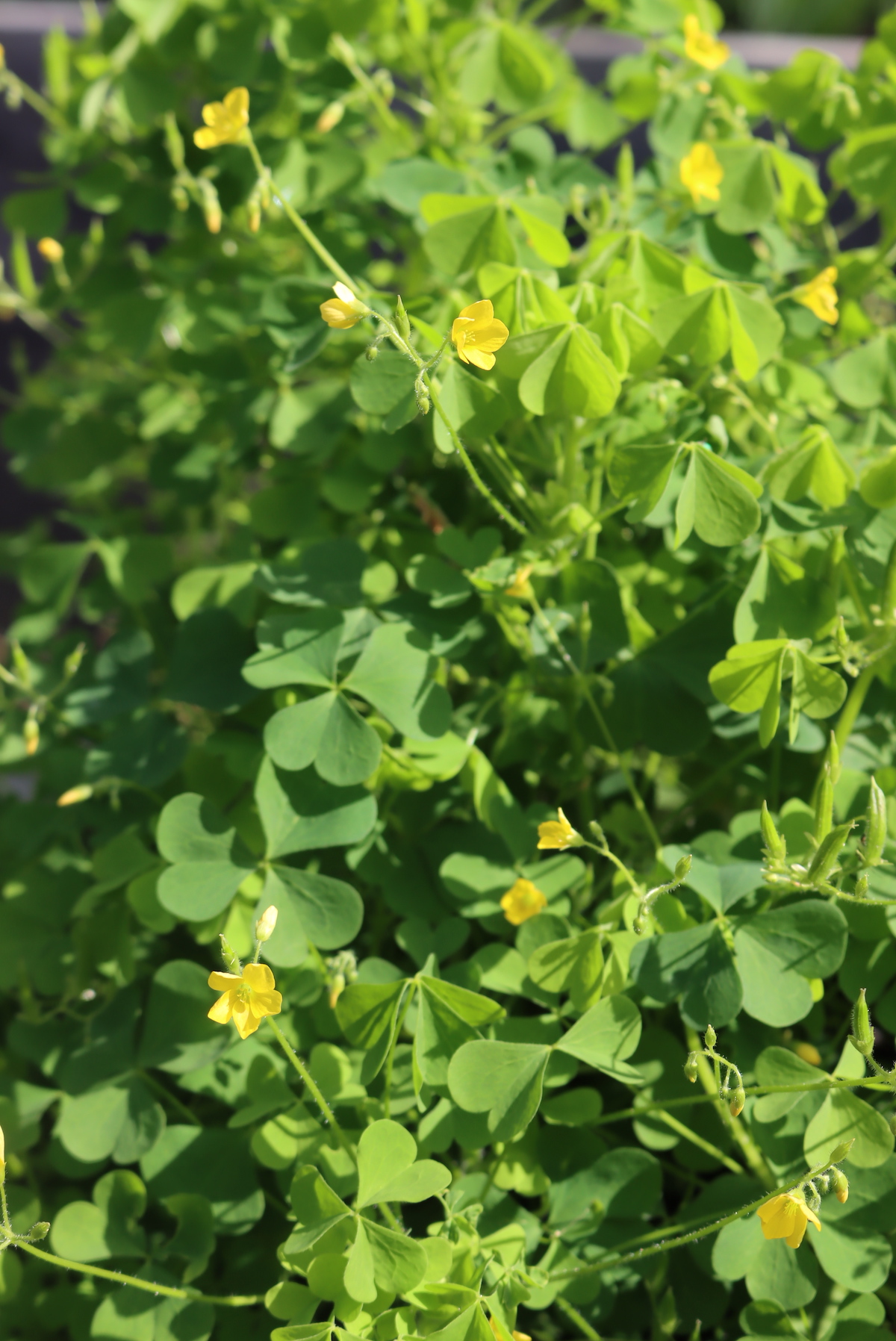
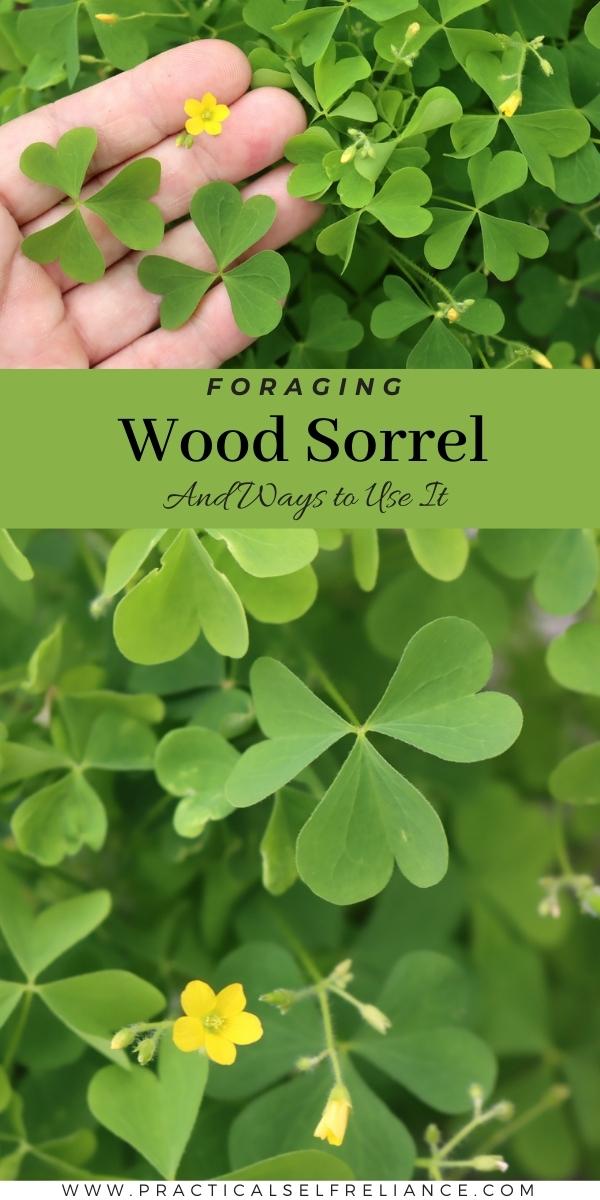
(There are many species of wood sorrel, but they all share many of the same characteristics. All of the wood sorrel pictures in this article are Common Yellow Wood Sorrel (Oxalis stricta), which is one of the most common species in North America. If you’d like to try growing wood sorrel, you can also buy Wood Sorrel Seed Packets to plant in your garden. It’s easy to grow and delicious.)
Notes from My Homestead

Wood sorrel was one of the first wild plants I taught my kids to identify on their own. The little heart-shaped leaflets and sour-lemony pop are about as kid-friendly as foraging gets, and I trust them to graze on it in the garden without checking in with me first. By June every summer, our Vermont yard is full of yellow wood sorrel, especially around the edges of the raised beds and the gravel paths. The kids call them “sour leaves,” and a handful tossed into a bowl of strawberries with a little maple syrup is one of their favorite quick desserts.
The wood sorrel sorbet is something I make once or twice a summer, mostly for the novelty of it. Most guests can’t place the flavor; they say “lemon,” then “cucumber,” then “something else,” and that “something else” is the wood sorrel. The seed pods are my favorite part: tiny green capsules shaped like miniature okra that snap with a satisfying tartness when you eat them right off the plant. The pods also “pop” when ripe, flinging seeds several feet in all directions, which is exactly the kind of plant trick that gets kids hooked on paying attention to what’s growing under their feet.
What Is Wood Sorrel?
Oxalis is a genus comprised of over 550 species of flowering plants found worldwide.
Many of these species are known as wood sorrels, but they have other common names, including yellow sorrels, yellow oxalis, pink sorrels, shamrock, false shamrocks, sour grasses, sleeping beauty, sour trefoil, sheep’s clover, and oxalises. The name Oxalis comes from the Greek oxus, meaning “sharp” or “sour,” and refers directly to the bright, sour flavor of the leaves.
Depending on the species, this herbaceous weed may be perennial or annual. One of the most common species in North America is the native, perennial Common Yellow Wood Sorrel (Oxalis stricta). There are also many cultivated varieties available today, including some grown as houseplants and others cultivated for their edible tubers.
Common Wood Sorrel Species
A handful of Oxalis species show up most often in foraging conversations:
- Common Yellow Wood Sorrel (Oxalis stricta) — the most familiar lawn-and-garden species across much of North America, with bright yellow flowers and upright seed pods.
- Creeping Wood Sorrel (Oxalis corniculata) — a low-growing mat-forming species often confused with O. stricta; commonly found in cracks of pavement, in pots, and in greenhouses.
- Common Wood Sorrel (Oxalis acetosella) — a woodland species native to Europe and parts of North America with white flowers veined in pink, often growing in deep shade.
- Violet Wood Sorrel (Oxalis violacea) — a perennial native to North America with pinkish-purple flowers that’s most often found in mature woodlands.
- False Shamrock (Oxalis triangularis) — a popular houseplant variety with deep purple, triangular leaves.
- Oca or Uqa (Oxalis tuberosa) — cultivated in the Andes and New Zealand for its edible tubers; not known in the wild.
All of the wood sorrel species are edible, and they can be used interchangeably in any recipe that calls for wood sorrel.
Is Wood Sorrel Edible?
The entire Wood Sorrel plant is edible. People have consumed different varieties of wood sorrel worldwide for hundreds of years. As the common name sour grass suggests, it’s known for its sour flavor, due to the plant’s oxalic acid content.
Wood Sorrel should be eaten in moderation. While oxalic acid isn’t poisonous, excessive amounts can prevent your body from absorbing essential nutrients and minerals. It may also cause kidney stones. The same compound is present in spinach, rhubarb, and many other cultivated vegetables, and the concentrations in wood sorrel are similar to what you’d find in those everyday foods. Anyone eating occasional servings of wood sorrel as part of a varied diet has nothing to worry about. People with a history of kidney stones, gout, rheumatism, or who are sensitive to oxalates should still take care.
Don’t use wood sorrel from areas that may have been polluted or sprayed with chemicals like pesticides.
Wood Sorrel Medicinal Benefits
Wood Sorrel has a long history of use in herbal medicine. Worldwide, herbalists have used species of Wood Sorrel to treat various ailments, including cancer, scurvy, indigestion, liver problems, digestive disorders, nausea, fever, mouth irritations, and swelling. Several Native American tribes have well-documented historical uses for wood sorrel: the Kiowa chewed the leaves to alleviate thirst on long trips, the Potawatomi cooked it with sugar to make a dessert, the Cherokee ate it to treat mouth sores and sore throats, and the Iroquois used it for cramps, fever, and nausea.
Today in North America, it is primarily used as an edible herb rather than a medicinal one. However, some modern studies have indicated that Wood Sorrel has some promising medicinal properties and should be studied further.
One study found that Creeping Wood Sorrel (Oxalis corniculata) leaves contain various medicinal substances and possess some medicinal properties, including antioxidant, anti-inflammatory, antimicrobial, astringent, diuretic, febrifuge, and cardio-relaxant.
Another study found that Common Yellow Wood Sorrel (Oxalis stricta) has considerable antioxidant properties and supports the plant’s use in certain medicinal preparations, including treating fevers, loss of appetite, stomach cramps, external inflammation, and more.
Wood Sorrel can be employed internally by creating an infusion with the entire plant or externally by making a poultice. The plant is also a notable source of vitamin C, and was historically used aboard ships and on long expeditions to help prevent scurvy.
Where to Find Wood Sorrel
Different species of Wood Sorrel may be found worldwide except in polar regions. It will grow in various habitats, including gardens, lawns, vacant lots, waste areas, open woodlands, roadsides, and other disturbed areas.
Wood Sorrel prefers partial shade and moist soil but will tolerate a wide range of conditions. Wood Sorrel may grow in the shade to full sun and may grow in fertile or poor soil. The deeply-shaded woodland species like O. acetosella and O. montana tend to grow under hemlock and hardwood canopies, while the lawn species like O. stricta and O. corniculata show up in any disturbed sunny patch you can find.
Some species are in cultivation. False Shamrock (Oxalis triangularis) is commonly kept as a houseplant. Oca or Uqa (Oxalis tuberosa) is not known in the wild but is cultivated in the Andes and New Zealand.
When to Find Wood Sorrel
In tropical climates, it’s often possible to find wood sorrel year-round. In the United States, it’s possible to forage for wood sorrel roughly from spring to fall. You may find it in early spring in warmer areas like the deep south, but it may not appear until early summer in northern regions. Here in Vermont, it’s usually showing up by late May and stays available right through to the first hard frost in late September.
Unlike many wild greens, wood sorrel leaves remain tender and palatable throughout the season; you don’t need to catch a narrow harvest window the way you do with ramps or fiddleheads. The flowers and seed pods come on through summer and into fall, so different parts of the plant are available at different times.
How to Identify Wood Sorrel
Wood Sorrel is an herbaceous weed with a rather dainty appearance. As the common name false shamrock suggests, it bears some resemblance to a shamrock.
It’s often found in patches or clumps. Oxalis may reproduce and spread in multiple ways, including seeds, stolons, rhizomes, or bulbils, depending on the species. Certain species, like Creeping Wood Sorrel (O. corniculata) form low, dense mats while others have a more upright appearance.
All of the wood sorrel pictures in this article are Common Yellow Wood Sorrel (Oxalis stricta).
Wood Sorrel Leaves
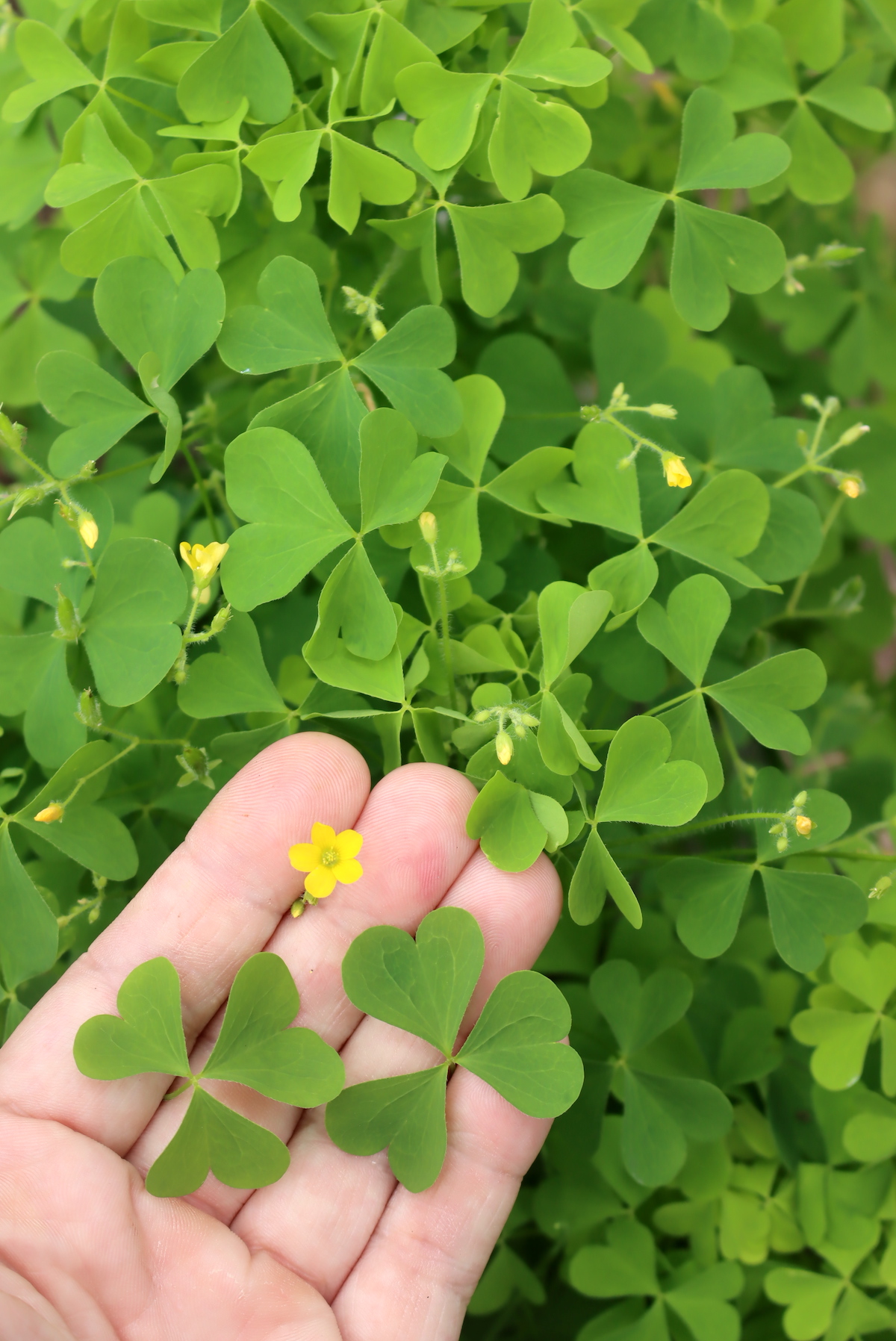
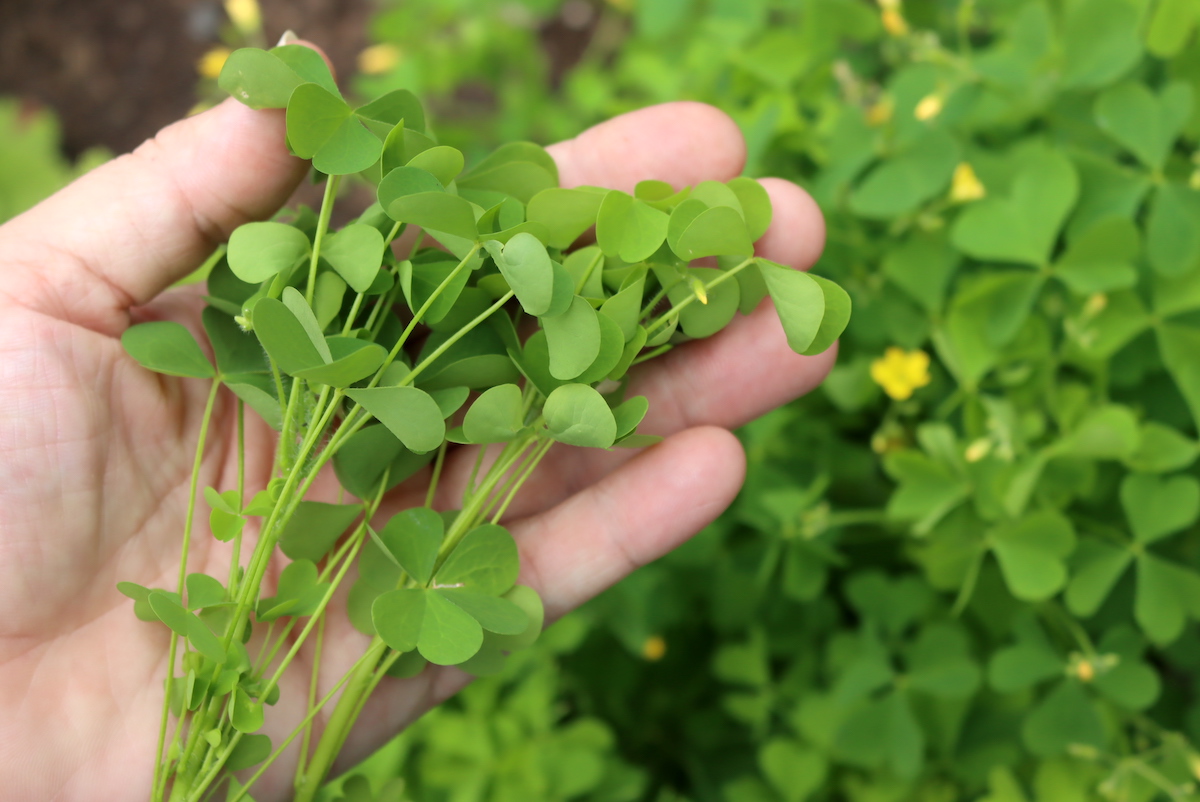
Wood Sorrels have palmately compound leaves. Most Wood Sorrels have leaves that are made up of three to four leaflets, but some may have up to ten leaflets.
The leaflets are heart-shaped with a crease along the middle, allowing them to fold at night and during storms. They are often green but may be purple or burgundy or have markings of those colors. Wood sorrel folds its leaves up when stressed by heat or strong sun, which is one of the easiest ways to confirm an identification: come back at dusk, and the leaves will already be beginning to fold.
For example, the species False Shamrock (Oxalis triangularis) is usually purple.

Wood Sorrel Stems
Wood Sorrel stems are relatively thin and delicate. They’re typically light green but may be reddish in some species. They are usually smooth or slightly hairy. The stem height varies with species, but most are herbaceous weeds and stay fairly small, usually somewhere between a few inches and 15 inches tall.
Wood Sorrel Flowers
The bloom period for Wood Sorrels varies widely over their range. In North America, they typically bloom between spring and fall but may bloom year-round in warm climates.
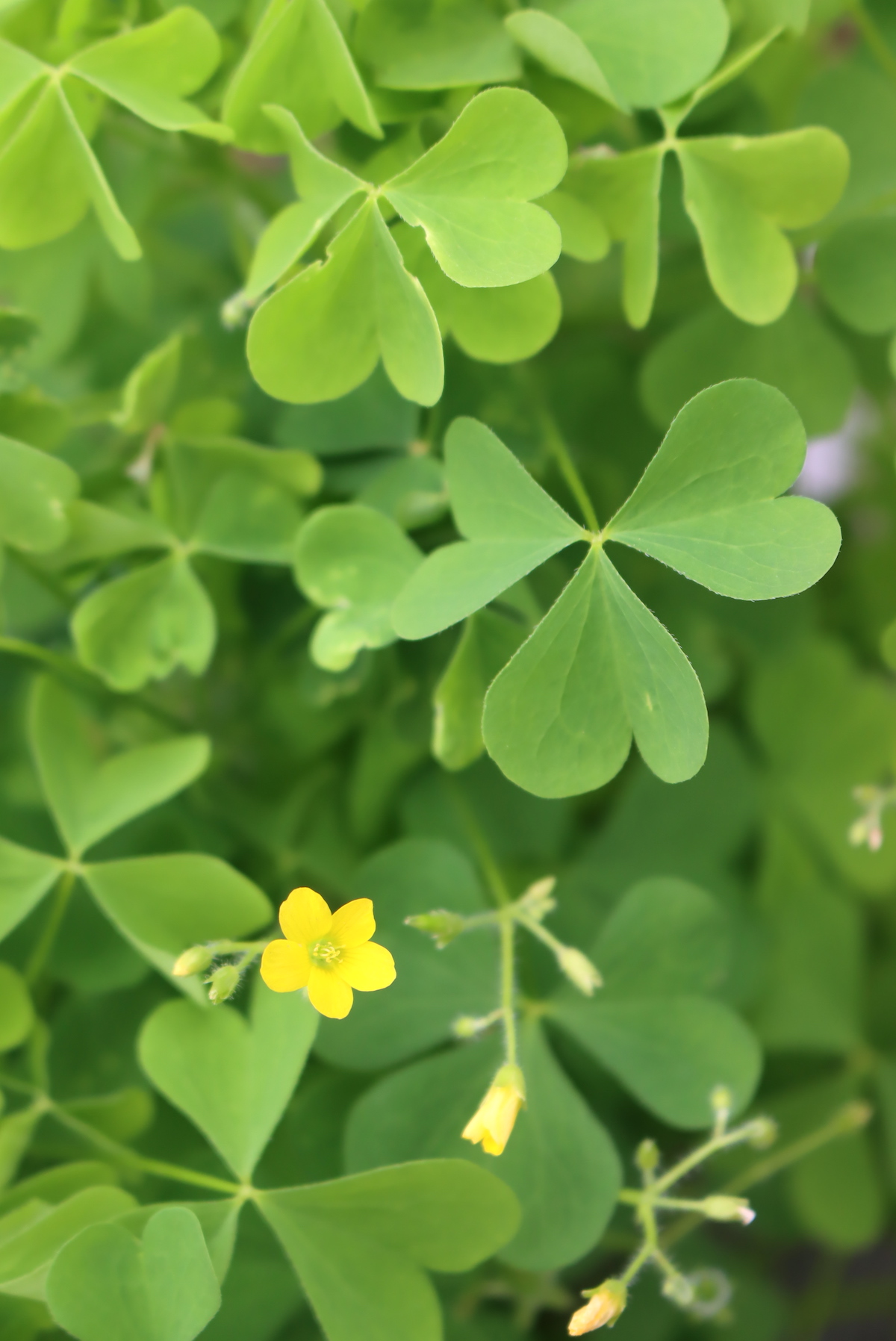
Wood Sorrel flowers typically have five petals that are fused at the base. They also usually have ten stamens. The flowers vary in color depending on the species and may be yellow, white, violet, red, or pink. The flowers are also edible.
Wood Sorrel Roots
Some species of wood sorrel have fleshy, tuberous roots. This is especially true of Oca or Uqa (Oxalis tuberosa), which is cultivated for its large edible tubers. These tubers look a bit like potatoes and may be yellowish, pink, or purple. Most North American wild species don’t produce a tuber large enough to be worth harvesting, but some species do produce small tubers and bulbils that you may notice when pulling up plants.
Wood Sorrel Seeds
Wood Sorrel seeds resemble tiny, green okra pods. Usually, they grow upright and are less than one inch long. When the seed pods are ripe, they “explode” and shoot their seeds into the air; this ballistic dispersal method is one of the plant’s most charming identification features. Eaten green, the seed pods have a sharp, lemony pop that’s even more concentrated than the leaves, and the small seeds inside are edible too.
Wood Sorrel Look-Alikes
The good news with wood sorrel look-alikes is that none of them are dangerously toxic. The most common confusion is with clover, which is itself an edible plant. The other plant most often confused with wood sorrel by name is “true sorrel,” a member of the genus Rumex that’s also edible. Even the well-known shamrock association is mostly a naming issue rather than a real identification challenge. That said, a quick look at each helps you confirm what you’ve actually got in your hand.
Clover Species
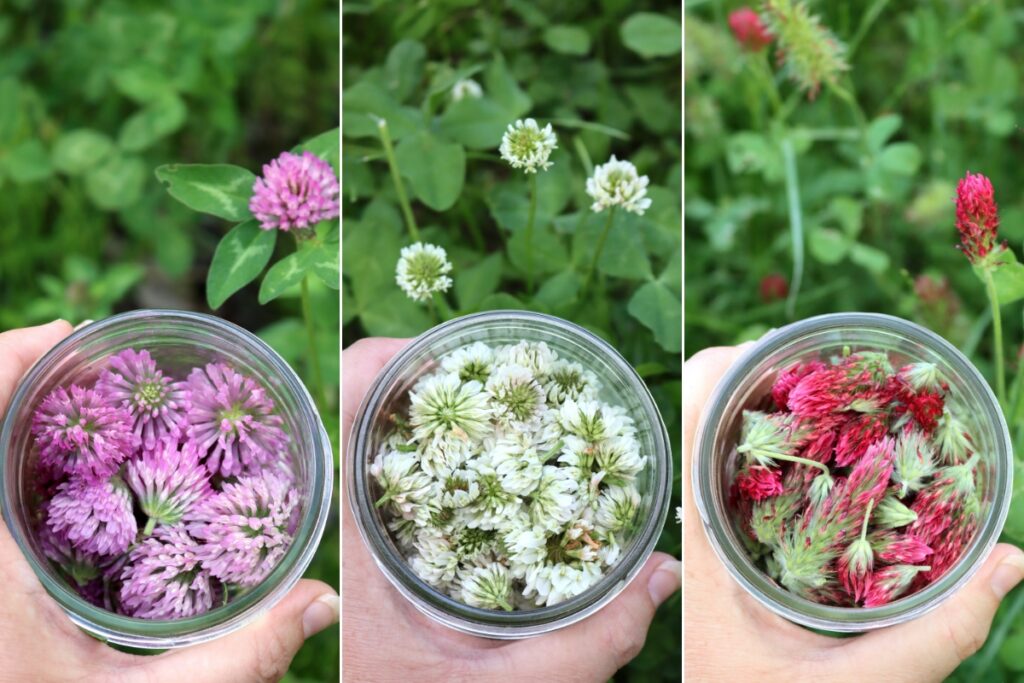
Wood Sorrel is sometimes confused with various clover species, including white clover (Trifolium repens), red clover (Trifolium pratense), and crimson clover (Trifolium incarnatum). However, all clovers can be differentiated from all Wood Sorrel species in several easy-to-spot ways:
- Clover leaflets are round instead of heart-shaped.
- Clover leaflets lack a center crease and don’t fold in half.
- Clovers don’t produce okra-like seed pods.
- Clovers produce round or long inflorescences with a spiky appearance rather than single flowers.
- Clover leaves don’t fold up at night, while wood sorrel leaves close at night and during storms.
Both plants are edible, so confusion between them isn’t a safety problem. The biggest practical difference is flavor: clover leaves are mild and grassy, while wood sorrel leaves have that distinctive sour-lemon snap.
True Sorrel (Rumex)
Despite the shared name, “true” sorrels (Rumex acetosa and other species, including the related yellow dock) are not closely related to wood sorrel. They’re members of the buckwheat family (Polygonaceae), while wood sorrel is in its own family (Oxalidaceae). The two plants share a sour, lemony taste, but they look completely different:
- Rumex sorrels have arrow-shaped or lance-shaped single leaves, not three-part heart-shaped leaflets.
- Rumex sorrels can grow much taller (often 1 to 4 feet) than the typical wood sorrel.
- Rumex seed heads are clusters of small, papery, reddish-brown three-sided seeds, very different from wood sorrel’s exploding green pods.
Both are edible, and recipes that call for “sorrel” might mean either one. When in doubt, the heart-shaped trifoliate leaves identify wood sorrel; the arrow-shaped single leaves identify true sorrel.
Shamrock
The “shamrock” of Irish tradition is generally considered to be white clover (Trifolium repens) rather than any wood sorrel species. However, several wood sorrel species are sold commercially as “shamrock” or “false shamrock” plants, especially around St. Patrick’s Day. The most common is Oxalis triangularis, the purple-leaved houseplant.
Both wood sorrel and clover have three-part leaves, which is where the confusion comes from, but the heart-shaped leaflets and yellow flowers of wood sorrel set it apart from the round-leafleted, white-flowered clover of Irish iconography.
How to Harvest Wood Sorrel
Wood sorrel is one of the easier wild plants to harvest, since it’s so abundant and the harvest window stretches across the entire growing season. To harvest, simply pinch off the leaves, flowers, and immature green seed pods at the base of the leaf stem. The leaves and stems are both tender enough to eat, though some foragers prefer to skip the slightly stringier stems and use only the leaflets and flowers.
For the brightest flavor, harvest in the cool of morning when the leaves are fully open. By midday in hot summer sun, the leaves often fold up to conserve moisture, and the flavor can be slightly less sharp. The leaves are perishable and don’t keep well; use wood sorrel within a day or two of harvest, or freeze it into ice cubes to preserve the bright flavor for cocktails and lemonades later.
If you’re harvesting wood sorrel from your own lawn, only take from areas that have not been treated with herbicides or pesticides. Roadside and parking-lot patches are usually best avoided since wood sorrel can pick up petroleum residue from disturbed soils. The cleanest harvests come from your own untreated yard, edges of organic gardens, or shaded woodland edges.
Because wood sorrel reproduces aggressively (by seed, stolon, rhizome, and bulbil depending on species), you don’t need to worry about over-harvesting from any healthy patch. A typical wood sorrel patch can produce indefinitely, and the more you pinch the tops, the more side shoots the plant will produce.
Ways to Use Wood Sorrel
You can employ this beautiful plant in various ways in the kitchen, either raw or cooked. The entire plant is edible. Try adding Wood Sorrel leaves, stems, and blooms to green salads, potato salads, rice dishes, soups, teas, and cold drinks. The leaves are sometimes used in India to create a sour fish curry, and the bright lemony pop works beautifully as a garnish on plated dishes; chefs often use the small leaves and flowers as a finishing element on appetizers and desserts.
You can also use the tubers of certain varieties cooked as you would potatoes or sweet potatoes or raw like other root vegetables. Oca or Uqa (Oxalis tuberosa) can be cultivated for this purpose. Raw, it has a crunchy, carrot-like texture, but cooked, it’s softer and starchy. In Mexico, it’s often eaten raw with salt, lemon, and hot pepper.
While not commonly used in the United States, you can also use Wood Sorrel as a medicinal herb. Wood Sorrel can be used externally as a poultice to treat minor inflammation. For internal use, use Wood Sorrel in teas and other infusions.
In addition, various Wood Sorrel species are cultivated for ornamental purposes, and fiber artists employ certain Wood Sorrels to create yellow or orange dyes. The oxalic acid in the plant acts as a natural mordant, which means no additional fixative is needed for natural dye work.
Wood Sorrel Tea
Wood sorrel makes a refreshing herbal tea that’s especially good iced. To make a simple wood sorrel tea, gather a small handful of fresh leaves and flowers, place them in a heat-safe mug, and pour over boiling water. Steep for 5 to 15 minutes, then strain. The tea will have a delicate lemony flavor that pairs well with a touch of honey or maple syrup. The leaves can also be dried for tea, though the bright flavor of the fresh plant is hard to match. Cold-steeping the fresh leaves in water for several hours in the refrigerator makes one of the most refreshing summer drinks I know.
Wood Sorrel Recipes
Wood Sorrel is an excellent choice for refreshing summer recipes.
- Try this chilled, lemony wood sorrel soup from Very Vegan Val.
- Try this Wood Sorrel sorbet to get even picky eaters excited about foraging.
- Or these Wood Sorrel mini cream tarts with this fun recipe from Gather Victoria.
- Try this recipe for Wood Sorrel Gimlet and simple syrup from Escarpment Kombucha.
- Learn to make Wood Sorrel “lemonade” and herbal tea with this simple guide from Alt Nature.
Wood Sorrel FAQs
Yes, all parts of wood sorrel are edible, including the leaves, stems, flowers, seed pods, and (in some species) tubers. The plant has a bright lemony flavor from the oxalic acid in its tissues. Wood sorrel should be eaten in moderation, since oxalic acid in large quantities can interfere with calcium absorption, but the same compound is present in spinach and rhubarb at similar levels. Anyone eating occasional servings of wood sorrel as part of a varied diet has nothing to worry about.
Wood sorrel tastes bright, sour, and lemony, somewhere between cucumber and lemon zest with a tart finish. The leaves and flowers carry the most flavor; the seed pods give an even sharper sour pop that snaps pleasantly between your teeth. The flavor comes from the oxalic acid in the plant tissue, which is the same compound that gives spinach and rhubarb their characteristic edge.
Wood sorrel and clover both have three-part leaves and grow in similar lawn habitats, but they’re easy to tell apart on close inspection. Wood sorrel leaflets are heart-shaped with a crease down the center and fold up at night; clover leaflets are round, lack a center crease, and stay open. Wood sorrel produces small five-petaled flowers (yellow, white, pink, or purple depending on species) and exploding okra-like seed pods, while clover produces round or oblong flower heads with many small florets. Both are edible, but wood sorrel has a sour lemony flavor while clover is mild and grassy.
Wood sorrel is a low-growing herbaceous plant with three heart-shaped leaflets on each leaf, joined together like a shamrock. The leaflets fold along the center crease at night and during heat or stress. Stems are thin and delicate, typically 4 to 12 inches tall. Flowers have five petals fused at the base, in colors that range from yellow (the most common North American species) to white, pink, or violet. The seed pods are slim, upright, and resemble tiny green okra; they explode when ripe, scattering seeds.
Wood sorrel is not poisonous, but it does contain oxalic acid, which can interfere with calcium absorption when consumed in large amounts. The same compound is present in spinach, chard, rhubarb, and many other common foods, and the levels in wood sorrel are similar. People with a history of kidney stones, gout, rheumatism, or oxalate sensitivity should limit how much they eat. For most people, eating wood sorrel as a salad green or garnish in normal amounts is perfectly safe.
Did you find this Wood Sorrel foraging guide helpful? Tell me in the 📝 comments below how you use wood sorrel on your homestead!
And make sure you stay in touch with me by following on social media!
More Foraging Guides

Find the perfect foraging guide
Searching for something else? Enter keywords to find the perfect foraging guide!











Question: when you use the phrase “the entire plant’ does that include the roots or just the aerial parts?
Good question, and the wording could be clearer. The short answer is that the roots are edible too, so “the entire plant” is accurate. It’s just that on most of the common lawn species there isn’t much root to bother with. Common yellow wood sorrel (Oxalis stricta) spreads by thin rhizomes, so in practice you’re harvesting leaves, stems, flowers, and green seed pods and leaving the rest.
Some species do form larger roots or bulbs, and to the best of my knowledge all of those are edible as well, but I’d suggest double checking by species. Violet wood sorrel (O. violacea) has a real bulb that was a traditional food source and oca (O. tuberosa) is grown in the Andes specifically for its tubers, cooked like a potato.
But yes, I did mean to say entire plant there, even though the roots aren’t really worth it in most cases.
I did enjoy reading about the various “sour grass” plants. Yesterday morning I was up early weeding a flower garden. I saw as much red and green and I wondered if various soils had anything to do with the plant’s coloring. I now know there are many varieties all over the world. When my sisters and I were kids, we were so happy to come upon a plant. Where we lived they were few in number. We just harvested a few leaves and left it to return to another time. Where I live now, it’s everywhere, both red and green. Growing up, we only had the green. But here, I can pick a lot, it’s everywhere by the river.
Thanks for a very informative article. I’ve become a fan!
Love Wood Sorrel, probably one of my favourite garnishes. Looks so pretty on the plate!
My mom used to put sugar and milk (probably coffee cream really) on a little serving of O. whichever for us every spring. I think I remember it growing between the porch steps or maybe near their foot, very shaded. Leaves smallish, very thin, not a trace of a hair.