
Affiliate disclosure: This post may contain affiliate links. Please see our Privacy Policy.
Thimbleberries (Rubus parviflorus and Rubus odoratus) are a delicious wild fruit in the raspberry family, with two distinct species growing across most of North America. The western thimbleberry (R. parviflorus) ranges from Alaska down through California and east to the Great Lakes, with white flowers and bright red fruit. The eastern thimbleberry (R. odoratus), also called purple-flowering raspberry, grows along the Appalachians from Georgia to Quebec, with showy pink-purple flowers and similar fruit. Both produce hollow thimble-shaped berries that taste like an intensified version of a raspberry, with a unique soft texture that’s almost velvety. Learn how to identify thimbleberries, distinguish them from raspberries and other look-alikes, and harvest the fruit before it falls apart in your hand.
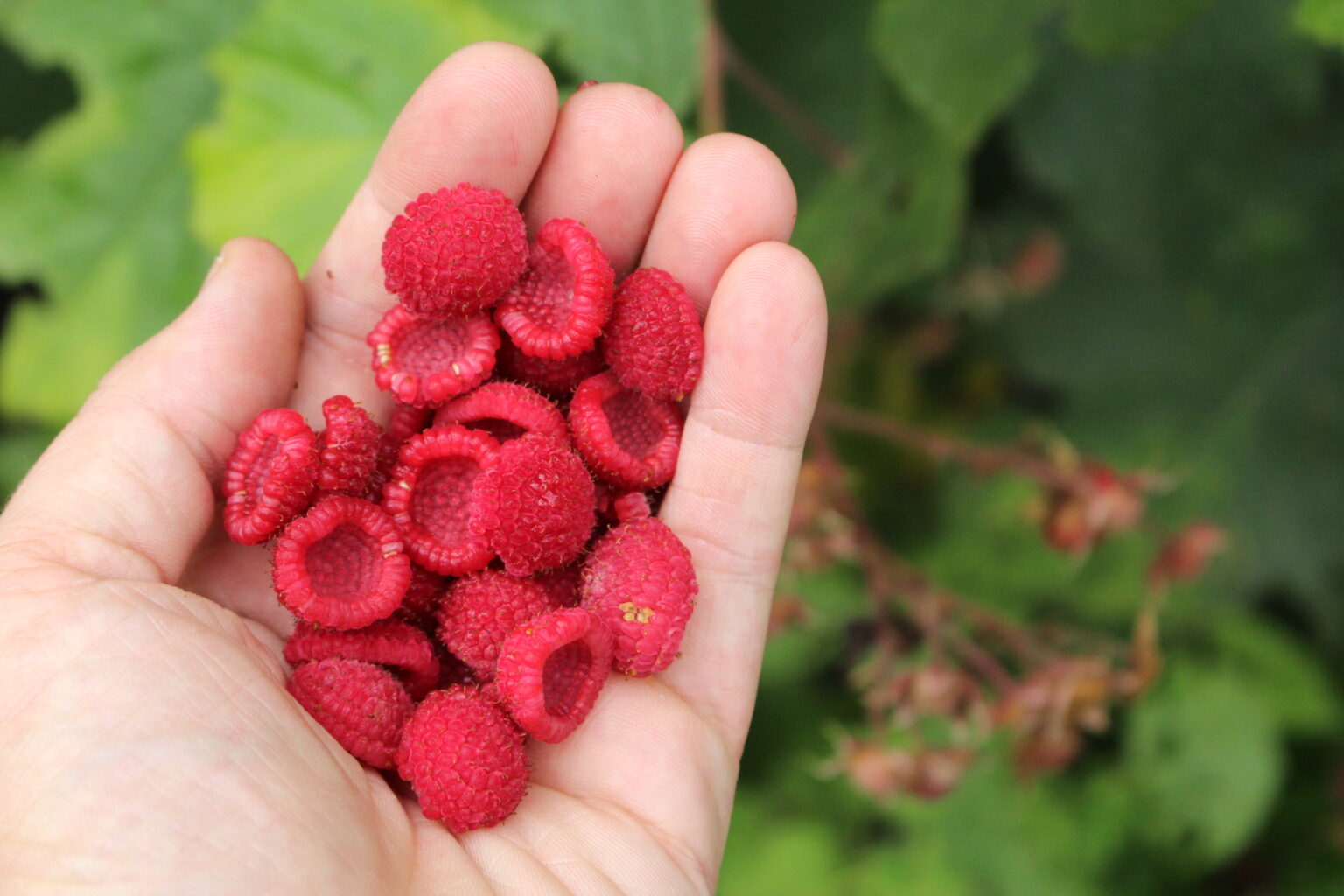
Table of Contents
- Notes from My Homestead
- What Are Thimbleberries?
- Are Thimbleberries Edible?
- Thimbleberry Medicinal Benefits
- Where to Find Thimbleberries
- When to Find Thimbleberries
- How to Identify Thimbleberries
- Thimbleberry Look-Alikes
- How to Harvest Thimbleberries
- Ways to Use Thimbleberries
- Thimbleberry FAQs
- Edible Brambles
If you’ve ever wandered through the woods in late summer, you might have caught a glimpse of a sweet, berry-like fruit hanging from arching, thornless brambles. You may have even tasted one and instantly fallen in love with its unique sweet-tart flavor that tastes more like a raspberry than a raspberry does. The flavor is intense and almost candy-like, which is why some foragers consider thimbleberries the most flavorful of all wild brambles.
Western Thimbleberries (Rubus parviflorus) grow across North America from the Pacific Northwest to the Great Lakes region. There’s another similar berry in the Northeast that locals also call thimbleberry (Rubus odoratus), which is almost identical in form but has pink-purple flowers instead of white. Both species share the delicate bright red color and soft, almost velvety texture that distinguishes them from wild raspberries, and both have the distinctive hollow thimble shape that gives the plant its common name.
Notes from My Homestead

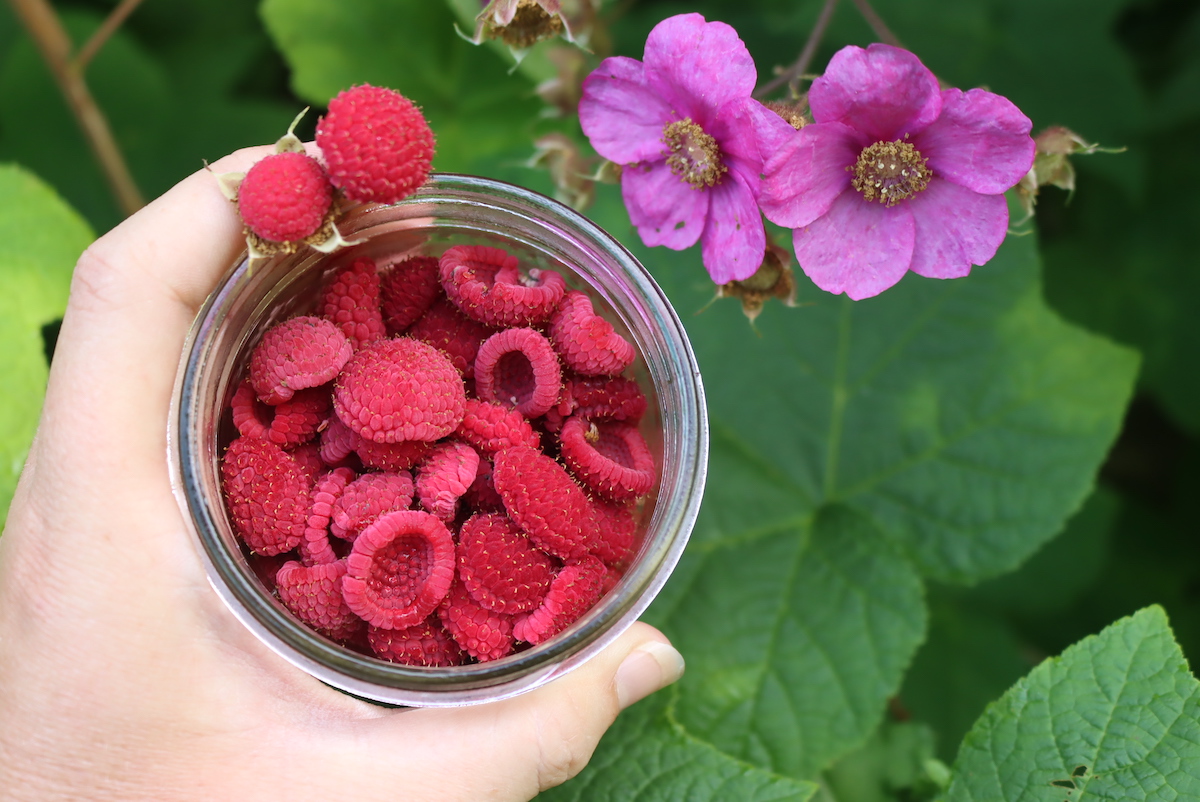
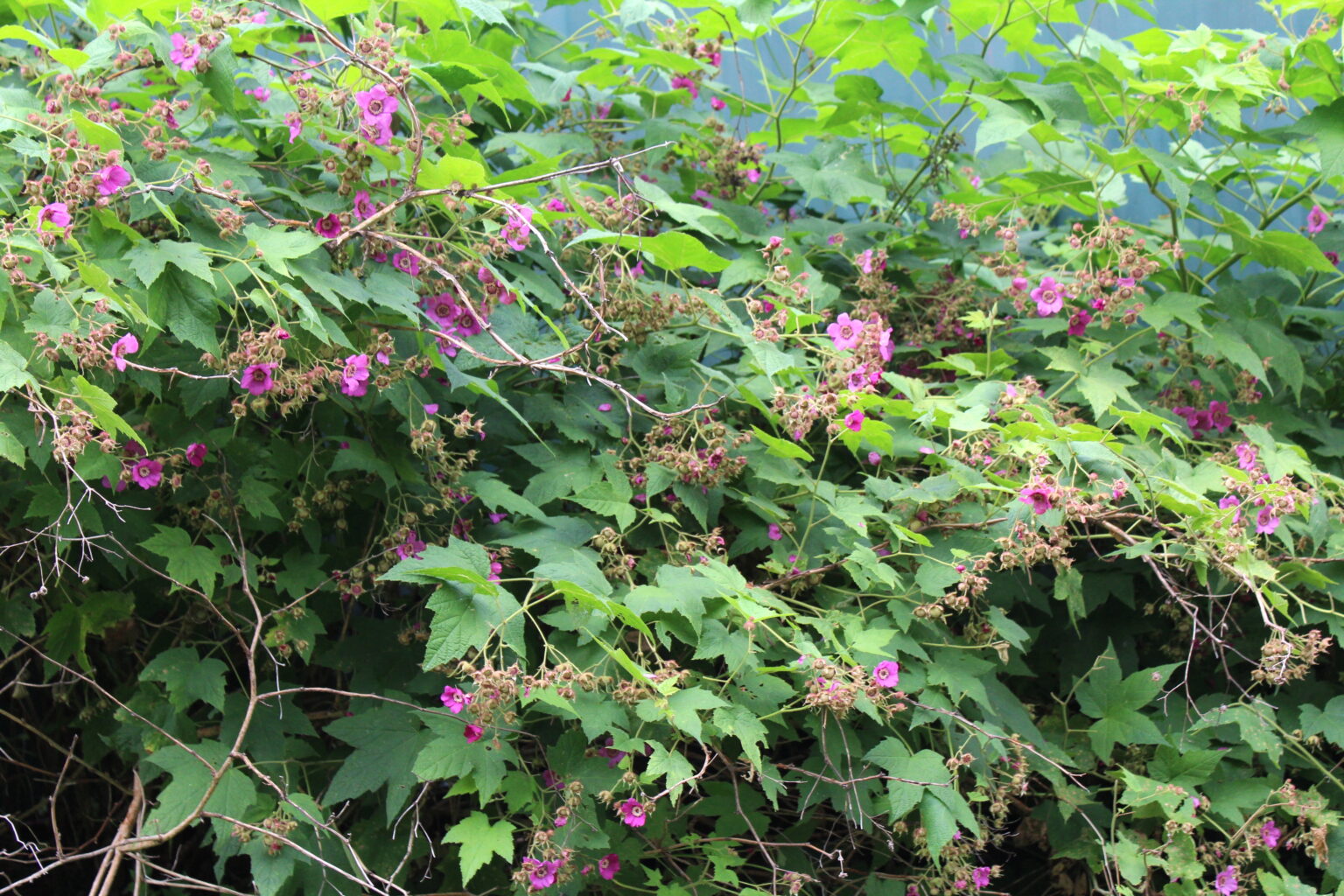
Here in Vermont we have the eastern thimbleberry (Rubus odoratus), and it’s an absolute showstopper when it blooms. The big pink-purple flowers can be three inches across, far larger than any other wild raspberry-family flower in the woods, and the bushes line our roadsides and the edges of our maple sugar bush. The plant is so distinctive once you’ve seen it that I’ve never confused it with anything else, even from a distance. The fruit comes a few weeks after the flowers and trickles in slowly through July and August, never in great quantity but always reliable.
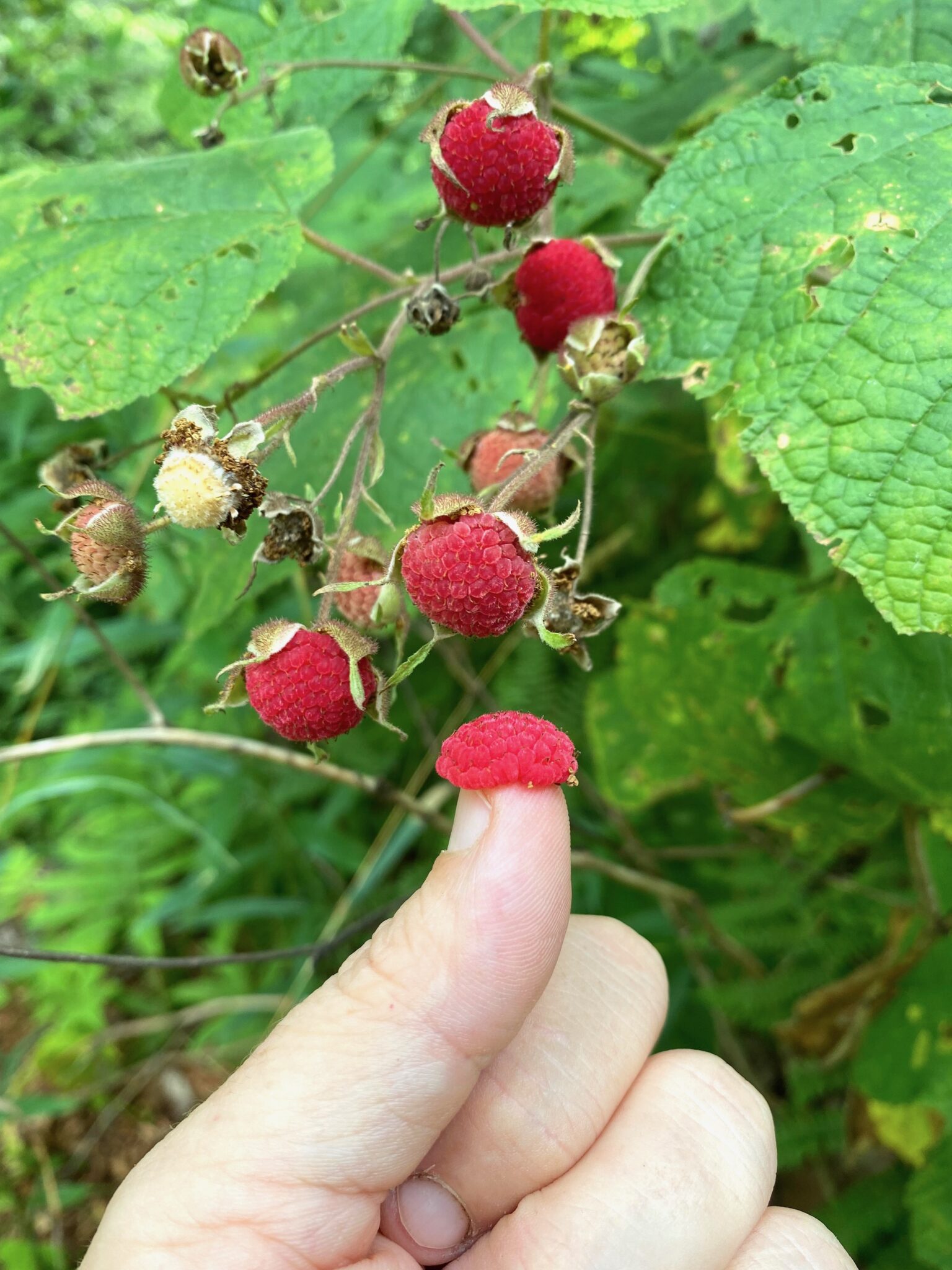
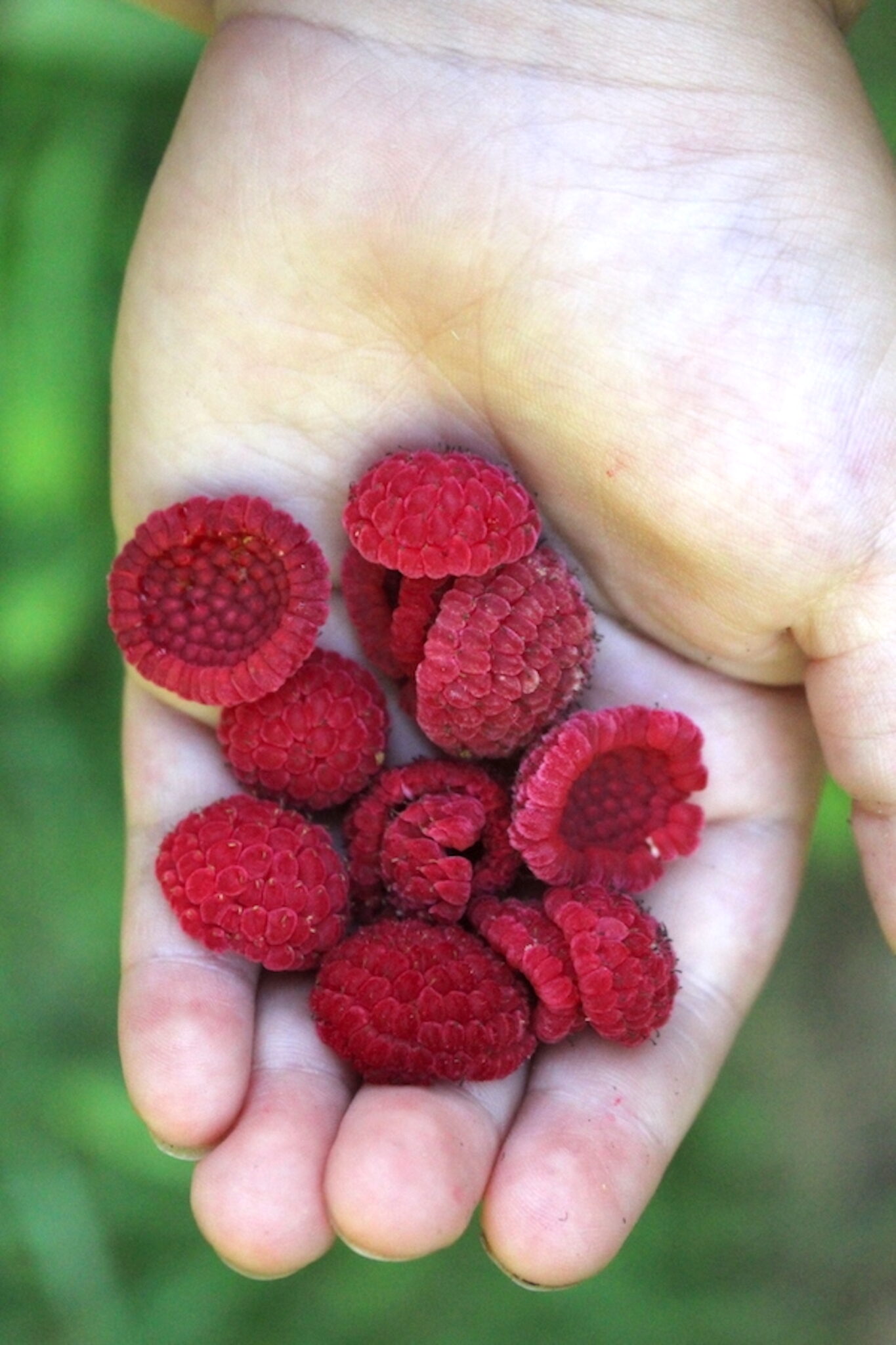
The kids love thimbleberries for the obvious reason: the hollow fruit slides perfectly onto a small finger, and there’s an immediate ritual whenever we find them of putting one on each fingertip and then eating them off one by one. We’ve never made jam from them because we never have enough at once. They’re a strict trail-snack fruit on our property, eaten warm off the bush as we wander past. The fruit doesn’t keep well anyway since the soft drupelets fall apart in your hand the moment they’re truly ripe. If you want any volume of preserved thimbleberries, your best bet is to combine them with another wild bramble (red raspberries, black raspberries) and make a mixed-berry preparation rather than fighting for thimbleberries alone.
What Are Thimbleberries?
Thimbleberries are perennial fruiting shrubs in the Rubus genus, the same group that includes red raspberries, black raspberries, and blackberries. Thimbleberries are native to North America, and there are two main species:
- Western Thimbleberry (Rubus parviflorus) is the more famous species. It grows from Alaska south through California, throughout the Rocky Mountains, and east as far as the Great Lakes. White flowers and bright red fruit are characteristic.
- Eastern Thimbleberry (Rubus odoratus), also called Purple-flowering Raspberry, Flowering Raspberry, or Virginia Raspberry. It grows throughout the eastern United States and southern Canada, particularly along the Appalachian Mountains. Showy pink-purple flowers and similar red fruit.
Other regional and alternative common names include redcap, red cap berry, thistleberry (a misheard form of “thimbleberry”), and wee raspberry. You may also occasionally see western thimbleberry called salmonberry, although the true salmonberry is a different species (Rubus spectabilis) covered in the look-alikes section below. Various cultivated varieties of both thimbleberry species are available, and gardeners often use them in ornamental shade gardens. Rubus odoratus has also naturalized in parts of Europe, especially East England.
Are Thimbleberries Edible?
Yes, thimbleberries are edible and a safe plant to collect and enjoy. The berries are highly prized wild edibles, making an excellent fresh-eating snack while hiking or cooked like the closely related raspberries. The young shoots are also edible and safe, cooked or raw. Most frequently, foragers cook the shoots like asparagus.
Like other members of the Rubus genus, the leaves are sometimes gathered by herbalists for use in internal and external remedies, though they’re not a choice fresh edible. The roots and young shoots are also occasionally employed in traditional medicine.
Avoid harvesting thimbleberries along busy roadsides where the fruit could be contaminated with vehicle exhaust, herbicide drift, or other chemicals. Quiet rural roadsides and forest edges are usually fine, but skip the highway-adjacent patches.
The use of thimbleberry leaf tea and other preparations hasn’t been widely studied in people who are pregnant or nursing. Some herbalists recommend leaf tea from members of the Rubus genus, like Red Raspberry, to aid in labor. However, some studies have shown that these teas may help by softening the cervix and inducing labor, and therefore should be avoided during early pregnancy. We don’t know if this is true for thimbleberry specifically, but you should still avoid thimbleberry preparations while pregnant or breastfeeding until you consult your physician.
Thimbleberry Medicinal Benefits
While many foragers pick thimbleberries for the flavor, they also pack a nutritional punch. Thimbleberries are high in vitamins A and C, and historically both Native Americans and settlers ate them to treat scurvy.
Native Americans employed thimbleberries in their traditional medicine. Some groups used the fresh leaves to create poultices or decoctions for treating acne. They would also make a powder from the dried leaves to treat wounds and burns. The Quileutes also chewed the bark and spit it into wounds to clean them, particularly burns. The Makah pounded the bark and used it to treat toothaches or festering wounds.
Native Americans also used the leaves, roots, and shoots to make teas for treating various ailments, including nausea, diarrhea, vomiting, and dysentery. The Quileutes also boiled the bark in seawater and used this drink to lessen labor pains.
Today, herbalists often employ thimbleberry leaves to boost the appetite and treat various stomach ailments. The leaves are believed to have astringent, antiemetic, stomachic, and blood-cleansing properties. Occasionally, people will incorporate the roots and leaves into cosmetics and other external preparations to treat acne, heal irritated skin, and prevent scarring.
Modern medical research hasn’t spent much time focusing on thimbleberry remedies. However, one study found that the tannins in the eastern thimbleberry (Rubus odoratus) have anti-tumor properties.
Generally, herbalists also use thimbleberries in many of the same remedies as they would other members of the Rubus genus, such as Red Raspberries, Blackberries, and Black Raspberries. People worldwide began using different species of Rubus for food and medicine shortly after the Ice Age.
Where to Find Thimbleberries
Thimbleberries are native to North America but have naturalized in parts of Europe, especially East England. You can find Rubus parviflorus in the western region of the United States, east to the Rockies, and in patches as far east as the Great Lakes. Rubus odoratus is found in the eastern United States, particularly along the Appalachian Mountains, ranging from Georgia north into Quebec.
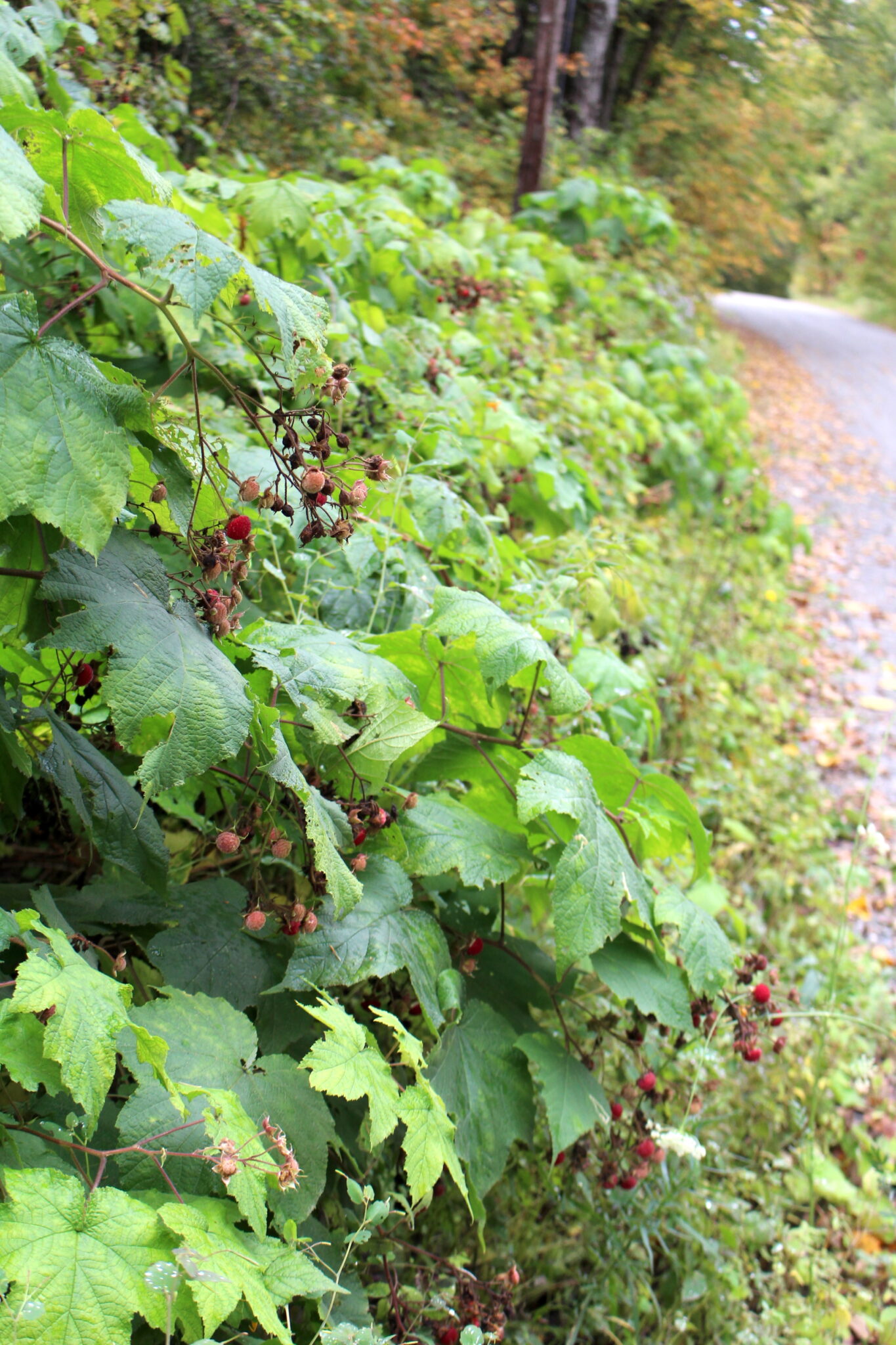
Thimbleberries of both species thrive in areas with cool, moist summers. They often grow along forest edges, open woodlands, or newly cleared land after logging or forest fires. Frequently, thimbleberries pop up on sloped edges like road banks, trail edges, and the sides of railroad tracks.
Thimbleberries can grow in shade to full sun but prefer acidic, moist soils. They grow best in sandy, gravelly, or loamy soils. Some unusual occurrences worth noting: R. parviflorus has also been documented as a naturalized species in parts of Hawaii, where it grows in higher-elevation moist forest, and the species was introduced for ornamental purposes in some gardens worldwide.
When to Find Thimbleberries
Thimbleberries are perennial and present year-round but deciduous, meaning they drop their leaves in the fall. The brownish canes that remain over winter can be tough to spot and identify in the off season.
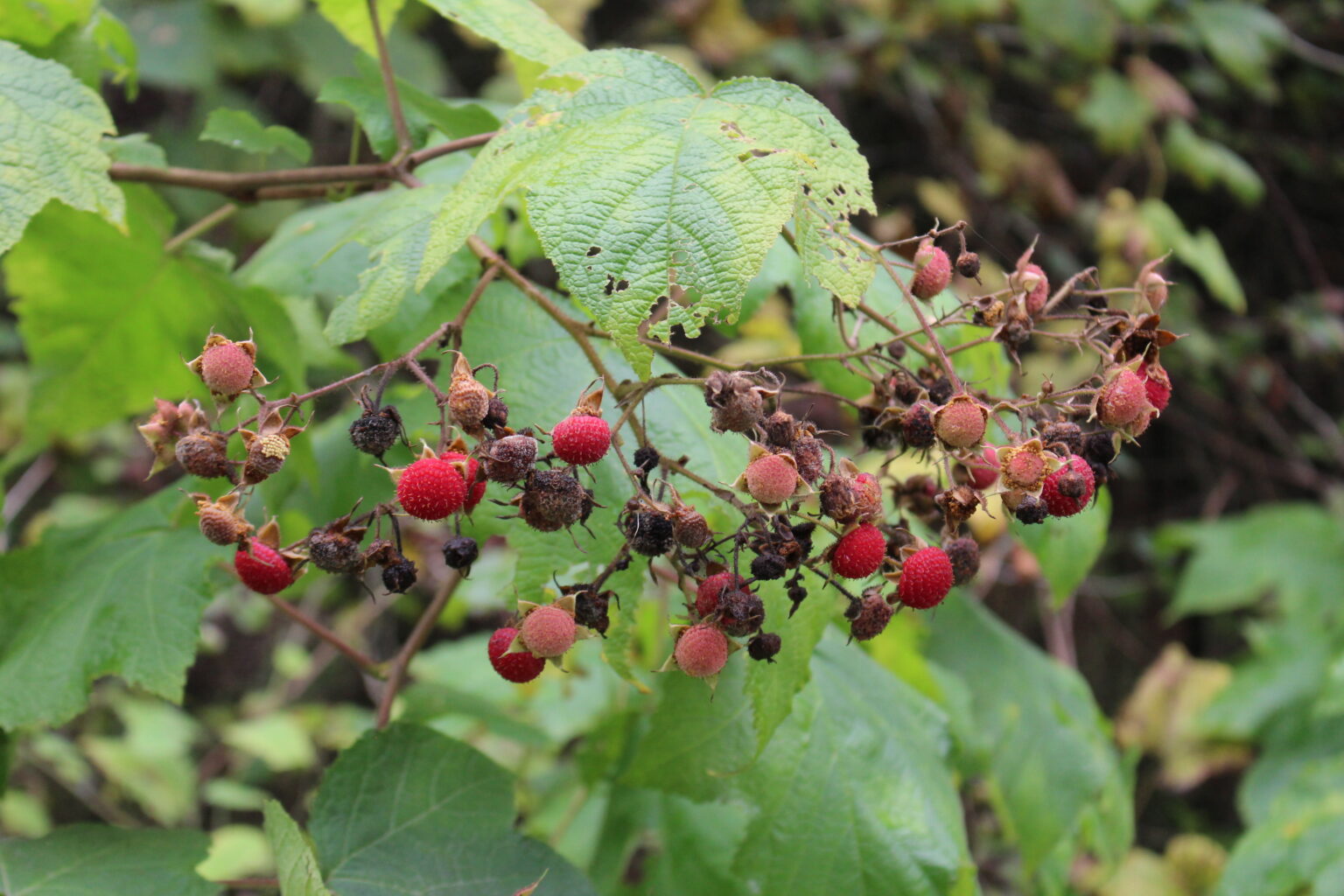
The plants begin to leaf out in early spring, around the same time as many other deciduous trees, and then flower soon after. They flower and fruit over a long period, and depending on your location, you may spot thimbleberries blooming from May to August. Fruiting follows the bloom by 4 to 6 weeks. Western thimbleberry typically peaks in July through August in northern California through the Pacific Northwest. Eastern thimbleberry peaks in late June through August along the Appalachian range, with northern populations fruiting later.
One key difference from red raspberries: thimbleberries don’t fruit all at once. The plants put out a few ripe berries at a time over a long window, which is wonderful for trailside snacking but frustrating for anyone trying to gather enough for a single jam batch.
How to Identify Thimbleberries
Thimbleberries are one of those plants that’s easy to overlook along the sides of roads and trails you regularly use until they have fruit. Then you may spot the bright red berries that look very similar to raspberries.
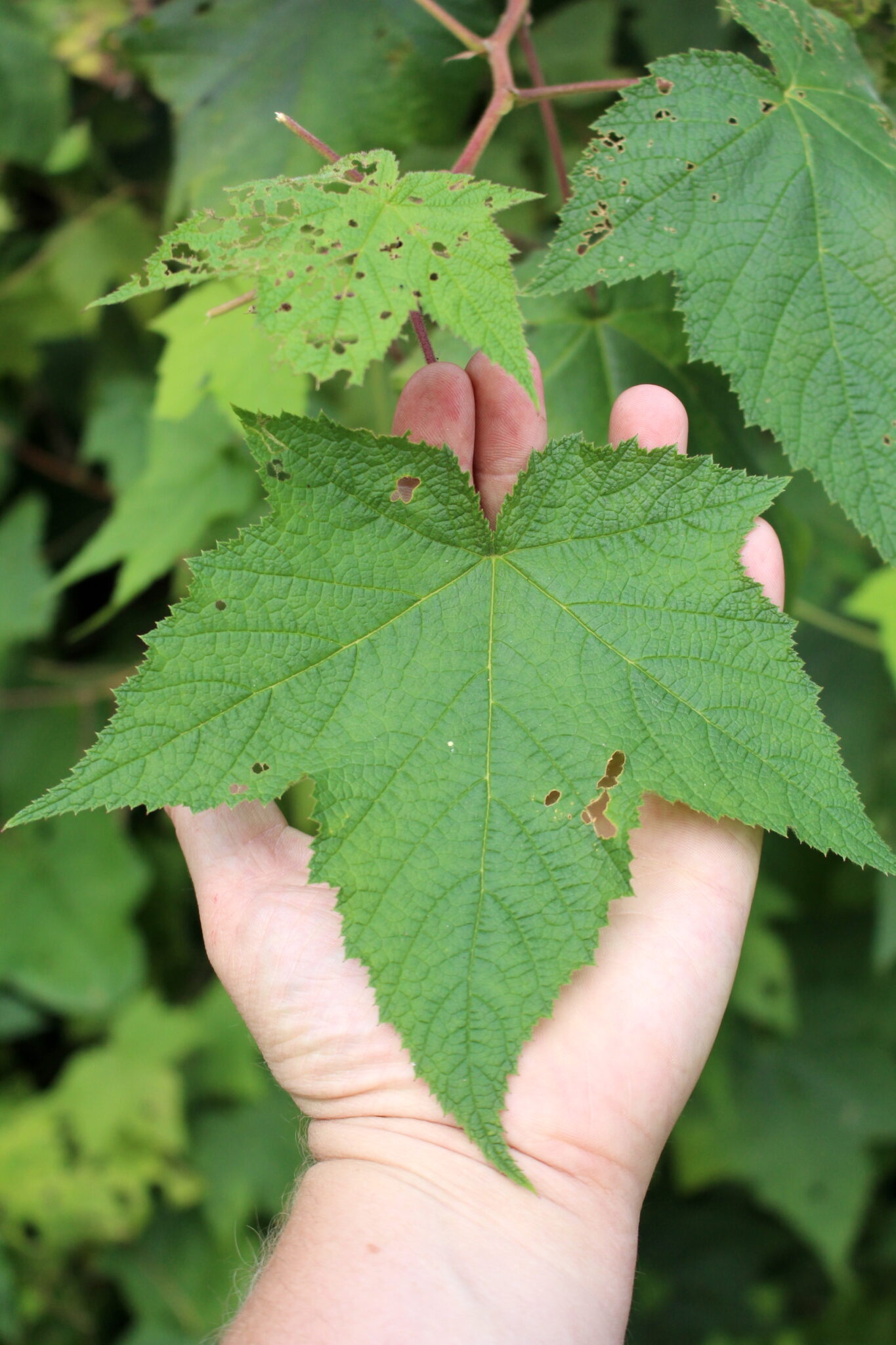
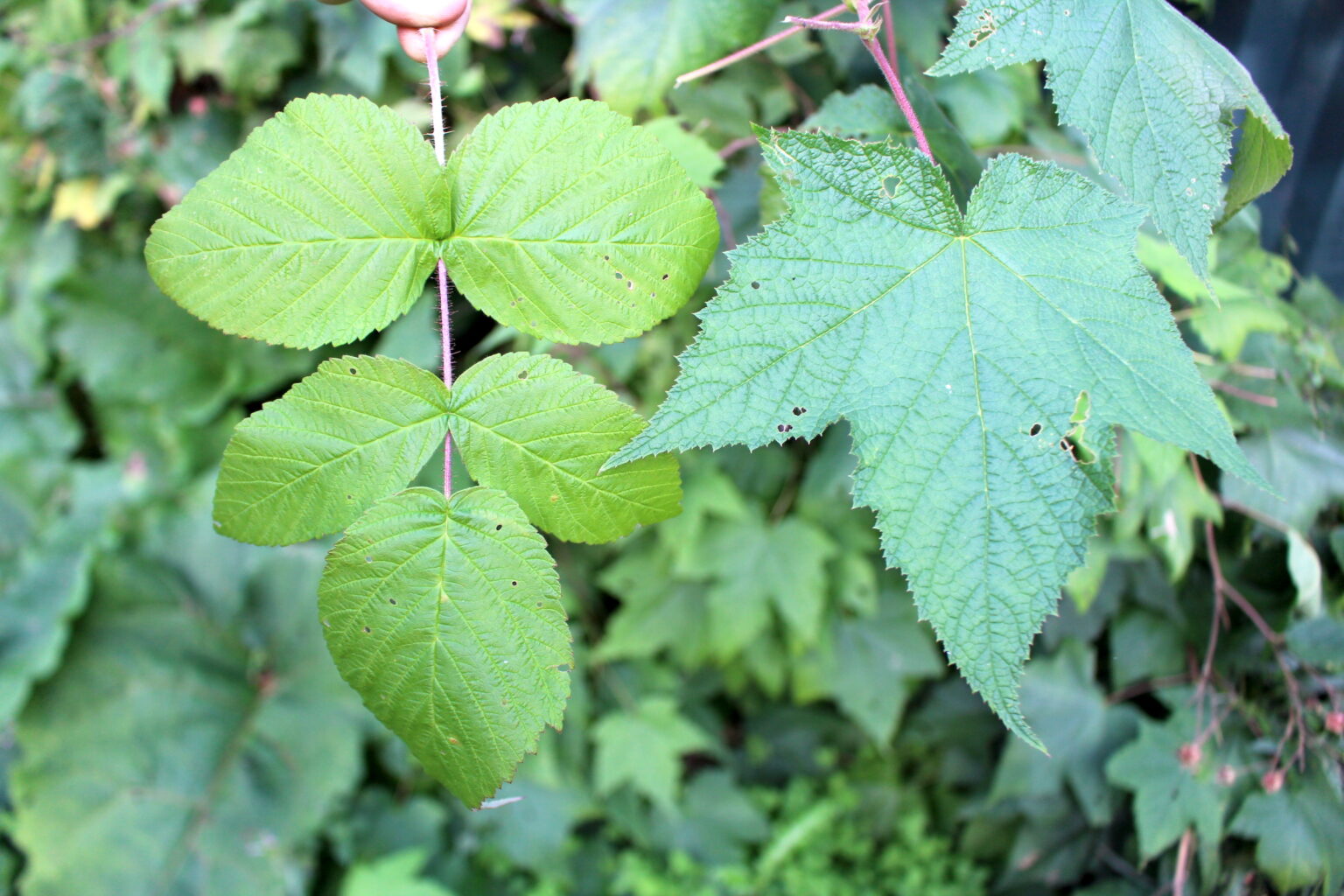
These shrubs also have a similar form to many other Rubus or raspberry species, with long arching canes. However, the leaves are quite different. While most Rubus species have compound leaves made up of three or more leaflets, thimbleberry leaves are simple and palmate, looking more like maple leaves than raspberry leaves.
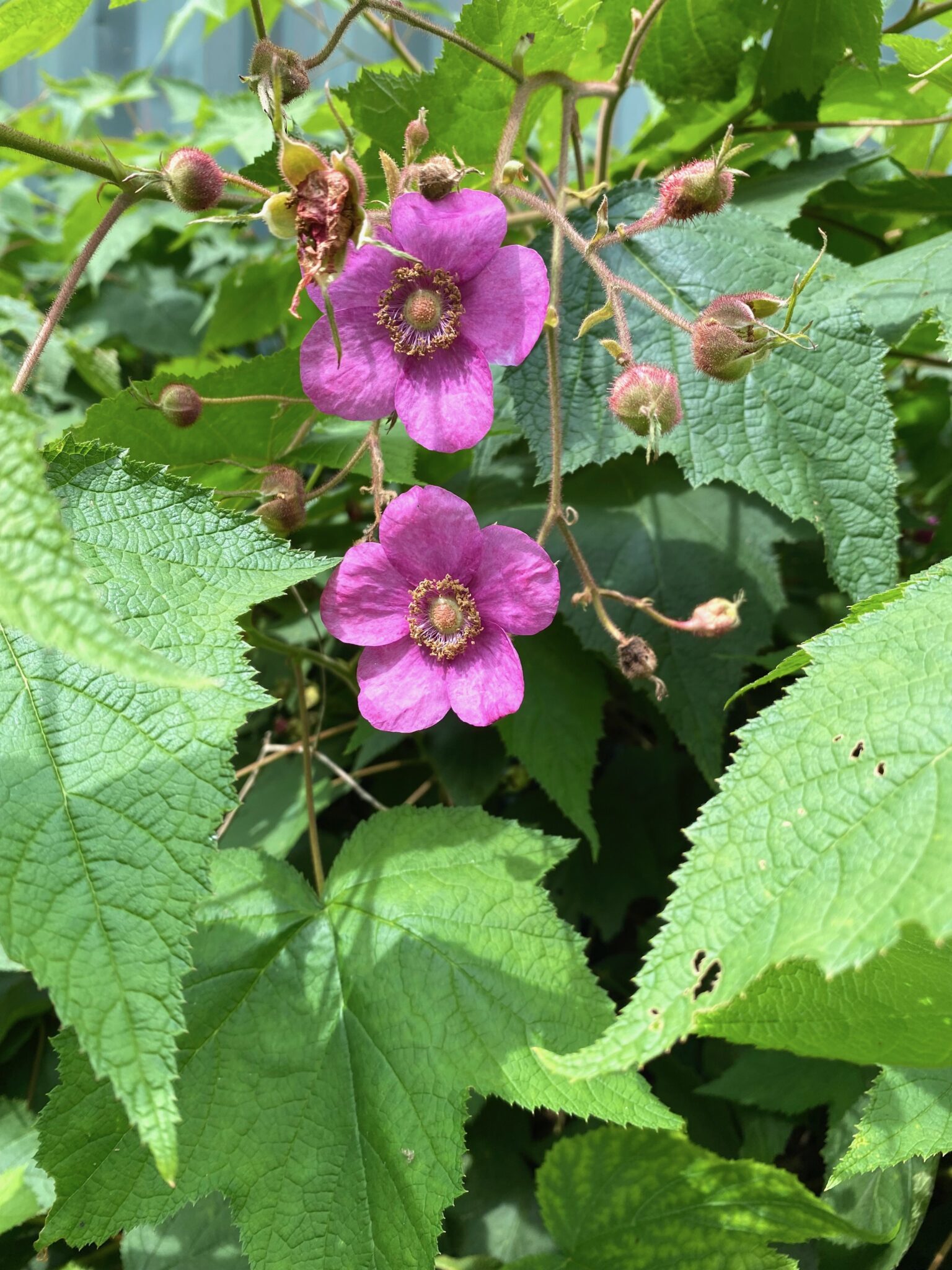
Both species of thimbleberry taste and look similar in fruit. The major difference is the flowers. Rubus odoratus has very fragrant pink-purple blooms rather than white like many Rubus species, including Rubus parviflorus. The pink-purple flowers make eastern thimbleberry especially easy to pick out. Compared to other Rubus species, both thimbleberries have relatively large blooms (¾ to 2¼ inches across).
You’ll often spot thimbleberries growing in large patches because they spread through underground rhizomes, allowing them to cover an area and outcompete other plants quickly.
Thimbleberry Leaves
Thimbleberries have soft, green, palmate, aromatic leaves. The leaves resemble maple leaves in shape and typically have between three and seven lobes. The leaves are much larger than most other Rubus species and can reach up to 10 inches long and across.
This is the single most useful identification feature, since the maple-like simple leaves immediately distinguish thimbleberries from raspberries, blackberries, and most other Rubus species, all of which have compound leaves made of multiple leaflets.
Thimbleberry Stems and Canes
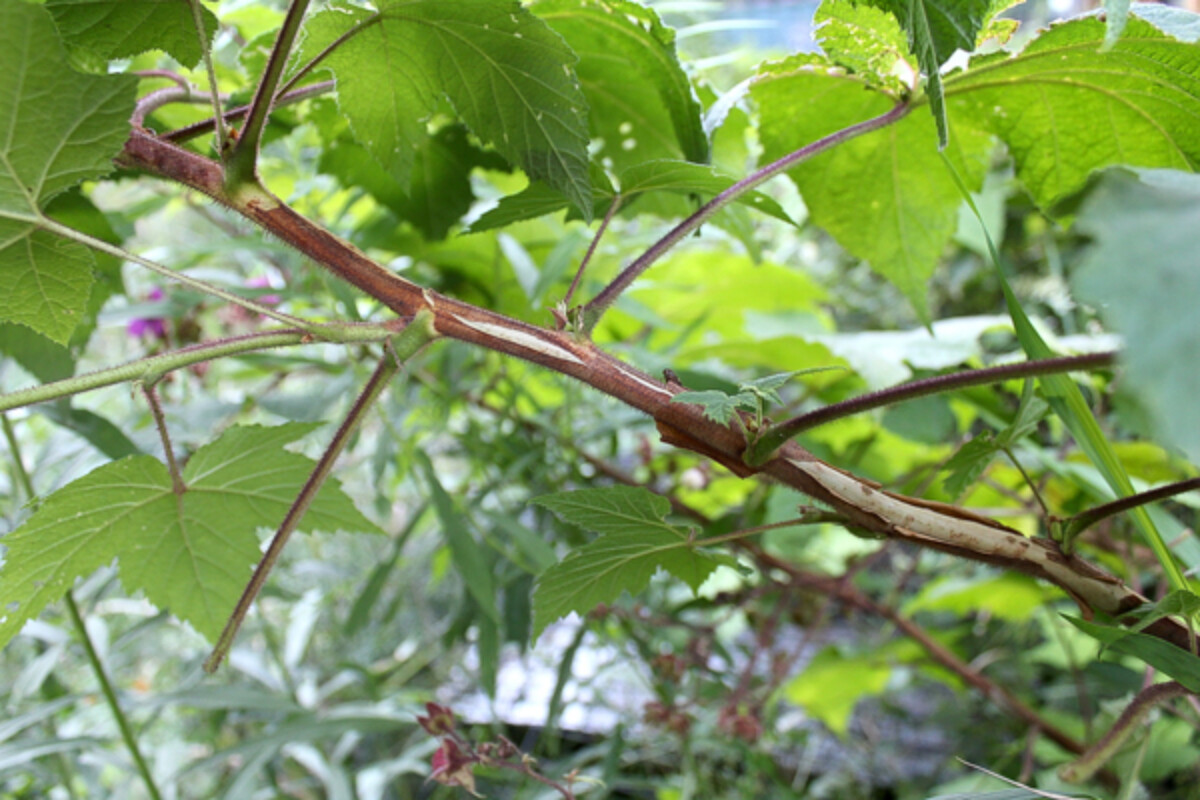
Thimbleberries grow large arching canes about ½ inch in diameter and up to 10 feet tall. The canes are completely thornless, covered in brown, reddish-brown, yellowish, or grayish bark. Some of the bark begins to crack and peel on older canes, revealing whitish underneath. New shoots and stems may be green. Young canes have short, reddish, bristly hair (but no actual thorns).
The thornless cane is the second-most useful identification feature, since most other Rubus species (raspberries, blackberries, salmonberry) have prickly or thorny canes.
Thimbleberry Flowers
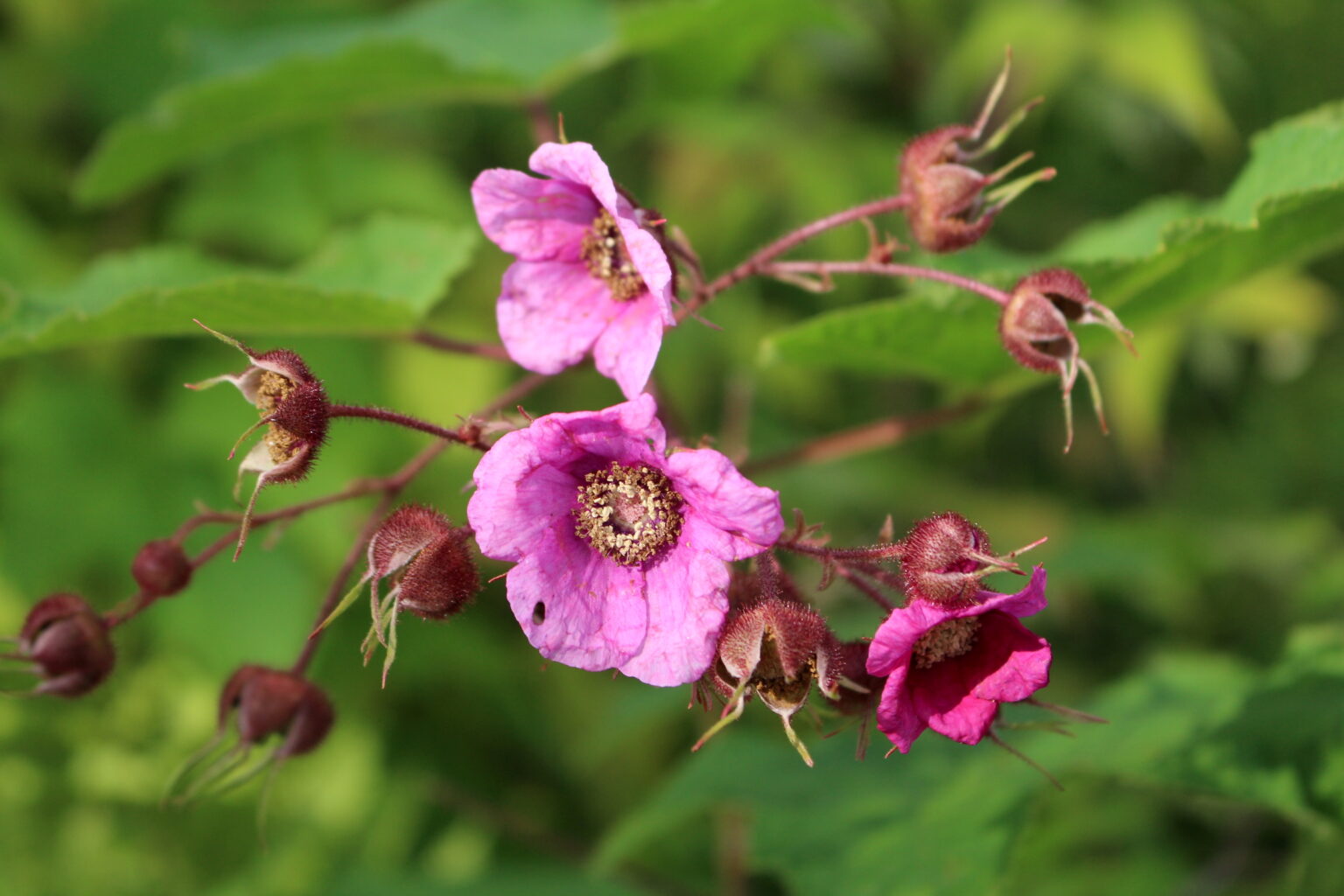
Thimbleberry flowers help set them apart from other Rubus species. They’re comparatively large, ranging from ¾ to 2¼ inches in diameter. Each flower has five petals and a yellow center.
In Rubus parviflorus, these petals are white. In Rubus odoratus, the petals are pink, pink-purple, or magenta, and the flowers are very fragrant. The fragrance of R. odoratus is part of why it’s also called the rose-flowering raspberry in some regions; the scent has a roselike sweetness that’s noticeable from several feet away on a warm summer day.
Thimbleberry Fruit
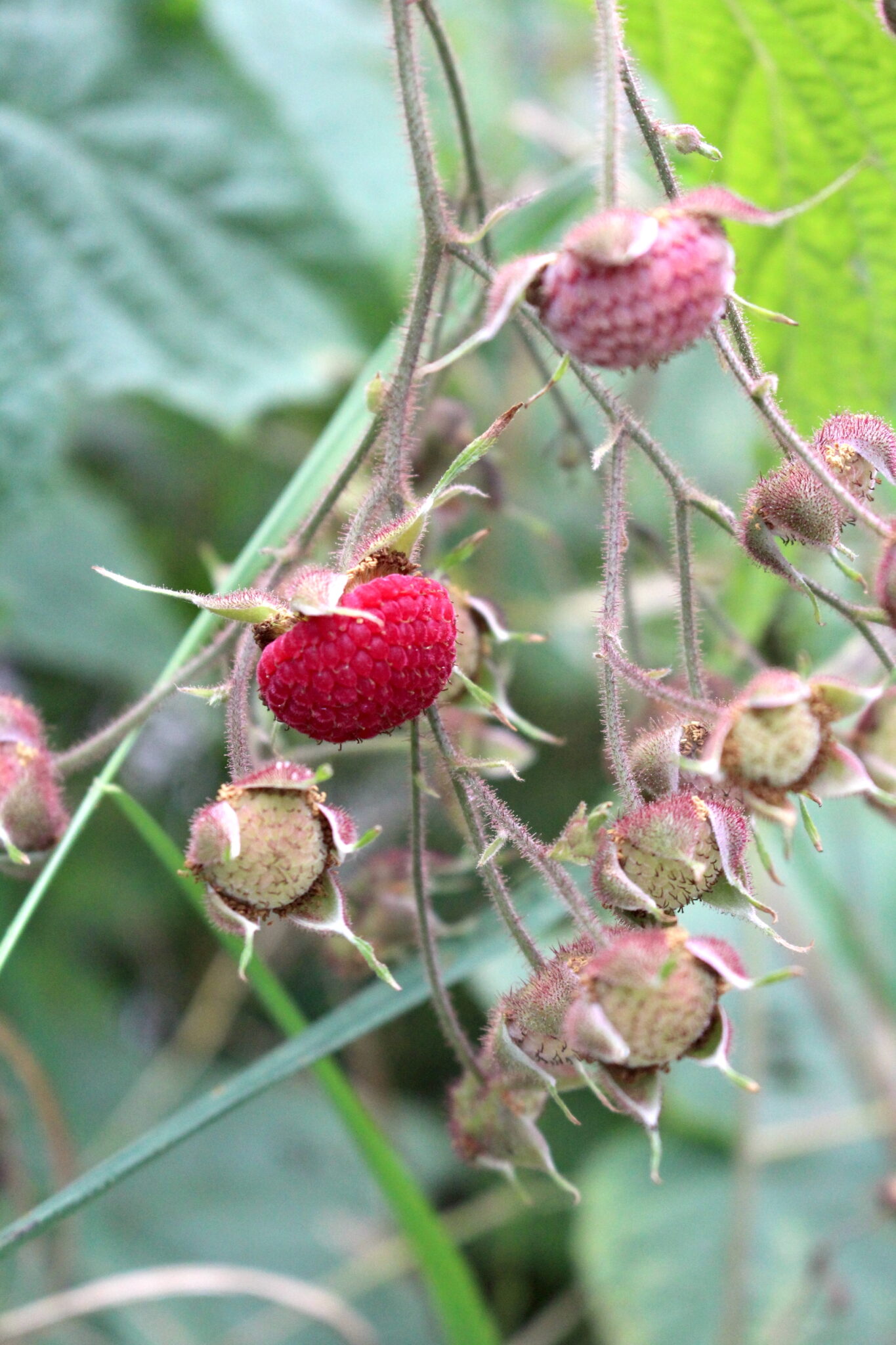
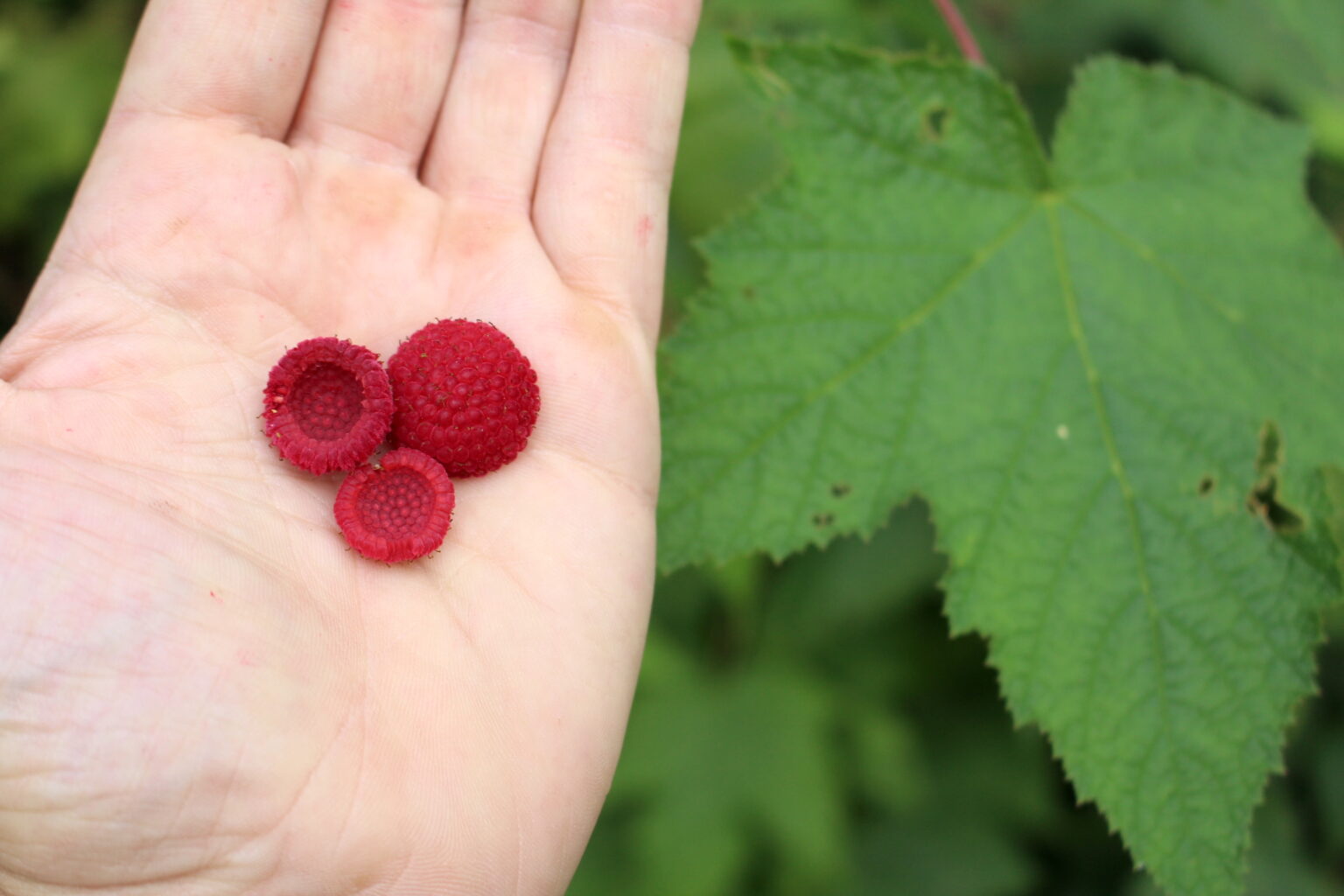
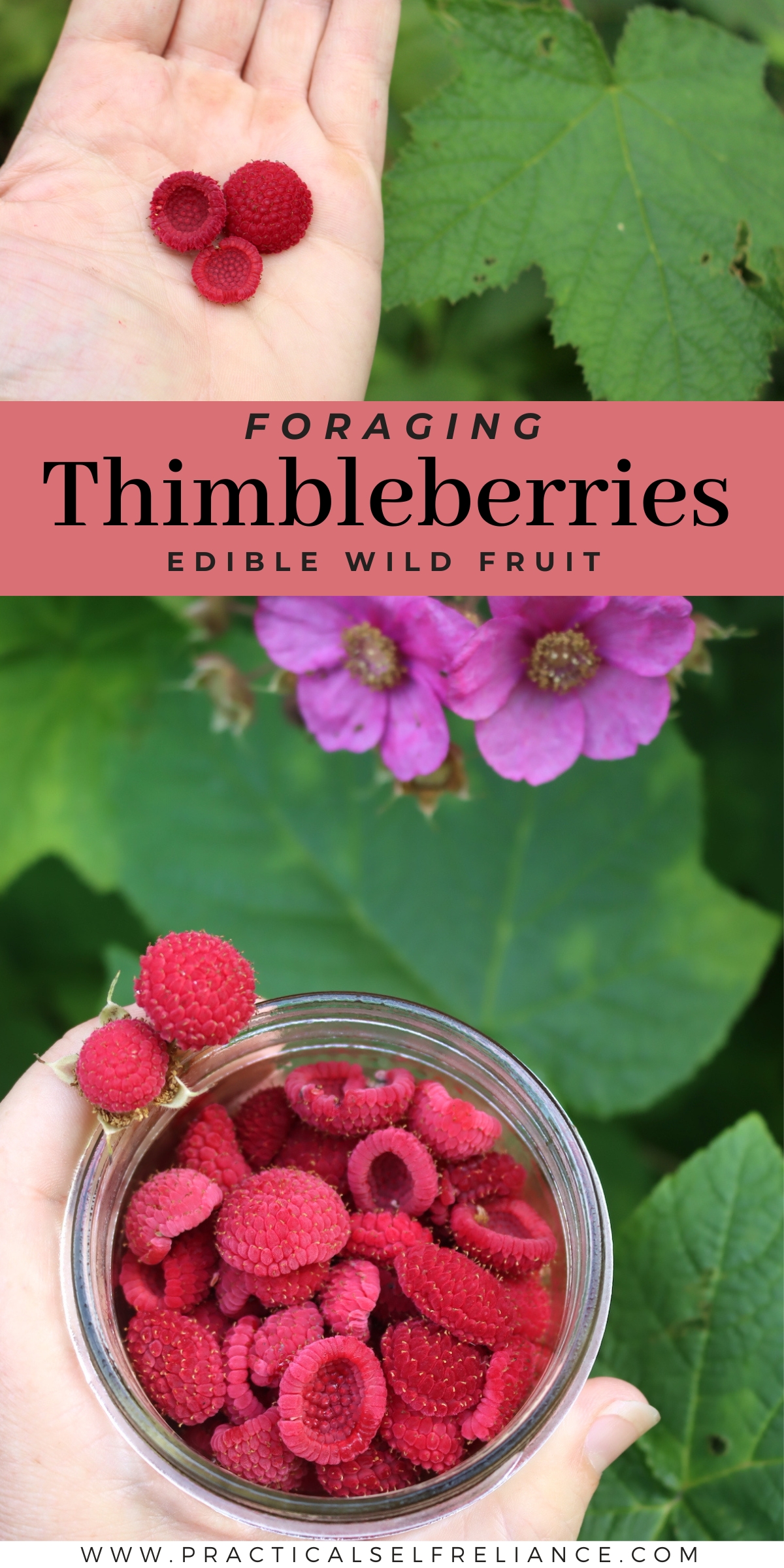
Thimbleberries get their name from the hollow-centered fruit, which is fun to slip onto a fingertip like a thimble. The berries look a bit like raspberries but are broader and shallower in profile, and the soft drupelets are larger and more loosely held together.
The berries are soft, almost velvety, usually about ½ inch in diameter, and ripen to bright red or sometimes purplish red. The fruit detaches from the cone-shaped receptacle (just like a raspberry), leaving a hollow thimble shape. Texture is the most distinctive fruit feature: thimbleberries are softer and more delicate than any other red bramble fruit, and a fully ripe thimbleberry will collapse in your hand if you squeeze it at all.
Thimbleberry Look-Alikes
Thimbleberries can be confused with several other red-fruited bramble species. The good news: most of the common look-alikes are themselves edible, and none of the common confusions are dangerously toxic. The differences are still worth knowing, since the fruit and use vary across species.
Wild Raspberries
The most common confusion is with wild raspberries, particularly the American Red Raspberry (Rubus idaeus var. strigosus). Both have red fruit on similar-sized arching canes, and they often grow in overlapping habitat. Both are fully edible, so confusion is not a safety issue, but you’ll want to know which you’re harvesting because they cook up differently and have different flavors.
- Red raspberry has compound leaves with three to five leaflets (occasionally seven); thimbleberry has simple maple-like palmate leaves.
- Red raspberry canes are purple-red and have sharp prickles; thimbleberry canes are brown to gray and completely thornless.
- Red raspberry flowers are small (about ½ inch) and white in loose clusters; thimbleberry flowers are large (¾ to 2¼ inches) and either white or pink-purple depending on species.
- Red raspberry fruit is shiny, conical, and holds its shape when picked; thimbleberry fruit is matte, broad, shallow, and falls apart easily.
- Red raspberry seeds are small but noticeable; thimbleberry seeds are larger and crunchier inside the soft fruit.
Both species can substitute for each other in jam and jelly recipes, but the texture difference shows up immediately in fresh-eating; thimbleberries have an almost candied, intense flavor while red raspberries are brighter and more straightforwardly fruity.
Salmonberry
The western thimbleberry (Rubus parviflorus) is sometimes mistaken for salmonberry (Rubus spectabilis), another western Rubus species. Salmonberry is also edible, so confusion is not a safety problem. The differences:
- Salmonberry canes (particularly young ones) are prickly; thimbleberry canes are thornless.
- Salmonberry has compound trifoliate leaves made of three separate leaflets; thimbleberry has simple maple-like leaves.
- Salmonberry leaves are smooth to slightly hairy on the upper surface.
- Salmonberry flowers have pinkish-purple petals (similar to R. odoratus) surrounding a cluster of stamens.
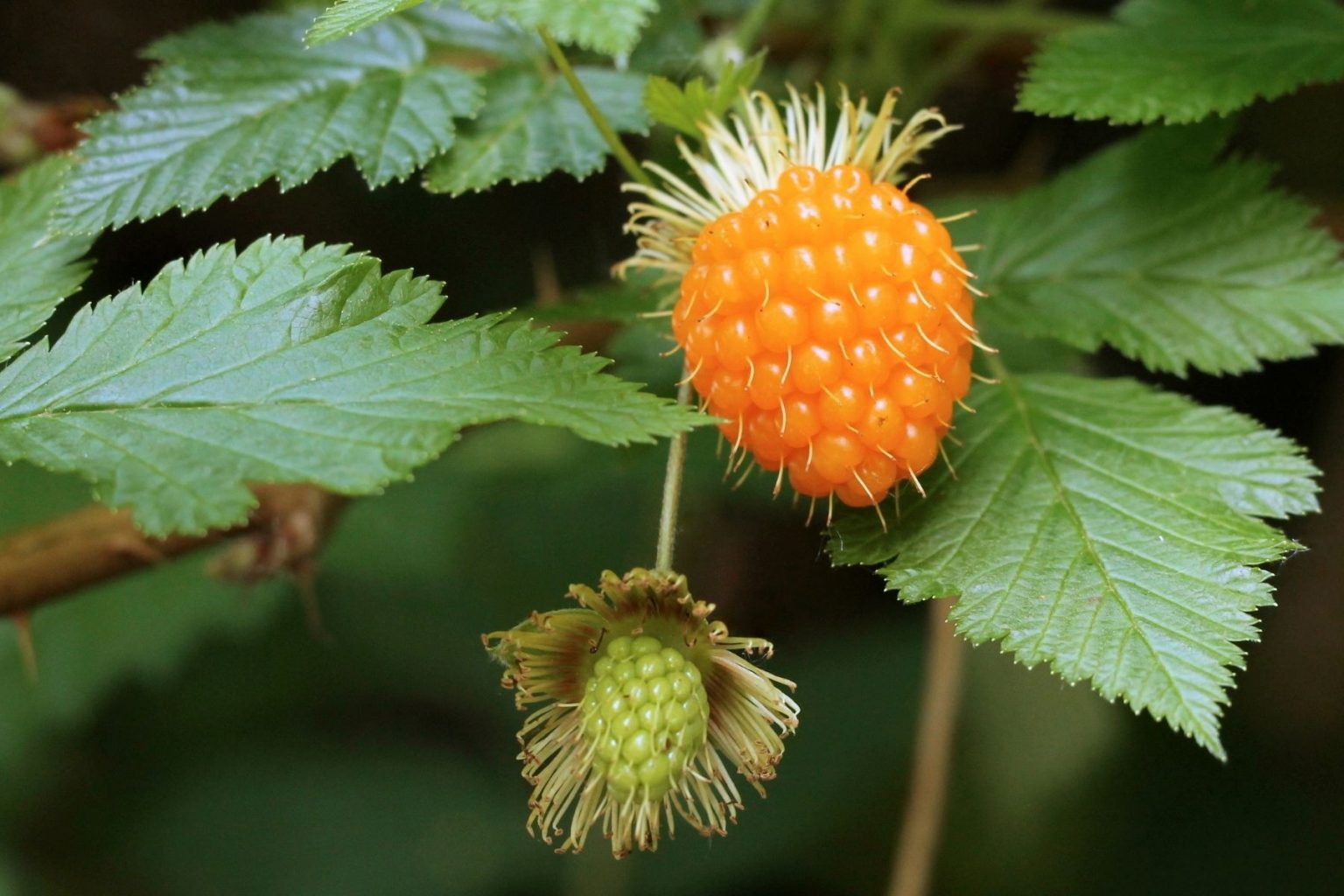
- Salmonberries are long and shiny, ripening to red, yellow-orange, or sometimes a dusty rose color, and they hold their shape rather than collapsing.
Stink Currant
Thimbleberry can be confused with the Stink Currant (Ribes bracteosum) in the Pacific Northwest because of similar-looking maple-shaped leaves. Stink currant is technically edible but unpleasant in flavor. The differences:
- The entire stink currant plant, including the leaves, is sprinkled with yellowish glands that emit a sweet-skunky odor (which gives the plant its name).
- The leaves are noticeably stinky when crushed; thimbleberry leaves smell faintly green and pleasant.
- Stink currants produce 6- to 12-inch-long racemes (elongated clusters) of 20 to 40 white to greenish flowers; thimbleberry has a few large showy flowers per cluster.
- Stink currant berries form in long clusters, are round and blue with a whitish bloom, and look nothing like a thimbleberry once they ripen.
Devil’s Club
Devil’s Club (Oplopanax horridus) is another Pacific Northwest plant with similar maple-like leaves. Unlike thimbleberry, Devil’s Club is sharply spined throughout and the spines can cause skin irritation. The fruit is not edible. The differences:
- Devil’s Club can reach 10 to 16 feet tall, though it may stay much smaller in some habitats.
- Devil’s Club flowers are small, greenish-white, and form in dense umbels up to 8 inches in diameter.
- Devil’s Club stems and leaf veins (on both upper and lower leaf surfaces) are covered in irritating brittle yellow spines; thimbleberry stems and leaves are completely free of spines.
- Devil’s Club berries are roundish and form in large cone-shaped clusters at the tops of the stems.
How to Harvest Thimbleberries
Thimbleberries are one of the most rewarding wild berries to harvest, but the soft fruit demands a different approach than picking raspberries or blackberries. The texture issue is the main challenge: a fully ripe thimbleberry will collapse the moment it leaves the cane, so the harvest method has to account for the fragility.
Practical tips for thimbleberry harvest:
- Harvest into a wide shallow container (a pie pan, a flat berry basket, or a wide bowl) rather than a deep bucket. Thimbleberries crush themselves under their own weight in just a few inches of accumulated fruit.
- Pick with two fingers, applying as little pressure as possible. The fruit detaches with a gentle pull when truly ripe; if you have to tug, the fruit isn’t ready.
- Plan to use the fruit the same day you pick it. Thimbleberries don’t keep well at room temperature and start breaking down within hours.
- For longer-term storage, freeze whole on a tray in a single layer (so the berries don’t crush each other), then transfer to bags once frozen solid. Freeze-drying also works well and preserves the texture better than ordinary freezing.
- Plan multiple trips to the same patch over a few weeks rather than one big harvest day. Thimbleberries fruit slowly over a long window, and you’ll get more total fruit by visiting often than by trying to clean a patch out at once.
If you’re harvesting for jam or jelly and want a useful volume, consider combining your thimbleberry harvest with another wild bramble (red raspberry, black raspberry) or a homegrown berry to bulk up the volume. The thimbleberry flavor will dominate even at 25 to 50 percent of the mix, and you’ll end up with a much more practical jam batch.
Ways to Use Thimbleberries
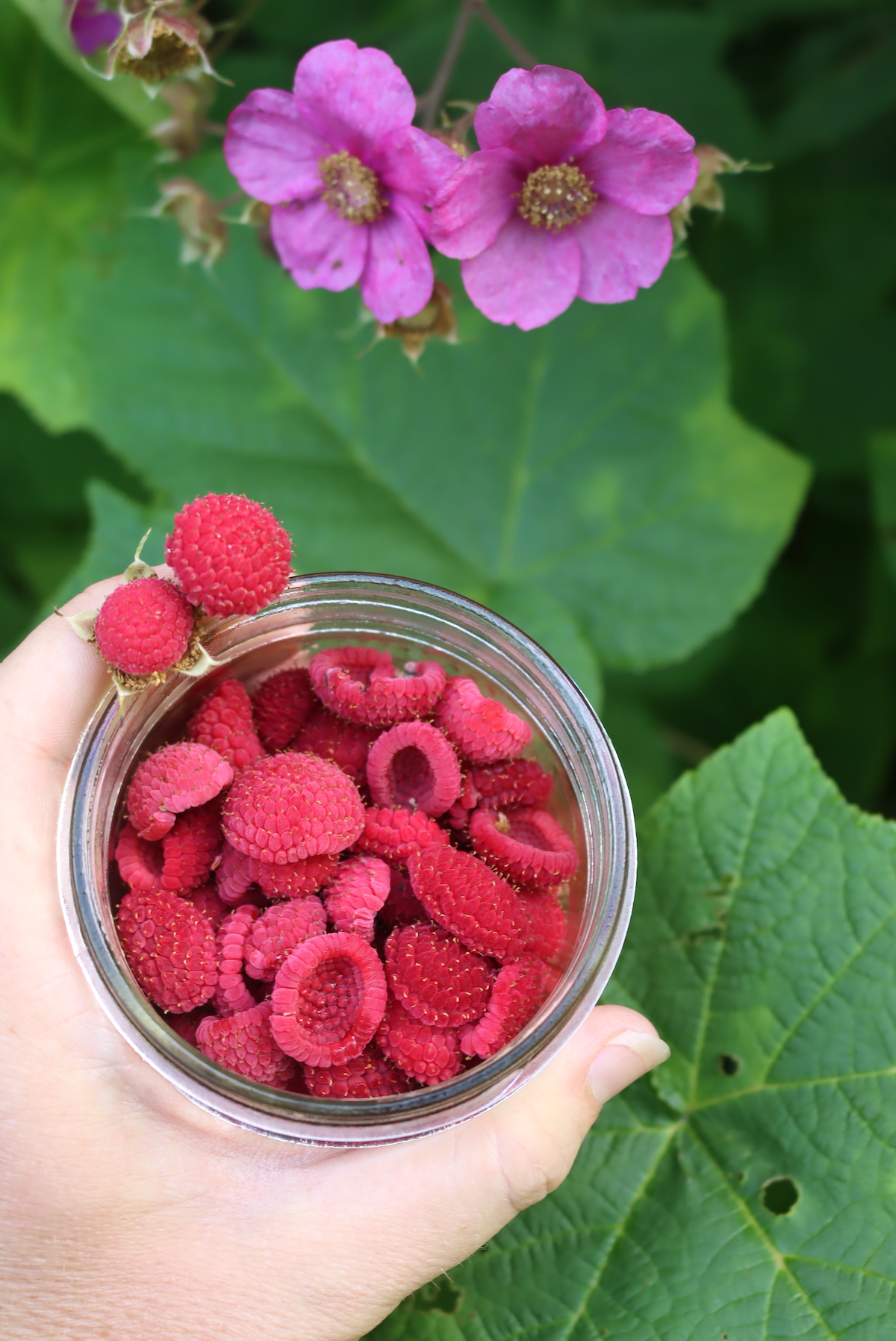
The easiest way to use thimbleberries is to enjoy fresh berries straight from the bush. They make excellent trailside snacks or toppings for granola, yogurt, or salads. Thimbleberries are also excellent cooked, working well in jams, cobblers, muffins, and other baked goods.
Unfortunately, thimbleberries produce berries slowly throughout the summer rather than all at once. While this is excellent for fresh eating, it makes it tough to gather enough for many recipes. The fruit is also delicate and difficult to transport. They’re best blended with other wild berries and homegrown fruits in applesauce, preserves, pie fillings, fruit leather, or pemmican.
If you have more than you can use fresh, you can preserve thimbleberries by freezing, dehydrating, or canning. Frozen whole berries hold up well for use in winter baking projects.
Young thimbleberry shoots also make for a tasty snack. Like the berries, you can eat the shoots fresh or raw. They’re a bit asparagus-like and are an excellent steamed or sautéed vegetable. Throw them into stir-fries, omelets, or quiches.
Thimbleberry can also be a helpful plant to add to your herbal medicine practice. The large soft leaves are wonderful for stomach ailments and digestive issues. Harvest the leaves to make decoctions, teas, and tinctures. You can use the roots and shoots similarly. Preserve some of the roots, shoots, and leaves for later use in tea or other herbal preparations by dehydrating them.
Thimbleberry leaves, roots, and shoots can also be used in external preparations. Herbalists believe thimbleberry may have soothing and healing effects on minor wounds, burns, acne, and other skin issues. Try incorporating thimbleberry leaves into poultices, salves, or herbal soaks.
Thimbleberry has a few non-culinary applications too. Hikers and woodland wanderers sometimes find that the soft, large leaves make excellent emergency toilet paper, which is what gives the plant its informal name “the TP plant” in some Pacific Northwest circles. Fiber artists have also used thimbleberries to create a natural, dull blue dye.
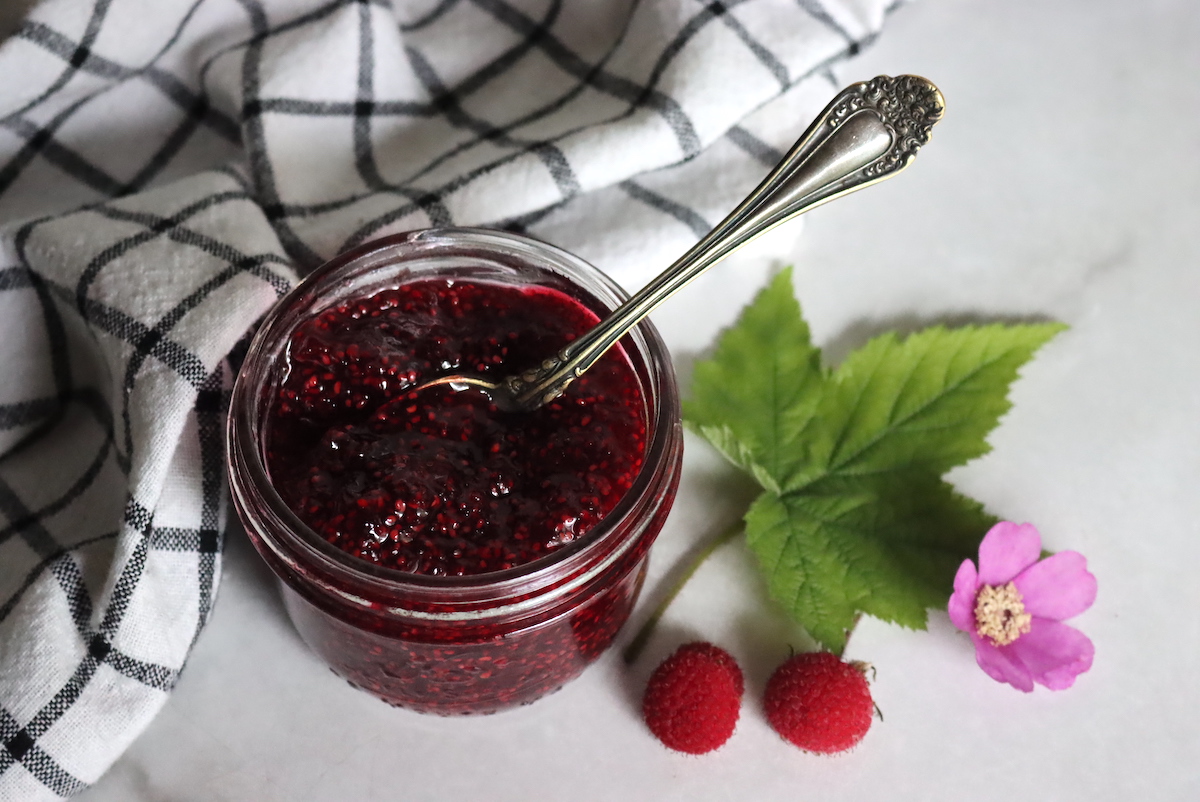
Thimbleberry Recipes
- Make a simple 3-ingredient Thimbleberry Jam from Creative Canning. You can water-bath can it, freeze it, or keep it as a refrigerator jam.
- Try Thimbleberry White Chocolate Chip Cookies from Hilda’s Kitchen Blog for a baking project.
- Try this Sugar-Kissed Vanilla Berry Cake from the Art of Natural Living using thimbleberries or a combination of foraged berries.
- Once you’ve got some jam, try Thimbleberry Bars from Girl Gone Grits.
- For an herbal use, try Thimbleberry leaf tea from GabNaturalist.
If your harvest is limited (as most are), consider blending thimbleberries with red raspberries or black raspberries in any of these recipes: Raspberry Jam (without pectin), Raspberry Jelly, or Black Raspberry Jam. The thimbleberry flavor comes through even at modest proportions, and you’ll have a more practical batch size.
Thimbleberry FAQs
Yes, thimbleberries are edible and a safe wild fruit to forage. The bright red berries are highly prized for fresh eating and are also good in jams, cobblers, muffins, and other baked goods. The young shoots are also edible and can be cooked like asparagus, and the leaves are used in some traditional herbal preparations. The two main species (Rubus parviflorus in the west and Rubus odoratus in the east) are both edible. Avoid harvesting from busy roadsides where the fruit may be contaminated with vehicle exhaust or herbicide drift, and consult a physician before using thimbleberry preparations during pregnancy.
Thimbleberries (Rubus parviflorus or Rubus odoratus) and red raspberries (Rubus idaeus var. strigosus) look similar but are different species. The clearest differences: thimbleberry leaves are simple and palmate (maple-like), while raspberry leaves are compound with three to five separate leaflets. Thimbleberry canes are completely thornless, while raspberry canes have sharp prickles. Thimbleberry flowers are large (up to 2¼ inches across) and either white or pink-purple; raspberry flowers are smaller and white. Thimbleberry fruit is broad, shallow, soft, and falls apart when handled; raspberry fruit is conical, holds its shape, and has smaller, less crunchy seeds. Both fruits are edible and substitute for each other in jam recipes.
Thimbleberries taste like an intensified, almost candy-like version of a red raspberry. The flavor has the sweet-tart character of a raspberry but with a deeper, more concentrated quality and a slight floral note. Some foragers describe the flavor as ‘more raspberry than a raspberry.’ The texture is unique: very soft, almost velvety, and prone to falling apart in your hand. The seeds are larger and more noticeable than raspberry seeds, with a faint crunch. The eastern species (R. odoratus) and western species (R. parviflorus) taste similar, with subtle regional variations.
Thimbleberries ripen over a long window from late June through August in most of their range, with the peak typically in July. They produce a few berries at a time over many weeks rather than fruiting all at once like raspberries, so the harvest stretches across most of the summer. In southern Appalachian populations, ripening can begin as early as mid-June. In northern Canada and Alaska, ripening continues into late August or early September. Ripe fruit is bright red to slightly purple, soft to the touch, and detaches from the cane with a gentle pull. The fruit doesn’t all ripen at once on the same plant, so plan to revisit a productive patch every few days during the harvest window.
None of the common thimbleberry look-alikes are dangerously toxic. The most likely confusions are with red raspberry (edible), salmonberry (edible), stink currant (technically edible but unpleasant), and Devil’s Club (inedible fruit, irritating spines). All of these grow in habitats where thimbleberries grow. If you’ve found a red bramble fruit on a thornless cane with simple maple-like leaves, you’ve almost certainly found a thimbleberry. The thornless canes and palmate leaves are the two most reliable distinguishing features.
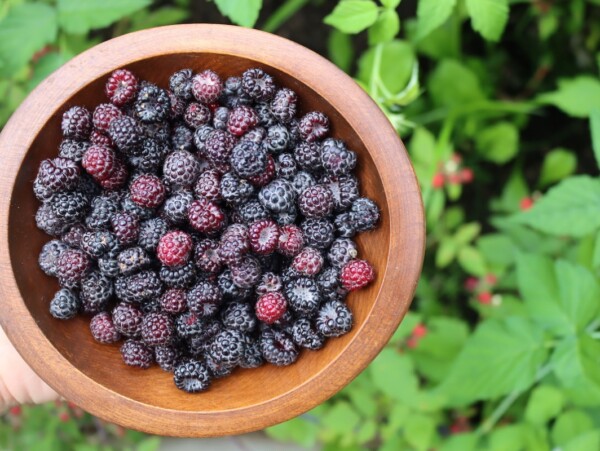
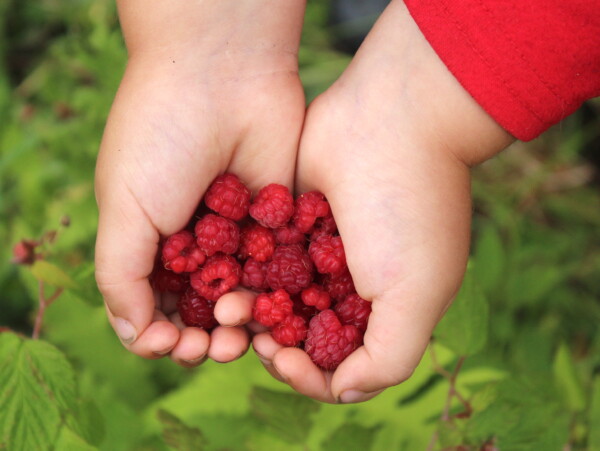
Edible Brambles

Did you find this Thimbleberry foraging guide helpful? Tell me in the 📝 comments below how you use thimbleberries on your homestead!
And make sure you stay in touch with me by following on social media!
Find the perfect foraging guide
Searching for something else? Enter keywords to find the perfect foraging guide!











I live in the Pacific NW. I know you mentioned it but they make excellent wild TP. My kids call it the TP plant. Aside from that, a ripe thimbleberry warmed by the sun is one of the best treats ever!