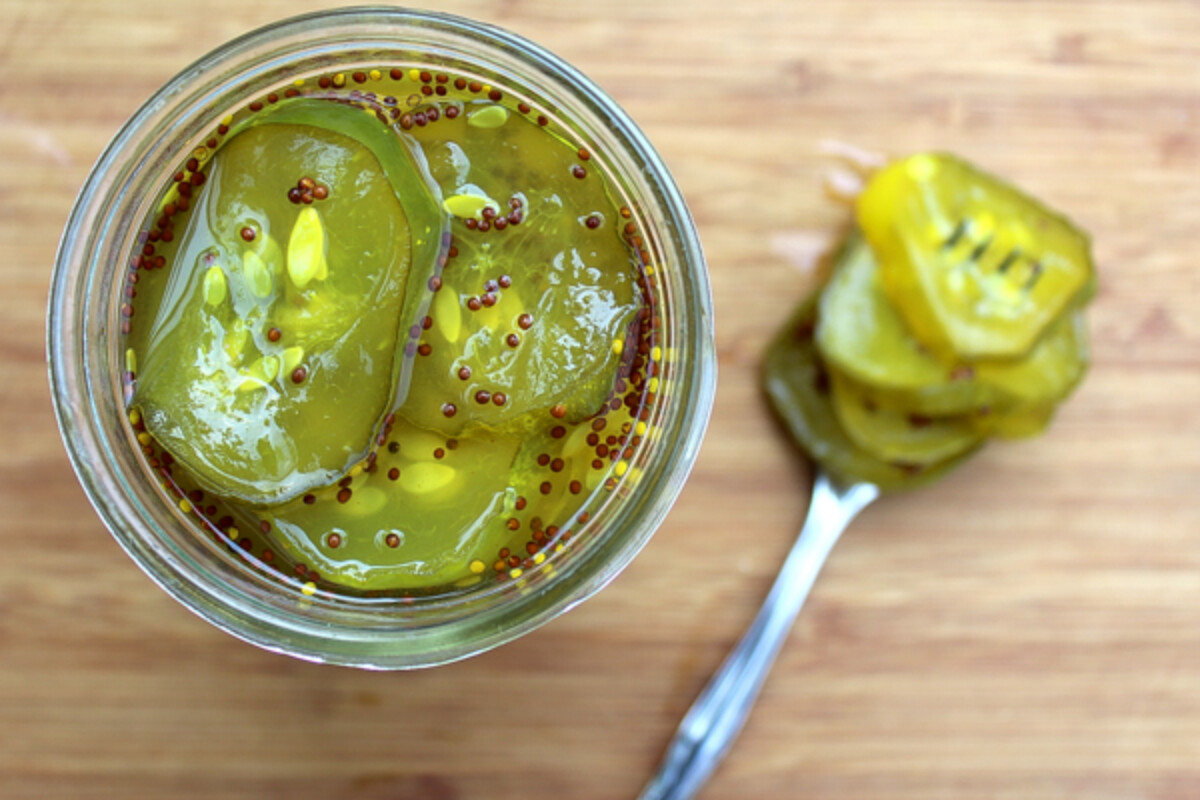
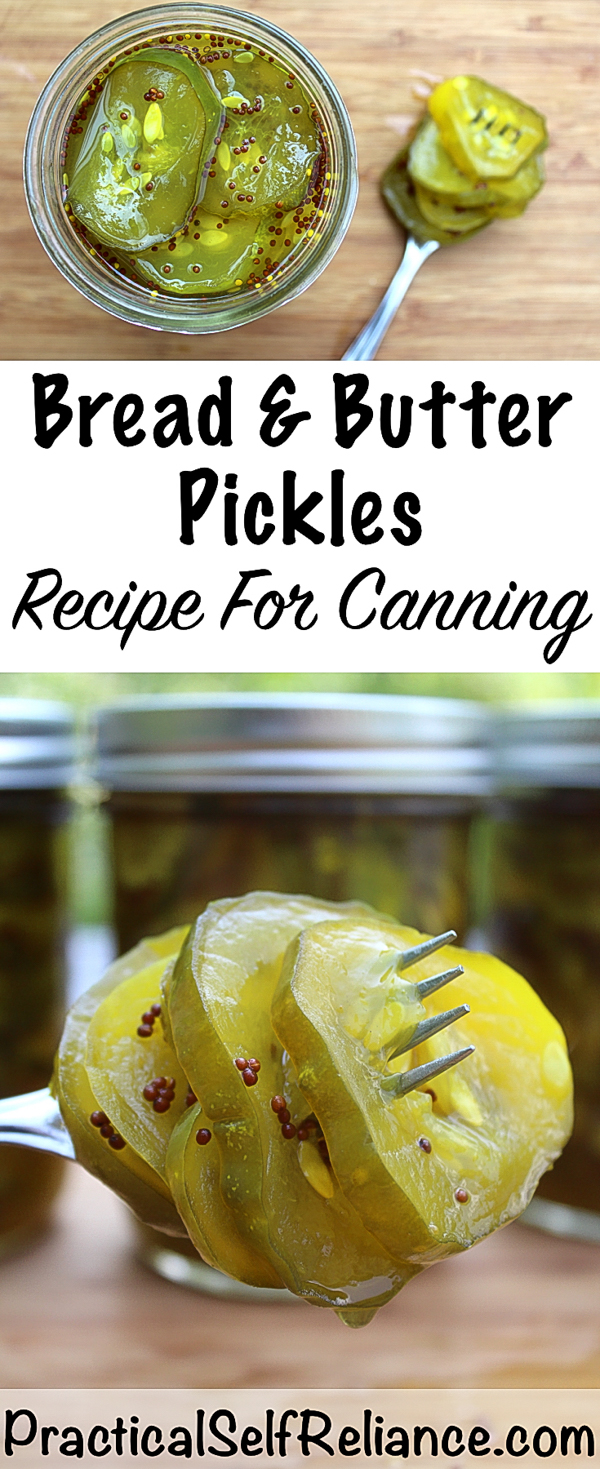
Every summer I make a huge batch of no sugar dill pickles with the tiniest cucumbers I can find. I save the monster cucumbers that get lost on the vine for sweet dill pickle relish, but that leaves me a lot of dill in my canning pantry. I searched for quite a while before stumbling across this bread and butter pickles canning recipe in my Ball Complete Book of Home Preserving.
I think what got me excited the most is the history behind bread and butter pickles. The story goes that a pair of Illinois cucumber farmers made it through the tough years by selling pickles to the local grocery in the 1920’s. They became known as “bread and butter pickles” simply because the farmers traded them for their bread and butter.
This bread and butter pickle recipe is special because it turns oversized cucumbers into flavorful pickles without bitterness. Generally, the best pickles come from the tiny sweet cucumbers, harvested before they’ve had time to fully develop seeds or bitterness. But what’s a farmer to do with all the monster cucumbers that get lost on the vine?
This recipe leaches the bitterness from the cucumbers soaking the cucumber slices in salt and then straining the liquid before canning. It’s the same process that’s used for removing the bitterness from other vegetables, like eggplant.
Soaking cucumber slices in salt to reduce bitterness and improve the texture of the finished bread and butter pickles.
The actual canning brine is both sour and sweet. Most pickle recipes use water and vinegar in the pickling brine, often in a 50/50 ratio. Bread and butter pickles are all vinegar with no water in the brine, but that sourness is balanced out with a heavy helping of sugar.
Even with 2 cups of sugar spread out across 5 pints of pickles, these bread and butter pickles don’t come across as too sweet. That’s because the sugar is balanced nicely by the vinegar, and any lasting bite the cucumbers still retain after a salt soak.
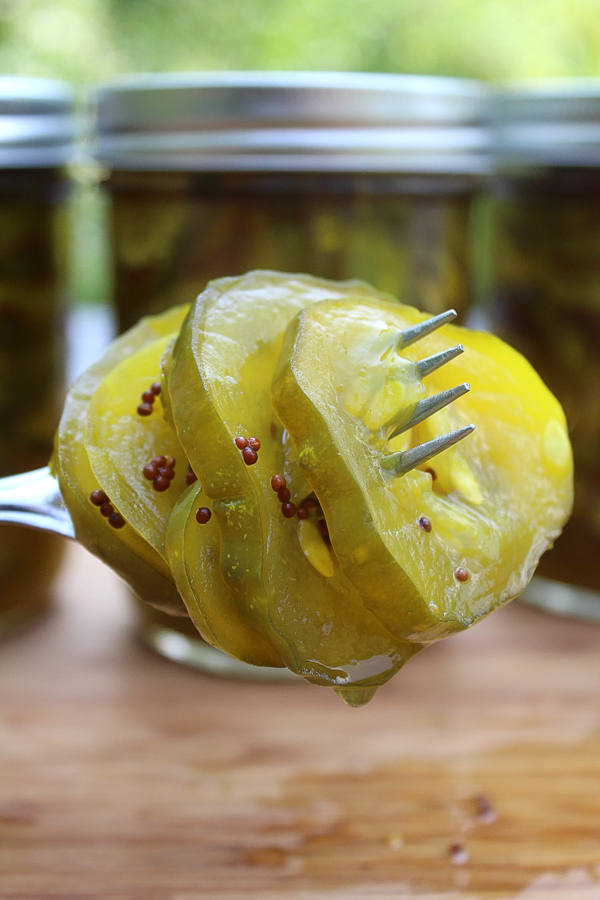
The spices are simple. Just mustard seeds for a tiny bit of heat, celery seed for a little umami and turmeric for warmth and color. Other recipe variations add horseradish and ginger to create spicy bread and butter pickles. Or as the ball book of canning calls them “zesty.”
Canning Bread and Butter Pickles
Start by slicing the cucumbers into uniform rounds, about 1/4 inch thick. Toss the cucumbers in salt, using 1/2 cup of pickling and canning salt for every 10 cups of cucumbers. Allow the cucumbers to soak in salt for 2 hours to pull out bitterness and extra liquid. This will result in sweeter cucumbers, and it also helps with texture.
Prepare a water bath canner along with canning lids and rings. In a separate pot, bring the bring ingredients including vinegar, sugar, mustard seeds, celery seeds and turmeric to a boil. Note that the brine doesn’t include any salt, but the cucumbers will be quite salty after their soak. There’s no need to add more to the brine.
Bring the brine to a boil, and while it’s heating, prepare the cucumbers by washing them in a colander. Remove as much of the salt and cucumber liquid as possible, and then add the cucumber slices and sliced onions into the boiling brine.
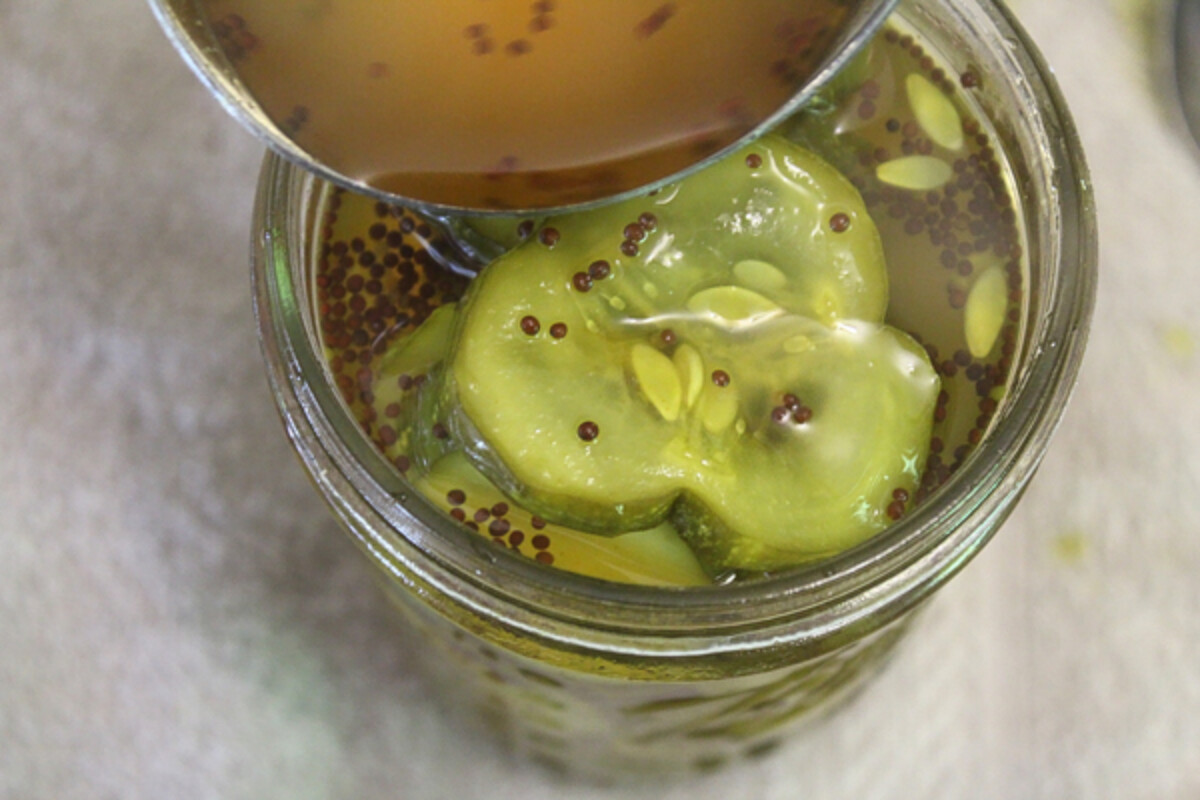
Allow the cucumbers to heat in the brine until the brine returns to a boil. Working quickly, pack the cucumber slices into jars leaving 1/2 inch headspace. Top with pickling brine, still leaving 1/2 inch of headspace.
Adding Brine to Bread and Butter Pickles
Seal the jars with 2 part canning lids to finger tight and process in a water bath canner for 10 minutes for pint jars (15 for quarts). Turn off the heat, but allow the jars to sit in the canner for another 5 minutes before removing them to cool.
Check the jar seals, and store any unsealed jars in the refrigerator. Home canned bread and butter pickles should last 18 months or more. Be sure to wait at least 2 weeks for the flavors to marry before trying your pickles.
Bread and Butter Pickle Variations
As with any pickling recipe, there’s the original traditional way to make the pickles and then there’s all manner of homegrown variations.So long as the vinegar, vegetables and processing time stay the same, you’re free to adjust just about anything else.
That includes both the sugar and salt, neither of which is used as a preservative in this recipe.Feel free to change up any of the spices to suit your preferences.Try less sugar if you’d like, or add a hint more or less salt.For sweet and spicy pickles, try adding red pepper flakes or black pepper.
The ball book of canning and preserving offers three variations that are commonly made in home kitchens.The British version has makes a darker pickle brine, and the brown sugar and cider vinegar add richness and character.The zesty bread and butter pickle recipe adds horseradish and ginger to help balance out the sweetness.The last variation, with garlic, just adds more flavor and umami to the pickles.
British Bread and Butter Pickles ~ Use cider vinegar instead of white vinegar, and brown sugar instead of white.Add in 1 tsp ground ginger along with the rest of the spices.
Zesty Bread and Butter Pickles ~ Skip the celery seeds and turmeric and add in 2 tbsp prepared horseradish and 2 tbsp freshly grated ginger root instead.
Garlic Bread and Butter Pickles ~ The ball book of canning says to add in 1 clove of garlic to each jar, but personally, I’d add in 3 to 4 cloves if you really want them to have a good garlic flavor.
This traditional bread and butter pickles recipe comes from the ball book of home preserving. It should yield 5 one pint jars of bread and butter pickles.
Start by combining cucumber, onions and salt in a non-reactive glass or stainless steel bowl. Toss the vegetables in the salt to fully coat and let them sit for 2 hours.
Prepare a water bath canner, jars and lids while the cucumbers are soaking in salt.
In a stainless steel saucepan, combine the remaining ingredients including vinegar, sugar, mustard seed, celery seed and ground turmeric. Note that all the salt in the recipe is used to soaking the cucumbers and is not added to the pickling brine.
Bring the pickling brine to a boil.
Strain the cucumbers and onions, and rinse them in the sink to remove most of the salt. Drain them thoroughly.
Add the strained vegetables to the boiling brine and allow the mixture to return to a boil.
Once the mixture has boiled, scoop the cucumbers and onions out of the brine and pack them into prepared canning jars leaving 1/2 inch headspace. Fill the canning jars with hot brine, still leaving 1/2 inch headspace.
Wipe rims, remove air bubbles and seal the jars with 2 part lids to finger tight.
Process in a water bath canner for 10 minutes and then turn off the heat and leave them to sit for another 5 minutes before removing the jars from the canner.
Allow the jars to cool completely before checking seals and removing canning bands for storage.
Notes
When canning pickles, it’s best to use pint jars because they require less cook time and result in crisper pickles. If you choose to use quart jars, add 5 minutes to the process time.
I'm an off grid homesteader in rural Vermont and the author of Practical Self Reliance, a blog that helps people find practical ways to become more self reliant.
Made these a couple weeks ago and just opened the 1st jar. These are hands down my favorite bread and butter pickle recipe ever! I will definitely be making more of them. Thanks so much!
Made these a couple weeks ago and just opened the 1st jar. These are hands down my favorite bread and butter pickle recipe ever! I will definitely be making more of them. Thanks so much!
Our first attempt at canning pickles, they turned out perfect! Excellent instructions that were easy to follow. We used quart jars and the pickles were so crisp and flavorful! Thank you so much for sharing. P.S. We thought the amount of sugar was perfect!
Our first attempt at canning pickles, they turned out perfect! Excellent instructions that were easy to follow. We used quart jars and the pickles were so crisp and flavorful! Thank you so much for sharing. P.S. We thought the amount of sugar was perfect!
So, how do I tell the difference between regular cucumbers in the garden and pickling cucumbers in the garden? I planted both, but the sticks with their names got lost through the season.
For those who want to do larger batches in quart jars: I used 20 cups of sliced cucumbers and one medium onion, and got 6 quarts. I used 8 cups vinegar (4 white; 4 apple cider) and 3 cups sugar (2 brown; 1 one). I added the turmeric into the vinegar, but I put 1 tsp mustard and 1/2 tsp celery seed directly into each jar for even distribution, as well as pickle crisp (1/4 tsp each jar). I had about 1/2 cup of brine left when I was done filling the jars. I like using bigger jars to make the most of my time and had a ton of cucumbers to process this year. I processed for 20 minutes as per my altitude. I don’t car if the pickles are super crisp – I mean, you’re boiling cucumbers, how crisp do they need to be? Anyway, thanks for all the details in recipes on how to alter recipes to your preferences. One of the best resources I’ve found for safe canning.
Hi Donna! Can I ask how much brown sugar you added as I like my pickles a bit sweeter as well? The cinnamon stick, garlic cloves and bell pepper sound great as additions as well! I can’t wait to try this recipe as my first time canning!
If my elevation is 1285 ft do I. need to adjust my cooking time? I am using the quart jars- which require 15 minutes….
These look great and thank you!!!
We had our cucumber plants in the garden explode with cucumbers. Found this recipe and being a canning novice was not sure about the result. I used the base pickle recipe and tried our first jar today. The pickles were divine!
We had our cucumber plants in the garden explode with cucumbers. Found this recipe and being a canning novice was not sure about the result. I used the base pickle recipe and tried our first jar today. The pickles were divine!
Although I rinsed, rerinsed, and rinsed again my end result pickle was a little salty. Will that dissipate with time or have a ruined my bread and butter pickles?
The “zesty bread and butter pickles” variation has 2 tablespoons prepared horseradish (along with the same amount of ginger) across 5 jars. That’s just a bit more than a teaspoon per jar of each, which is quite a bit with such strong spices.
When I read the recipe at the top you talk about just the cucumbers sitting in the salt for 2 hours. Then when I see the printed out recipe it states cucumbers and onions sit in the salt. I just did the cukes but am wondering which is the correct version.
You can do either. The cucumbers need to be in the salt for texture, the onions are optional. I actually forgot to do the onions in the salt when I was photographing this recipe and writing it up, and the onions were the same in the finished pickles. They can go either way, it’s the cucumbers that matter.













Can I use onion flakes instead of onions cut up?
That should work just fine.
Made these a couple weeks ago and just opened the 1st jar. These are hands down my favorite bread and butter pickle recipe ever! I will definitely be making more of them. Thanks so much!
Made these a couple weeks ago and just opened the 1st jar. These are hands down my favorite bread and butter pickle recipe ever! I will definitely be making more of them. Thanks so much!
You’re very welcome. So glad you enjoyed the recipe.
Our first attempt at canning pickles, they turned out perfect! Excellent instructions that were easy to follow. We used quart jars and the pickles were so crisp and flavorful! Thank you so much for sharing. P.S. We thought the amount of sugar was perfect!
Our first attempt at canning pickles, they turned out perfect! Excellent instructions that were easy to follow. We used quart jars and the pickles were so crisp and flavorful! Thank you so much for sharing. P.S. We thought the amount of sugar was perfect!
You’re very welcome. So glad you enjoyed the recipe.
So, how do I tell the difference between regular cucumbers in the garden and pickling cucumbers in the garden? I planted both, but the sticks with their names got lost through the season.
Pickling cucumbers tend to have thinner skin, bumps or spines on the skin and tend to be shorter and fatter.
For those who want to do larger batches in quart jars: I used 20 cups of sliced cucumbers and one medium onion, and got 6 quarts. I used 8 cups vinegar (4 white; 4 apple cider) and 3 cups sugar (2 brown; 1 one). I added the turmeric into the vinegar, but I put 1 tsp mustard and 1/2 tsp celery seed directly into each jar for even distribution, as well as pickle crisp (1/4 tsp each jar). I had about 1/2 cup of brine left when I was done filling the jars. I like using bigger jars to make the most of my time and had a ton of cucumbers to process this year. I processed for 20 minutes as per my altitude. I don’t car if the pickles are super crisp – I mean, you’re boiling cucumbers, how crisp do they need to be? Anyway, thanks for all the details in recipes on how to alter recipes to your preferences. One of the best resources I’ve found for safe canning.
Correction to above – just took jars out of canner and actually had 5 quart jars in there, not 6!
Can this recipe be used to make relish? I am looking for a bread n butter relish recipe. Thanks
As long as you use the same ingredients I don’t see any reason why you couldn’t make this into a relish.
I’ve been using this recipe for 4 years and love it. Wondering if you can use leftover brine if you have a lot left.
Do you mean the brine that is leftover in the jar after you have eaten the pickles or leftover brine that you didn’t use to can the pickles?
Hi Donna! Can I ask how much brown sugar you added as I like my pickles a bit sweeter as well? The cinnamon stick, garlic cloves and bell pepper sound great as additions as well! I can’t wait to try this recipe as my first time canning!
If my elevation is 1285 ft do I. need to adjust my cooking time? I am using the quart jars- which require 15 minutes….
These look great and thank you!!!
The correct processing time for pickles at your altitude is 15 minutes for both pints and quarts.
We had our cucumber plants in the garden explode with cucumbers. Found this recipe and being a canning novice was not sure about the result. I used the base pickle recipe and tried our first jar today. The pickles were divine!
We had our cucumber plants in the garden explode with cucumbers. Found this recipe and being a canning novice was not sure about the result. I used the base pickle recipe and tried our first jar today. The pickles were divine!
That’s wonderful to hear. So glad you liked them.
Although I rinsed, rerinsed, and rinsed again my end result pickle was a little salty. Will that dissipate with time or have a ruined my bread and butter pickles?
I would let them sit for a few weeks and then try them again. Once the flavors come together they may taste different.
I have a lot of regular cucumbers. Can I use those instead of the pickling kind?
Using larger cucumbers for canning will usually result in a mushy pickle. You can try a refrigerator pickle for these.
Newbie here! Any particular kind on onion to use? How would it change the taste if I omitted the onion?
Just regular white onions are fine but you could use any kind of onion. Omitting the onion will definitely change the flavor.
I am going to dig some horse radish and use that How much would you put in should I grind it or use slices?
The “zesty bread and butter pickles” variation has 2 tablespoons prepared horseradish (along with the same amount of ginger) across 5 jars. That’s just a bit more than a teaspoon per jar of each, which is quite a bit with such strong spices.
When I read the recipe at the top you talk about just the cucumbers sitting in the salt for 2 hours. Then when I see the printed out recipe it states cucumbers and onions sit in the salt. I just did the cukes but am wondering which is the correct version.
You can do either. The cucumbers need to be in the salt for texture, the onions are optional. I actually forgot to do the onions in the salt when I was photographing this recipe and writing it up, and the onions were the same in the finished pickles. They can go either way, it’s the cucumbers that matter.
Should I peel the cucumbers
No need to peel them.
My family prefers pickle spears, do you foresee a problem cutting the pickles into quarters lengthwise rather than rounds?
Nope! Spears are great!