
Affiliate disclosure: This post may contain affiliate links. Please see our Privacy Policy.
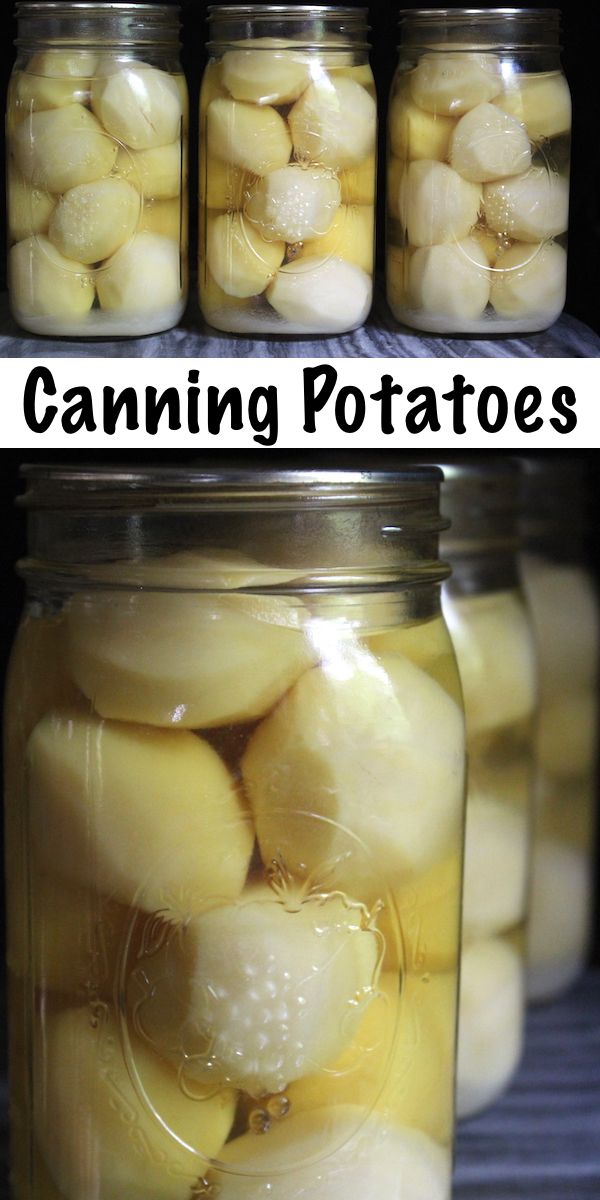
Canning potatoes puts peeled, precooked spuds on your pantry shelf, ready to heat whenever you need them. A jar turns into home fries, mashed potatoes, or a pot of stew in minutes, so dinner comes together on a busy weeknight with no peeling at all.
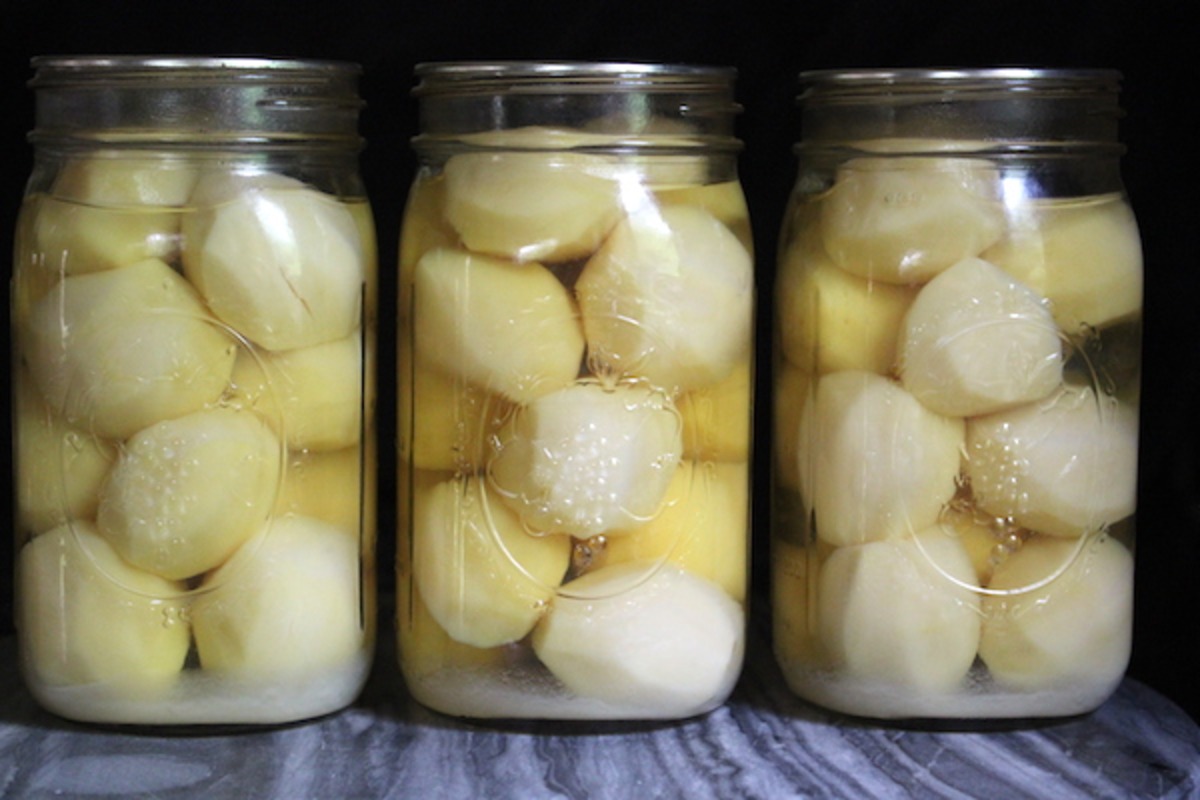
Table of Contents
- Notes from My Kitchen
- Choosing Potatoes for Canning
- Preparing Potatoes for Canning
- Ingredients for Canning Potatoes
- Safe Substitutions
- How to Can Potatoes
- Pressure Canning Potatoes
- Altitude Adjustments
- Ways to Use Canned Potatoes
- Storage and Shelf Life
- Yield Notes
- Canning Potatoes FAQs
- Vegetable Canning Recipes
- Canning Potatoes Recipe
- Pressure Canning Recipes
Small potatoes shrivel quickly in storage, and only the hardiest storage varieties last until the next crop comes in. Canned potatoes are already peeled and cooked, and they wait on the pantry shelf long after the stored ones have sprouted.
A lot of homes don’t have a spot cool enough to store potatoes at all, especially out west or in the desert. Without a root cellar, canning is a good way to keep a big harvest through the year.
Potatoes don’t have enough acid for a water bath canner, which only gets as hot as boiling water. That’s plenty for acidic foods such as jam and pickles, but low-acid vegetables need the higher heat of a pressure canner. If you’re new to pressure canning, start with my beginner’s guide to pressure canning.
If you’re filling the canner with root vegetables this fall, canning carrots and canning beets make good next batches, and there are plenty more in my vegetable canning recipes and pressure canning recipes. The potato canning recipes go well beyond plain jars, too, with soups, stews, and seasoned potatoes.
Notes from My Kitchen

I’ll can just about anything, but potatoes weren’t high on my list for a long time. Our basement stays around 50 degrees all year, which is on the warm side for a root cellar, but potatoes keep down there with very little work. Most years we put away about 200 pounds in the fall, and with two potato-loving kids in the house, that pile rarely lasts until June.
Then one year our garden gave us far more undersized potatoes than we could eat. We usually eat the little ones first, but there were just too darn many. I canned them out of sheer necessity, and I’m so glad I did. Those jars were a lifesaver on busy weeknights, and now they share the pantry shelf with the bone broth and pork stock we put up every year. Small potatoes may not keep in the basement, but in a jar they’re ready whenever we are.
Choosing Potatoes for Canning
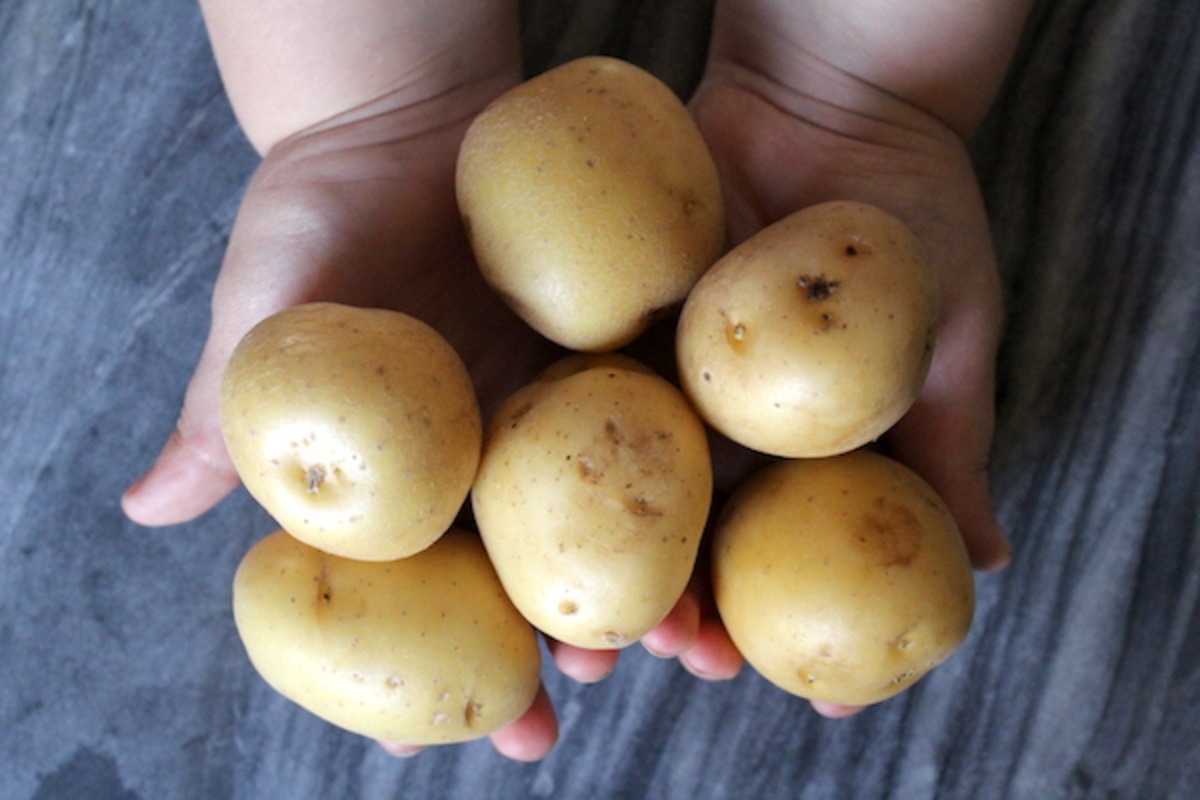
Waxy or boiling potatoes are the ones to can. They hold their shape through a long stretch in the pressure canner, while starchy baking potatoes break down into mush. Think of the potatoes you’d use for a firm potato salad, and you’ll be all set.
Most red-skinned potatoes work well, and so do many thin-skinned round white potatoes. Russets are too starchy for canning. In its notes on preserving potatoes, the National Center for Home Food Preservation adds that Yukon Golds can fall apart when they’re overcooked, and blue potatoes vary a lot from one variety to the next.
Smaller potatoes carry less starch than big ones, and they hold up better in the jars. If you grow potatoes, the little ones that turn up at harvest are the ones to can whole.
NCHFP also notes that potatoes that spent time below 45 degrees F in storage may discolor in the canner. Potatoes from a cold fridge or a chilly cellar can come out of the canner darker than you’d like.
Preparing Potatoes for Canning
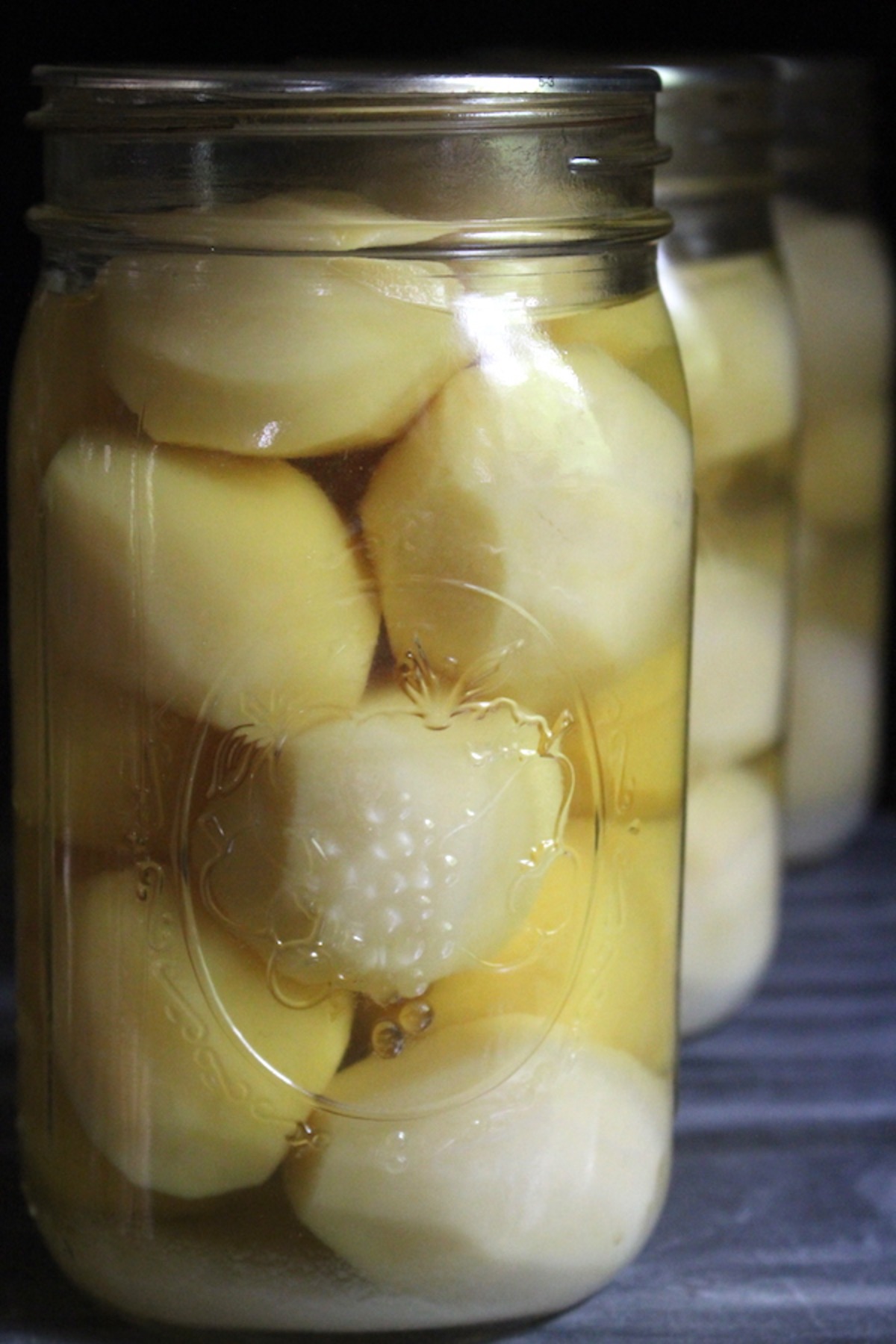
Peel every potato, even the little ones you’d usually cook with the skins on. USDA worked out the tested times with peeled potatoes, and NCHFP knows of no research on canning them with the peels on. Soil clings to potato skins, and soil carries microbes you don’t want sealed in a jar.
Peeling isn’t much more work than scrubbing, either. Homegrown potatoes come out of the ground covered in dirt, and getting every last bit off takes about as long as peeling. The skins would just slip off in the canner and float around the jar anyway. A sharp vegetable peeler makes quick work of a canner load.
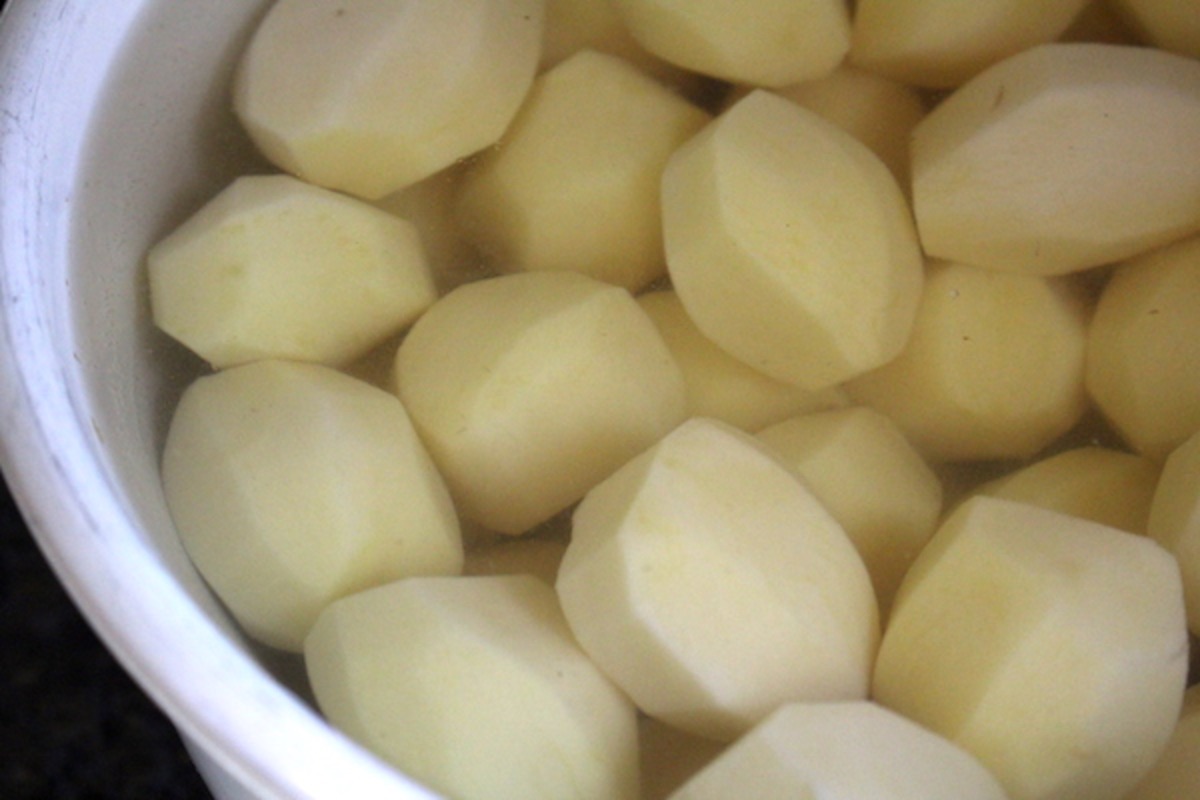
Cut larger potatoes into 1/2 inch cubes. Potatoes 1 to 2 inches across can stay whole, which is a nice way to use up the small ones at the bottom of the bin.
Peeled potatoes darken as they sit, so keep them in water while you work. NCHFP holds them in an ascorbic acid solution, which is pure vitamin C powder stirred into cold water. I just keep mine in a big bowl of plain water, and as long as they stay under it, they don’t brown.
Ingredients for Canning Potatoes
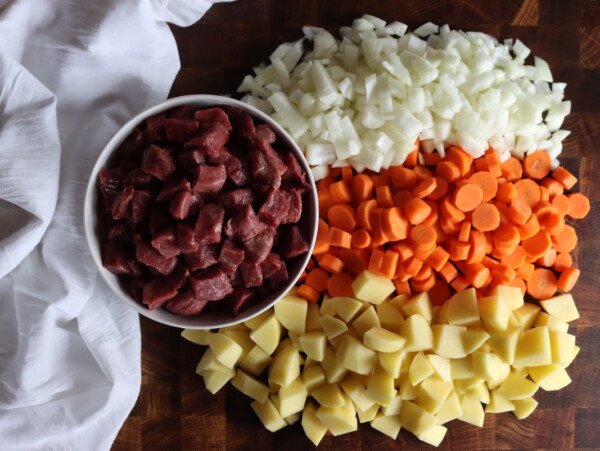
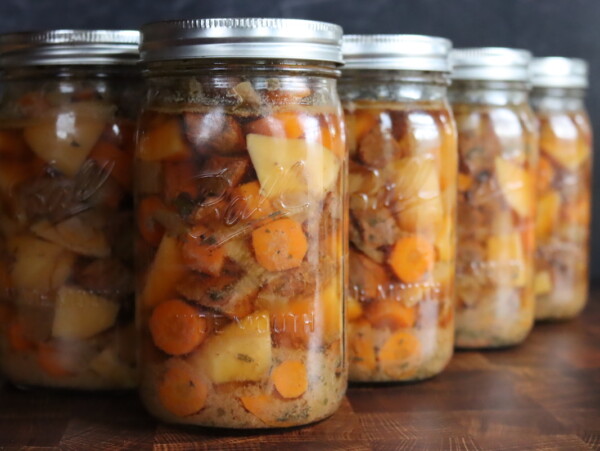
Readers often ask me about adding onions or broth to the jars. Those belong in a canning recipe written for the whole pot, like canning beef stew or potato leek soup.
Plain canned potatoes need only three ingredients.
- Potatoes: Waxy or boiling types, like most red-skinned potatoes and thin-skinned round whites. Can small new potatoes whole, and cube anything bigger.
- Water: Fresh boiling water to fill the jars, from its own pot. The precooking water is full of starch, so it stays out of the jars. It’s good in bread dough, though, or in a potato yeast starter.
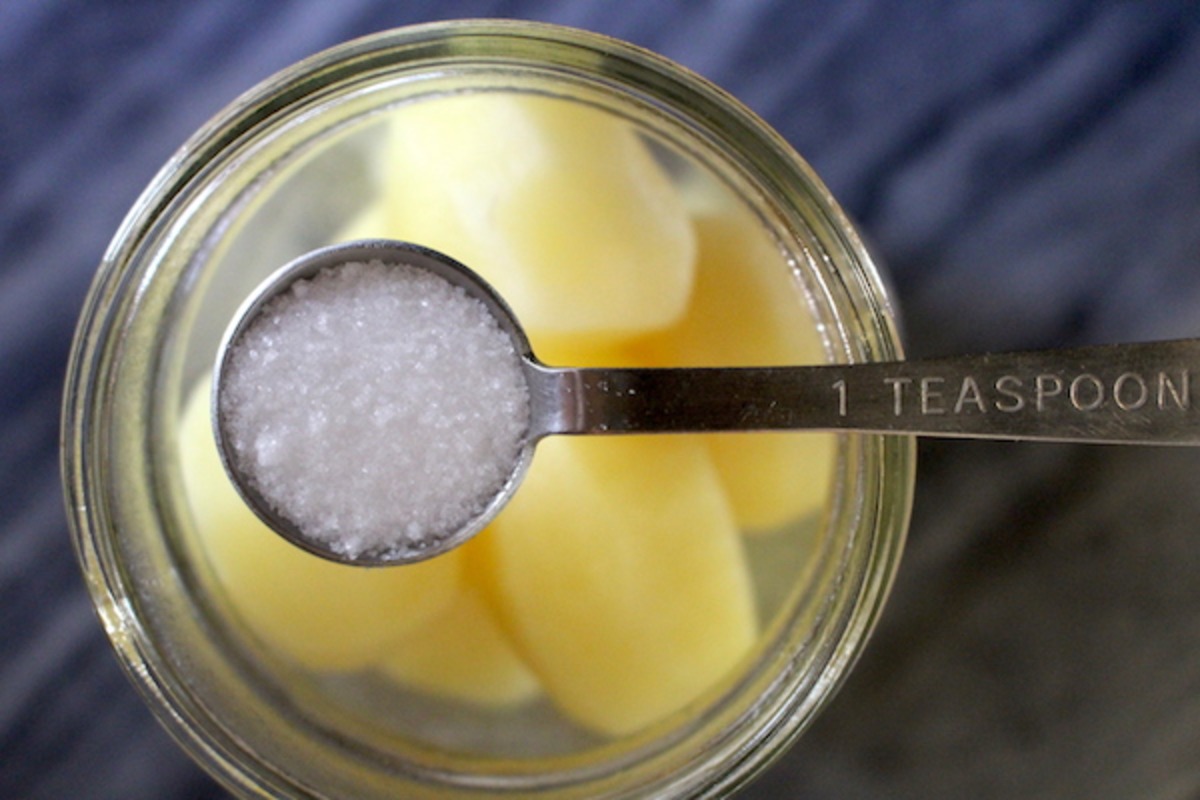
- Salt: Optional, and only for flavor. I always add it, because potatoes taste so much better with salt. Canning and pickling salt keeps the liquid clear, and a pure kosher salt works too. Skip iodized table salt, since its additives can cloud the jars.
Nothing else goes in the jar. Onions, garlic, butter, cream, flour, and spices all stay out, because the tested process is for potatoes in water.
Reading it exactly step by step, the way you explained everything, made me less nervous to try it. I have been nervous about it. Just wanted to say I appreciate it, and thank you.
Safe Substitutions
Safe changes: Pints or quarts, each with its own processing time, and half pints at the pint time. Cubes, small whole potatoes, or both in the same canner load. Salt in or out. Plain water or the ascorbic acid soak to keep peeled potatoes from darkening.
Not safe: A water bath canner, a shorter time or a lower pressure, unpeeled potatoes, or mashed, pureed, or riced potatoes. Butter, cream, flour, onions, and broth stay out of plain potatoes too, unless you’re following a canning recipe written with them. For more on what can and can’t change, see safe canning recipe changes.
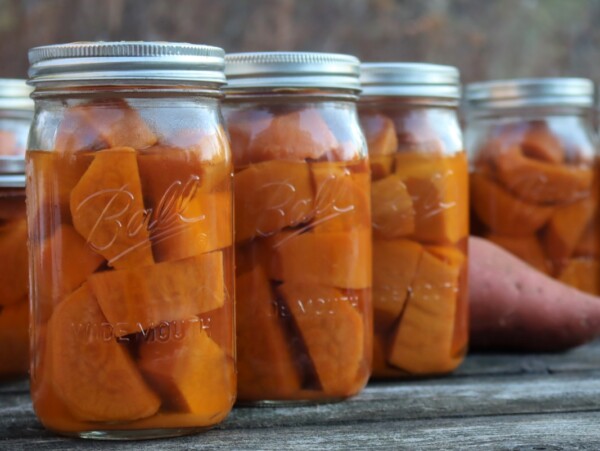
Sweet potatoes aren’t a swap for white potatoes. They have their own process and a longer time, so use the canning sweet potatoes recipe for them. Flavor plain potatoes when you heat them to serve.
How to Can Potatoes
Plain potatoes in water always go in as a hot pack. They get a short precook in boiling water, go into hot jars with fresh boiling water, and finish in the pressure canner. These steps follow the National Center for Home Food Preservation’s process for white potatoes, from the USDA Complete Guide to Home Canning.
With only one vegetable to prep and no sauce to cook, it’s a good first project for a new pressure canner. The peeling takes the longest.
Heat the Water
Set two large pots of water on to boil. One is for precooking the potatoes, and the other is clean water for filling the jars. Keep your clean jars hot until you fill them.
Get the pressure canner ready while the water heats. Follow your canner’s directions, which usually means setting the rack in the bottom and adding 2 to 3 inches of water. For a hot pack, heat that water to about 180 degrees F.
Precook the Potatoes
Drain the peeled potatoes and add them to the boiling pot. Start the timer when the water comes back to a boil, then cook 1/2 inch cubes for 2 minutes and whole potatoes for 10 minutes.
Lift them out with a large slotted spoon and leave the starchy water behind. The processing times are for potatoes packed hot, so go straight on to filling the jars.
Fill the Jars
Pack the hot potatoes into hot jars with a canning funnel, leaving 1 inch of headspace. Add the salt now, if you’re using it.
Ladle in the clean boiling water, covering the potatoes and keeping that 1 inch of headspace. Run a chopstick down the sides to release any trapped air bubbles, then wipe the rims and put on 2-piece lids, finger tight.
Pressure Canning Potatoes
Potatoes go in pints or quarts, and they’re always pressure canned. Load the jars onto the rack and lock the lid. Let a steady stream of steam vent for 10 minutes before you put on the weight or close the petcock.
Process pints for 35 minutes or quarts for 40 minutes at 10 pounds pressure in a weighted gauge canner or 11 pounds in a dial gauge canner, adjusting the pressure for your altitude with the chart below. Start the timer once the canner reaches pressure.
If the pressure ever drops below where it should be, bring it back up and start the timing over from the beginning. My weighted gauge canner holds its pressure with very little babysitting, but a dial gauge canner needs watching.
When the time’s up, turn off the heat and let the canner come back to zero pressure on its own. Remove the weight or open the petcock, wait 10 minutes, then take off the lid, tilting it away from you. Lift the jars out with a jar lifter.
Set the jars on a towel, not touching, and let them cool for 12 to 24 hours. Then check the seals, and refrigerate any jar that didn’t seal.
Don’t worry if the liquid drops a little and a few potatoes end up above it. In a sealed jar that’s only cosmetic, though the exposed tops may darken a bit. If it happens often, read up on the usual causes of siphoning.
Altitude Adjustments
With pressure canning, the canning time is always 35 minutes for pints and 40 minutes for quarts, at any altitude. Only the pressure changes as you go up.
For dial gauge pressure canners:
- 0 to 2,000 feet: 11 lbs pressure
- 2,001 to 4,000 feet: 12 lbs pressure
- 4,001 to 6,000 feet: 13 lbs pressure
- 6,001 to 8,000 feet: 14 lbs pressure
For weighted gauge pressure canners:
- 0 to 1,000 feet: 10 lbs pressure
- Above 1,000 feet: 15 lbs pressure
Not sure which band you’re in? Here’s more on altitude adjustments for pressure canning.
Ways to Use Canned Potatoes
Canned potatoes taste like freshly cooked potatoes, and they’re fully cooked, so they only need heating through. Warm them in their canning liquid on the stove, drain them, and top them with butter, sour cream, and chives for a quick side.
They make good home fries, too. Drain them well, pat them dry, and fry them in a hot skillet the same way you’d fry parboiled potatoes, until they’re brown and crispy.
For quick mashed potatoes, heat and drain a jar, then mash them with butter and milk using a potato masher. Cubed potatoes drop right into soups, chowders, and hash, and the small whole ones are ready for potato salad.
Storage and Shelf Life
Take the rings off sealed jars, label them, and store them in a cool, dark place. For best quality, use them within a year. After about a year, I find most pressure canned foods slowly lose quality, but sealed jars stay safe to eat as long as you processed them correctly.
Once a jar is open, keep it in the fridge and use it within 3 to 4 days. Any jar that didn’t seal goes straight into the fridge too, to use within the same 3 to 4 days.
If you’d rather keep a big harvest whole, a cool basement or a simple homemade root cellar holds potatoes for months.
Yield Notes
The National Center for Home Food Preservation figures about 20 pounds of potatoes for a canner load of 7 quarts, and about 13 pounds for 9 pints. A 50-pound bag fills about 18 to 22 quarts.
How you cut them changes the count. In my kitchen, cubed potatoes take just under 3 pounds per quart, while small whole potatoes take about 2 pounds, since they leave more space in the jar. Pack a jar with raw potatoes to check, and have a few extra ready, since they shrink a little in the precook.
My 30-quart All American pressure canner holds 14 quarts, and many smaller canners hold 7. The recipe scales by the jar, so halve or double it to fit your canner. Ball’s minimum for its pressure canned potatoes is 4 pints or 2 quarts in the canner at once.
If you add salt, use 1 teaspoon per quart or 1/2 teaspoon per pint. For the ascorbic acid soak, NCHFP uses 1 teaspoon of pure ascorbic acid powder per gallon of cold water.
Canning Potatoes FAQs
These are the questions readers ask me most often about canning potatoes.
No. Potatoes are a low-acid vegetable, and a water bath canner only gets as hot as boiling water, no matter how long the jars boil. Low-acid foods need the higher heat of a pressure canner, so potatoes always call for pressure canning.
Yes. The tested times are for peeled potatoes, and NCHFP knows of no research on canning them with the skins on. Soil clings to potato skins, and the skins slip off in the canner anyway, so peeled potatoes come out cleaner and look much nicer in the jar.
Plain potatoes in water are a hot pack only, so give them the short precook first. The All New Ball Book of Canning and Preserving does have three raw pack potato recipes on p. 278: Herbed, Chipotle, and Mediterranean Potatoes, packed raw with seasonings and covered with hot broth. They process for the same 35 minutes for pints and 40 for quarts. If you’d like potatoes in broth, follow one of those recipes exactly as written.
Some liquid loss is common with potatoes, since the starchy pieces soak up a little of it. Pressure that swings up and down during processing, a canner cooled too fast, air bubbles left in the jars, and jars packed too tightly also cause it. If the jar sealed, the potatoes are fine to eat, though the ones above the liquid may darken. Don’t open sealed jars to add more water. If a jar lost half its liquid or more, Penn State Extension says to refrigerate it and use it within 2 to 3 days. There’s more on liquid loss in canning if it keeps happening.
Sealed jars keep their best quality for about a year in a cool, dark place, and they stay safe to eat after that as long as you processed them correctly and the seal holds. Once a jar is open, keep it in the fridge and use it within 3 to 4 days.
Vegetable Canning Recipes
More vegetables to put up for the pantry.
If you tried this Canning Potatoes recipe, or any other recipe on Practical Self Reliance, leave a ⭐ star rating and let me know what you think in the 📝 comments below!
And make sure you stay in touch with me by following on social media!
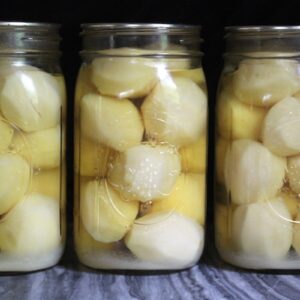
Canning Potatoes
Equipment
- Canning Jars, Lids, and Rings
Ingredients
- 20 lbs potatoes, as purchased, see notes
- water, fresh and boiling, to fill the jars
- canning salt, optional, 1 tsp per quart or 1/2 tsp per pint
Instructions
- Bring two large pots of water to a boil, one to precook the potatoes and one of fresh, clean water to fill the jars. Keep the jars hot until you fill them.
- Peel the potatoes. Cut larger potatoes into 1/2 inch cubes, and leave potatoes 1 to 2 inches across whole. Keep them under water as you work so they don’t darken (see notes).
- Get the pressure canner ready following the manufacturer’s directions, usually with the rack in place and 2 to 3 inches of water heated to about 180°F (82°C).
- Drain the potatoes and add them to the boiling pot. Once the water comes back to a boil, cook cubes for 2 minutes and whole potatoes for 10 minutes. Drain them, and keep the starchy cooking water out of the jars.
- Pack the hot potatoes into hot pint or quart jars, leaving 1 inch headspace. Add salt using the per-jar amounts in the ingredient list, if you like.
- Cover the potatoes with the fresh boiling water, keeping 1 inch headspace. Remove air bubbles, wipe the rims, and put on 2-piece lids, finger tight.
- Load the jars into the canner, lock the lid, and vent steam for 10 minutes before adding the weight or closing the petcock.
- Bring the canner up to pressure and start the timer once it gets there. Process pints for 35 minutes and quarts for 40 minutes at 10 lbs in a weighted gauge canner or 11 lbs in a dial gauge canner, adjusting for altitude (see notes).
- If the pressure drops below that at any point, bring it back up and start the timing over from the beginning.
- Turn off the heat and let the canner return to zero pressure on its own. Remove the weight or open the petcock, wait 10 minutes, then take off the lid, tilting it away from you, and lift the jars out.
- Cool the jars on a towel, not touching, for 12 to 24 hours, then check the seals. Refrigerate any jar that didn’t seal.
Notes
- 0 to 2,000 feet: 11 lbs
- 2,001 to 4,000 feet: 12 lbs
- 4,001 to 6,000 feet: 13 lbs
- 6,001 to 8,000 feet: 14 lbs
- 0 to 1,000 feet: 10 lbs
- Above 1,000 feet: 15 lbs
Nutrition
Nutrition information is automatically calculated, so should only be used as an approximation.
Pressure Canning Recipes
Broth, meat, and more for the pressure canner.
Find the perfect recipe
Searching for something else? Enter keywords to find the perfect recipe!










I just had an oops moment. Four years ago I canned potatoes for the first time. I canned white and red which were given to me. I peeled and cubed some of them, peeled and cut for scalloped potatoes, peeled small potatoes and left them whole, cubed unpeeled potatoes for stew and left small unpeeled potatoes which I canned. I washed the dirt off outside, rinsed them in the dishwasher and then washed the unpeeled again with a vegetable brush and peeled the rest. I had not read canning unpeeled potatoes was a no-no. In the meantime I have used the cubed, unpeeled potatoes multiple times when making vegetable beef soup. And I also used up all the jars of potatoes I cut for scalloped potatoes. We didn’t get sick. Now I have just been given a large quantity of potatoes again. Did I just have good luck the first time leaving on the skin or is it safe if one is diligent in preparation?
I would personally recommend that you peel all of your potatoes to be on the safe side. It’s possible that you may not get sick but I wouldn’t want to risk it myself. Botulism can be fatal. It’s good that you didn’t get sick before but now that you know the safe way to can potatoes I think it’s a good idea to follow those guidelines.
Thank you for your post Ashley. It is very informative and detailed. I have never used a pressure canner but I am hoping to buy one soon. When using the water bath method we are instructed to cover the filled jars with water (approx 1-2” above the jar) before starting the cooking process. I noticed the instructions for pressure canning potatoes suggested adding 2” of water to the bottom of the canner then add the jars. I am assuming no additional water is required. I Just wanted to make sure I didn’t miss something. Thank you.
Yes, that is correct. If the water depth is not specified then the standard depth is 2 to 3 inches.
I do not discard the water I boil my potatoes in, I cook it and use it to make bread.
That’s great! Thank you for sharing.
This is not my norm but. We got a deal on 50# of Yukon gold potatoes, what does a couple do with 50# of potatoes. Can them. I followed your instructions which included blanching the prepared potatoes. I cut them in large chunks, I sliced them and I cut them to use in soups and strews. I put them in 1.5 pint jars and put boiling (fresh) water up to 1 inch. 7 jars, processed them at 11 # for 40 min. They are completely cooked and almost NO liquid left in the jar. Where could it have gone. Could the potatoes absorbed it? Side note, I coursely mash one jar mixed with egg and fried them. With a mushroom gravy or sausage gravy. Yes I’ll keep on canning
Sounds like you had siphoning occur, which isn’t the end of the world if it’s minimal, but potentially a problem if you lost ALL the water in the jar. Here’s some info about potential causes: https://www.healthycanning.com/loss-of-liquid-during-home-canning/
I have canned my first batch of potatoes following the instructions above. I had water covering the potatoes when I put them in the pressure canner. Now, after having them in the canner for 35 minutes, in most of the jars the waterline is about 1/2″ to 1″ below the potatoes. Is this ok? Or did I do something wrong?
I just read the comment before mine. I scrolled too quickly and missed it. I followed the instuctions so my potatoes are probably ok.
Total 11 lbs was 40 min. 25min then reset forv15 min. After it dropped to 9 lbs.
So I actually had to look this up! I have a weighted guage canner (which holds pressure better with less babysitting) and I’ve never had it drop below pressure during canning…so I’ve never really had this problem.
Here’s what I found: “If the pressure drops during processing, you must bring it back up to pressure and start the processing timing all over again. Not the preliminary venting time, but the called-for processing time. “The correct gauge pressure must be maintained for the entire processing time. If the pressure drops below the target pressure, reset your timer and process for the entire recommended processing time.” Source here: https://www.healthycanning.com/pressure-canning-step-by-step/
I canned potatoes today. 5 quarts. This is the first time they turned a yellow golden color. We do have minerals in our water. Also I brought it to 11 lbs of pressure. Noticed when there was 4 min left the pressure dropped to 9 lbs. So I brought it back up to 11 lbs. Timed for 15 more minutes. I know it stayed at 11 lbs pressure for at least 25 min. Should they be ok?
What exact type of potato do you use?
I canned my potatoes and the water level is lower than the potatoes. Is this something that should be eaten more quickly, like green beans? I’ve never canned them before and am not sure what happened. I followed all the steps. I don’t want to pitch them after all my hard work but don’t want tp make anyone sicl either.
As long as you have processed them correctly they should be fine.
I have never considered canning potatoes, mainly because I never grew them, but this year I have a nice crop of SWEET potatoes and would like to can the surplus in my new pressure caner. Is canning sweet potatoes the same as canning white potatoes?
Also, I read above about someones potatoes going green. Can sweet potatoes that have come partially to the surface be bitter or unsafe to eat? Can I just cut off the green end and prepare as usual? Thanks so much for all your wonderful articles!
~Lynda
Here is an article from the Penn State Extension office that tells you the procedure for canning sweet potatoes. https://extension.psu.edu/lets-preserve-potatoes-and-sweet-potatoes
And here is an article that talks about the green on potatoes. Basically, if it is just a small amount then it is probably ok to cut it off and prepare as long as there is no bitter taste and the article also advises to use special care when serving children.
https://www.canr.msu.edu/news/is_it_safe_to_eat_a_green_potato
I’m curious because my Ball Canning andPreserving book actually has a recipe for raw packed pressure canned potatoes. It’s titled “Mediterranean potatoes.” I’m wondering if anyone has tried it previously. The book was published in 2016.
If it is a current tested recipe then it should be good. If you have any questions about it, you could probably contact Ball directly.
Have canned for many years using water bath method. Got a pressure canner and tried canning potatoes for the first time read many directions and followed exactly. My potatoes went into canner looking beautiful and came out looking awful…a pinky/orangy color. I have been researching to see what I did wrong but to no avail. Used a Ruset type potato bc I had many free given to me but needed to be taken care of. Help? What went wrong??
Hmmm…That is strange. Some veggies I’ve heard can react with minerals in the water and change color. It might be your tap water? Try using bottled or distilled water and see if that helps? I’m guessing though, as I’ve never had that problem.
I guess we didn’t plant our potatoes deep enough because our red potatoes taste bitter close to the skin. Is there any way we can save them?
To the best of my knowledge, once they start going green there’s no way to save them. I could be wrong, but that’s what I’ve heard…
Ann, are you hilling your potatoes so the sun doesn’t get at them? You need them well hilled to protect the potatoes from the sun.
I’d really like to can potato’s again. I did it years ago and would like to teach my daughter. I was wondering how things changed. I’d like to use this recipe so I’m sure I am doing it as safe as possible.
Any chance you can recommend a good electric potato peeler. My hands and fingers have some arthritis. How can I save this recipe.
I have never tried an electric potato peeler. If your daughter is old enough, maybe she can help peel them.
Do you let your potatoes dry out any from the garden or go from garden to canning? Thanks
Good question. I’ve always let them dry and then canned them. It honestly didn’t occur to me to try it with new potatoes. I imagine it’d be fine? But I honestly have no idea.
Thanks for sharing! How long does a jar last after its been opened?
Hi, Vanessa! They can last for 3 or 4 days in the refrigerator.
This is so helpful! I was wondering why it was more beneficial to can potatoes can than store in the root cellar!
A couple of reasons…small potatoes don’t tend to store too well in root cellars. Beyond that, many people don’t have a space cool enough to store potatoes (out west, or in the desert, etc). But if you have a root cellar, that’s a great option instead of canning.
When you say “pre-cook” does that mean to put your potatoes in the boiling water and leave for 10 minutes? Or, put your potatoes in the boiling water and bring potatoes and water back up to boiling and boil 10 minutes?
Thanks for all the details that you added.
Debbie
Bring the water to boiling, add potatoes, and then start the timer when it comes back to a boil. Thanks for asking, I should have clarified.
I am about to start pressure canning and I was just wondering how much the taste is altered after canning. Do they taste like freshly cooked potatoes, or reheated potatoes, or completely different? I love your instructions — thank you!
They taste like freshly cooked potatoes, and I’ve found they can even be fried as home fries, in the same process we use when we parboil potatoes then strain and fry them. It’s like right after the parboiling step.
I am fairly new to canning and my canner is not like others in most recipes. It has a dial gauge but no indications of pounds, just high or low. How would I convert the chart to that?
And thank you for the very clear instructions for something that may seem intimidating to a new canner. The were very easy to understand without being mundane.
It sounds like you have a “pressure cooker” rather than a “pressure canner” and I wouldn’t recommend trying to pressure can in it. Pressure cookers don’t maintain exact pressures and they fluctuate through a pretty wide range on either high or low. There’s no guarantee you’ll properly process food in one, since it’s not designed to maintain certain pressures without dipping below (because that’s not necessary for cooking, only for canning).