
Affiliate disclosure: This post may contain affiliate links. Please see our Privacy Policy.
Highbush Cranberry is a cluster of three closely related Viburnum species (V. trilobum, V. opulus, and V. edule) that produce bright red cranberry-like berries on shrubs rather than on the spreading vines of true cranberries. Two of the three species produce edible, vitamin-C-rich fruit that’s been a traditional food across northern North America for centuries, and all three have a medicinal bark called crampbark that’s been used to treat muscle cramps, menstrual cramps, and tension since at least medieval times. Learn how to identify highbush cranberry, distinguish the three species, harvest the fruit, and make a traditional crampbark tincture.
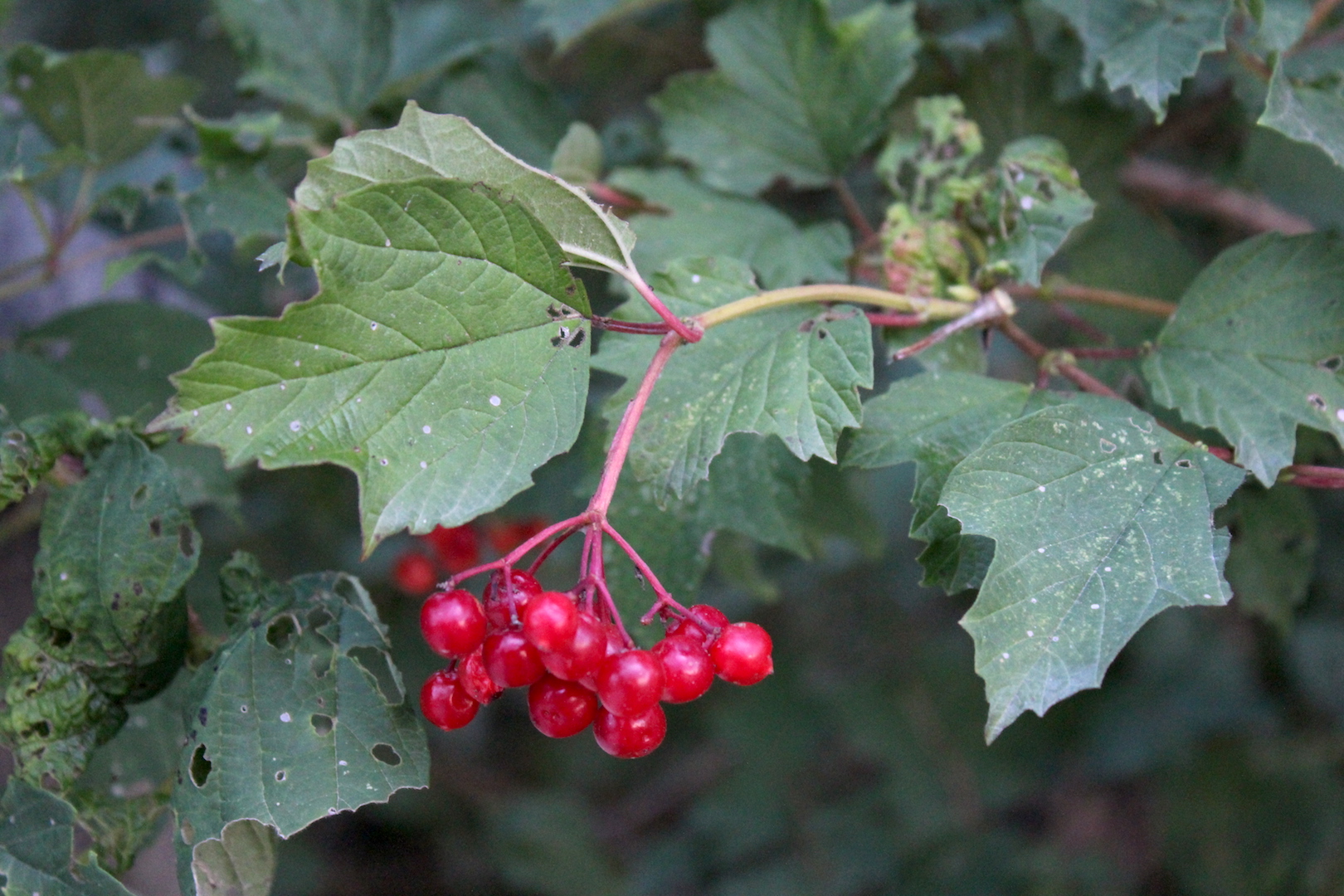
Table of Contents
- Notes from My Homestead
- What Is Highbush Cranberry?
- Three Species of Highbush Cranberry
- Is Highbush Cranberry Edible?
- Where to Find Highbush Cranberry
- When to Find Highbush Cranberry
- How to Identify Highbush Cranberry
- Highbush Cranberry Look-Alikes
- How to Harvest Highbush Cranberry
- Ways to Use Highbush Cranberry
- Highbush Cranberry Medicinal Uses
- How to Make Crampbark Tincture
- Edible Viburnums
- Highbush Cranberry FAQs
- Herbal Tincture Guides
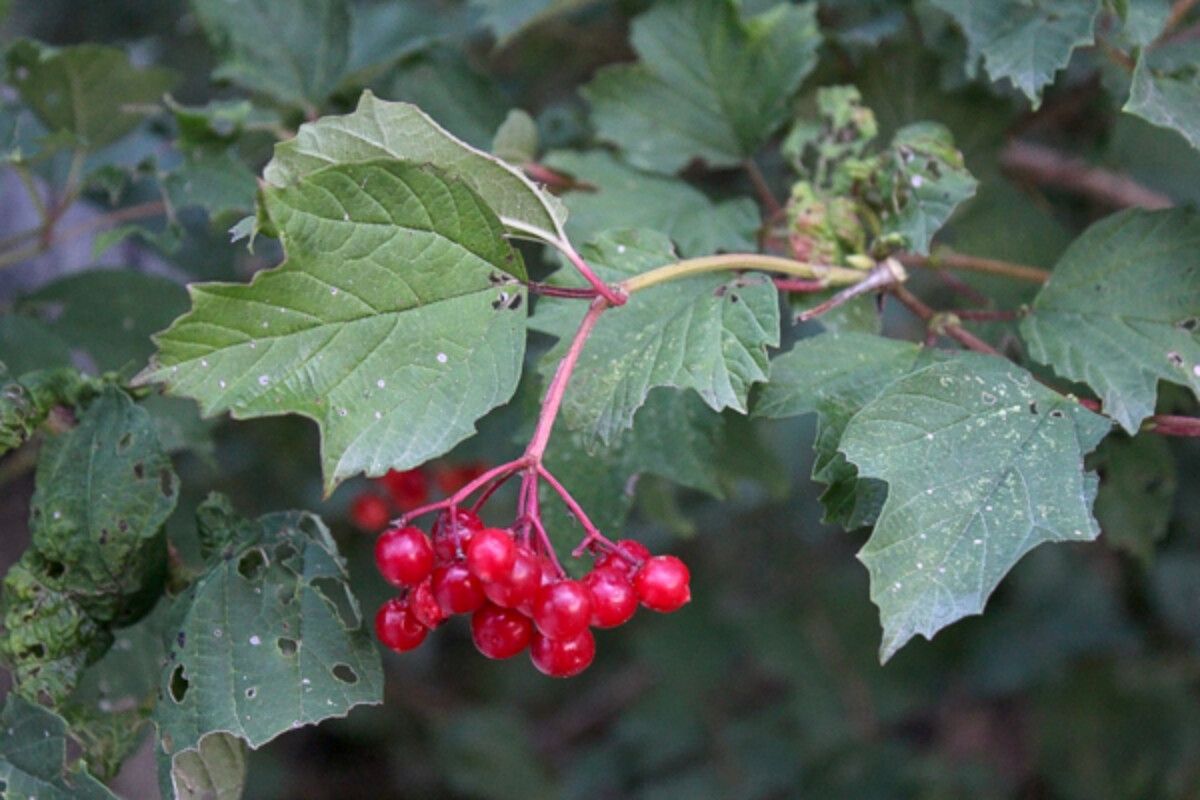
Every fall the hedgerows are filled with color in my neighborhood. Thimbleberries and wild plums dot the roadside, and the clusters of bright red highbush cranberry are visible from a distance.
I’d seen those bushes every fall for years and never gotten around to harvesting. In early September there are so many wild edibles, and they never made it to the top of my list. Then I learned that the bark of highbush cranberry is a potent medicinal, and that got me out foraging the very next day.
Notes from My Homestead

Highbush cranberry has become one of those plants I check on every September during my fall foraging tour. There’s a productive stand at the edge of an old hayfield down the road from us, and over the years I’ve learned to identify the individual bushes by taste before I commit to harvesting. The good ones (likely V. trilobum, the native American highbush cranberry) make beautiful jelly that captures the wild tartness alongside the cranberry-meets-currant flavor that’s distinctively northern. The bushes nearby that look almost identical but produce barely-edible bitter fruit are V. opulus, the European Guelder Rose, escaped from old ornamental plantings.
Mostly we use the fruit for jelly, since the large flat seeds make jam impractical. The bark goes into crampbark tincture, which has become a regular part of my home herbal kit, and a small bottle lives in the bathroom cabinet for when I have menstrual cramps or muscle spasms. As with anything medicinal I make at home, I’m cautious about claims and careful about dosage; this is supplemental, not a substitute for medical care, but for everyday muscle tension the tincture genuinely works for me.
What Is Highbush Cranberry?
As a child, I always imagined cranberries grew on bushes, in much the same way as blueberries. True cranberries (Vaccinium sp.) are actually a spreading groundcover with long thin tendrils. The “cranberries” that grow on bushes aren’t technically cranberries at all, but a group of Viburnum species that happen to produce somewhat edible fruit that resembles a cranberry in color and tartness.
So highbush cranberry is not a true cranberry. It’s a fall-fruiting shrub in the family Adoxaceae (formerly placed in Caprifoliaceae), and the bright red, slightly translucent berries growing in flat clusters on shrubs 10 to 15 feet tall are technically drupes, each containing a single large flat seed. They look like cranberries, taste somewhat like cranberries, and ripen at roughly the same time of year, which is why early settlers called them “highbush cranberries.”
The plant goes by several other common names depending on region: highland cranberry, cranberry tree, cranberry bush, American cranberry bush, squashberry, mooseberry, pembina, and (for the European species) Guelder rose. The medicinal bark is called crampbark in herbal medicine, regardless of which highbush cranberry species it comes from.
Three Species of Highbush Cranberry
This is where things get confusing. There are three species of plant called “highbush cranberry” growing in North America, and they look so similar that without flowers (or a botany degree) they’re nearly impossible to tell apart by eye. Two of the three are highly palatable; one is bitter and considered inedible by most foragers. They readily hybridize where their ranges overlap, which makes positive identification even harder.
The practical takeaway is one I learned the hard way the first time I went out to forage these: always taste-test every bush before you commit to harvesting. The species can grow side-by-side along a single hedgerow, and the tasty native bush you remember from last year might be next to a bitter ornamental escapee.
American Highbush Cranberry (Viburnum trilobum)
Viburnum trilobum is a highbush cranberry species native to the northeastern and north-central United States and southern Canada. The fruit is tart, bright red, and rich in vitamin C. It tastes a lot like cranberries, with one large flat seed inside instead of the many small seeds of a true cranberry. The fruit was a traditional food of many Native American peoples and is still made into jams, jellies, syrups, sauces, and pies today.
Modern taxonomy has reclassified V. trilobum as Viburnum opulus var. americanum, treating it as the American variety of the same species as the European Guelder rose. You’ll see both names used in field guides and gardening references; the older name V. trilobum is still the more common one in foraging literature.
Cultivars of V. trilobum include ‘Alfredo,’ ‘Wentworth,’ ‘J.N. Select,’ and ‘Compactum’; these have been bred for landscape use, sometimes for sweeter or more abundant fruit. If you’re buying a highbush cranberry shrub for the home garden, ask for the American native (V. trilobum or V. opulus var. americanum) by name to make sure you’re getting the edible species.
European Highbush Cranberry / Guelder Rose (Viburnum opulus)
Viburnum opulus (the European species, also called Guelder Rose) is native to Europe and western Asia and was introduced to North America in ornamental plantings, where it has naturalized in many areas and readily hybridizes with the American V. trilobum. The fruit looks nearly identical to the American species but is bitter, astringent, and considered inedible by most foragers. It’s listed as edible in small quantities but potentially toxic in larger amounts; the side effects of eating any quantity are diarrhea and vomiting.
Interestingly, V. opulus berries are traditionally consumed in parts of Eastern Europe (especially Russia, Ukraine, and the Baltic states) after a hard frost, which reduces the bitterness. The plant is called kalina in Russian and Ukrainian and is a culturally significant fruit, made into jams, syrups, and jelly that are considered medicinal as well as food. So it’s not strictly inedible everywhere, but in North American foraging contexts the consensus is that the American V. trilobum is the better-tasting species.
V. opulus is the most-documented source of crampbark in Western herbalism. The herbal references that talk about crampbark traditionally point to the European species, though the medicinal compounds appear in all three highbush cranberry species.
Squashberry / Mooseberry (Viburnum edule)
Viburnum edule is the highbush cranberry species native to the northern parts of the United States and across most of Canada and Alaska. It’s commonly called squashberry, mooseberry, or pembina. This is widely considered the best-tasting of the three highbush cranberry species, with sweeter, less astringent fruit that’s prized in northern and Pacific Northwest foraging traditions.
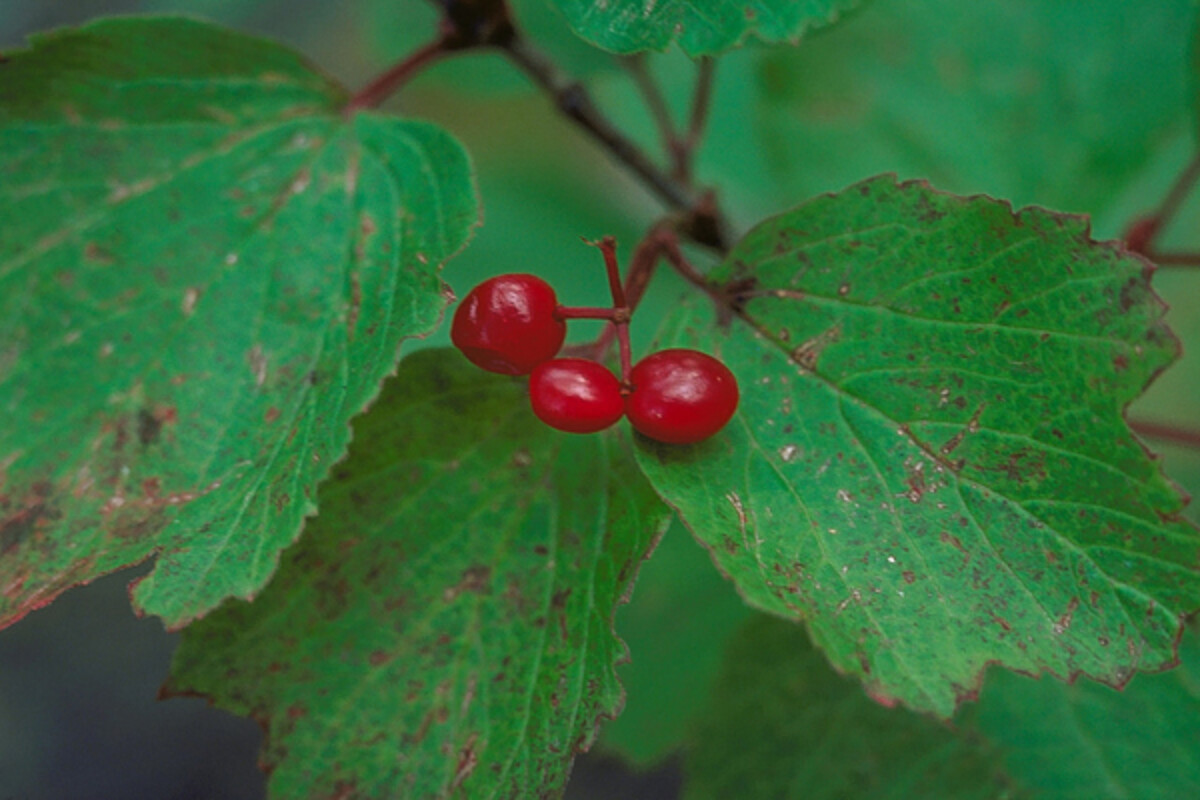
V. edule is the dominant highbush cranberry across Alaska and northwestern Canada, where it’s a regional staple for jelly, syrup, juice, ketchup, and traditional preserves. Identification clue: V. edule tends to grow as a smaller shrub than the other two species (typically 3 to 6 feet tall, sometimes up to 12 feet), and the fruit clusters are often smaller (groups of 2, 3, or 4 berries) rather than the larger flat clusters of V. trilobum and V. opulus.
Is Highbush Cranberry Edible?
The fruit of Viburnum trilobum (American highbush cranberry) and Viburnum edule (squashberry) is fully edible and considered a desirable foraged fruit. The fruit of V. opulus (European highbush cranberry / Guelder rose) is bitter and considered inedible to unpalatable in raw form by most foragers, though it’s traditionally used in eastern European cuisine after frost and cooking.
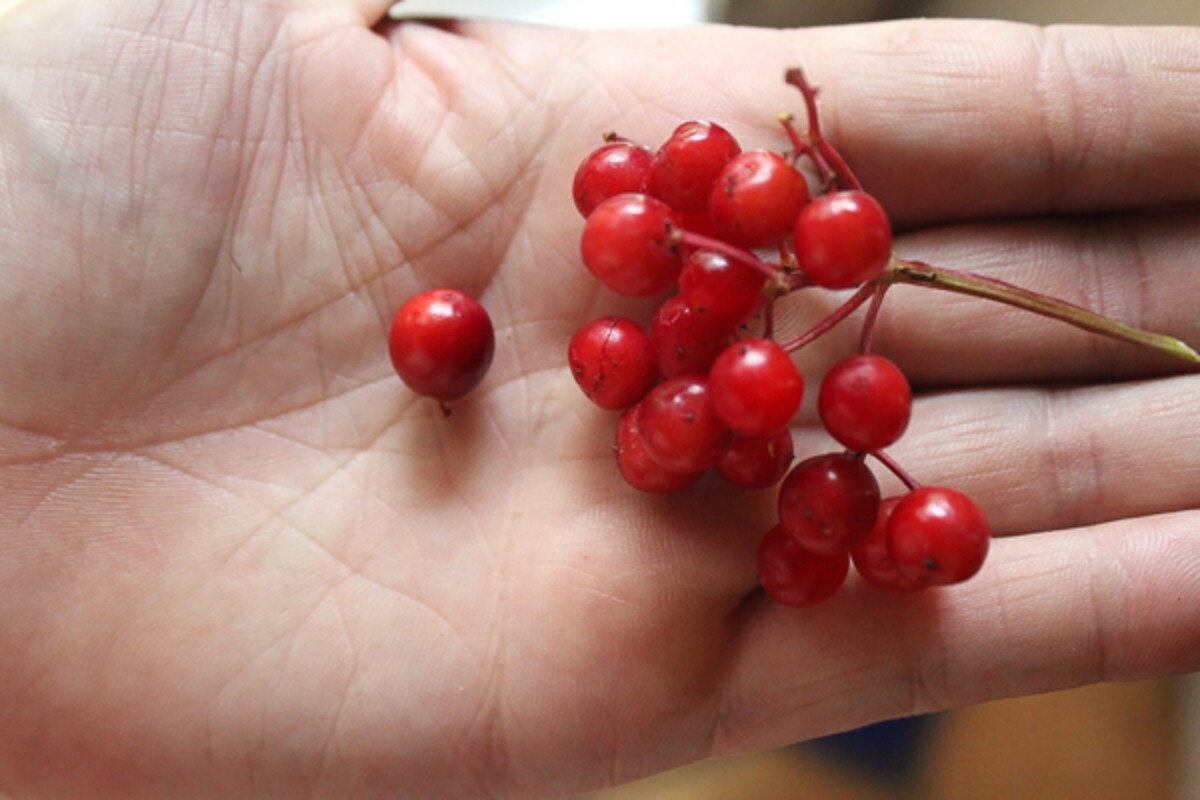
The first time I went foraging for highbush cranberry I tentatively bit into one and spit immediately. I spit five more times, and the first time I swallowed the tiny bit of residue in my mouth made me regret it. Looks like I’d definitively found a V. opulus. The bush was in a spot that had gone a bit wild on the roadside, but given the location, I could believe that it had been part of an ornamental planting at some point in the past. It had the fullest clusters of berries and was by far the showiest plant I came across. Beware that, I guess, if the highbush cranberry is too pretty that might be a warning sign.
I also ran across a number of other scrubbier highbush cranberries down the same hedgerow. One of them was notably different. The berries came in small clusters, groups of 2, 3 or 4. The individual berries were also larger and rounder than the ones on the showy bush. I tentatively gave it a bite, and it was tasty. Sour and acidic, but definitely not the same poison taste that I’d had in my mouth earlier.
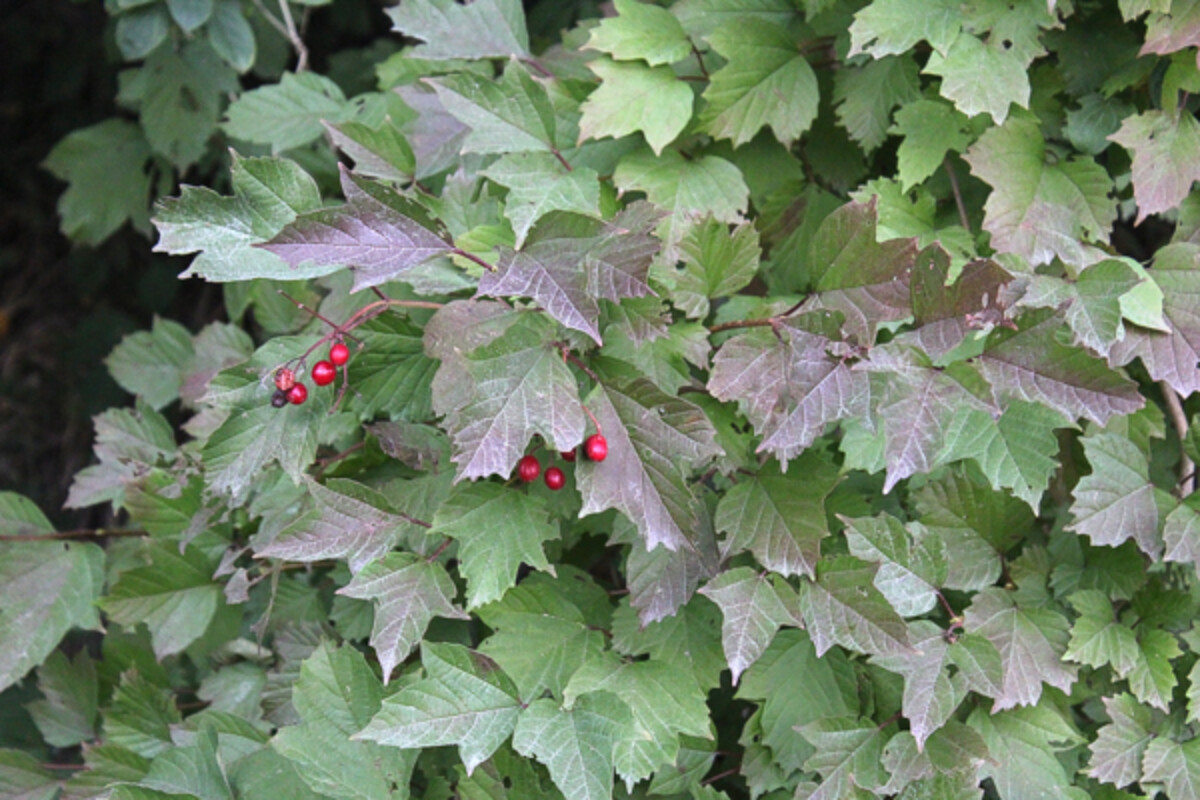
The moral of the story is to test every single bush before putting it in your foraging basket. If you’re really out in the bush, you’re much safer and less likely to encounter the unpalatable ornamental fruit. If you’re in the Northwest or Alaska, V. edule is the dominant species so you’re likely to find tasty berries, but still, check to be sure.
One other thing to note about highbush cranberry fruit: while the completely unrelated lowbush cranberry has small, unobtrusive seeds, the seeds inside highbush cranberry are huge. They’re flat and round, and they cut through the whole fruit. The seed is almost as large as the fruit itself, much like in a chokecherry or pin cherry, but since the seed is flat there’s still plenty of meat around it.
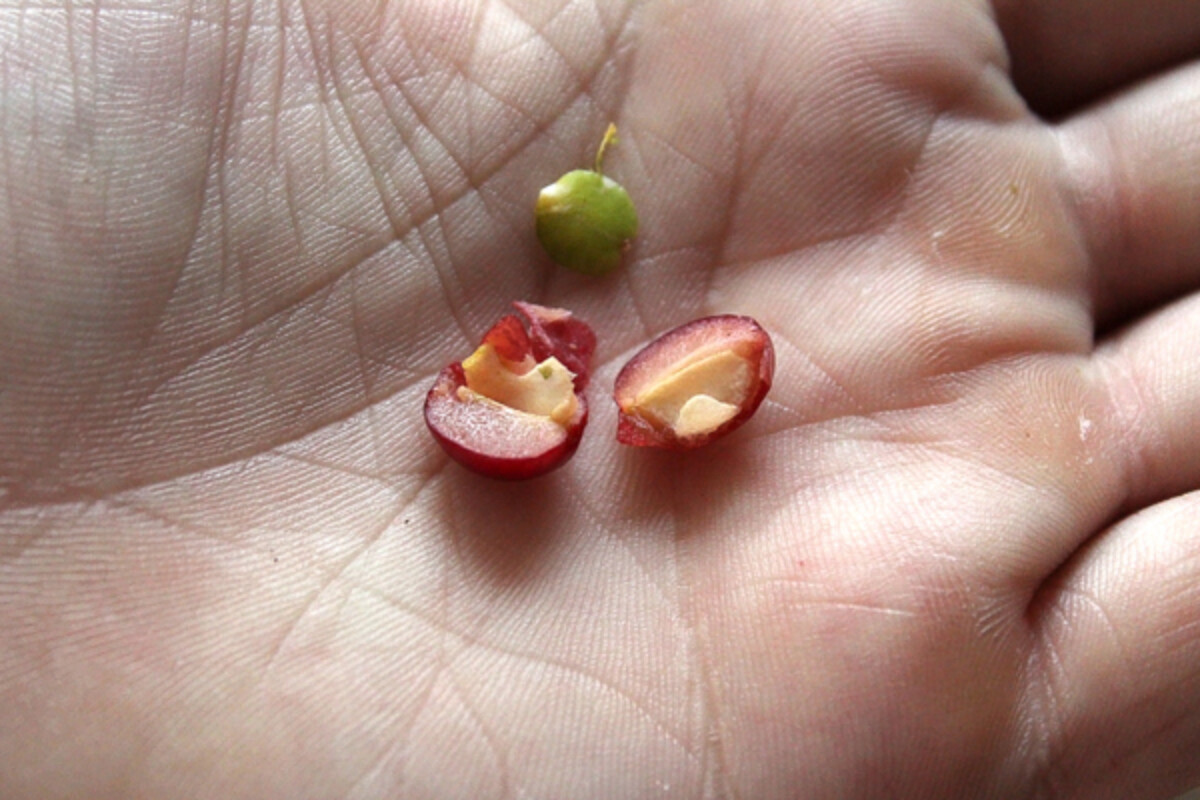
Most sources say to remove the pit and that it will ruin the taste of your food. In the highbush cranberry pie recipe linked below, the writer says she always leaves them in and the pie is amazing. The most common processing approach is to use a food mill, sieve, or steam juicer to separate the pulp and juice from the seeds before turning the fruit into jelly, syrup, or sauce.
Where to Find Highbush Cranberry
The three highbush cranberry species between them cover most of North America. V. trilobum grows wild across the northeastern US and southern Canada, from Newfoundland down to Pennsylvania and west across the Great Lakes states. V. edule dominates the boreal forests of Alaska, the Yukon, and across most of Canada. V. opulus is naturalized along roadsides, old farmsteads, and abandoned ornamental plantings throughout the eastern half of the continent.
All three species prefer:
- Moist, well-drained soil along streambanks and forest edges
- Forest clearings and woodland margins with partial sun
- Hedgerows and roadside thickets
- Old farmstead margins where ornamental plantings have escaped (V. opulus)
- Boreal and mixed-hardwood forest edges (V. edule)
- Wet meadows and floodplain edges
The shrubs are particularly easy to spot in late September and October when the bright red fruit clusters glow against the autumn-colored leaves. Once you know what you’re looking for, you’ll see them every time you drive a rural road in the right region.
When to Find Highbush Cranberry
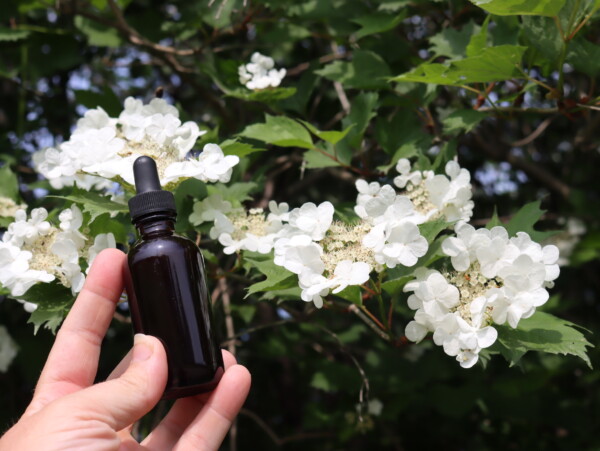
Highbush cranberry flowers in late spring or early summer (May through June in most of its range), with flat clusters of small white flowers that resemble lacecap hydrangea. The fruit develops through summer, ripening to bright red in late August through October depending on latitude.
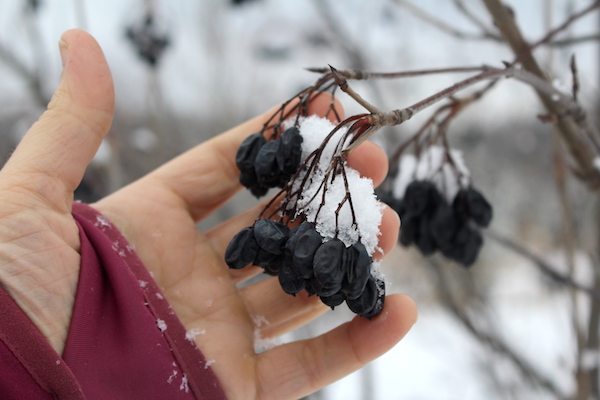
Unlike many wild fruits that disappear quickly once ripe, highbush cranberry fruit persists on the bush long after the leaves have dropped. The dried red clusters often hang on through winter and into early spring, providing both winter forage opportunity and an easier identification window when other foliage is gone.
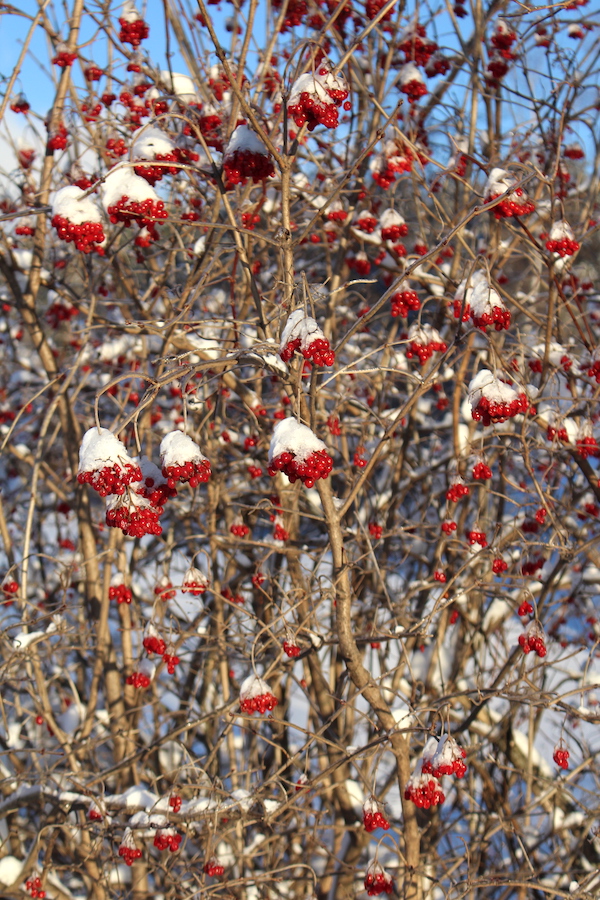
Many foragers actually prefer to harvest highbush cranberry after a hard frost, since the freezing temperatures break down some of the bitterness in the bitter species (V. opulus) and intensify the sweetness in the palatable ones. The frost-sweetened fruit is what makes traditional Eastern European kalina preparations work despite using the otherwise-bitter V. opulus. The bark for crampbark medicine is traditionally harvested in spring, when the bark slips most easily from the wood. Winter foraging for highbush cranberry is straightforward; the fruit is highly visible against snow and the dried bark can be peeled in late winter when the trees are still dormant.
How to Identify Highbush Cranberry
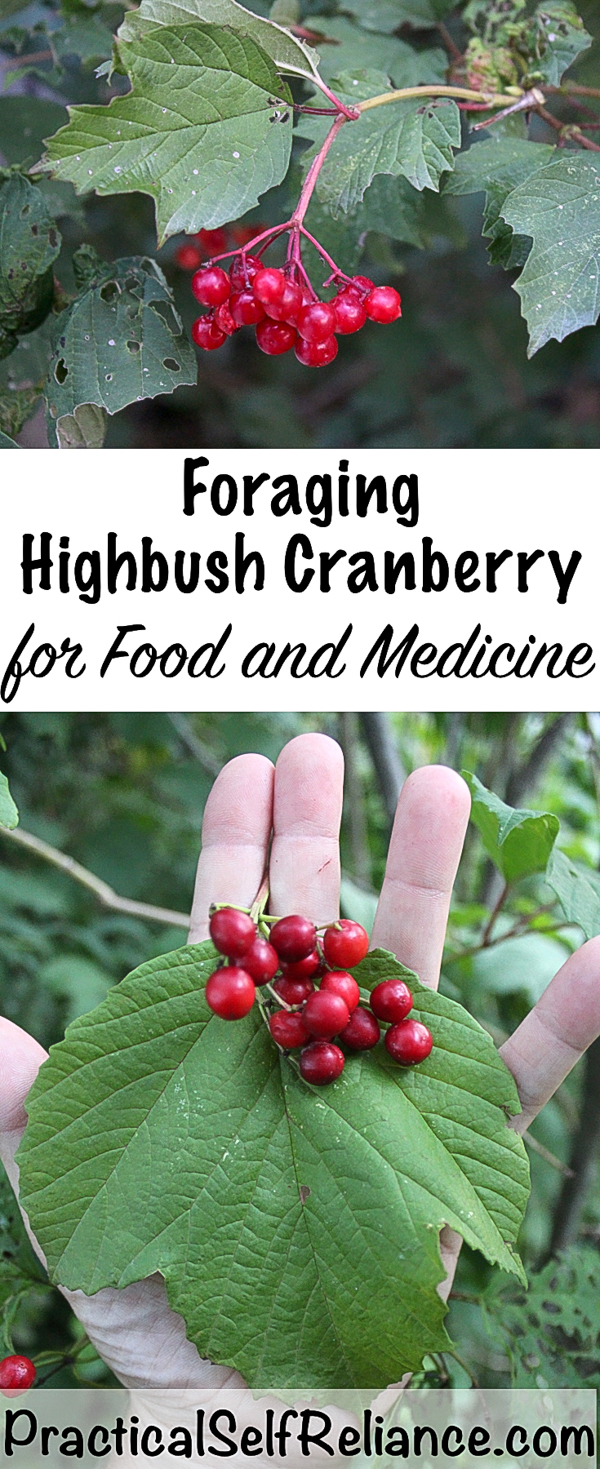
Highbush cranberry is generally easy to identify in fruit; the combination of three-lobed maple-like leaves, flat clusters of bright translucent red drupes, and a multi-stemmed shrub habit is distinctive. Identifying which of the three species you’re looking at is much harder and usually requires a taste test.
Leaves
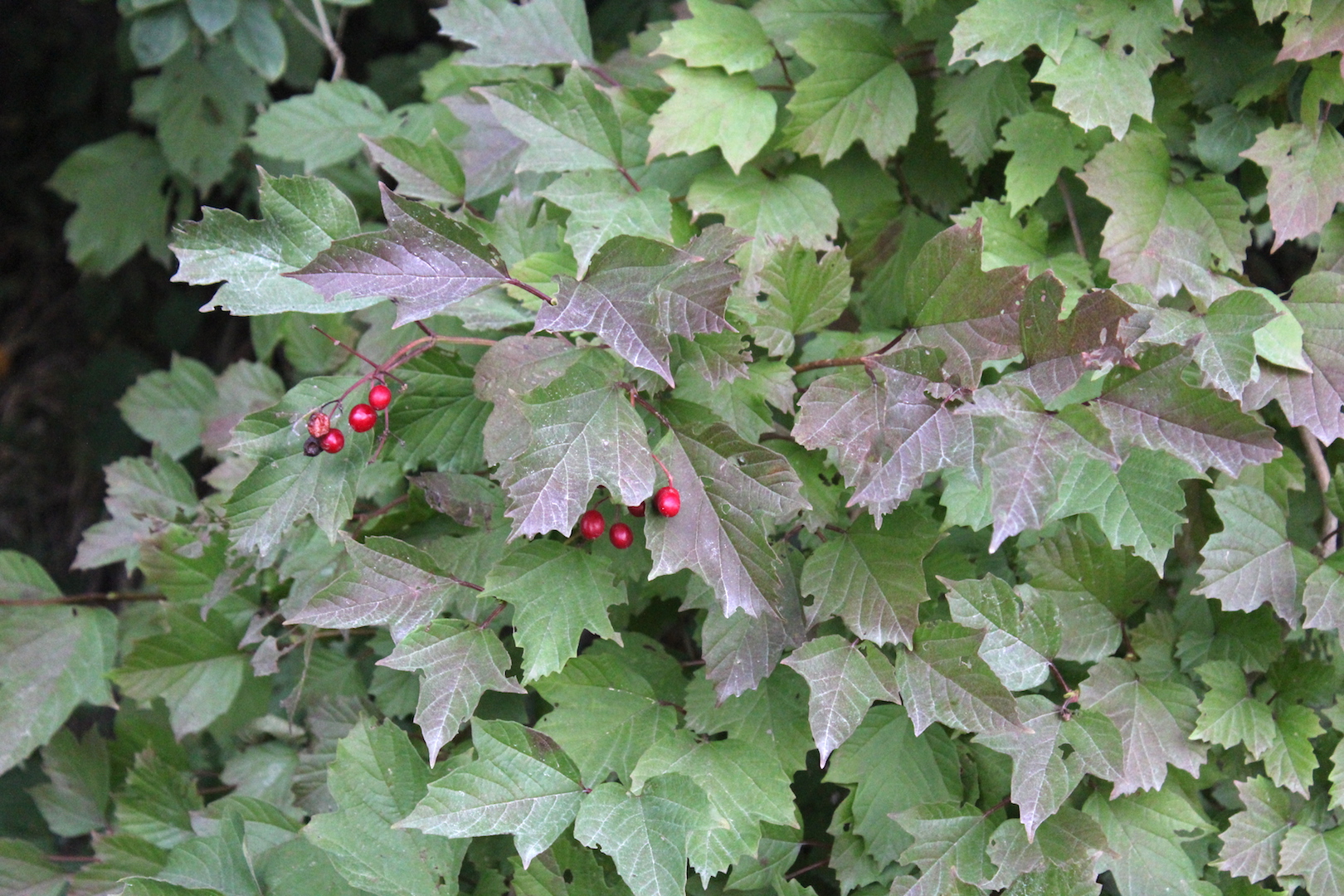
Highbush cranberry leaves are opposite (always paired across from each other on the stem), 2 to 5 inches long, and three-lobed in a distinctive maple-leaf shape. The lobes are typically pointed with coarsely toothed margins. The leaf bases have small projections (stipules) at the petiole. In fall, the leaves turn brilliant red, orange, or purple, often before the berries fully ripen.
The three-lobed maple-like leaf is the easiest distinguishing feature for the genus, separating highbush cranberry from most other red-fruited shrubs. V. edule often has more lobed leaves with deeper sinuses than V. trilobum, but the difference is subtle and not reliable for species identification.
Bark
Mature highbush cranberry bark is grayish-brown, smooth to slightly fissured, with prominent lenticels (small horizontal raised pores). Young twigs are reddish-brown to gray. The inner bark, which is the medicinal crampbark used in traditional herbal preparations, is yellowish-green and somewhat astringent in scent and flavor.
The bark is harvested in early spring when it slips most easily from the wood, after the sap has started rising. Strip narrow vertical sections of bark from a few large branches without girdling the entire trunk; girdling will kill the shrub. Better yet, prune a few branches and strip the bark from the cut wood, which doesn’t damage the living plant.
Flowers
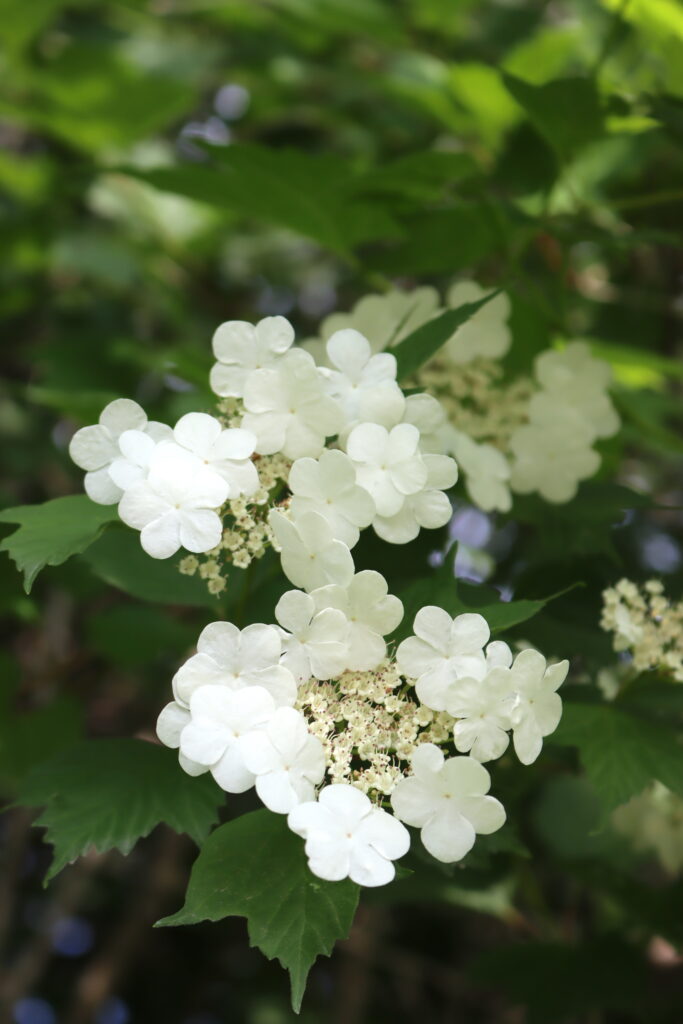
Highbush cranberry flowers are arranged in flat clusters (cymes) 2 to 5 inches across, blooming in late May through June across most of its range. Each cluster has two distinct flower types: a ring of larger showy sterile flowers around the outside (5 white petals, about ½ inch across) and many smaller fertile flowers in the center (also white, but only about 1/8 inch across).
This two-tier flower arrangement is one of the only reliable ways to distinguish the three species, but the differences are subtle enough that they require careful examination:
- V. trilobum and V. opulus: Both have the showy sterile outer flowers and tiny fertile inner flowers. Distinguishing the two requires looking at the petiolar glands (small bumps on the leaf stems), which differ slightly in shape between the two species.
- V. edule: Lacks the ring of large sterile flowers; all flowers in the cluster are small and fertile. This is actually one of the easier ways to distinguish V. edule from the other two species, but only if you can find the plant in flower.
For most foragers, the flowers will be long gone by the time the berries are ripe, so the practical species identification approach remains the taste test.
Fruit
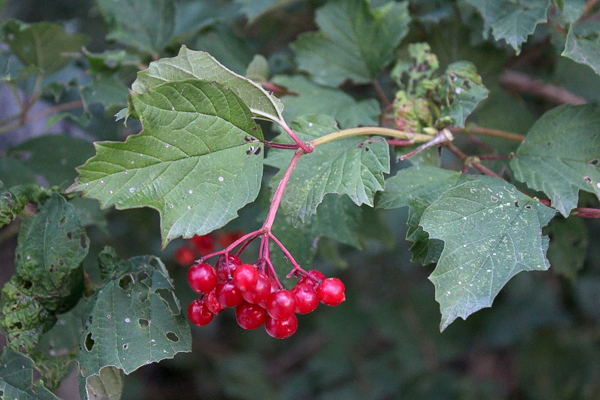
The fruit is a round to slightly oval drupe, ¼ to ½ inch across, bright red and slightly translucent at full ripeness. Each drupe contains a single large flat seed that runs the diameter of the fruit. The fruits hang in flat clusters of dozens of berries on a single stalk, ripening more or less simultaneously across the cluster.
The fruit develops a slightly translucent, almost jelly-like quality when fully ripe, especially after the first frost. Unripe fruit is harder, more opaque, and significantly more bitter and astringent.
Highbush Cranberry Look-Alikes
Beyond the three highbush cranberry species, several other plants can be confused with highbush cranberry, especially when the fruit is in cluster form on a multi-stemmed shrub. None of the common look-alikes are dangerously toxic, but several are unpalatable enough that confusion can disappoint a forager.
True Cranberry (Vaccinium)
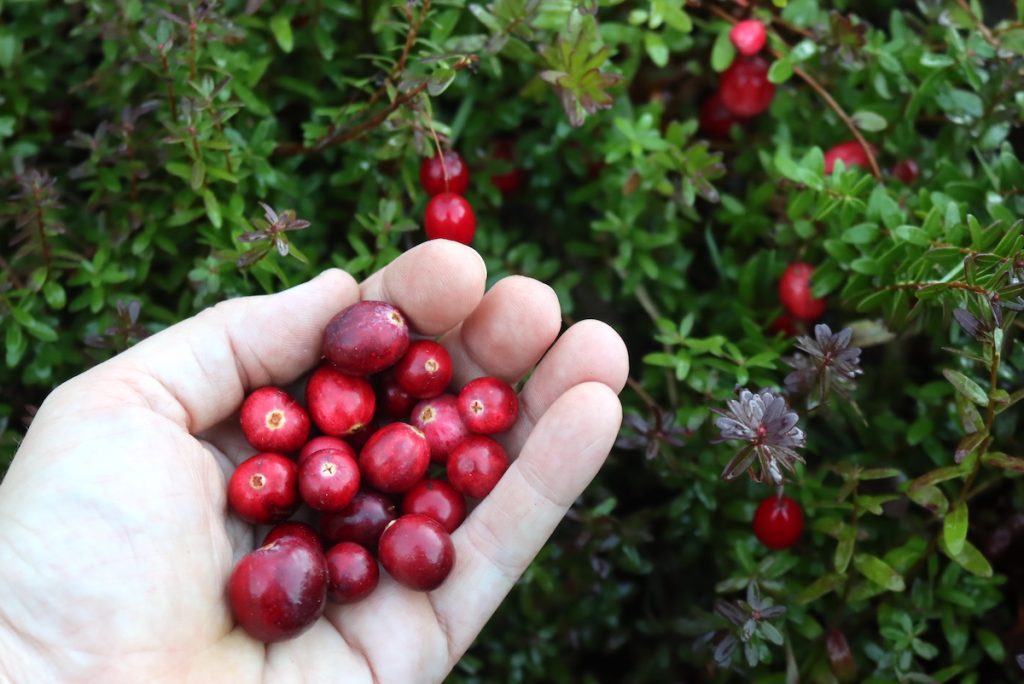
The most common confusion isn’t visual but conceptual: searchers often arrive looking for “cranberry pits” or expecting that highbush cranberry is the same plant as the cultivated cranberry. True cranberries (Vaccinium macrocarpon and V. oxycoccos) grow on a sprawling, ground-hugging vine in acidic boggy soils, never on tall shrubs. The fruit of true cranberries has many tiny soft seeds, not a single large flat pit. If you’ve found berries on a shrub 6 to 15 feet tall, you’re not looking at a true cranberry; you’re looking at a highbush cranberry, regardless of how similar the fruit might appear.
This matters for cooking: true cranberries can be processed whole and the soft seeds disappear into the sauce or jam. Highbush cranberries have hard, large seeds that need to be removed via a food mill or sieve before the fruit becomes anything more refined than juice.
Other Edible Viburnum Species
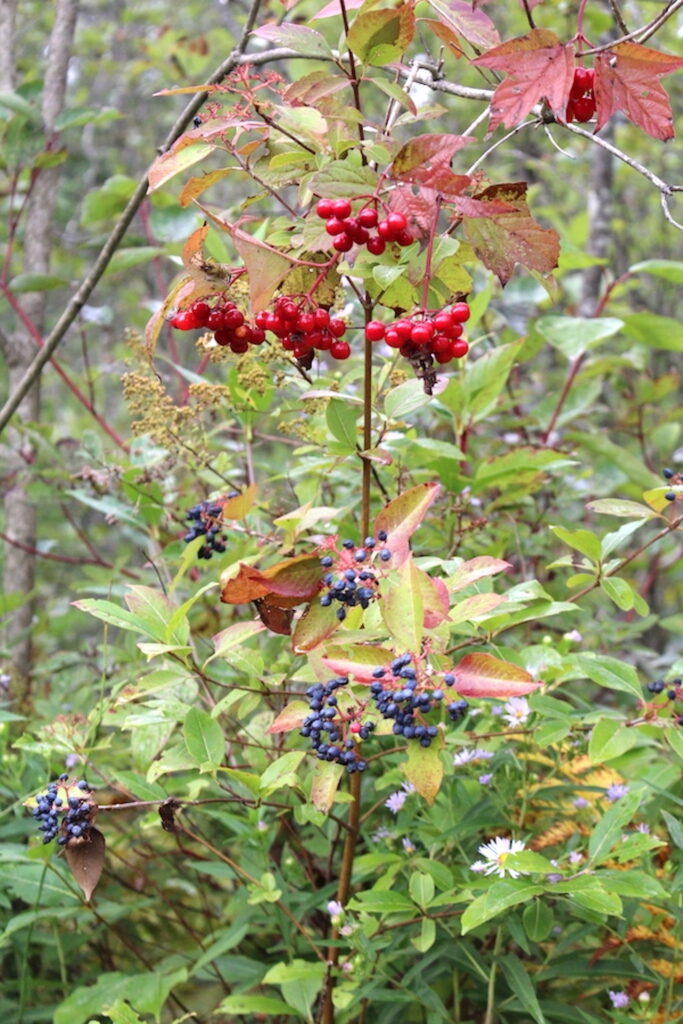
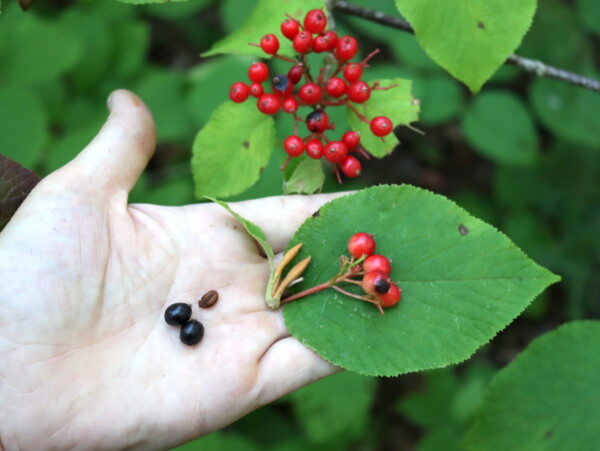
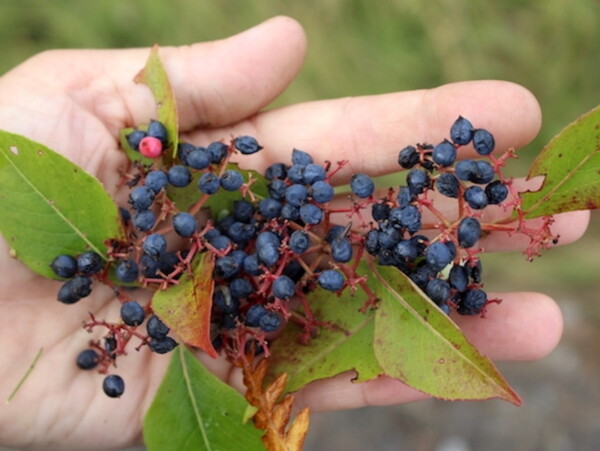
Several other Viburnum species in North American woods produce edible fruit that’s sometimes confused with highbush cranberry. None are toxic, and several are themselves desirable foraged fruits with their own distinct flavors:
- Nannyberry (V. lentago): produces dark blue-black drupes (not red), with a sweet date-like flavor. Different ripening schedule and color make confusion unlikely once the fruit is ripe.
- Northern Wild Raisin (V. cassinoides, syn. V. nudum var. cassinoides): produces black drupes that go through a multi-color speckled stage. Sweet and edible.
- Hobblebush (V. lantanoides): produces clusters of red-then-purple-then-black drupes that pass through a similar red phase to highbush cranberry but eventually turn dark.
The best way to distinguish highbush cranberry from these other Viburnums is the leaf shape: highbush cranberry has distinctive three-lobed maple-like leaves, while the other Viburnums have simple oval leaves with serrated margins.
Bittersweet Nightshade
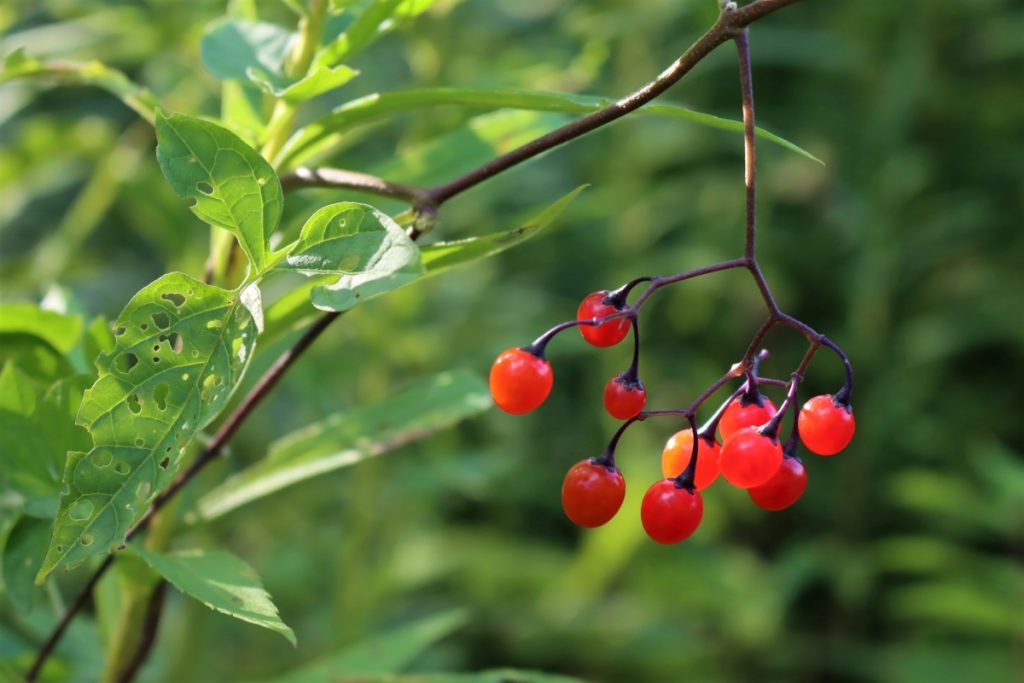
Bittersweet Nightshade (Solanum dulcamara), also called climbing nightshade, is a toxic Eurasian vine that grows in the same streambank and hedgerow habitat as highbush cranberry, and I’ve found the two tangled together more than once. The bright red berries contain solanine and other glycoalkaloids and shouldn’t be tasted at all, since the toxicity can be severe in children. The differences:
- Bittersweet nightshade is a twining woody vine that climbs and sprawls through other vegetation, not an upright multi-stemmed shrub.
- The leaves are arrowhead or “halberd” shaped, with two small lobes at the base, not three-lobed and maple-like.
- The berries are oval or egg-shaped (like miniature tomatoes) with many small flat seeds inside, not round with a single large flat pit.
- The berries hang in loose drooping clusters of 5 to 15 on long slender stalks, not in dense flat clusters of dozens.
- Bittersweet nightshade has distinctive purple star-shaped flowers with prominent forward-pointing yellow stamens, not flat clusters of small white flowers.
American Bittersweet
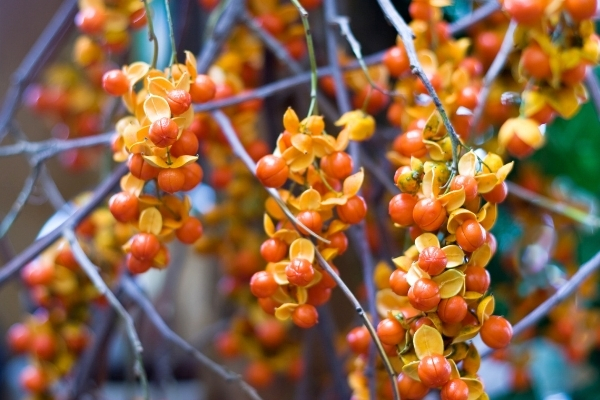
American Bittersweet (Celastrus scandens) and Oriental Bittersweet (Celastrus orbiculatus) produce bright red-orange fruits in fall that can be confused with highbush cranberry from a distance. Bittersweet fruits are toxic and shouldn’t be eaten. The differences are clear up close: bittersweet grows as a climbing woody vine (not a shrub), and the bright orange fruit emerges from a yellow papery capsule that splits open in fall to reveal the orange-red berry inside, giving it a distinctive two-tone appearance unlike anything in the highbush cranberry family.
How to Harvest Highbush Cranberry
The most important step in harvesting highbush cranberry is the taste test. Always sample one or two berries from each individual bush before committing to a harvest from that plant. The bitter V. opulus and the palatable V. trilobum can grow side by side along a single hedgerow, and the bitter species is showy enough that it sometimes looks like the better harvest from a distance.
For fruit harvest:
- Wait until the berries are fully ripe (translucent, slightly jelly-like, and bright red).
- For the sweetest harvest, wait for the first hard frost; this dramatically improves flavor across all three species.
- Harvest whole clusters by clipping the cluster stem rather than picking individual berries; this is much faster and the cluster stems strain out easily during processing.
- The fruit is highly visible from a distance, and many foragers do annual scouting drives in early autumn to identify productive bushes before the actual harvest.
For bark (crampbark) harvest:
- Harvest in early spring when the sap is rising and the bark slips most easily from the wood.
- Don’t girdle the trunk; instead, prune a few branches and strip the bark from the cut wood, or take narrow vertical strips from larger branches without removing the entire ring.
- The inner bark is the medicinal part. Use a sharp knife to scrape away the outer bark, exposing the green-yellow inner bark.
- Dry the harvested bark in a single layer on a screen or in a dehydrator at low temperature, then store in airtight containers away from light. Properly dried crampbark keeps for 2-3 years.
Frozen whole fruit clusters are the easiest way to store a highbush cranberry harvest. The fruit freezes well, and the freezing-thawing actually breaks down the cell walls, making juice extraction faster than with fresh fruit.
Ways to Use Highbush Cranberry
Highbush cranberry fruit is best used in cooked preparations rather than fresh. The flat seeds need to be strained out (a food mill or sieve works well), and the resulting pulp and juice can be made into jelly, syrup, sauce, ketchup, juice, pie, or wine. The flavor is sharper and more wild than cultivated cranberries, with a slight musky note that some foragers love and others find off-putting.
Some classic preparations and recipes:
Highbush cranberry fruit also makes excellent country wine in the same style as a true cranberry wine, with the flavor sitting somewhere between cranberry and pomegranate. The fruit can substitute one-for-one in any cultivated cranberry recipe (cranberry sauce, cranberry juice) once the seeds have been milled out.
Highbush Cranberry Medicinal Uses
When highbush cranberry is used as medicine, it goes by the common name crampbark and is used to relieve muscle cramps. The berries are not the medicinal part; the bark is. (Although several modern herbalists like Beverly Gray have noted that the fruit also has some anti-inflammatory and bladder-supportive applications.)
The renaming from “highbush cranberry bark” to “crampbark” can add another layer of confusion to an already-confusing plant family: which species of highbush cranberry produces the bark known as crampbark?
The clearest answer from the herbal literature is that V. opulus (the European species) is the most-documented source of medicinal crampbark in Western herbalism. Older European herbal traditions specifically reference V. opulus bark, and most commercial dried crampbark and crampbark tinctures are sourced from V. opulus. Modern North American herbalists, including Rosemary Gladstar, have indicated that V. opulus is the primary medicinal species.
However, both North American native species (V. trilobum and V. edule) appear to share medicinal properties. The Plants for a Future database (pfaf.org) cites medicinal qualities of V. trilobum bark related to the womb and uterus. Beverly Gray, a Yukon-based herbalist, cites V. edule bark as medicinally similar to V. opulus. Native American ethnobotanical sources document medicinal use of all three species for similar conditions.
If you want to be sure of the species when buying crampbark, you can buy dried crampbark commercially with a known source, or purchase a standardized tincture already made and ready for use.
Beyond general cramp relief, crampbark is used to treat any condition caused by muscle tension. That includes tension headaches and even some rheumatic conditions where tension is a major factor. Crampbark can relax muscles and allow improved blood flow to a painful area, which is why it’s used for high blood pressure, Raynaud’s syndrome, and restless legs.
Since crampbark works on both skeletal muscle and smooth muscle, it’s also used to relax the uterus, which makes it helpful for menstrual cramps. Some traditional herbalists, including Rosemary Gladstar, have referenced crampbark in the context of preventing miscarriage caused by uterine tension and stress, with specific mention of its uterine-relaxing properties. As with any herb used during pregnancy, this should be approached with serious caution and only under the guidance of a qualified herbalist or healthcare professional.
According to herbalist Julie Bruton-Seal in Backyard Medicine, a crampbark tincture is traditionally used to treat:
- cramps
- menstrual pain
- muscle spasm
- backache
- spastic constipation
- IBS
- high blood pressure
- restless legs
- rheumatic pain
- Raynaud’s syndrome
- poor circulation to the extremities
Crampbark works best as a complement to (not a replacement for) standard medical care for any chronic condition. The information here is traditional and historical; consult a qualified healthcare provider before using crampbark for any specific medical purpose, especially during pregnancy or in combination with other medications.
How to Make Crampbark Tincture
Most herbs can be extracted using a simple tincture, where you just pour alcohol over the herb and allow it to sit. Good examples are echinacea tincture and burdock tincture, both of which extract well using a single-extraction method.
Crampbark needs to be extracted using a double extraction tincture, similar to a reishi mushroom tincture. The process is a bit different than with a mushroom tincture. With mushrooms, the alcohol step happens first followed by the boiling water extraction. With crampbark, the order is reversed:
Boil the bark in water first. Add the crampbark to a saucepan and add just enough water to allow all the crampbark pieces to float. Bring the mixture to a boil and then simmer for 10 minutes. This quick water extraction softens the bark and extracts the water-soluble constituents.
Strain out the bark and measure the volume of the water. Add in an equal amount of vodka (80 proof) and then add the crampbark back in. Place the whole mixture in a glass jar and allow it to infuse for about a month. When it’s ready, strain out the bark and bottle the double extraction tincture in amber dropper bottles for later use.
For a step-by-step photo walkthrough with measurements and timing, see the dedicated Crampbark Tincture recipe.
Edible Viburnums
Highbush Cranberry FAQs
Yes, highbush cranberries are edible, with one important caveat: there are three species of plant called highbush cranberry, and only two of them are palatable. American highbush cranberry (Viburnum trilobum) and squashberry (Viburnum edule) produce tart, vitamin-C-rich fruit that’s been used as food for centuries. European highbush cranberry or Guelder rose (Viburnum opulus) is bitter and astringent, and considered inedible by most North American foragers. Always taste-test individual bushes before harvesting, since the species can grow side-by-side and look nearly identical.
Highbush cranberry (Viburnum) is not actually a cranberry. True cranberries (Vaccinium macrocarpon and V. oxycoccos) are sprawling ground-hugging vines that grow in acidic boggy soils, with small soft seeds inside the fruit. Highbush cranberries are tall multi-stemmed shrubs (6-15 feet) in the genus Viburnum, with a single large flat seed inside each fruit. The fruits look similar from a distance and have a similar tart flavor, but they’re entirely unrelated plants. Highbush cranberry can substitute for true cranberry in most recipes, but the seeds need to be strained out via food mill or sieve.
Yes, highbush cranberries have a single large flat pit (technically a stone, since the fruit is a drupe). The pit is almost as large as the fruit itself and runs through the diameter of the berry. This is one of the major differences between highbush cranberry and true cranberry; true cranberries (Vaccinium) have many tiny soft seeds, not a single large pit. The hard flat pit means highbush cranberry fruit needs to be processed through a food mill, sieve, or steam juicer before being used in jelly, jam, or sauce; it can’t be eaten whole or pureed without straining.
Crampbark is the medicinal inner bark of highbush cranberry, used in traditional Western herbalism for muscle cramps, menstrual cramps, tension headaches, and conditions caused by muscle spasms. The most-documented source is European highbush cranberry (Viburnum opulus), and most commercial crampbark is from this species. However, both North American native species (V. trilobum and V. edule) appear to have similar medicinal properties; modern herbalists including Rosemary Gladstar and Beverly Gray have written about all three species as sources of crampbark. Crampbark is harvested in spring when the bark slips easily from the wood, and is traditionally prepared as a double-extraction tincture.
Guelder rose is one of three plants called highbush cranberry. Specifically, Guelder rose is the common name for Viburnum opulus, the European species of highbush cranberry. The American highbush cranberry (V. trilobum, sometimes classified as V. opulus var. americanum) and squashberry (V. edule) are the other two species. The European Guelder rose has bitter, mostly inedible fruit but is the most-documented source of medicinal crampbark; the American and squashberry species have palatable, edible fruit and also yield medicinal bark. The three species can hybridize where their ranges overlap, and they’re nearly impossible to tell apart by leaves and fruit alone (taste-testing is the practical identification method).
Did you find this Highbush Cranberry foraging guide helpful? Tell me in the 📝 comments below how you use highbush cranberries on your homestead!
And make sure you stay in touch with me by following on social media!
Herbal Tincture Guides
Find the perfect foraging guide
Searching for something else? Enter keywords to find the perfect foraging guide!








Hi Ashley,
The link for the Highbush Cranberry Ketchup does not seem to be working on my end, just an FYI. I foraged Highbush cranberries today for the first time. I had never found them before. I am considering making a jelly a f then possibly making a highbush cranberry and crabapple jelly as well. I am going to have to figure that one out. I love learning new things and experimenting. BTW, I also foraged autumn olive berries today. My kids love it when I make it into a fruit leather.
Thanks so much for the heads up! I switched the link to the University of Alaska’s recipe, and that page has a highbush cranberry jelly recipe too: https://www.uaf.edu/ces/publications/database/food/highbush-cranberries.php
Congrats on your first highbush cranberry find! They’re tart, so pairing them with crabapples for jelly is a great idea, since crabapples are loaded with natural pectin. My crabapple jelly recipe is a good starting point: https://practicalselfreliance.com/crabapple-jelly/
Autumn olive fruit leather sounds like a big hit. Happy foraging!
You mentioned ed that you couldn’t tell the difference between viburnum trilobum and viburnum edule once the flowers are gone. It is true that the fruit and leaves look the same but if you look carefully at the seed, the v. trilobum seed is a flat oval shape and the v. edule seed is a flat heart shape. My father taught me how to spot the difference when I was just 9 years old. In northern Alberta we call v. edule “mooseberry”.
Thank you for this great article!!
grew up in N Minnesota and as a kid we
Would pick the edible berries.
Loved the taste. We would cook them up
and run them thru the hand food processor.
To make a thick sauce.
We Use the sauce with dressing at thanksgiving.
It was great with meat.
I ordered a plant and I did not know until this article
That I got the inedible one. Very bitter and yes spit it right out.
I would love to get the right plant
If anyone knows where to order.
Check out Samuel Thayer at foragersharvest.com I believe they sell highbush cranberry bushes.
Beverly Gray cites Viburnum edule bark as medicinally capable similar to V. opulus.
Rosemary Gladstone’s book indicate that crampbark is V. opulus. I was also trying to determine if V. trilobum could be used with similar results. The pfaf website indicates medicinal qualities of V. trilobum relating to the womb and uterus and references are provided but I haven’t look them up.
love your website!
Julie
Would like a source to buy the eatable high Bush cranberry please..
Hi I’m in canada and these berries are not bitter in harvest late fall at all, and they are truly amazing for bladder infections and anti inflammatory properties I use it all the time , I dont know why it said you get sick from it??? Probabky when they are not ripping ready, Were is this Information coming from? Is it a personal view? The pictures taken are of early blooms, beautiful pictures by the way.
In Ontario, you can purchase 3 different High Bush Cranberries shrub/plant varieties (Viburnum trilobum ‘Alfredo’ and ‘J.N. Select’ plus Viburnum plicatum f. tomentosa ‘Shasta” from the Whiffletree Farm & Nursery in Elora. They ship to all areas in Canada via FedEx but not to the USA as far as I know. They carry all kinds of edible, medicinal, fruit bearing trees, shrubs and plants for colder climes Zones 2-5
Hello!
I am Russian and my mom gifted me a Viburnum opulus. It is common in Russia to pick the berries after a frost as that will take a tiny bit of the bitterness away. The jellies and syrups made from it are considered medicine, so I am a bit sad to see that Western medicine dismisses this berry that has been used for centuries in Ukraine, as toxic. Thanks for your articles, they are very interesting.
Hello, Jenja Bee. What are the medicinal properties of the berries, if you don’t mind sharing? Thank you!
Hi there!
Just wanted to reach out from Switzerland and tell you that I’m just so happy your page exists and I really appreciate your thorough written articles!!! You are amazing!
Please keep going and thank you so much!
<3
Thanks so much! It’s always so lovely to be appreciated =)
Loved harvesting high bush cranberries when living in northern BC. We would raw press the juice and then freeze it in ice cube trays.