
Affiliate disclosure: This post may contain affiliate links. Please see our Privacy Policy.
Lady’s Thumb (Persicaria maculosa) is a common edible garden weed with a long history of medicinal use and a distinctive dark thumbprint marking on each leaf. If you have disturbed ground anywhere on your property, you almost certainly have it growing somewhere, and it’s well worth learning to recognize.
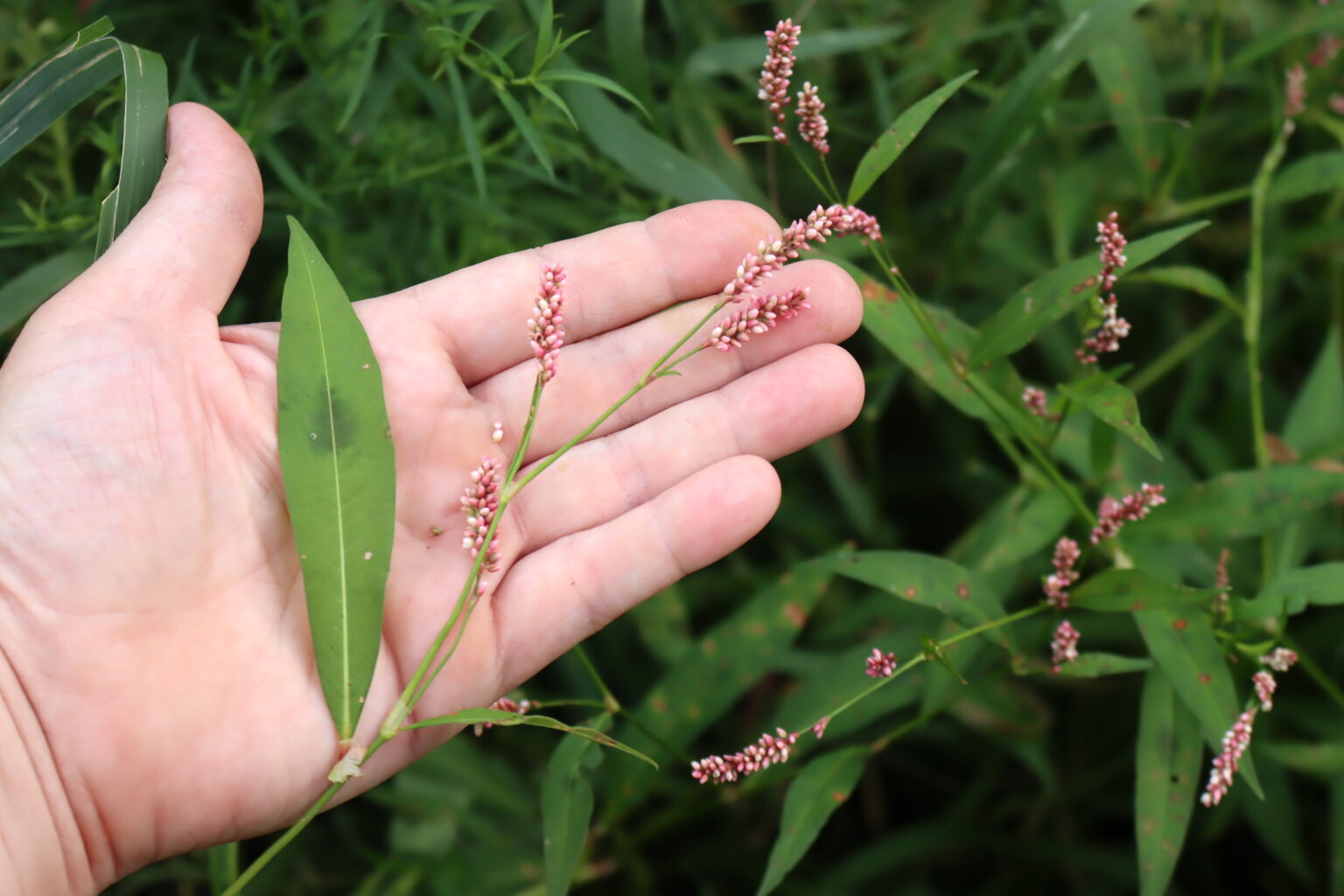
Table of Contents
The name Lady’s Thumb comes from the dark smudge near the center of each leaf, which looks for all the world like someone has pressed an inky thumb against it. That marking, combined with the slender pink flower spikes that rise above the foliage in summer, makes Lady’s Thumb one of the easier wild plants to learn on sight. Other common names include spotted lady’s thumb, redshank, thumbweed, and heart’s ease, though you’ll also hear it called by its old botanical name Polygonum persicaria.
This humble edible garden weed has a surprisingly long history of use. Herbalists across Europe, Asia, and North America have leaned on various Persicaria species for centuries, and modern research is starting to catch up with some of those traditional uses. The young leaves and shoots are tender and mildly lemony, the seeds are edible and can be gathered in quantity once you get the technique down, and the whole plant can be tinctured or used as a poultice for minor skin irritations.
Notes from My Homestead

Lady’s Thumb grows all over our Vermont homestead, and it’s one of the plants I notice shifting with the seasons. It turns up in the disturbed ground around the chicken coop, along the edges of the vegetable garden, and in the gravelly patches near the driveway. For years I walked past it without knowing what it was, until I started really looking at leaves and spotted those dark thumbprint markings that give it its name.
What surprised me most once I started working with it is how quiet it is in the garden. Unlike lambsquarters or purslane, which will take over a bed if you let them, lady’s thumb tends to hang out in the edges and disturbed spots without being pushy. The chickens pick at it when they free-range, and the young leaves go into early summer salads alongside purslane and wood sorrel. It is one of those wild edible weeds I’ve grown fond of precisely because it doesn’t demand attention.
What is Lady’s Thumb?
Lady’s Thumb (Persicaria maculosa) is a member of the Persicaria genus, often collectively known as smartweeds or knotweeds, within the buckwheat family (Polygonaceae). That puts it in the same family as Japanese knotweed, yellow dock, and cultivated buckwheat. You’ll sometimes still see it listed under its older botanical name, Polygonum persicaria, which was moved to Persicaria in recent taxonomic revisions.
Most species in the genus are herbaceous, flowering annuals. There are a few outliers, like Mile-A-Minute (Persicaria perfoliata), which is a larger annual vine, and Water Pepper (Persicaria hydropiper), which is still an herbaceous weed but typically grows in shallow water. Several Persicaria species are edible, and Lady’s Thumb is one of the most widely available and commonly foraged.
Members of this genus grow worldwide. Some species, like Pennsylvania Smartweed (Persicaria pensylvanica), are native to the United States, while others, like Lady’s Thumb itself, have naturalized here from Europe and Asia. Oriental Lady’s Thumb (Persicaria longiseta) is another common naturalized relative that’s nearly identical in use and appearance. Beyond the botanical names, Lady’s Thumb goes by a long list of folk names, including redshank, thumbweed, spotted lady’s thumb, heart’s ease, and bristly lady’s thumb.
Is Lady’s Thumb Edible?
Lady’s Thumb and most other members of this genus are edible. The leaves, young shoots, flowers, and seeds are all safe to eat raw or cooked, with the tender young growth being the most palatable.
Most members of the Persicaria genus contain some amount of oxalic acid, the same compound that gives wood sorrel, rhubarb, and spinach their tangy, lemony flavor. In large quantities, oxalic acid can interfere with mineral absorption, so it’s best to eat these plants in moderation rather than as a daily staple. Individuals with rheumatism, arthritis, gout, kidney stones, or hyperacidity can be especially sensitive to oxalic acid and should consult a doctor before consuming these plants regularly.
You can also use Lady’s Thumb medicinally. Historically, herbalists often used Lady’s Thumb and other Persicaria species internally as tea, and externally as poultices and insect repellent. More on the medicinal side in the next section.
Homesteaders often find their backyard chickens enjoy Lady’s Thumb as well, and it’s a useful volunteer in a free-range run. That said, some sources note that consumption of significant amounts of Lady’s Thumb can cause nitrate accumulation in horses, cattle, goats, and other grazing livestock, so it’s worth keeping an eye on pasture populations if you have larger animals.
One more note for homesteaders with grazing animals: Persicaria species are documented as potential primary photosensitizers in livestock, particularly cattle and sheep that consume large quantities. A closely related species, Pale Knotweed (Persicaria lapathifolia), has been documented causing liver necrosis and photosensitization in cattle when eaten in bulk under heat and moisture stress. Light-skinned animals and animals with unpigmented areas are most at risk. This isn’t a concern for chickens or for humans eating normal culinary quantities, but it is worth knowing if you have dairy cows, beef cattle, sheep, or horses grazing pastures with heavy smartweed populations.
Lady’s Thumb Medicinal Benefits
The presence of Persicaria species worldwide means that many different cultures have incorporated their local species, and often naturalized ones, into their traditional medicine practices. There’s a remarkable amount of overlap in how different herbal traditions have used these plants, which is usually a hint that the underlying chemistry is doing something real.
The Cherokee, Chippewa, and Iroquois prepared simple or compound decoctions of Lady’s Thumb (Persicaria maculosa), which they used as dermatological, urinary, gastrointestinal, and veterinary aids, for heart medicine, and as an analgesic. Specific traditional uses include drinking the tea for stomach pains and urinary complaints, applying the crushed leaves as a poultice to treat poison ivy and burns, and rubbing the foliage on horses as a bug repellent.
Herbalists in China and India have long used the moisture-loving Persicaria, Water Pepper. In India, this plant is traditionally used to treat intestinal worms, and modern research has backed up that usage. One study found that Water Pepper (Persicaria hydropiper) leaves possess noteworthy anthelmintic efficacy.
Another study from the Indian Journal of Traditional Knowledge tested Lady’s Thumb (Persicaria maculosa) extract on rats with induced liver damage. The researchers found that the extract did help prevent liver damage, and that the liver enzyme levels of the rats given the extract returned to near normal.
Lady’s Thumb also has some antibacterial properties. One study found it was particularly effective at inhibiting the growth of a gram-positive bacterium called Bacillus cereus, a food-borne pathogen that causes vomiting and diarrhea.
Herbalists have also used these plants for asthma, uterine bleeding, digestive complaints, gynecological disorders, headaches, gout, fever, inflammation, and hemorrhoids. A wide review of research on Persicaria species supported some of these uses, finding that many of these species contain biochemical constituents with anticancer, antioxidant, analgesic, antileukemic, antimicrobial and tyrosinase inhibiting properties. If you’re interested in exploring the medicinal side further, a simple tincture or dried herb tea is the most common starting point. See the Ways to Use section below, and my guide to making herbal tinctures for the basic method.
Where to Find Lady’s Thumb
These cosmopolitan plants occur nearly worldwide. You can find Lady’s Thumb (Persicaria maculosa) in its native range across Europe and Asia, as well as throughout North America, New Zealand, and Australia, where it has naturalized. Several species, including Pennsylvania Smartweed (Persicaria pensylvanica) and Pink Smartweed (Persicaria bicornis), are native to the United States. Oriental Lady’s Thumb (Persicaria longiseta) is also widely naturalized, especially in the eastern US.
Persicaria species generally thrive in moist soil, and some, like Water Pepper (Persicaria hydropiper), actually grow right in shallow standing water. Most prefer full sun, so it’s common to spot them in disturbed habitats: streambanks, roadsides, ditches, freshwater shorelines, garden edges, and fallow fields. On my Vermont homestead, I most often find Lady’s Thumb in the compacted edges of garden beds and along the gravel drive.
When to Find Lady’s Thumb
Lady’s Thumb and other Persicaria are summer annuals. They germinate in spring and grow until fall frost. You may see seedlings in April or even earlier in southern climates, but here in Vermont and other northern areas, they often don’t appear until May or June.
The tender young shoots and leaves are at their best in late spring and early summer. You can still eat the whole plant through summer and early fall, though the older leaves get tougher and the oxalic acid content tends to increase. Flowers typically bloom between June and September, depending on species and location, and the small seeds that follow are gatherable from late summer into fall. For a fuller seasonal picture, see my guides to summer foraging and fall foraging.
Identifying Lady’s Thumb
Persicaria is a relatively large genus, and the different species have a wide range of attributes. For this guide, I’m focusing on Lady’s Thumb and the other Persicaria species you’re most likely to encounter in North America that share its general characteristics, properties, and uses. That includes Pink Smartweed (Persicaria bicornis), Pennsylvania Smartweed (Persicaria pensylvanica), and Oriental Lady’s Thumb (Persicaria longiseta).
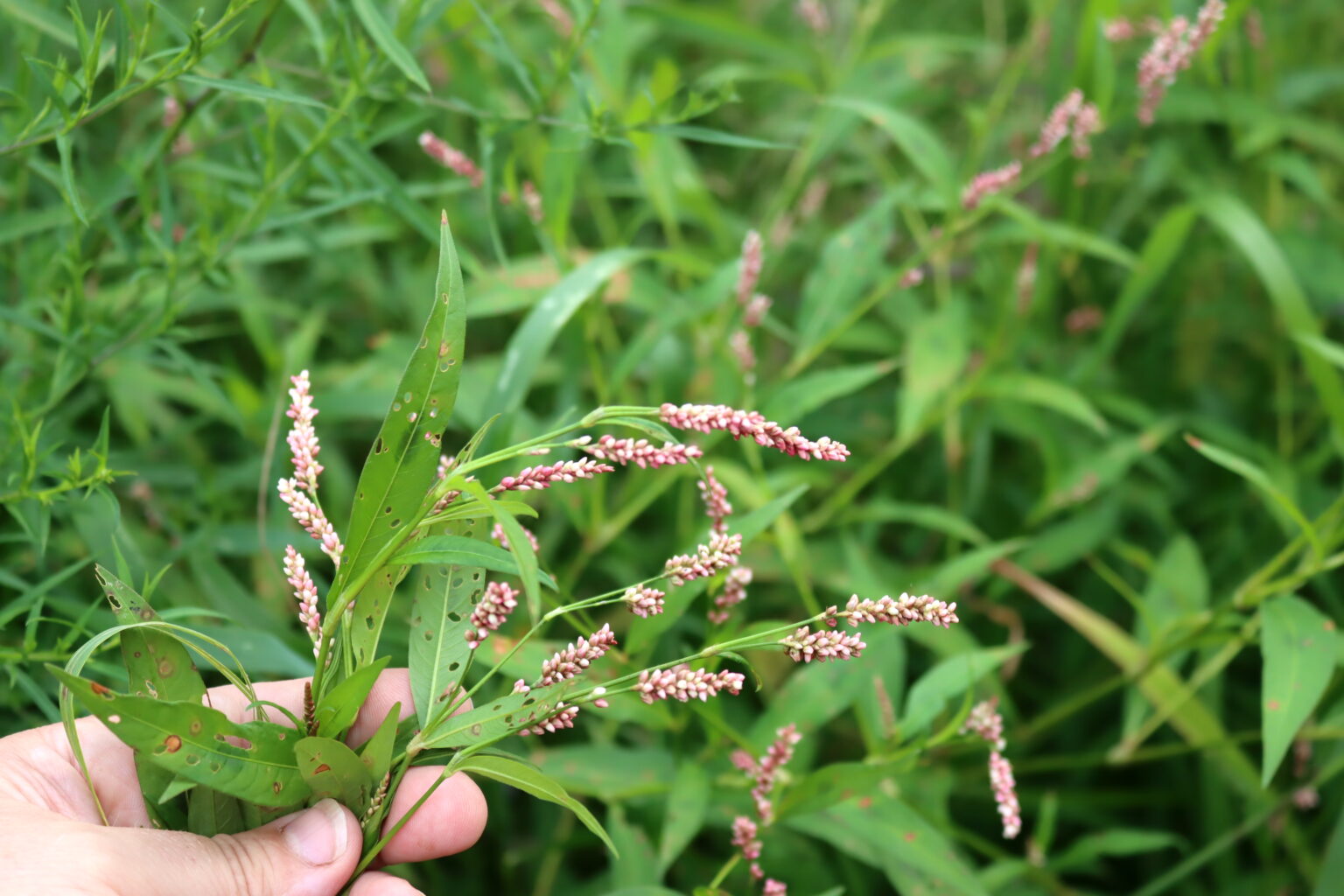
These annual weeds have an erect but slightly floppy growth pattern. In early summer they often form dense patches that outcompete other weeds. Their narrow leaves and pink flower spikes help foragers pick them out quickly once you know what to look for.
Lady’s Thumb Leaves
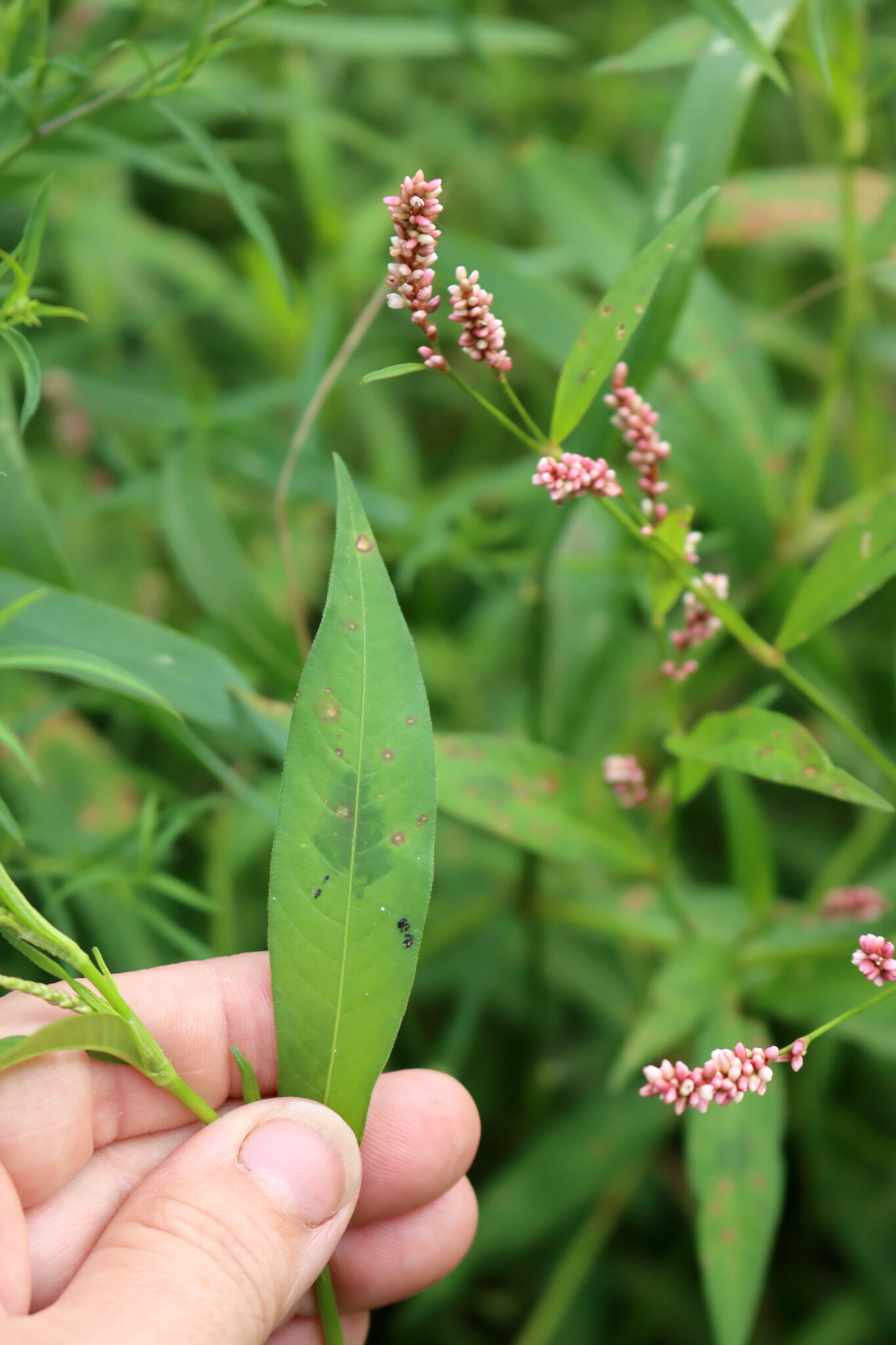
Lady’s Thumb and many Persicaria species have simple, alternate, narrowly ovate to lance-shaped leaves with noticeable pinnate venation. The leaves are held on short petioles and may be close to stalkless. They’re usually green, 2 to 7 inches long, and slightly pointed at the tip.
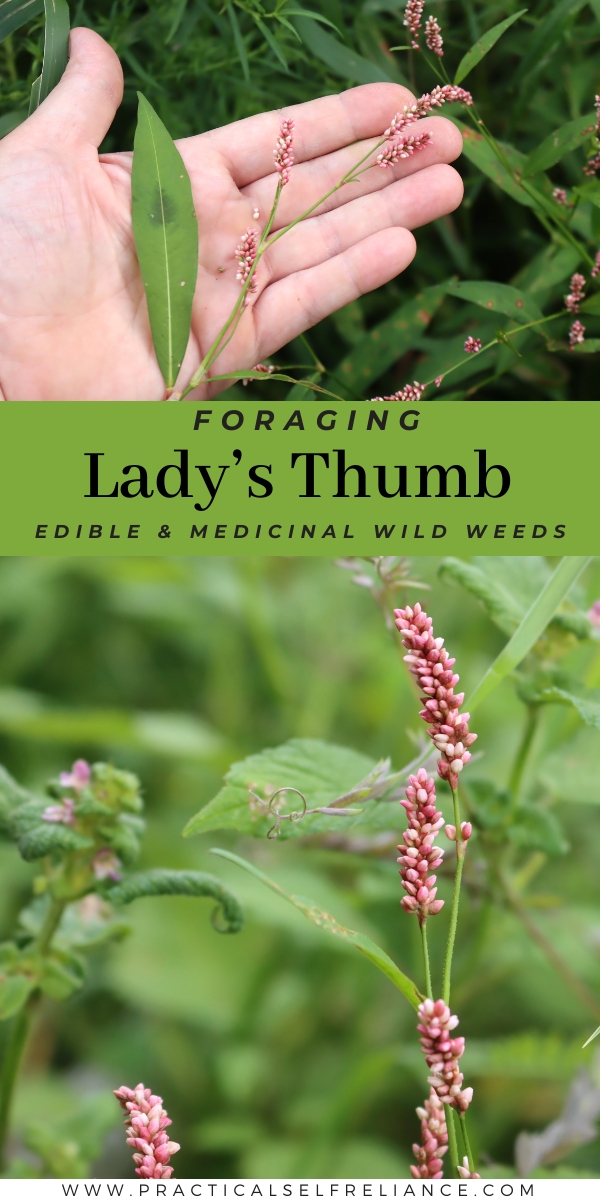
Lady’s Thumb (Persicaria maculosa) and Pennsylvania Smartweed (Persicaria pensylvanica) leaves often have a black, dark brown, or purplish spot or V-shape blotch near the center. That distinctive thumbprint marking is the single best field ID feature for Lady’s Thumb specifically, and it’s what gives the plant its common name.
Lady’s Thumb Stems
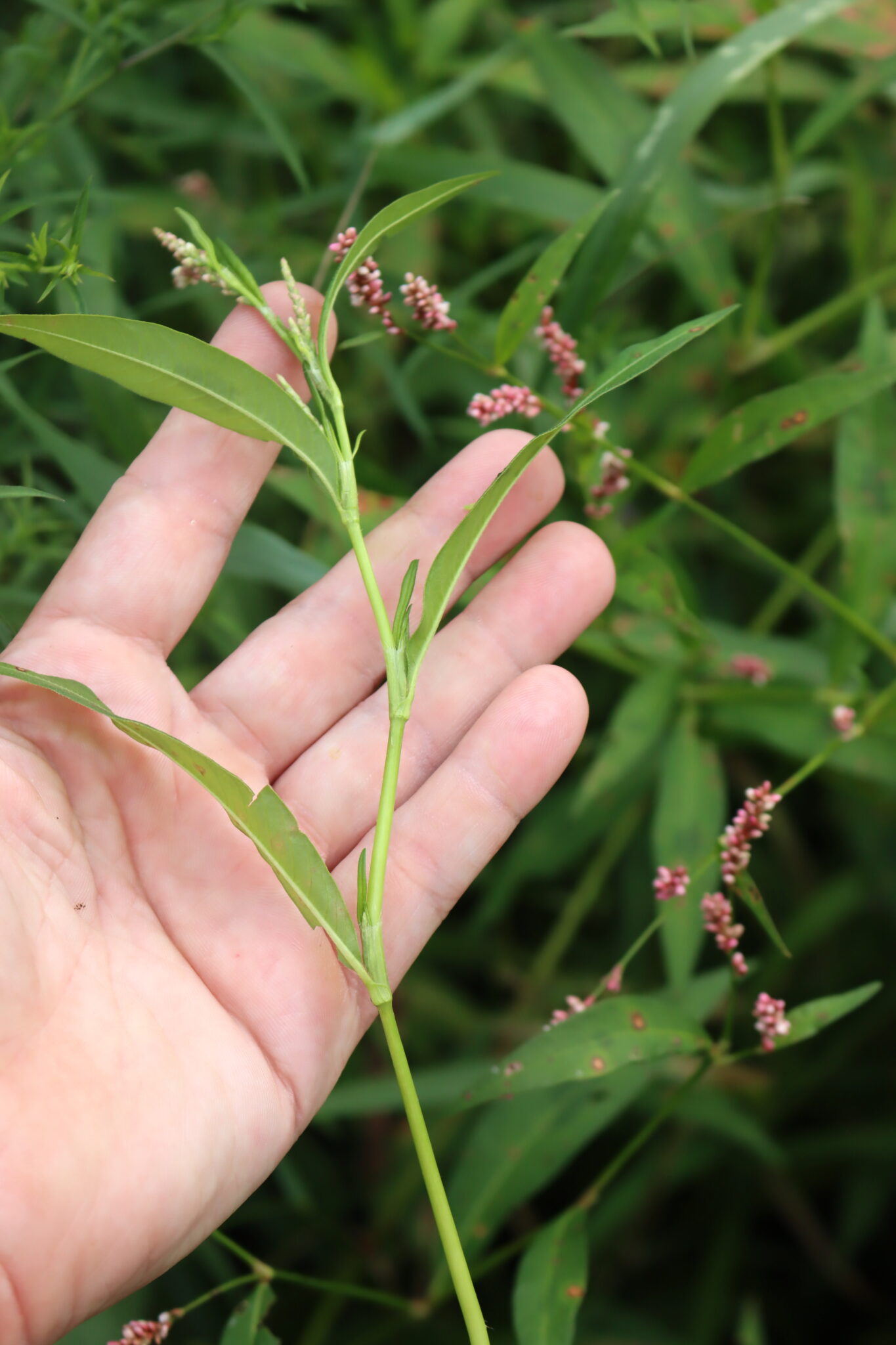
Lady’s Thumb generally doesn’t get any taller than 3 to 4 feet, but other Persicaria species like Pennsylvania Smartweed (Persicaria pensylvanica) can reach about 6 to 7 feet tall.
The stems are usually light green or reddish and may be branching or unbranched. They tend to grow erect but often flop over a bit, especially in dense stands. The stems have swollen nodes, and the plant often roots at the lower nodes where they contact moist soil.
Lady’s Thumb Flowers
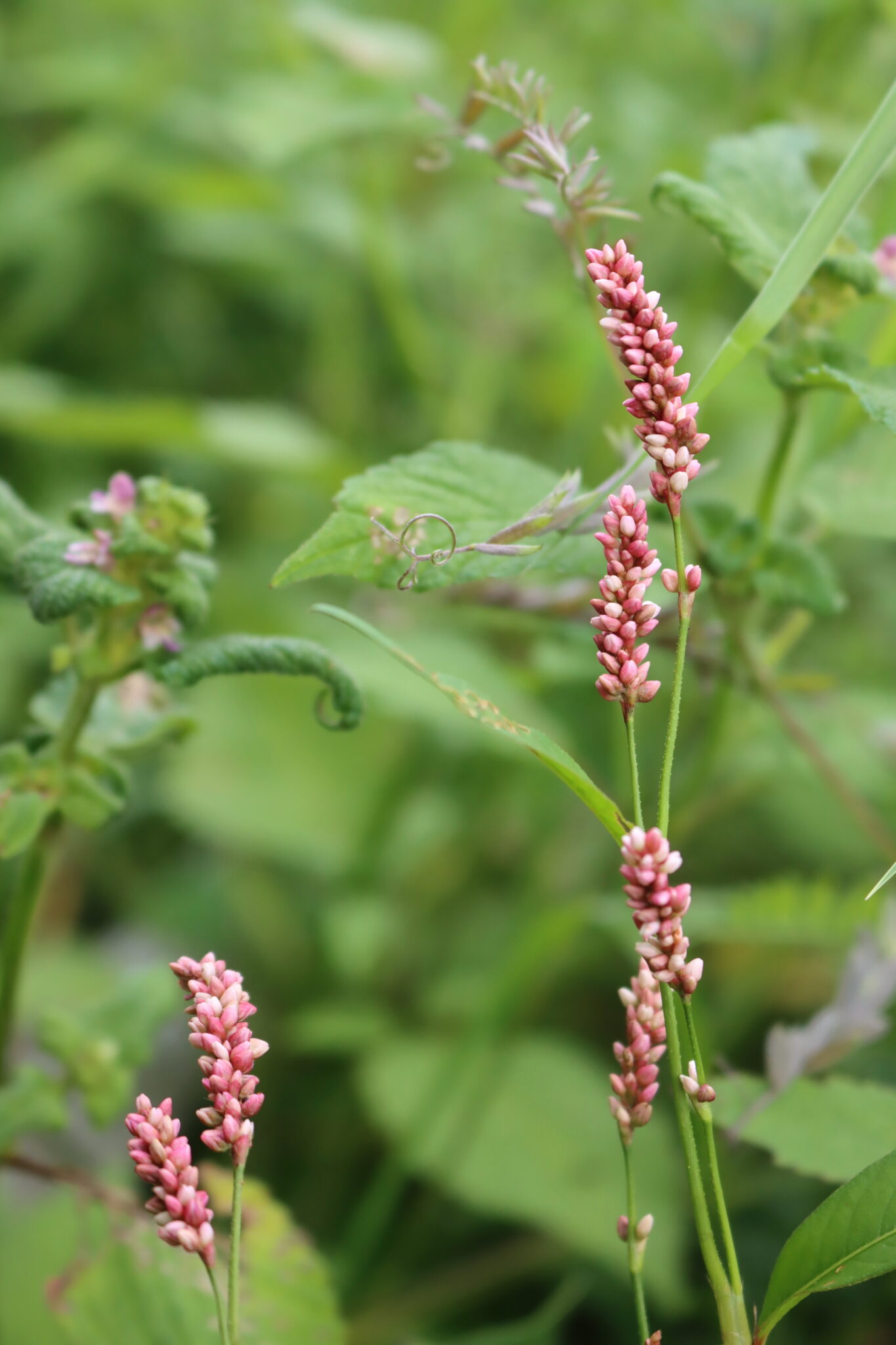
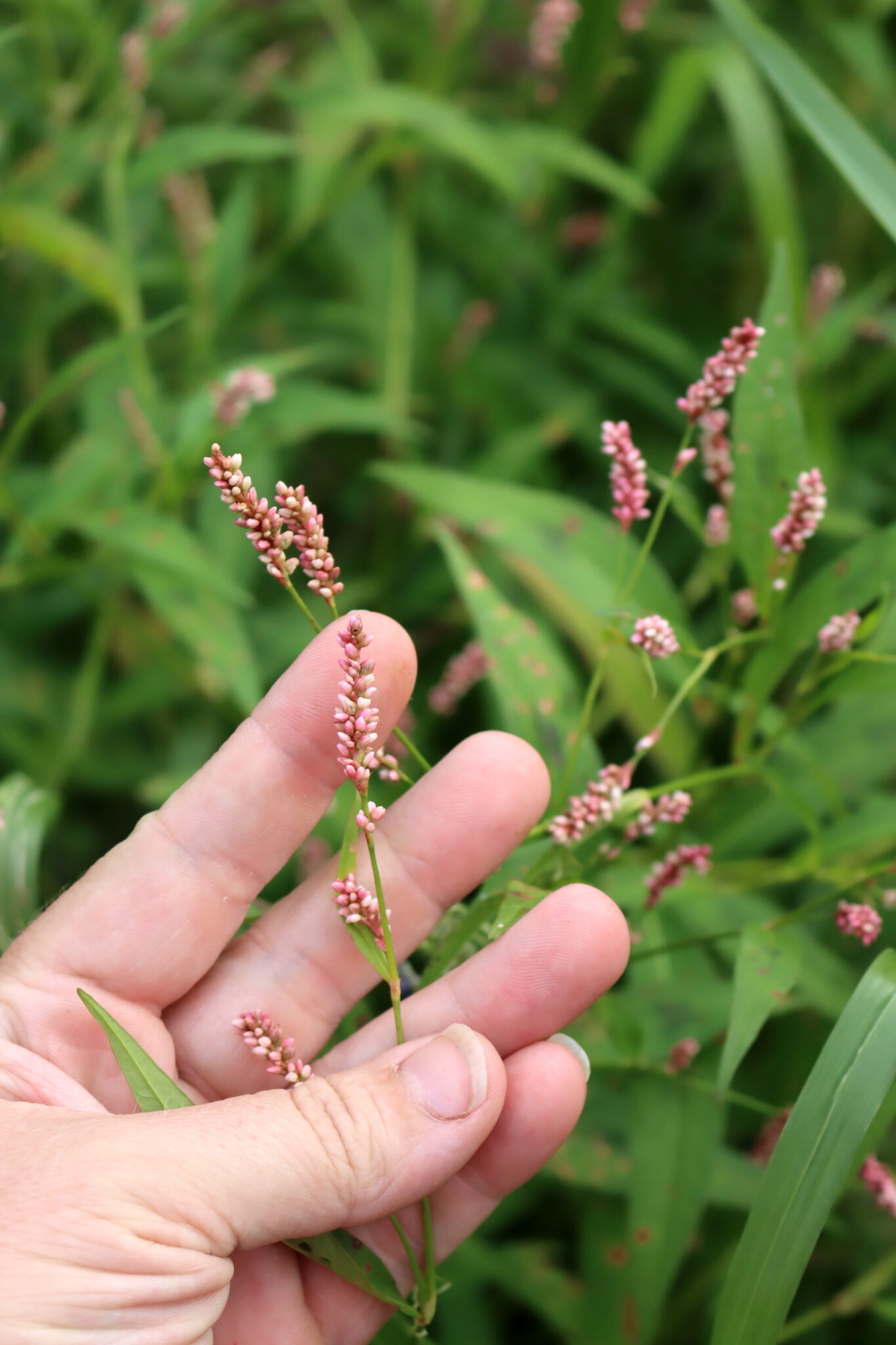
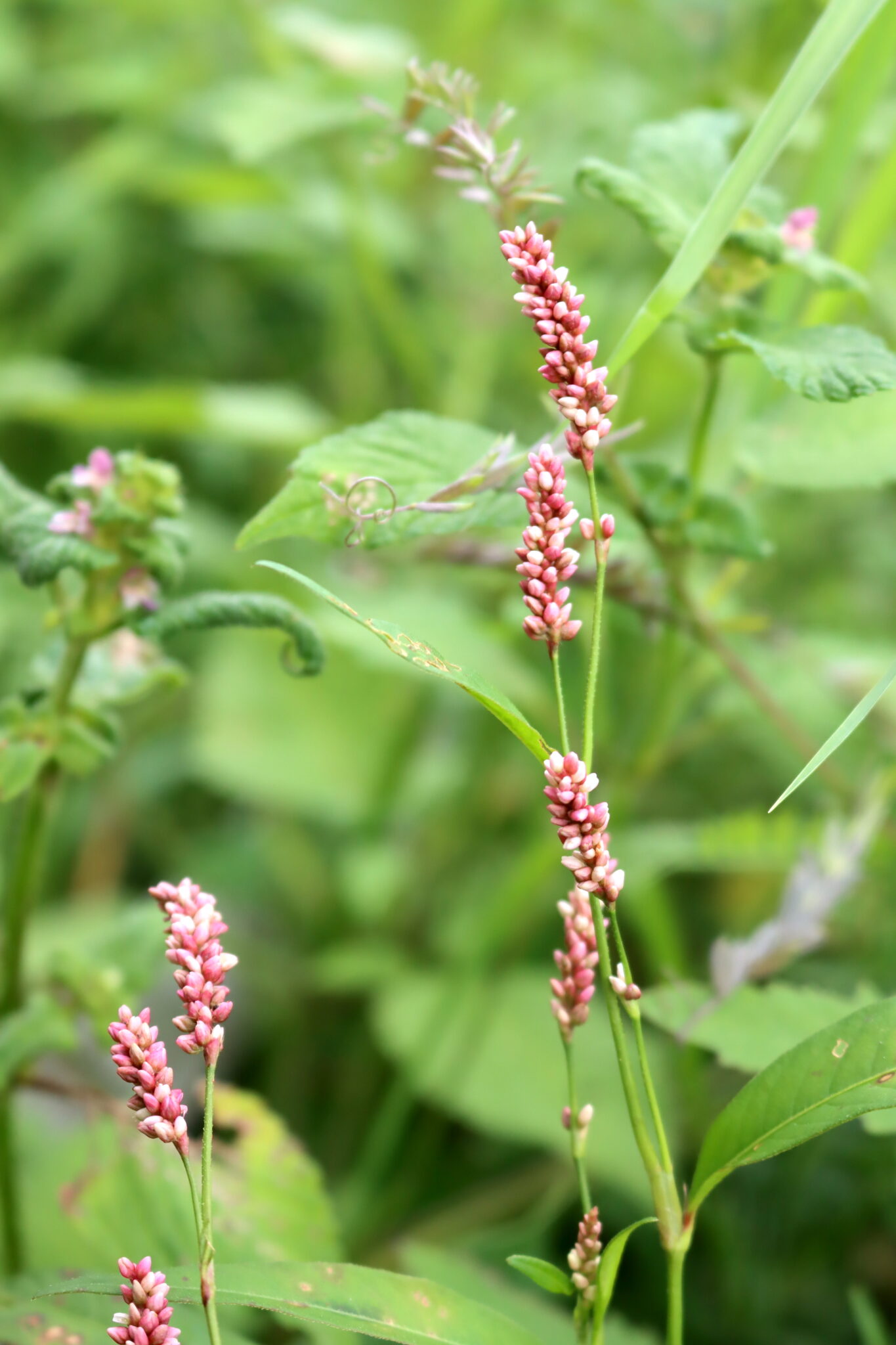
Persicaria flowers are one of the attributes that varies significantly between species. Typically, tiny flowers grow densely packed at the top of a spike, and the flower spikes emerge from the top of the stem or from leaf axils. The flowers are usually pink, white, or greenish and composed of 5 sepals (there are no true petals).
Lady’s Thumb itself has short, blunt pink flower spikes, while Pennsylvania Smartweed tends toward longer, brighter pink spikes, and Oriental Lady’s Thumb has longer, narrower spikes with bristly awns. The flower spike shape is one of the easier ways to distinguish between related Persicaria species in the field.
Lady’s Thumb Seeds
Persicaria flower spikes give way to seed heads that mature as the flowers dry to brown. The seeds are small, dark brown to black, shiny, and nearly round. As a member of the buckwheat family, Lady’s Thumb seeds have a similar starchy, mildly nutty flavor to cultivated buckwheat, which shouldn’t be a surprise given they’re close relatives.
If you’ve ever gathered dock seeds for flour, the process for Lady’s Thumb seeds is similar.
Lady’s Thumb Look-Alikes
A handful of grass species can resemble Lady’s Thumb at a casual glance, particularly when all you’re seeing is narrow foliage at a distance. Once you get close enough to look at the leaves and flower structure, none of these are easily confused with Lady’s Thumb. They’re worth knowing about so you can rule them out quickly in the field.
Lady’s Thumb may be mistaken for Japanese Stilgrass (Microstegium vimineum). However, you can differentiate the two with a few key features:
- Japanese Stiltgrass leaves have parallel venation.
- Japanese Stiltgrass has inconspicuous spikes of tiny greenish flowers similar to other grass species.
- Japanese Stiltgrass has wiry stems with less fleshy nodes.
- Japanese Stillgrass has weak, shallow root systems and is easy to pull.
Lady’s Thumb can also be mistaken for Basketgrass (Oplismenus hirtellus). It differs in a few noticeable ways:
- Basketgrass leaves have parallel venation.
- Basketgrass leaves appear wavy or ribbed.
- Basketgrass flower spikelets have long, sticky awns or hair or bristle-like structures.
- Basketgrass usually grows in moist woodlands rather than open areas.
Lastly, Lady’s Thumb can be confused with Deer Tongue or Panic Grass (Dichanthelium spp.). Here are a few ways you can tell them apart:
- Deer Tongue leaves have parallel venation.
- Deer Tongue leaves clasp around the stem.
- Deer Tongue has loose, spreading flower and seed heads.
Other Persicaria Species
The plants most likely to be confused with Lady’s Thumb aren’t grasses at all, but other Persicaria species that share the same family, the same habitat, and the same general shape of lance-shaped leaves and pink flower spikes. The good news is that all of the commonly encountered North American Persicaria species are edible and share similar uses. If you’re trying to distinguish between them for a specific recipe or flavor profile, the following notes should help. If you just want to eat some smartweed greens, you’re fine picking the best-looking leaves from any of them.
Pennsylvania Smartweed (Persicaria pensylvanica)
Native to North America and often growing side by side with Lady’s Thumb. Pennsylvania Smartweed is typically taller (up to 6.5 feet), with brighter pink and more upright flower spikes. The leaves usually lack the distinctive thumbprint marking, though occasionally they’ll show a faint blotch. The ocrea (papery sheath where the leaf meets the stem) is usually smooth rather than fringed with bristles. Edible and used the same way as Lady’s Thumb.
Pale Smartweed / Curlytop Knotweed (Persicaria lapathifolia)
A larger cousin, sometimes reaching 4 feet or more, with nodding or arching flower spikes in pale pink or nearly white. The leaves are typically longer and more pointed than Lady’s Thumb, and usually lack the thumbprint spot. The ocrea is hairless and often has glandular dots on the underside of the leaf. Edible, though the flavor can be slightly more bitter than Lady’s Thumb.
Oriental Lady’s Thumb (Persicaria longiseta)
Nearly identical to Lady’s Thumb at first glance and often growing right alongside it. Oriental Lady’s Thumb typically has longer, more slender flower spikes and long bristly hairs (over 1/4 inch) on the ocrea, where Lady’s Thumb has shorter bristles (around 1/8 inch). The leaves often lack or have a faded thumbprint marking. Edible and used interchangeably with Lady’s Thumb in most kitchen applications.
Water Pepper (Persicaria hydropiper)
This one is worth singling out because the flavor is dramatically different. Water Pepper typically grows in or near shallow water, with narrower leaves that often show a purplish tinge, and drooping green-to-pinkish flower spikes. A raw leaf will give you a strong, lasting burn comparable to horseradish or a fresh jalapeño, thanks to a compound called polygodial. If you’re trying to pick Lady’s Thumb as a mild pot herb and accidentally grab Water Pepper, you’ll know within a bite or two. Water Pepper is the species used in traditional Japanese tade-zu sauce.
Ways to Use Lady’s Thumb
Lady’s Thumb and other Persicaria species are easy to use as greens. Depending on the species, they have a lemony or mildly peppery flavor and work well in salads or cooked dishes like stir-fries, soups, and sauces. The flowers are also edible and make a pretty garnish on a salad or as confetti across a bowl of pasta. Think of lady’s thumb as a supporting player rather than a starring green: it mixes beautifully with lambsquarters, purslane, or cultivated greens.
Water Pepper (Persicaria hydropiper) is the most culinarily famous species in the genus, often used in Japanese cuisine. The leaves are used as a vegetable or to garnish tempura, sushi, or sashimi, and they’re the key ingredient in traditional water pepper sauce (tade-zu). You can use traditional Water Pepper or experiment with the Persicaria species you find locally.
The seeds are also tasty and safe to eat raw or cooked. They’re excellent sprinkled over stir-fries, breads, and other dishes, or added to baked goods like muffins, granola, and cookies. As a member of the buckwheat family, they also make a decent wild foraged flour, though it takes a good bit of effort to gather enough.
To harvest the seeds, wait until about 80% of the flowers have turned brown. Then slide your fingers up the stalk and strip them into a bag or container. You can use these seeds fresh or lay them out for a week or two in a single layer, out of direct sunlight, to finish drying. You can winnow them if you want clean seed, but many foragers leave the chaff in with the seeds, especially when grinding for flour.
You can also use these plants medicinally. For internal use, you can make teas and tinctures with the leaves, stems, and flowers of Persicaria species. My guides to making a herbal tincture and herbal tincture recipes walk through the basic method, which you can adapt for Lady’s Thumb using a simple folk-method alcohol extraction of the fresh or dried aerial parts. For external use, you can grind or chew the leaves into poultices for minor burns, poison ivy, and other skin irritations, in the same way you might use plantain. A poultice-first-aid tradition is shared across many cultures for this whole genus.
The insect-repellent use is a fun one to try. Historically, people rubbed the crushed leaves on skin or horses to keep biting flies away, and some readers have reported noticeably fewer fleas and biting insects in areas where lady’s thumb grows densely. It’s not a substitute for a proper repellent in tick country, but it’s a nice traditional use worth experimenting with in the garden.
Fiber artists can also use Lady’s Thumb with an alum mordant to make a soft yellow natural dye. The whole flowering plant works well for this.
Thank you Ashley for this article, I’ve had this growing out my back door all summer and I didn’t know what it was. Now I do, and I’m glad it’s growing there. I wondered why I didn’t see any fleas this year or bugs by it.
Lady’s Thumb Recipes
- For a detailed culinary overview of Lady’s Thumb and several related smartweeds, visit The Forager Chef’s guide to edible smartweeds. James Beard Award-winning chef Alan Bergo covers flavor profiles across the genus and how to use them in the kitchen.
- For a simple, classic preparation, try Merriwether’s approach on Foraging Texas: boil the young leaves for 8 to 10 minutes and serve as a pot herb with butter, roasted garlic, or crispy bacon.
- If you’re brave enough to try Water Pepper, spice things up with this Japanese Water Pepper Style Sauce (Tade-Zu) recipe from The Forager Chef.
Lady’s Thumb FAQs
Yes, chickens can safely eat lady’s thumb, and many free-range flocks graze on it readily. It’s a useful volunteer plant in a chicken run. Larger grazing livestock like horses, cattle, and goats should be monitored, as significant quantities of lady’s thumb can cause nitrate accumulation in those animals.
Lady’s thumb is used as a mildly lemony edible green, for its edible seeds (which make a passable flour), for tea and tinctures, and topically as a poultice for minor burns and skin irritations. Traditional uses also include insect repellent and, with an alum mordant, a natural yellow dye for fiber.
Lady’s thumb tincture is made the same way as any other herbal tincture: fill a clean jar loosely with fresh or dried aerial parts (leaves, stems, flowers), cover fully with 80 to 100 proof vodka or other drinking alcohol, cap, and steep in a dark place for four to six weeks, shaking occasionally. Strain off the plant material and store the finished tincture in a dropper bottle. See my guide to making herbal tinctures for the full folk method.
Lady’s thumb (Persicaria maculosa) and oriental lady’s thumb (Persicaria longiseta) are closely related naturalized species with very similar uses. The clearest differences are in the flower spike and the ocrea (the papery sheath where the leaf meets the stem). Oriental lady’s thumb has a more slender, elongated flower spike and long bristly hairs on the ocrea, while lady’s thumb has shorter, blunter flower spikes and shorter fringe on the ocrea. Both are edible and used similarly.
Lady’s thumb is one of several species commonly called smartweed. The name smartweed refers broadly to plants in the Persicaria genus, which includes lady’s thumb (P. maculosa), Pennsylvania smartweed (P. pensylvanica), water pepper (P. hydropiper), and oriental lady’s thumb (P. longiseta), among others. Most are edible and share similar uses, though flavor intensity varies (water pepper in particular is much spicier than lady’s thumb).
Did you find this Lady’s Thumb foraging guide helpful? Tell me in the 📝 comments below how you use lady’s thumb on your homestead!
And make sure you stay in touch with me by following on social media!
More Foraging Guides
Find the perfect foraging guide
Searching for something else? Enter keywords to find the perfect foraging guide!
Herbal Remedies










Thank you Ashley for this article, I’ve had this growing out my back door all summer and I didn’t know what it was. Now I do, and I’m glad it’s growing there. I wondered why I didn’t see any fleas this year or bugs by it.
Thanks