
Affiliate disclosure: This post may contain affiliate links. Please see our Privacy Policy.
Serviceberries (Amelanchier sp.) are a tasty wild fruit that ripens in late spring and early summer, growing on small trees and shrubs across most of North America. The fruit looks like a blueberry on a tree and tastes like a blueberry crossed with an almond, and many foragers consider them one of the best wild fruits in eastern North America.
Learn how to identify serviceberries, distinguish them from blueberries and toxic look-alikes, and harvest the fruit before the cedar waxwings beat you to it.
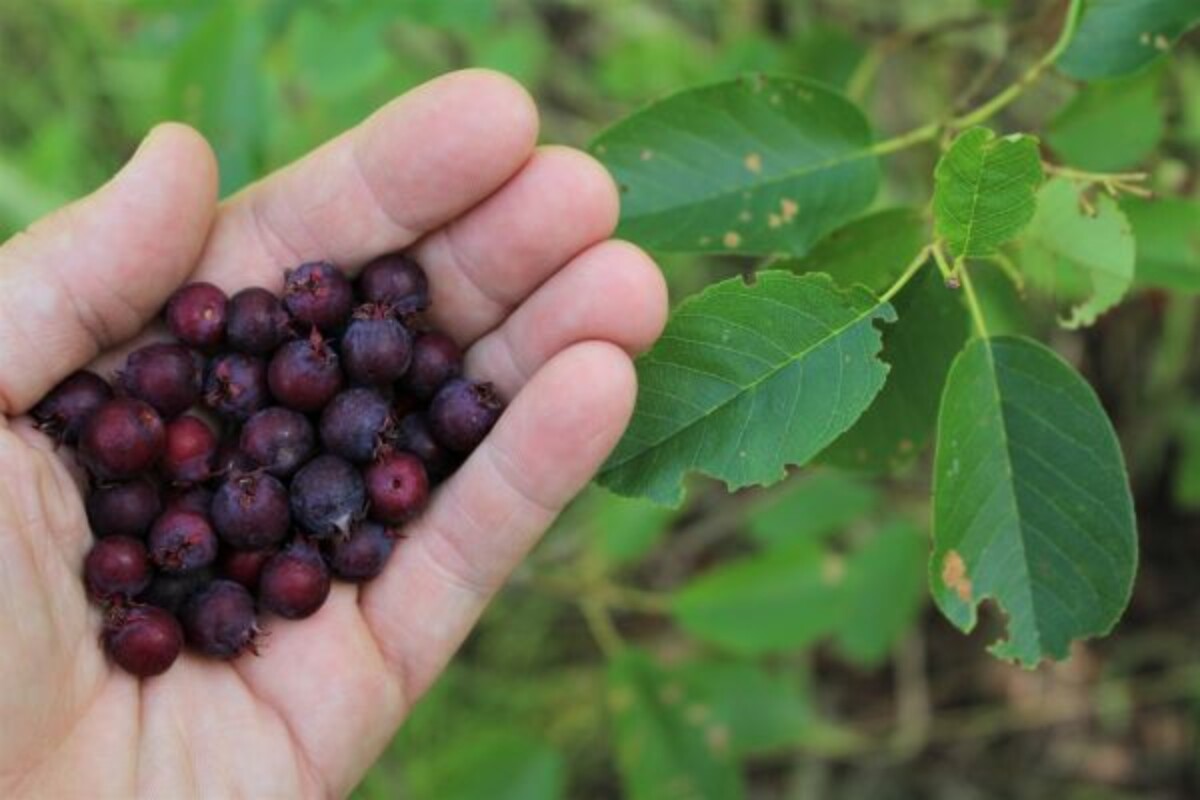
Table of Contents
- Notes from My Homestead
- What Are Serviceberries?
- Types of Serviceberry
- Are Serviceberries Edible?
- Where to Find Serviceberries
- When to Find Serviceberries
- How to Identify Serviceberries
- Serviceberry Look-Alikes
- How to Harvest Serviceberries
- Ways to Use Serviceberries
- Wild Fruit Foraging Guides
- Serviceberry FAQs
- Summer Foraging Guides
Serviceberries go by a number of regional names: Saskatoon (in Canada and the upper Midwest), Juneberry (across the northeast), Shadbush or Shadberry (in coastal New England), Sarvisberry or Sarvis (in Appalachia), Pidgeon Berry, Bilberry, Sugarplum, and many others. They’re all the same group of plants in the genus Amelanchier; the names just shift with the dialect and the latitude.
Truly ripe serviceberries are a real treat, and though I forage literally dozens of edible wild berries each summer, a perfectly ripe serviceberry puts them all to shame.
The trick is beating the Cedar Waxwings to the fruit, as they’re liable to pick them off at the first hint of pink, long before they ripen to a deep purple. In mast years, the fruit will overwhelm the birds, meaning you can pick them by the bucket load in the right spot.
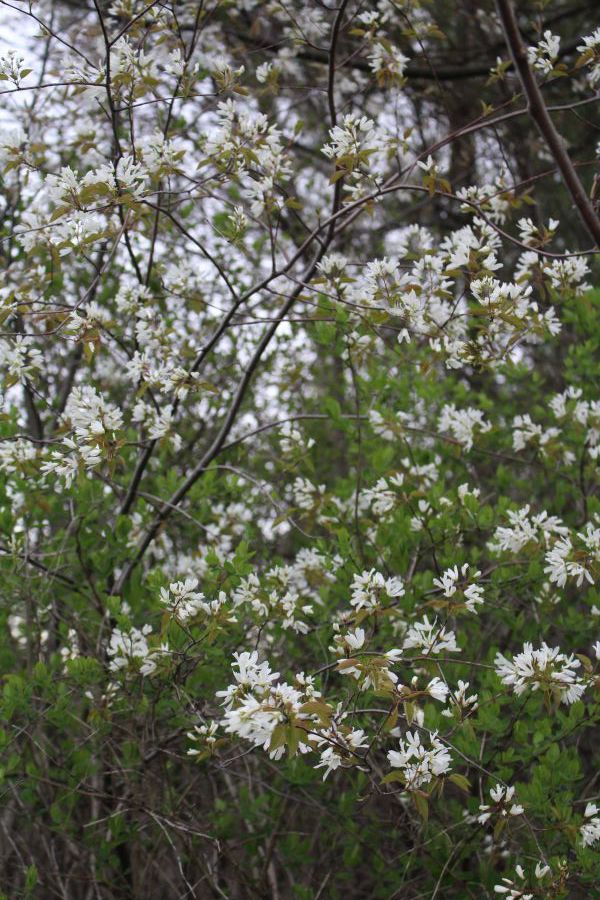
The very best time to identify serviceberries is in the early spring, when their white blooms stick out against a still dull countryside. Serviceberry trees fill with small white blossoms just as the earliest trees are breaking bud. The leaves of serviceberry shrubs have a brown/red/orange tinge as they’re emerging, making it especially easy to see the bright white blossoms against the dark background.
Later in the season, the flavorful berries may hide in the dense foliage. One of my favorite summer walking spots is covered in serviceberry trees, but I’d never noticed them. That is, until I took a walk there in the spring months. They can be hard to notice during the fruiting season, even for an experienced forager.
Notes from My Homestead

We have a long-running serviceberry walk on our Vermont homestead that I’ve been refining for almost a decade now. Most of the productive trees are along the old fence lines and the woodland edges where the soil is rich and the morning sun gets through. The serviceberries here ripen in early July, just before the wild raspberries hit their peak, and the harvest window is short. Maybe two weeks if I’m lucky and the cedar waxwings haven’t found the patch first. I keep a mental map of the productive trees, and I check them every other day starting around June 25th to time the harvest right.
For our family, most of the serviceberry harvest gets eaten on the spot or goes into a quick batch of pancakes the morning after picking. We’ve never managed to put away enough for jam or jelly, partly because the kids inhale them and partly because the harvest is so brief. I’ve also planted three serviceberry shrubs in our permaculture orchard near the house, including a low shadbush (Amelanchier humilis) that stays compact and a downy serviceberry that’s already fruiting after four years. The cultivated ones don’t quite match the flavor of the wild ones, but they’re close, and they’re easier to harvest at scale.
What Are Serviceberries?
Serviceberries are the edible fruits of small trees and shrubs in the genus Amelanchier, family Rosaceae (the same family as apples, plums, and cherries). The fruit is technically a pome (the same fruit type as an apple) rather than a true berry, but it looks and tastes much more like a blueberry than an apple, with a sweet, almost almond-like flavor that comes from the small seeds inside.
Serviceberries grow as multi-stemmed shrubs or small understory trees, typically reaching 15 to 30 feet tall. They produce showy white flowers in early spring (often the first major bloom in the woods after the willows), followed by green berries that ripen through pink and red to a deep purple-blue in early summer. The fruit ripens unevenly within a cluster and within a tree, which means the harvest window can stretch out for weeks even though any individual berry passes through ripeness in just a few days.
The name “serviceberry” likely comes from the older term “sarvis” or “sarvisberry,” which itself is a corruption of “sorbus,” an Old World name for a related Rosaceae fruit. There’s a popular folk-etymology that the trees were named because they bloom around the time of year when funeral services could finally be held in the Appalachians (after the ground thawed enough for burial), but the timing doesn’t actually line up; the soil thaws weeks before serviceberries bloom in most of their range.
The “shadbush” name has a more verifiable folkloric origin. A reader from Maine wrote to me to share that locals there note when “the shad are flowering,” because serviceberries traditionally bloom at the same time the shad (a migratory fish) run up the streams to spawn. The flowering serviceberry was historically a marker of when to head out for the shad fishing run.
Types of Serviceberry
There are dozens of different species of serviceberry within the Amelanchier genus, and the species are mostly differentiated by region. The plants are slightly different, as are the fruit, but as a whole, they’re all pretty similar wild edible berries. The classification of serviceberries is a bit confusing, and even botanists will disagree on exact species names. There’s a lot of overlap and interbreeding, along with variation within species.
It’s really not important to identify the exact species; just look for the general characteristics of all Amelanchier species for tasty serviceberries. Here are the more common species you’ll encounter in the wild:
- Amelanchier alnifolia — Known as Western Serviceberry, dwarf shadbush, pigeon berry, or most commonly Saskatoon. This is the dominant species in the western US, the Canadian prairies, and Alaska. It produces some of the largest and sweetest serviceberries and is the species most often grown commercially. (Range Map)
- Amelanchier arborea — Common Serviceberry or Downy Serviceberry, present throughout the eastern half of the US and Canada. The fruit is dark purple-blue when fully ripe, and this is the species we harvest most often here in Vermont. (Range Map)
- Amelanchier laevis — Allegheny Serviceberry or smooth serviceberry, native to the eastern US. The young leaves are smooth and bronze-tinged (rather than fuzzy like downy serviceberry), and the fruit is generally considered the best-tasting of the eastern species. (Range Map)
- Amelanchier canadensis — Known as Bilberry, chuckleberry, sugarplum, or Canadian Serviceberry. Present along the East Coast of North America from the deep south to northern Canada, particularly in wetter habitats. (Range Map)
- Amelanchier bartramiana — Mountain Shadbush or Oblongfruit Serviceberry. The fruits are unique in that they’re oblong rather than round, a bit like a very tiny pear. Native to the Northeastern US and Canada. (Range Map)
- Amelanchier humilis — Low shadbush, a smaller shrub-form species (rarely over 4 feet tall) that maintains a bushy habit. Native to north-central and northeastern North America. We grow this one on our permaculture homestead because it stays manageable in size. (Range Map)
- Amelanchier sanguinea — Round-leaf Serviceberry, with a distinctive rounder leaf shape that helps with identification. Native to the eastern US and Canada. (Range Map)
- Amelanchier x grandiflora — A natural hybrid between A. arborea and A. laevis, often grown as an ornamental. The named cultivars ‘Autumn Brilliance’ and ‘Robin Hill’ are this hybrid. The fruit is edible, just like the parent species.
Beyond the wild species, serviceberries are widely planted as ornamentals, especially in the northeastern US. Their beautiful flowers in the spring make them well appreciated by landscapers, and the birds largely harvest the delicious fruit. They’re a common sight in parking lot plantings, around public buildings, and as foundation plantings here in Vermont. If you can identify the bark and leaves, you can harvest from these urban plantings as long as they haven’t been treated with pesticides.
Are Serviceberries Edible?
Yes, all true serviceberries (Amelanchier species) are edible, and most are considered delicious. The fully ripe fruit has a sweet flavor that’s been described as a blueberry crossed with an almond, with a slight cherry-like undertone. Underripe pink berries are tarter and less sweet but still pleasant; many foragers harvest the slightly underripe pink berries because they’re easier to get to before the birds find them.
The fruit contains several small seeds, similar in size to blueberry seeds. The seeds have a mild almond extract flavor when chewed, which is the source of the slight almond note in the overall flavor. Some foragers find the seeds noticeable and slightly bitter; others (myself included) barely register them at all.
Like other plants in the rose family (Rosaceae) including apples, peaches, and cherries, serviceberry seeds contain very small amounts of cyanogenic compounds. The amount in serviceberry seeds is far below any toxic threshold and similar to what you’d find in apple seeds; the fruit is safe to eat in any normal quantity. This is mentioned only because some foraging references list serviceberries as “containing cyanide,” which is technically true but practically misleading; the same statement could be made about every apple or peach you’ve ever eaten.
Where to Find Serviceberries
Serviceberries are native to most of North America, from northern Mexico through Canada and into Alaska. Different species dominate different regions; Amelanchier alnifolia (Saskatoon) covers the West and Canadian prairies, A. arborea and A. laevis cover the eastern hardwood forests, A. canadensis hugs the eastern coast, and several smaller species fill specific habitats from boreal bogs to Appalachian ridges.
Look for serviceberries in:
- Forest edges, woodland clearings, and the understory of mixed hardwood forests
- Sunny patches along trails, old fence lines, and woodland streams
- Hillsides with thin-to-moderate soil and good drainage
- Roadsides and abandoned farmstead margins
- Ornamental plantings in parking lots, parks, and around public buildings
- Riparian zones and floodplain edges (especially A. canadensis in the East)
- Open prairie edges and aspen parkland (A. alnifolia in the West)
Serviceberries are particularly easy to spot in early spring when their white blooms appear before the surrounding hardwoods leaf out. A hillside with multiple serviceberry trees in bloom looks dramatically different from any other woodland in early May, and you can mark productive locations from a moving car at highway speeds.
When to Find Serviceberries
Serviceberry timing varies dramatically by latitude and species. The general progression:
- Bloom (white flowers): Late March in the deep south, mid-April in the mid-Atlantic, early May in the upper Midwest and Northeast, late May to early June in northern Canada and Alaska. The bloom typically lasts 1 to 2 weeks.
- Green fruit: Develops over 3 to 6 weeks after the bloom, depending on species and weather.
- Pink stage: The fruit begins to blush pink to red about 5 to 8 weeks after bloom. This is the earliest harvest window for foragers willing to accept slightly tarter, less sweet fruit.
- Fully ripe (deep purple-blue): Roughly 6 to 10 weeks after bloom. This is when the fruit reaches peak sweetness and most closely resembles a blueberry in color.
- Cedar waxwing arrival: Usually within a day or two of the first ripe berries. The birds are remarkably consistent across years and will strip a tree clean within 24-48 hours of arrival.
In Vermont, serviceberries bloom in early May (just before the first dandelion blossoms), pass through pink in mid-to-late June, and reach full ripeness in early July. In southern states, the same sequence can wrap up by late June. The “Juneberry” name reflects the timing across most of its eastern range.
How to Identify Serviceberries
Serviceberry plants vary significantly in size depending on location and species. Some are small bushes just a foot or two tall (like A. humilis), while others are modest trees reaching 30 feet or more. Either way, they tend to have a bushy habit, and even the taller tree serviceberries often have multiple small trunks.
Serviceberry Bark
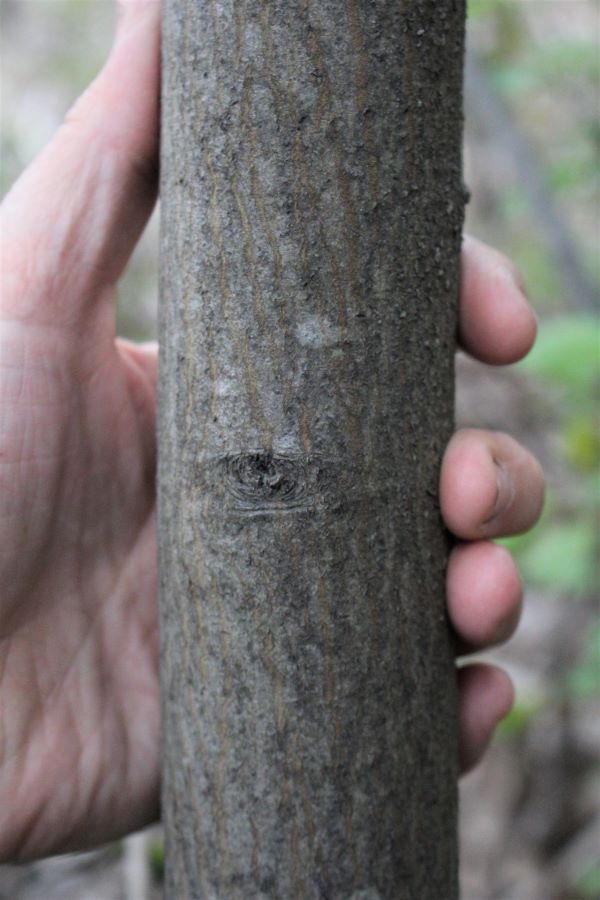
Serviceberry bark is one of the most reliable identification features and is visible year-round. The bark is a smooth, nondescript grey color, but it almost always has subtle vertical striping. To my eye, it looks like stretch marks (and as a mother of two, I’m pretty familiar with what those look like). On some trunks the stripes are much more distinctive than others, with the “stripes” being a greenish color.
This vertical striping is the easiest way to identify serviceberries out of season, and I’ll keep an eye out for the “stretch mark” bark alongside winter snowshoe trails. Once you’ve trained your eye to it, you’ll never miss a serviceberry tree again, even in the dead of winter.
Serviceberry Flowers
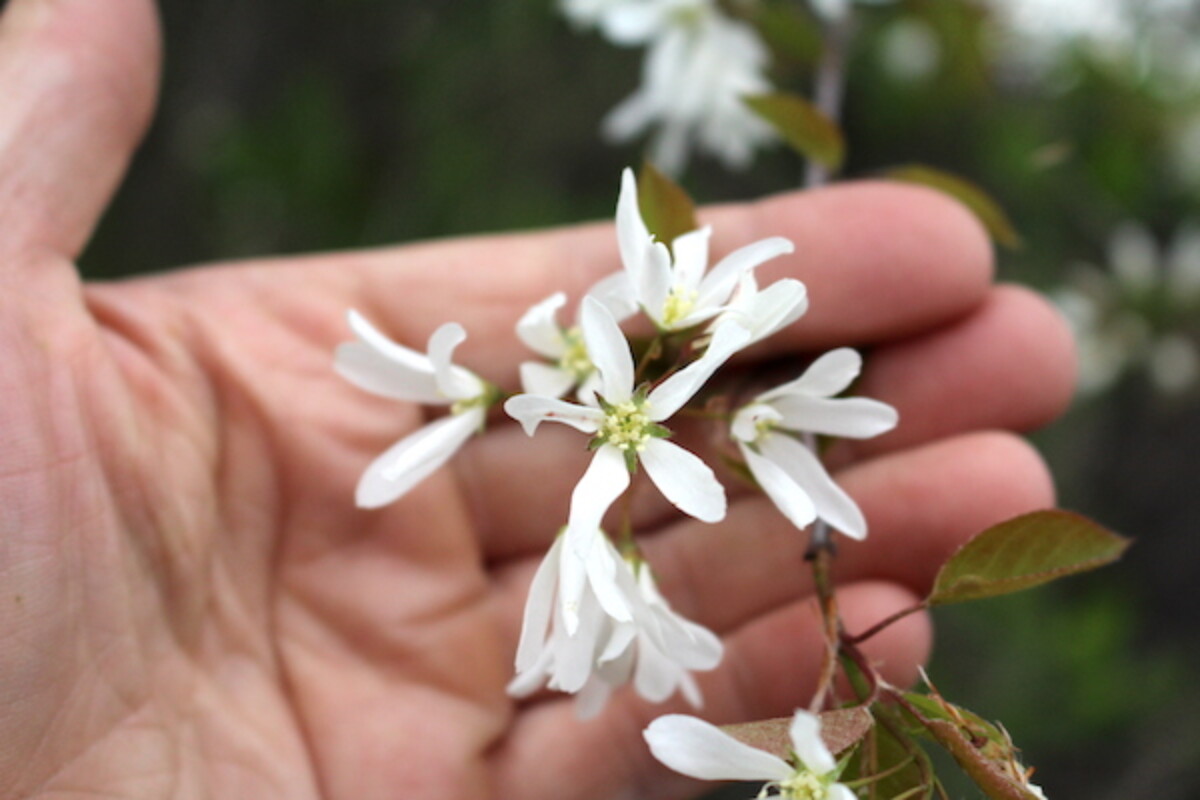
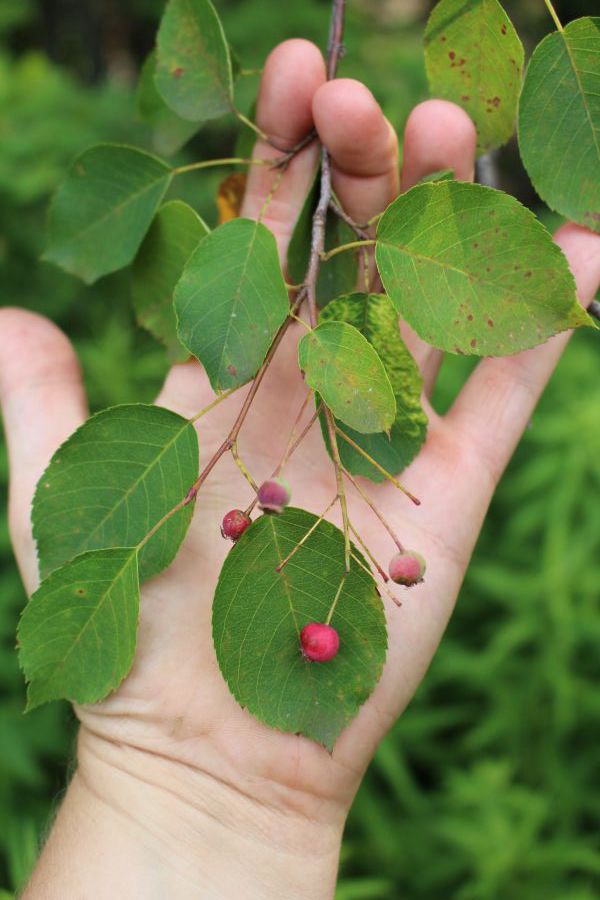
Once spring arrives, serviceberries are a lot easier to spot. They’re covered in distinctive white flowers, with 5 long narrow petals each. The petals are a defining feature of the genus; most other early-spring flowering shrubs have rounder, broader petals.
On hillsides with multiple trees you can spot them at a distance, and it’s easy to mark dense patches of them (even driving at highway speeds). Flowering time varies by location, but it generally corresponds with the first warm spring weather. In Vermont, serviceberries bloom in early May, just before the first dandelion blossoms, but the bloom is clearly much earlier in southern states.
Serviceberry Leaves
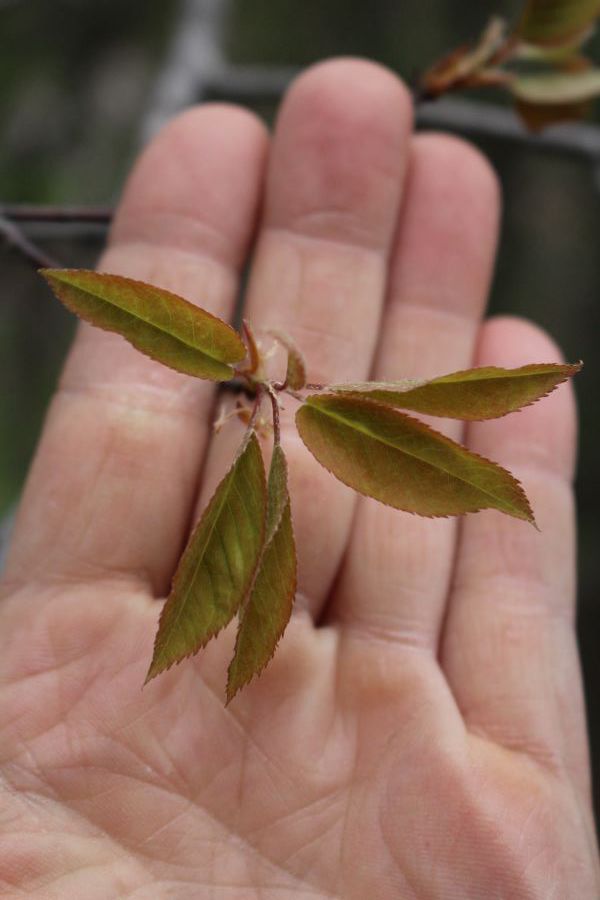
The leaves of serviceberry trees change color throughout the season, and they start off with a rusty tinge. That dark brown/red color is a good backdrop for the bright white petals and makes it easier to spot serviceberry shrubs in early spring. They lose that coloration as they mature into full leaves.
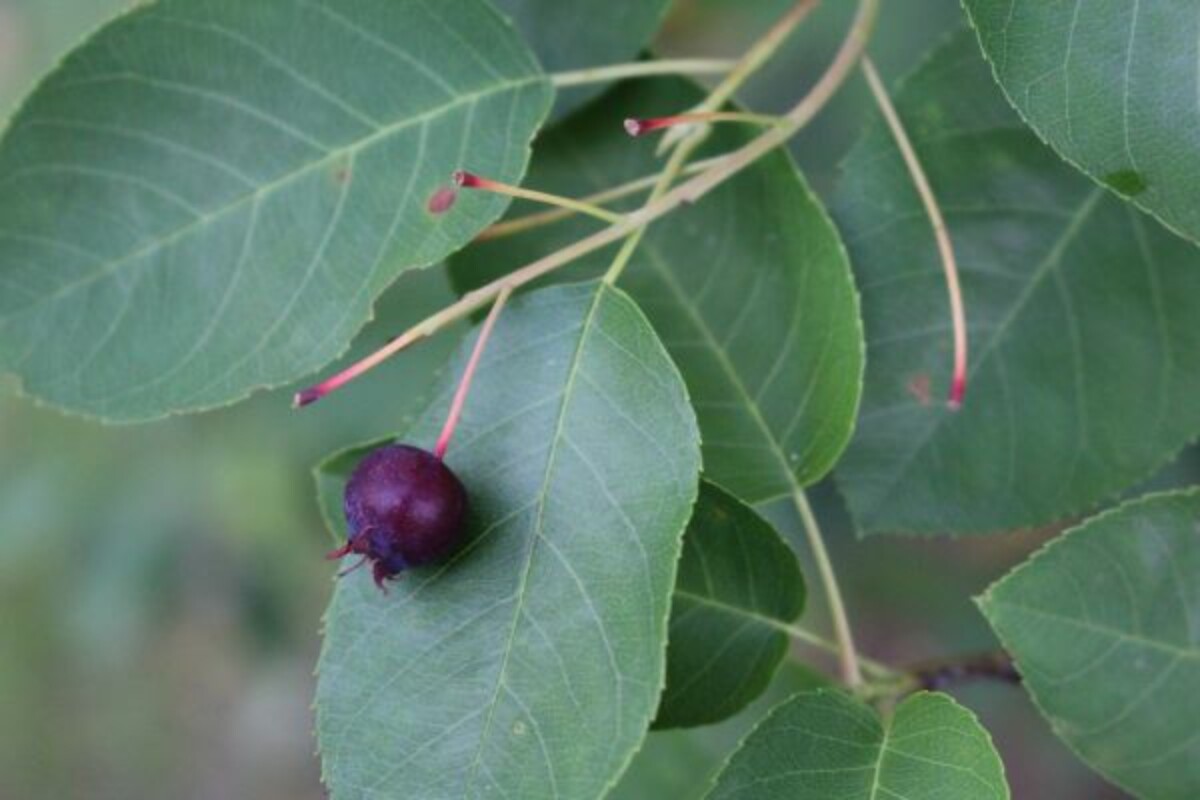
Full-sized serviceberry leaves are dark green with finely serrated margins, and vary a bit in shape from round to elliptic to ovate depending on the species. The leaves are simple (not compound), alternate, and usually 1 to 3 inches long. The leaf undersides may be slightly fuzzy (especially on A. arborea, “downy serviceberry”) or smooth (on A. laevis, “smooth serviceberry”). The leaf shape is one of the easier ways to distinguish among the species, though for general edibility it doesn’t matter much.
I often find young plants growing at the edge of our woods, under trees where birds have dropped their fruit. Though the young plants are only a few inches high, the leaves are rather distinctive compared to most of the forest edge plants that grow in these parts. When I spot one, I’ll mark it with a quick tie of flagging tape and make sure to step around it and allow it to mature.
Serviceberry Fruit
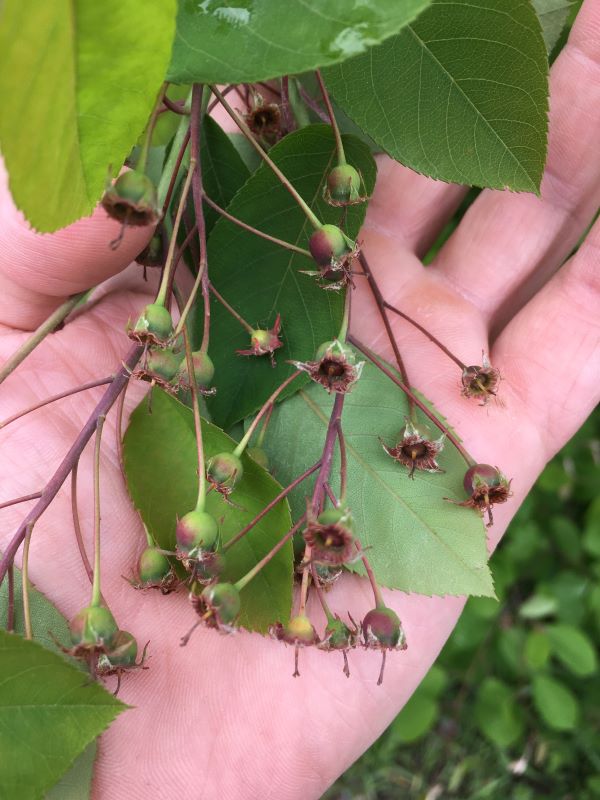
After the bright white flowers come green immature fruit. The fruit develops in small clusters at the tips of last year’s branches, with each fruit hanging on a slender stalk about ½ inch long. As the fruit ripens, it passes through pink and red before reaching full ripeness as a deep purple-blue.
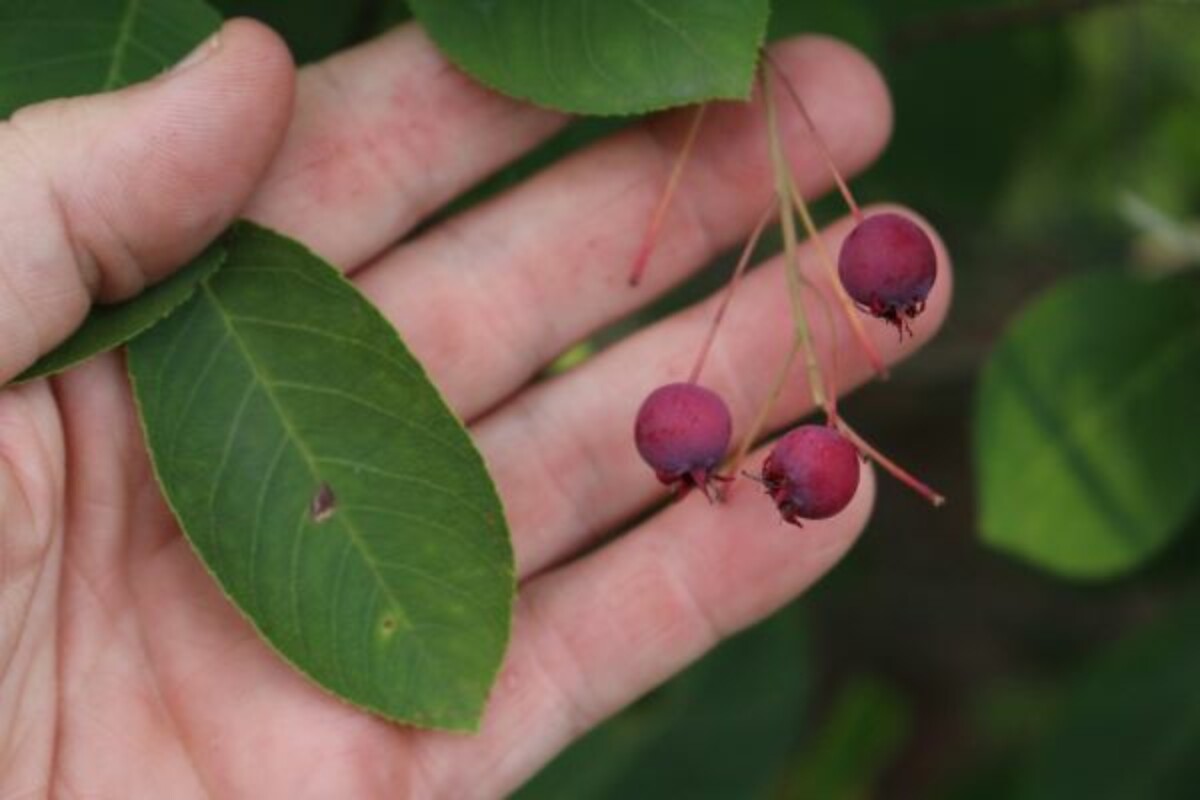
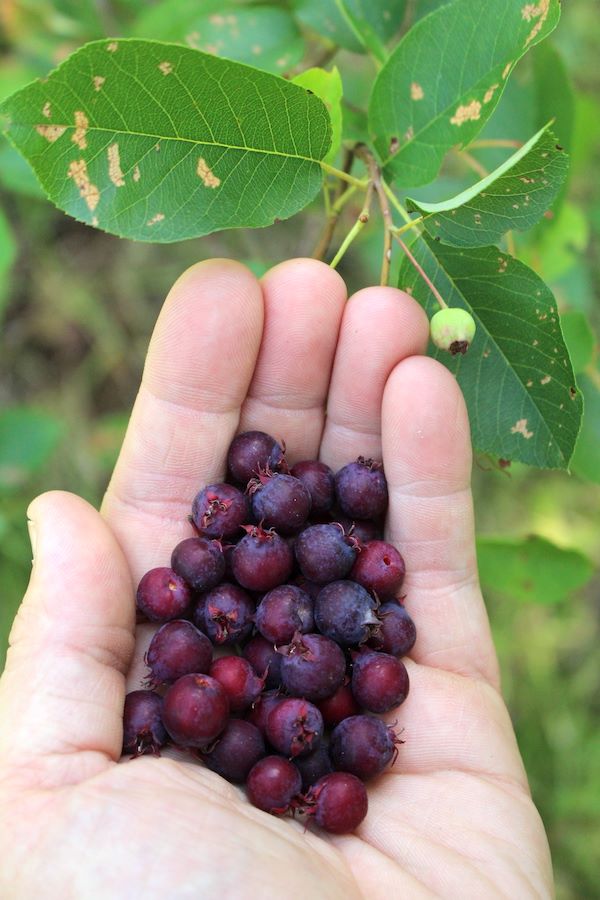
Each ripe serviceberry is round (or slightly oblong, depending on species), about ¼ to ½ inch across, with a small five-pointed crown at the bottom (a leftover from the flower’s calyx). The crown is a useful identification feature because it’s similar to a blueberry’s crown but on a tree-grown fruit; once you’ve trained your eye to look for it, you can recognize a serviceberry at a glance.
The fully ripe fruit is very soft and has multiple small seeds. The seeds are about the size of blueberry seeds and have a mild almond extract flavor when chewed. Some people find the seeds noticeable; I barely notice them, but that may be a function of the local varieties or just personal taste.
Serviceberry Look-Alikes
Serviceberries are reasonably easy to identify once you know the bark, leaves, flowers, and fruit, but several other plants share enough features to be worth a closer look. Most of the common look-alikes are themselves edible, but a few are mildly toxic and worth knowing well before harvesting.
Blueberries (Vaccinium)
The most common confusion is the most useful one to clear up: serviceberries look so much like blueberries that the two are constantly compared. Both are edible, both are delicious, and they’re often substituted for each other in recipes. The differences:
- Plant habit: Serviceberries grow on small trees and tall shrubs (3 to 30 feet tall). Blueberries grow on low shrubs (typically 1 to 6 feet, though some highbush varieties reach 12 feet).
- Fruit interior: Serviceberry fruit has 4 to 10 small dark seeds inside (each with a faint almond flavor when chewed). Blueberry fruit has many tiny soft seeds that are practically invisible.
- Bloom timing: Serviceberries bloom in early spring, before most other woodland trees leaf out. Blueberries bloom later, after their own leaves have fully expanded.
- Habitat: Serviceberries grow in mixed hardwood forests, woodland edges, and ornamental plantings. Wild blueberries grow in acidic boggy soils, on dry sandy slopes, and in cleared mountain meadows.
- Flavor: Serviceberries have a sweet, blueberry-like flavor with an almond/cherry undertone. Blueberries have a cleaner, brighter, more uniformly sweet flavor.
Both are wonderful to eat fresh or in any baking application. Serviceberries can substitute one-to-one for blueberries in any recipe, though the slightly more intense flavor of serviceberries comes through.
Saskatoon, Juneberry, Shadbush, and Sarvisberry
This isn’t actually a look-alike but a name confusion: Saskatoon, Juneberry, Shadbush, Shadberry, Sarvisberry, Sarvis, and several other names are all common names for serviceberry (Amelanchier) in different regions. They’re the same plant, just different regional dialects:
- Saskatoon is the standard name across Canada and the upper Midwest, derived from the Cree word misâskwatômin. Saskatoon usually refers specifically to Amelanchier alnifolia, the western species.
- Juneberry is common in the eastern US and reflects the typical ripening time. Most juneberry references are to A. arborea or A. laevis.
- Shadbush is the New England coastal name, tied to the timing of shad fish runs (the trees bloom when the shad swim upstream).
- Sarvisberry or Sarvis is the Appalachian dialect name and is the older form that “serviceberry” derives from.
- Bilberry, Sugarplum, Pigeon berry, and Chuckleberry are less common regional names.
So if you’ve seen a recipe for “Saskatoon pie,” “Juneberry muffins,” or “Shadbush jam,” they’re all interchangeable with serviceberries. The slight species differences in flavor between regions are real but minor.
Common Buckthorn
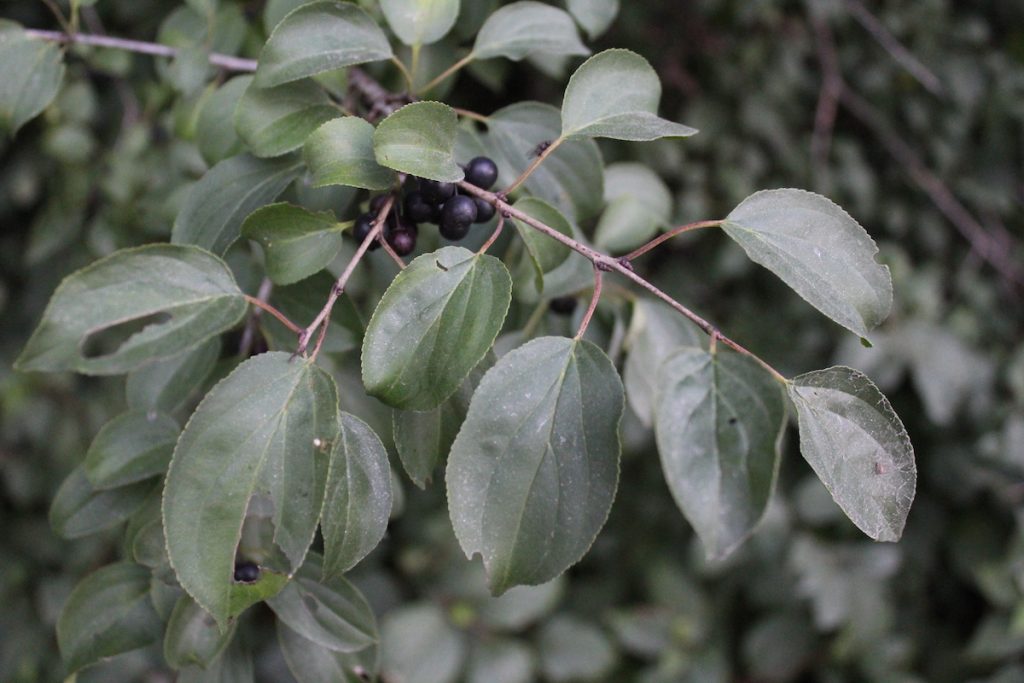
Common Buckthorn (Rhamnus cathartica) is an invasive shrub that produces small dark berries in late summer and fall. The berries are mildly toxic and act as a strong laxative when eaten in any quantity. Buckthorn doesn’t ripen at the same time as serviceberries (buckthorn ripens in late summer/early fall while serviceberries ripen in June/early July), but the shrub habit and dark berry color can confuse beginning foragers. The differences:
- Common Buckthorn has spines on its branches; serviceberry branches are smooth and unarmed.
- Buckthorn has yellowish-green flowers in dense small clusters along the branches; serviceberry has showy white five-petaled flowers in early spring.
- Buckthorn berries grow in tight clusters along the branches; serviceberry fruit hangs in small loose clusters at the tips of branches on long stems.
- Buckthorn has smooth oval leaves with arching parallel veins that curve toward the leaf tip; serviceberry has finely serrated leaves with straight veins.
- Buckthorn ripens in late summer to fall, weeks to months after serviceberries are done.
Invasive Honeysuckles
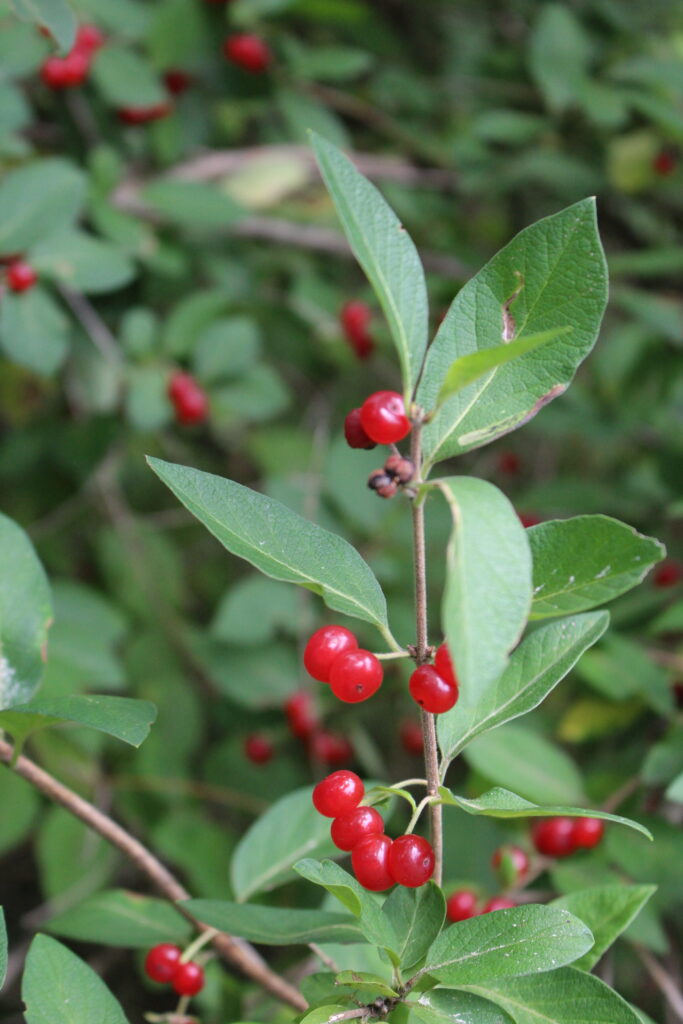
The invasive Asian honeysuckles, particularly Amur Honeysuckle (Lonicera maackii) and Japanese Honeysuckle (Lonicera japonica), have small red berries that can be confused with underripe (pink-stage) serviceberries from a distance. The honeysuckle berries are mildly toxic and shouldn’t be eaten. Key distinguishing features:
- Honeysuckles have opposite leaves (paired across from each other on the stem); serviceberries have alternate leaves.
- Honeysuckle berries are smaller (¼ inch), uniform red, and grow in pairs along the stem; serviceberry fruit grows in small clusters at branch tips.
- Honeysuckle stems are hollow when mature; serviceberry stems are solid wood.
- Honeysuckle has tubular pink-yellow flowers in spring (not the white five-petaled flowers of serviceberry).
- Japanese honeysuckle is a climbing vine; serviceberry is always a free-standing shrub or small tree.
Chokecherry
Chokecherry (Prunus virginiana) is another small Rosaceae tree with dark fruit that occasionally gets confused with serviceberry. Both are edible (with cautions), but they’re quite different in use. The differences:
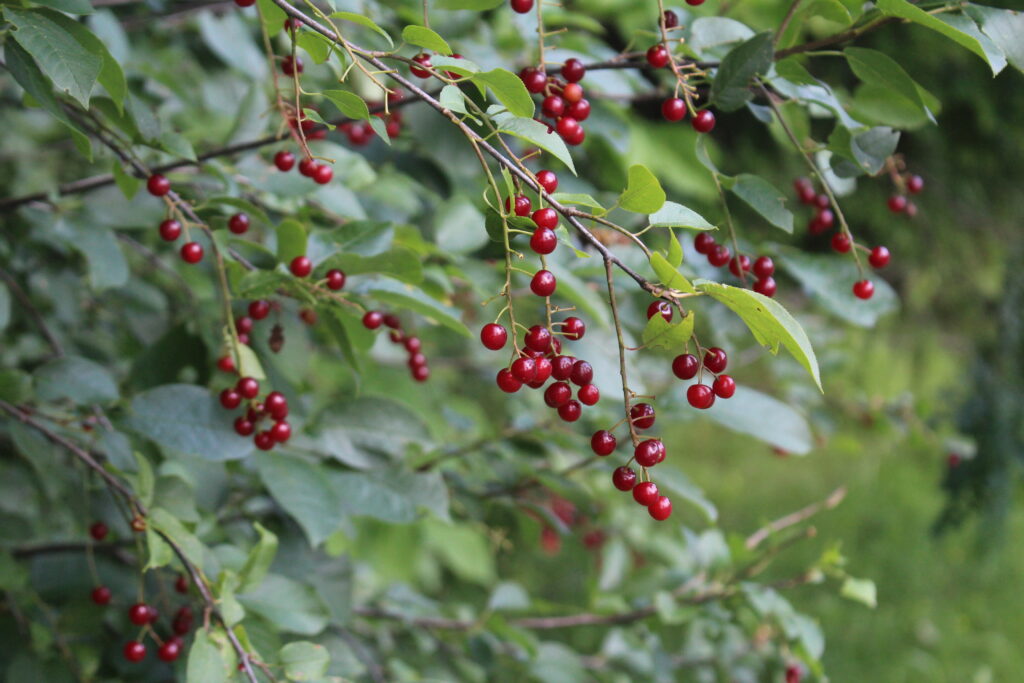
- Chokecherry fruit grows in long, drooping cylindrical clusters of 6 to 24 berries on a single stem; serviceberry fruit grows in small loose clusters at branch tips.
- Chokecherry fruit ripens to almost-black with a single large flat pit; serviceberry ripens to deep purple-blue with multiple small seeds.
- Chokecherry leaves are simple, ovate, and finely toothed (similar to serviceberry but typically larger and more elongated).
- Chokecherry has horizontal lenticels on the bark and a strong almond/bitter-almond scent when twigs are scratched (the genus Prunus signature).
- Chokecherry ripens in late August to early September, weeks after serviceberries are finished.
Chokecherry fruit is too astringent to eat raw in quantity but excellent for jelly and wine. Both species can be used in similar preserves, but the fruit are not interchangeable in fresh-eating contexts.
How to Harvest Serviceberries
Serviceberry harvest is a straightforward but time-sensitive operation. Once you’ve identified a productive tree, the timing of the harvest matters more than any technique:
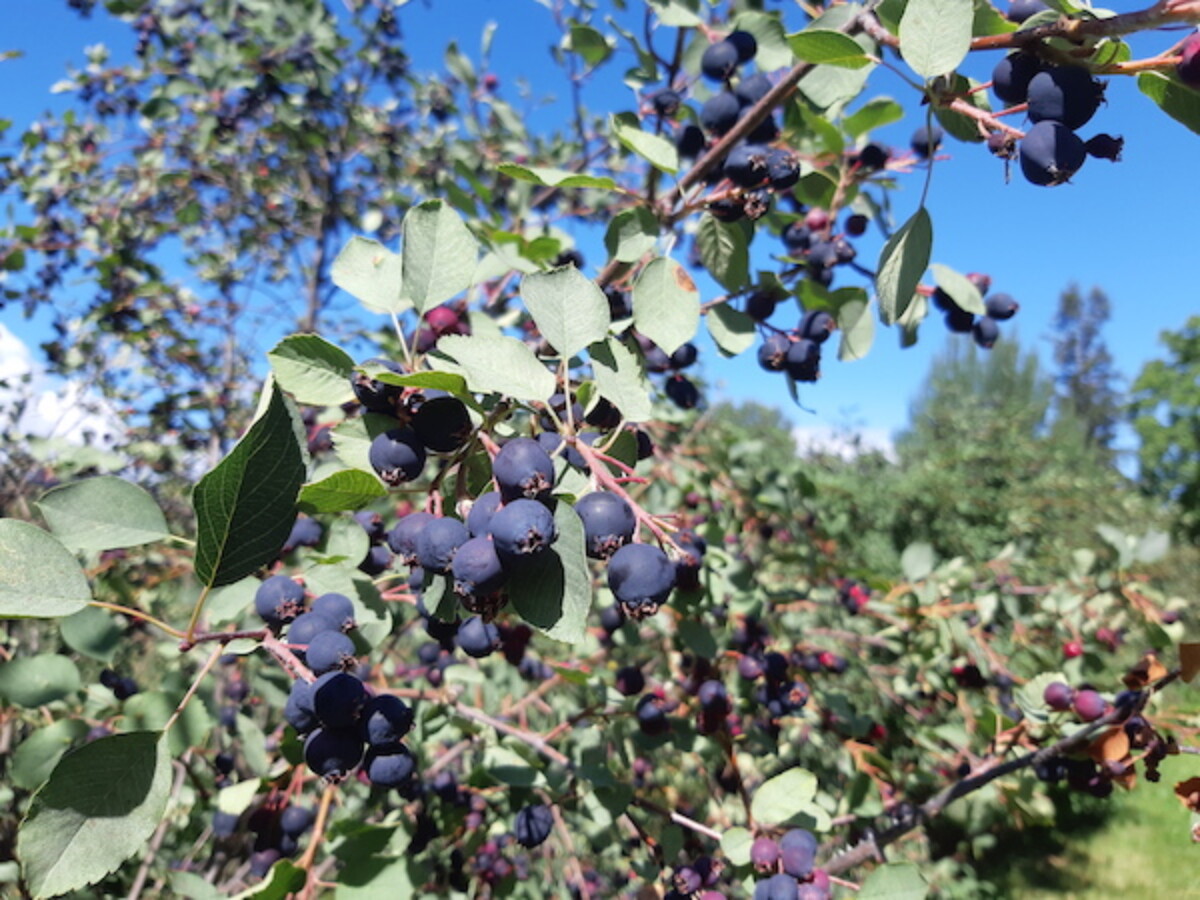
When ripe, serviceberries look a lot like blueberries on trees. The blossom end is slightly different, and they have a deeper purple color than blueberries. The fully ripe fruit is very soft and detaches from the stem with a gentle pull. If you have to tug, the fruit isn’t quite ready.
I often pick serviceberries a bit pink, since that’s the best way to beat the cedar waxwings to them. The pink-stage fruit is tarter than the fully ripe deep purple stage, but still pleasantly sweet, and the trade-off is usually worth it. A perfectly ripe tree is so attractive to birds that you can lose the entire harvest in a single morning if you wait too long.
For practical harvest tips:
- Bring a wide shallow container rather than a deep one; the fruit is soft and crushes easily under its own weight.
- Pick fruit from the inside of the tree first (the birds work the outside branches first).
- If you’re harvesting from a tall tree, bend the upper branches gently down rather than climbing; serviceberry branches are flexible enough to handle this without damage.
- Process the harvest within a day or two; serviceberries don’t keep as well as blueberries at room temperature, though they freeze beautifully whole for up to a year.
Ways to Use Serviceberries
For the most part, any recipe that calls for blueberries can be made with serviceberries. The fruit has a more intense flavor that’s a bit like a blueberry on steroids. It’s honestly hard to describe until you’ve tasted one, but I think they’re one of the very best tasting (if not the best tasting) wild berries.
Honestly, I eat them as fast as I harvest them, so I’ve yet to cook with them at scale. I’m out there snacking up a storm with plenty of cedar waxwings for good company. When I do bring some home, the favorite uses are pancakes, muffins, and freezing the rest whole for winter use.
Sam Thayer, one of my favorite foraging authors, harvests them in great quantity. In The Forager’s Harvest, he describes storing serviceberries year-round, sun-drying them in good weather and canning them in cloudy weather. He notes that dried serviceberries are excellent on their own as a trail snack, and he uses canned serviceberries on toast, in hot cereal, on pancakes, or as a simple dessert. The dried fruit mixed with hickory nuts makes a particularly satisfying all-wild trail mix.
Serviceberry Recipes
Here are some recipes specifically developed for serviceberries:
- Serviceberry (Saskatoon) Pie from The Kitchen Magpie
- Serviceberry Skillet Cobbler from Garden & Gun
- Serviceberry (Saskatoon) Jam from The Kitchen Magpie
- Gin Fizz with Serviceberry Syrup from Inspired by the Seasons
- Fermented Serviceberry Syrup from Edible Ohio Valley
- Serviceberry (Juneberry) Muffins from Persephone’s Kitchen
- Serviceberry Ice Cream from Explore Big Sky
Serviceberry FAQs
Yes, all true serviceberries (Amelanchier species) are edible and considered delicious. The fully ripe fruit is sweet, soft, and tastes like a blueberry crossed with an almond, with a slight cherry undertone. The seeds inside are small (about the size of blueberry seeds) and have a mild almond flavor when chewed. Like other plants in the rose family (apples, peaches, cherries), serviceberry seeds contain very small amounts of cyanogenic compounds, but the level is well below any toxic threshold and similar to apple seeds.
Serviceberries (Amelanchier sp.) and blueberries (Vaccinium sp.) look similar but are unrelated plants in different families. Serviceberries grow on small trees and tall shrubs (3-30 feet) and produce fruit with 4-10 small dark seeds inside. Blueberries grow on low shrubs (1-6 feet) and have many tiny soft seeds you can barely feel. Serviceberries bloom in early spring before most other trees leaf out, while blueberries bloom later. Both are sweet and edible; serviceberries have a slightly more complex flavor with an almond-like undertone, while blueberries are cleaner and brighter.
Yes, saskatoon and serviceberry are the same plant. Saskatoon is the standard name across Canada and the upper Midwest for Amelanchier (typically Amelanchier alnifolia, the western species). Other regional names for the same family of plants include Juneberry (eastern US), Shadbush (New England coast), Sarvisberry or Sarvis (Appalachia), Bilberry, and Sugarplum. The slight differences in flavor between regions reflect different Amelanchier species, but they’re all interchangeable in any serviceberry recipe.
Serviceberry timing varies by latitude. They typically ripen in late June to early July across the northern US and southern Canada, late June in the mid-Atlantic, and as early as mid-June in the southern US. The fruit goes through a green, pink, red, and finally deep purple-blue progression. The ‘Juneberry’ name reflects the typical ripening time in the eastern US. Cedar waxwings and other birds typically arrive within a day or two of the first ripe berries and can strip a tree clean in 24-48 hours, so the harvest window is usually only 1-2 weeks long.
Fully ripe serviceberries have a sweet, complex flavor that’s most often described as a blueberry crossed with an almond, with a slight cherry undertone. Underripe pink berries are tarter and less sweet but still pleasant. The almond note comes from the small seeds inside, which contain trace amounts of the same compounds that flavor real almond extract. Some people pick up the seed flavor strongly while others (myself included) barely notice it. Many foragers consider serviceberries one of the best-tasting wild fruits in eastern North America.
Did you find this Serviceberry foraging guide helpful? Tell me in the 📝 comments below how you use serviceberries on your homestead!
And make sure you stay in touch with me by following on social media!
Summer Foraging Guides
Find the perfect foraging guide
Searching for something else? Enter keywords to find the perfect foraging guide!










Super helpful, Ashley, thank you! I just discovered we have the 30 ft understory variety of Serviceberry trees on our new land. I can order some more trees from our conservation department to plant and keep under cultivation closer to the house. I didn’t know that they were so tasty!
I know, right?!?! They are so darn good. Glad you found one =)
Hello. Love your posts and have learned so much, Thank you! Quite certain I have identified the fruiting shrub on our new property in the mountains of the northwest thanks to you. We’ve quite a few blue ones too. Yum!
Do you have a printed book you would recommend to help with edible plant identification? Love your blog but the cell reception and internet connection here are spotty and I need something printed that I can take in the woods with me.
Yes, you definitely want to invest in some good books. Here is a post with a huge list of helpful books. https://practicalselfreliance.com/books-for-self-reliant-living/ Sam Thayer is a great resource. He also has a new book that is not on this list which is his “Field Guide to Wild Edible Plants. It has a great key to help with identification and also tells you which parts of the plant to eat in which seasons. Botany in a day is also a really great resource that helps you learn how to identify plants through botany.
I have red glossy berries on stems with pointy green leaves along my drivewy/ I can’t tell what they are. Can you help identify them. Are they safe to eat ?
I would recommend getting a plant identification app or there is a plant identification group on Facebook that would be a good starting point. The apps can often be inaccurate though so be sure to just use this as a starting point and then do your own research to verify.
Hello, this is a great article. Can I ask you which one you prefer for eating purposes: A. humilis or A. sanguinea?
Thank you very much!
Both seem to have the same edibility rating from pfaf.org A. sanguinea is described as having a sweet flavor and A. humilis is described as “Sweet. Very pleasant flavour, the fruit is juicy with a hint of apple in the taste and contains a few small seeds in the centre.”
When I lived in Maine, the locals would note that the shad were flowering. As one of the names for them is ‘shadbush’. The reason I was told is that they typically flower when shad are running in the streams. So, their flowering is a marker of when to go fishing for shad!