
Affiliate disclosure: This post may contain affiliate links. Please see our Privacy Policy.
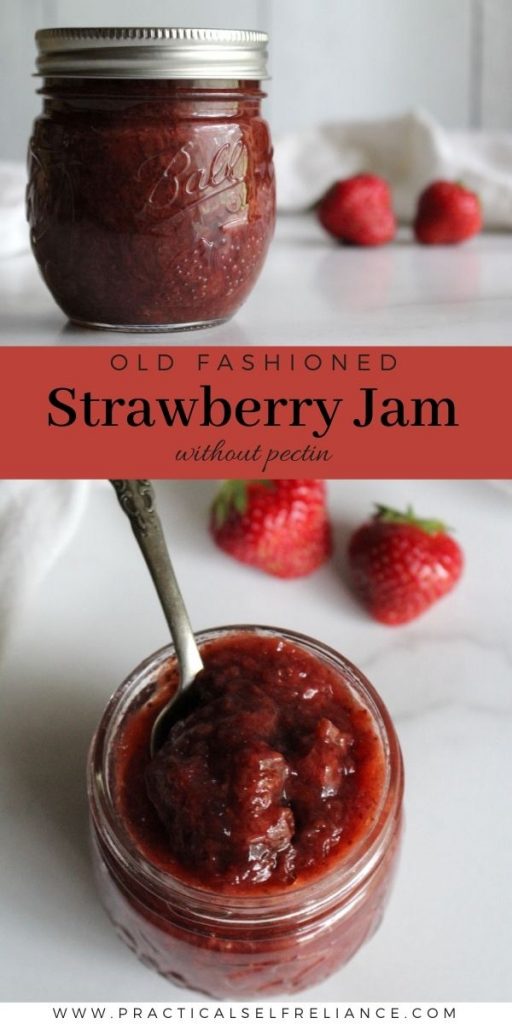
Strawberry jam without pectin is the way jam was made for generations before the little boxes of powdered pectin showed up at the grocery store. Just three ingredients (strawberries, sugar, and lemon juice) get cooked down on the stove until the natural pectin in the fruit pulls everything together into a silky, deeply flavored preserve.
No boxed mixes, no artificial thickeners, no paying $6 for pectin to make four half-pint jars. Just better jam.
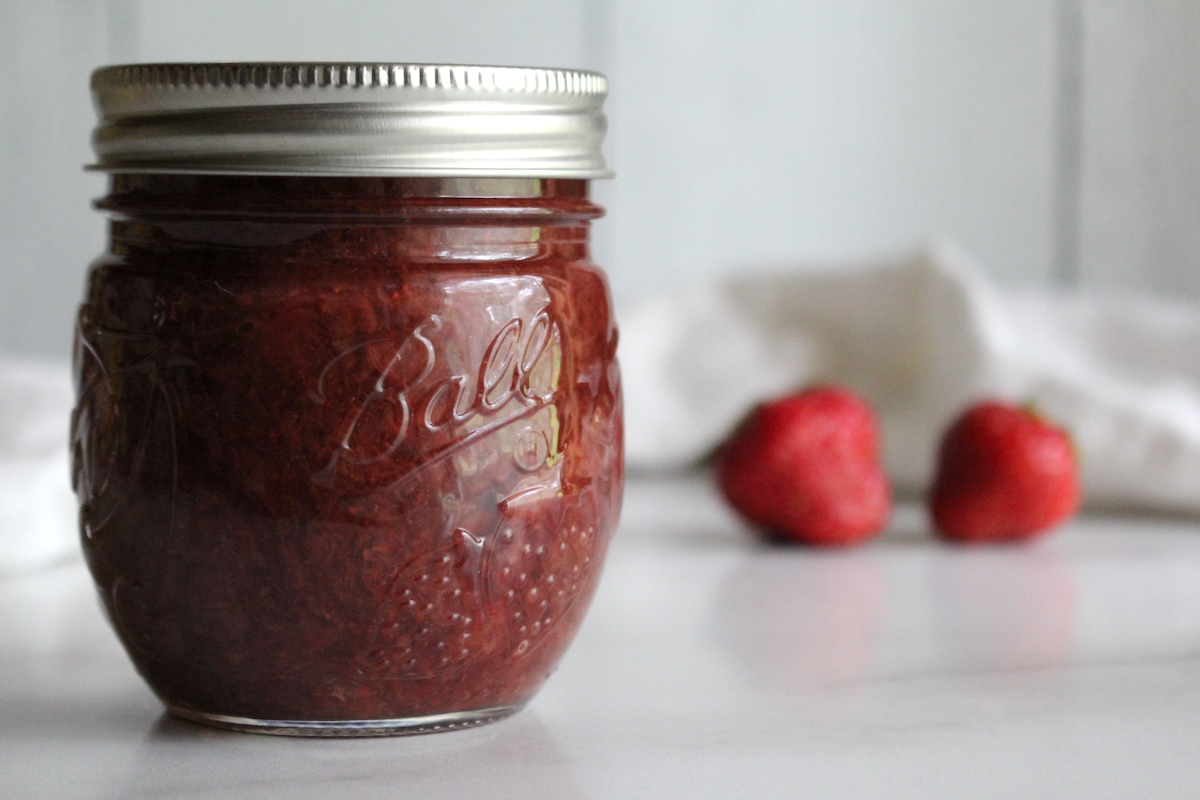
Table of Contents
- What Is Old-Fashioned Strawberry Jam?
- What Does It Taste Like?
- Why Make Your Own?
- Ingredients You’ll Need
- How to Make Strawberry Jam Without Pectin
- Step by Step Instructions
- The Best Strawberries for Jam
- Substitutions and Variations
- Storage and Shelf Life
- Strawberry Jam FAQs
- Jam Recipes
- Old-Fashioned Strawberry Jam (Without Pectin) Recipe
Strawberry jam is a yearly ritual in my house, without fail.
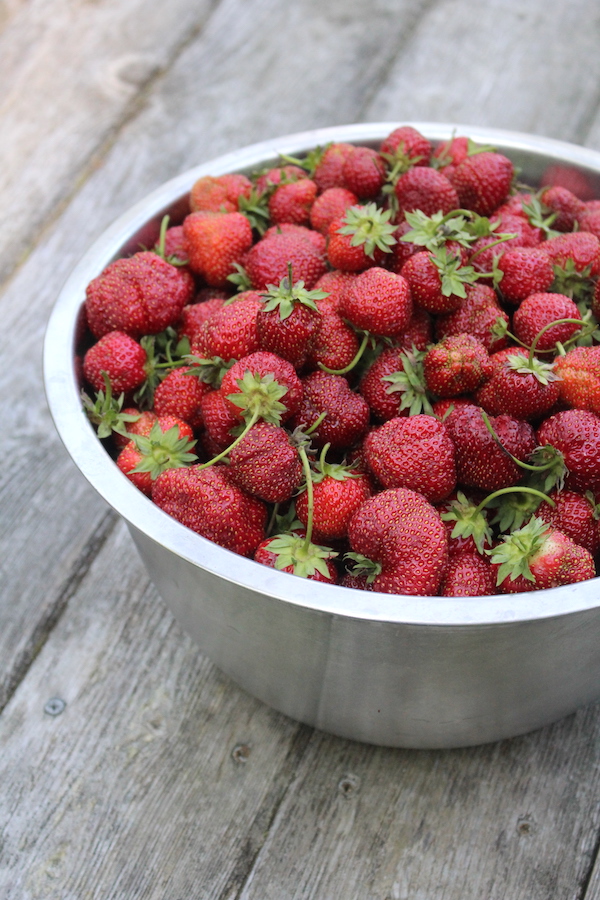
This is the recipe I make this every June when the first strawberries come in from the garden. My kids are the ones who really drive our strawberry obsession. Every spring they’ll pick their fill and spend the rest of the morning playing between the rows, so over the years we’ve added a lot of beds and a lot of varieties. Classic June-bearing, day-neutral everbearing strawberries, tiny wild alpine strawberries, and those oddball white pineberries with their tropical pineapple flavor.
All of that fruit ends up in jam.
What Is Old-Fashioned Strawberry Jam?
Old-fashioned strawberry jam is made the way your grandmother (or great-grandmother) made it: by cooking fresh strawberries with sugar and lemon juice until the mixture thickens on its own, using only the natural pectin that already exists in the fruit and the lemon. No added commercial pectin, no special gelling agents.
The tradeoff is cooking time. A boxed-pectin jam sets in 2 minutes of hard boiling. This jam takes 45 minutes of gentle simmering. What you get in exchange is a jam that tastes dramatically more like concentrated strawberry. The flavor gets deeper and richer as the water cooks out, the texture comes out silky instead of rubbery, and you avoid the faintly-gelatinous quality that commercial pectin imparts.
It’s also nearly free to make. Strawberries from the garden (or U-pick), sugar at a few dollars for a 4-pound bag, a splash of lemon juice, and canning jars you’ve probably owned for years. Compare that to $6 for a single box of pectin that only stretches to 4 half-pint jars.
What Does It Taste Like?
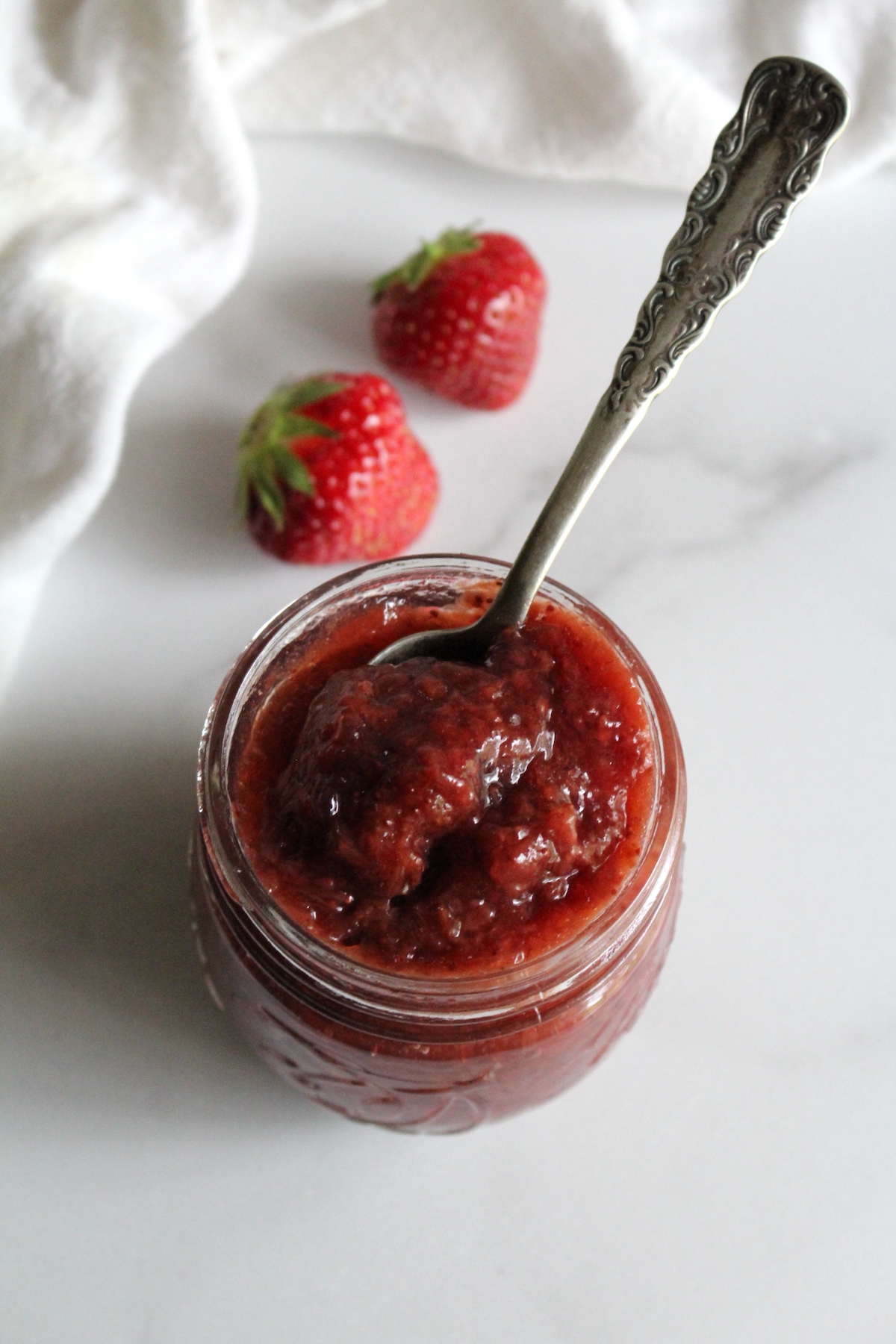
When made without pectin, strawberry jam has a concentrated, bright, intensely strawberry flavor. Sweeter than fresh fruit (obviously, there’s sugar), but not cloying, because the long cook time drives off water and intensifies the natural acidity of the berries. The lemon juice keeps it tasting fresh rather than overly jammy-sweet. The texture is silky and spreadable, with a soft set rather than a springy commercial-pectin texture. The jam flows slowly off a spoon and holds its shape on bread without feeling rubbery.
Compared to store-bought: it actually tastes like strawberries, not like strawberry-flavored sugar.
Why Make Your Own?
A few good reasons:
- It’s shelf-stable for 12 to 18 months when water-bath canned properly. One morning of work yields 7 to 8 half-pint jars, enough to last most families through the winter.
- The flavor is significantly better. Cooking strawberries down slowly with sugar and lemon concentrates the fruit flavor in a way that boxed-pectin jams can’t match. Those set too quickly for the berries to develop. This jam tastes like summer captured in a jar.
- It’s almost free. Sugar is pennies per pound. Jars get reused for a decade or more. Strawberries from your garden or a U-pick farm cost a fraction of supermarket pricing. Unlike boxed pectin (around $6 for a batch of 4 jars), you pay basically nothing.
- Three ingredients you can actually pronounce. Strawberries, sugar, lemon juice. That’s it. No gums, no additives, no mystery ingredients on the label.
- It’s a forgiving recipe. Cook a little less if you want it softer. Cook a little longer if you want it firmer. Add more lemon if you like tartness. This is a recipe that welcomes improvisation, unlike boxed pectin jams, which require exact ratios to set.
Ingredients You’ll Need
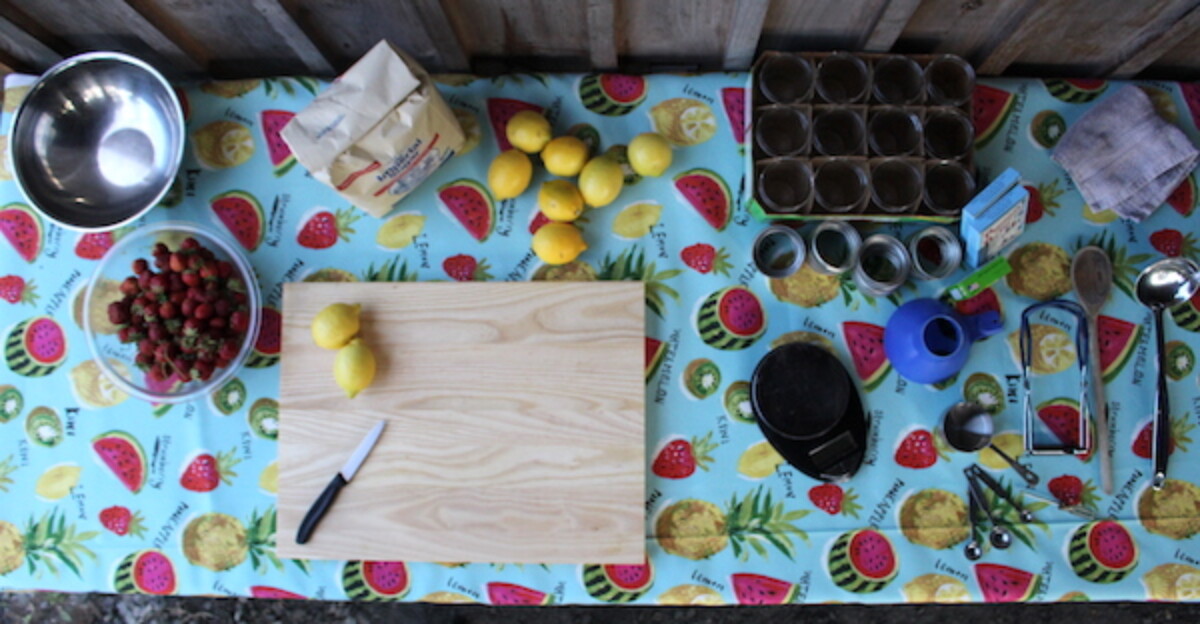
Just three of them, all simple. See the recipe card for exact quantities.
- Fresh strawberries. The heart of the recipe. Use the freshest, most flavorful fruit you can get. Avoid frozen berries (more on that below).
- Sugar. Plain granulated white sugar. It does three jobs: it sweetens the jam, it acts as a preservative, and it interacts with the natural pectin and acid to create the gel set.
- Lemon juice. Just two tablespoons per batch. Adds brightness, balances the sugar, and provides extra pectin and acidity to help the jam set properly. Fresh or bottled both work.
That’s the whole list. No pectin, no gelatin, no starch, no chemistry-set ingredients.
How to Make Strawberry Jam Without Pectin
The method is simple but requires patience. Active time is about 20 minutes. Total stovetop time is 45 minutes to 1 hour. The photos in this step-by-step are from my outdoor canning kitchen, where I do most of my summer canning to keep the heat and steam out of the house.
Step by Step Instructions
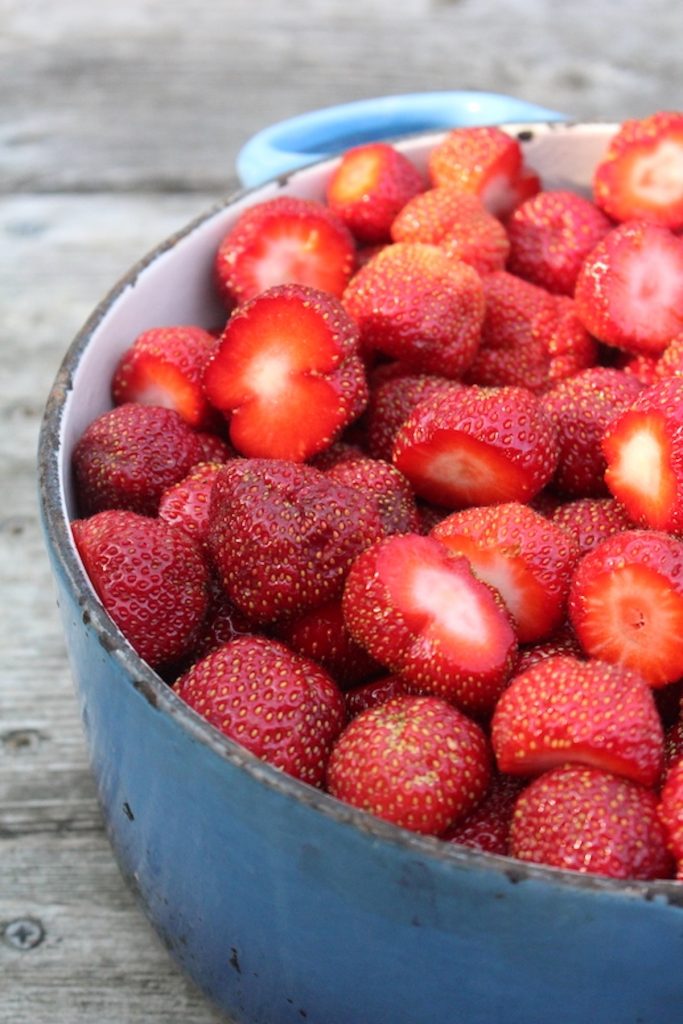
- Wash and hull about 4 quarts of fresh strawberries (around 4½ to 5 pounds), removing the green tops and any bruised spots. Use the ripest fruit you can find, ideally with a quarter to a third of the berries slightly underripe for better natural pectin.
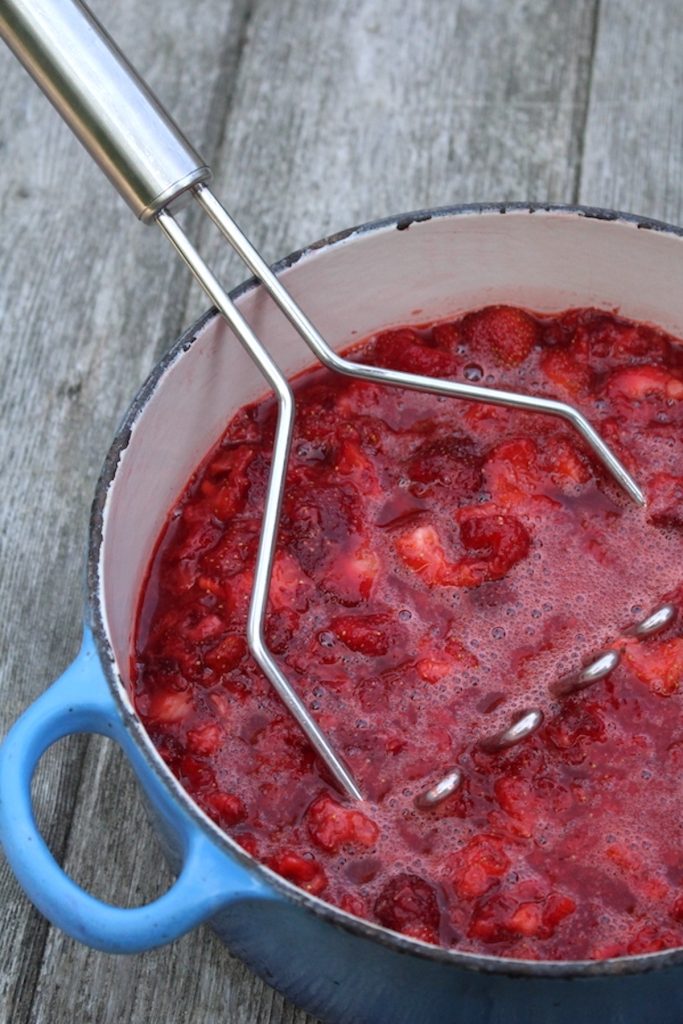
- Slice and mash the strawberries until you have 8 cups of mashed fruit. Combine in a deep, heavy-bottomed Dutch oven or stockpot with 6 cups of sugar and 2 tablespoons of lemon juice. The pot should be no more than half full to leave room for foaming.
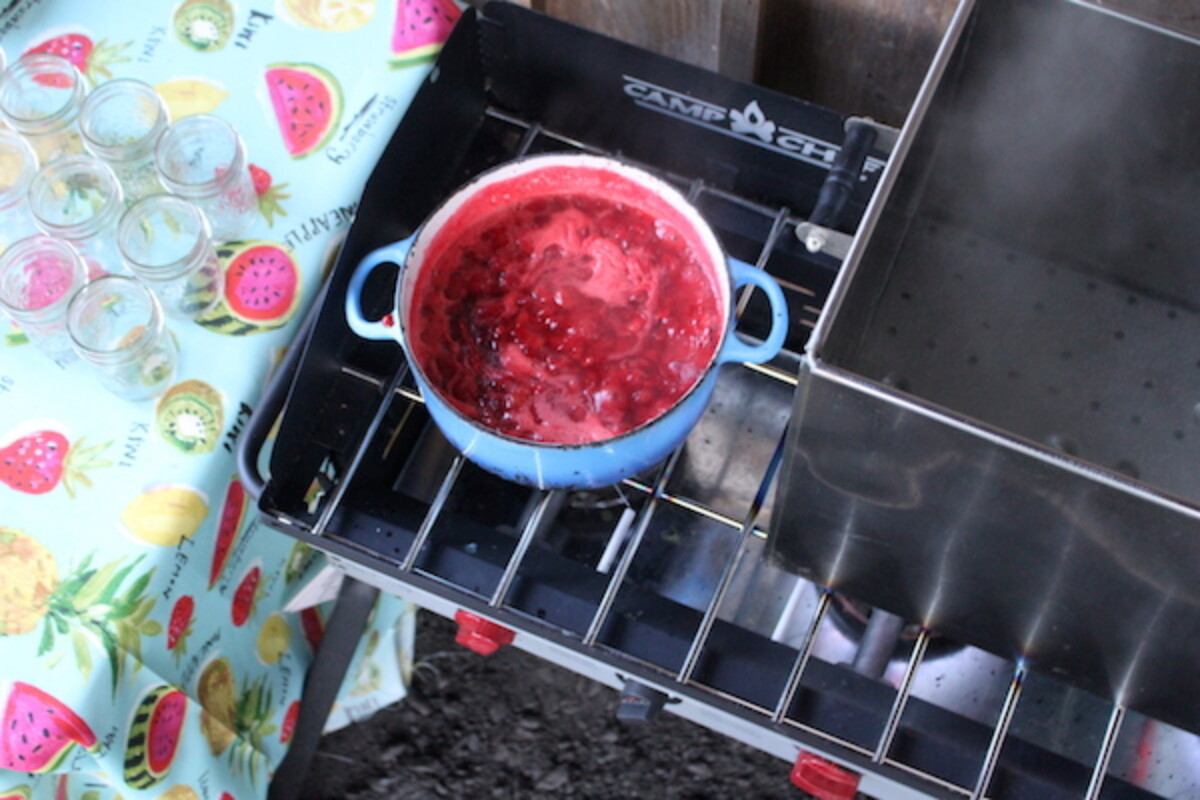
- Bring to a boil over medium-high heat, then reduce and simmer gently for 45 minutes to an hour, stirring frequently and skimming foam. The jam is ready when it reaches 220°F on an instant-read thermometer (subtract 1°F per 500 feet of elevation), or passes the frozen plate test.
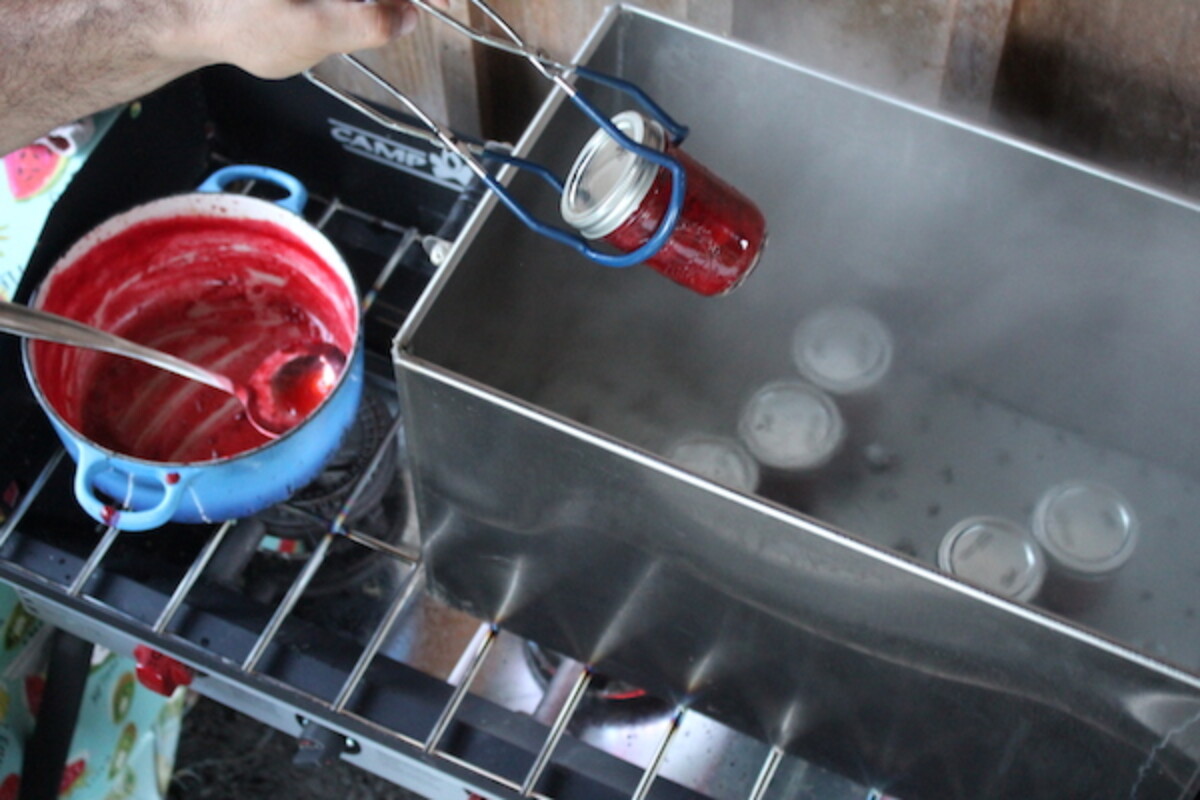
- Ladle the finished jam into prepared half-pint jars, leaving ¼ inch headspace. Cap with 2-part lids to finger-tight, then process in a boiling water bath for 10 minutes (15 minutes above 6,000 feet elevation). Skip this step for refrigerator or freezer storage.
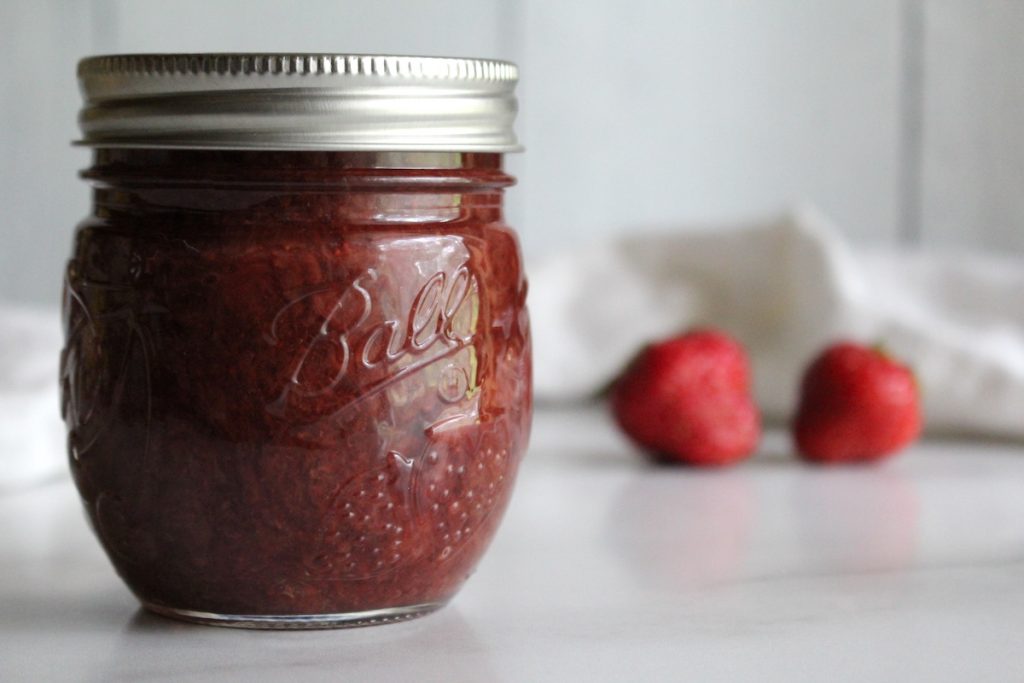
- Cool jars undisturbed on a towel for 12 to 24 hours, then check seals. Properly canned jars keep 12 to 18 months on the pantry shelf. Refrigerated (uncanned) jam keeps several weeks; frozen jam keeps 6 months.
The whole process is slower than boxed-pectin jams, but there’s nothing tricky about it. Just stirring, waiting, and testing for set.
The Best Strawberries for Jam
This matters more than most people realize. A few guidelines:
Use fresh, not frozen. Freezing fruit for as little as a week can reduce pectin content by half. Strawberries are already low-pectin, so frozen fruit simply won’t gel as well. If frozen is all you have, switch to a pectin-based recipe like our low sugar strawberry jam with Pomona’s pectin.
Include some slightly underripe berries. Old-fashioned jam-making wisdom says to use ¼ to ⅓ slightly underripe fruit, and there’s real science behind it: fruit loses pectin as it ripens. A quarter of your berries being a day or two shy of fully ripe will help the whole batch set. Don’t use hard green berries (they’re tough and flavorless), just ones that haven’t quite hit peak.
Pick sweet varieties. Supermarket strawberries bred for shelf life taste watered-down and make bland jam. If you can, use U-pick berries, farmers’ market fruit, or home-grown. June-bearing varieties tend to have the most classic strawberry flavor. Alpine and wild strawberries are exceptional for jam but yield is tiny.
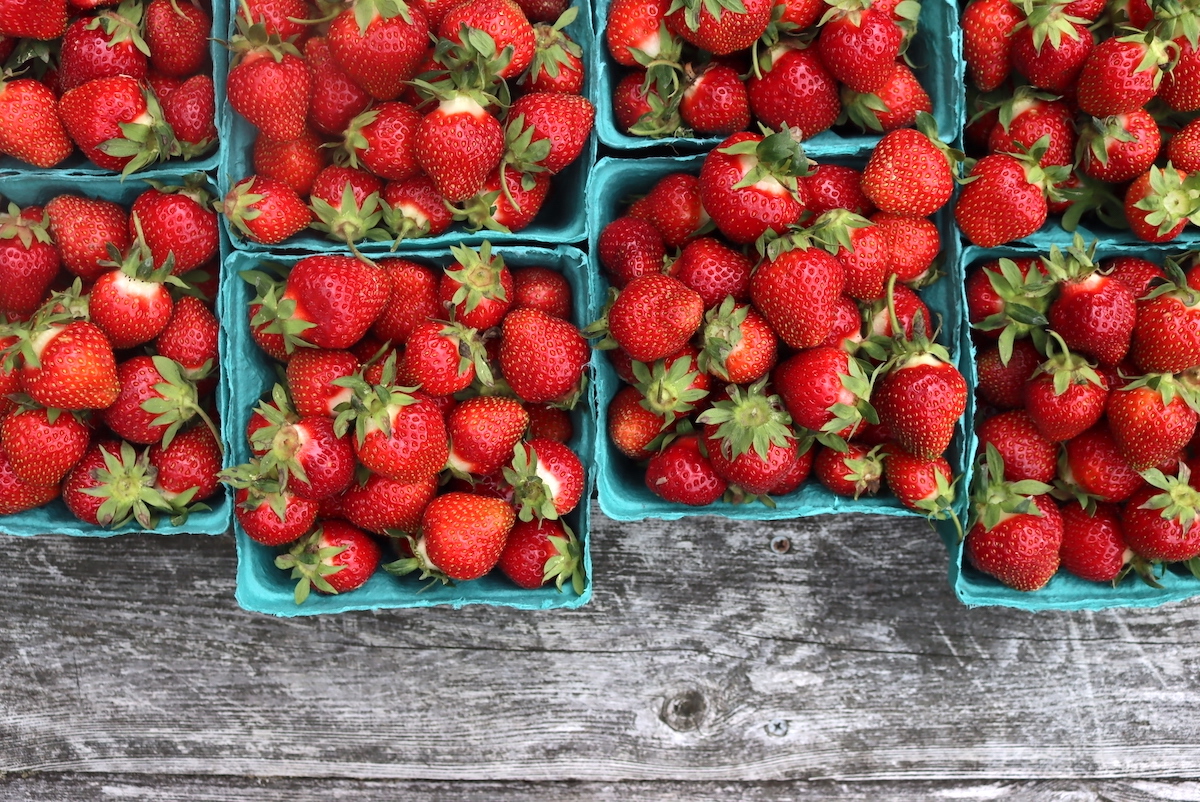
Peak-ripe plus slightly-underripe is the sweet spot. If you’re picking your own, grab berries of all three: the deep-red juicy ones for flavor, the lighter red ones for balance, and a handful of just-turning pink ones for pectin.
Substitutions and Variations
This recipe is more flexible than commercial-pectin jams, since you’re working with natural chemistry instead of precise gelling ratios:
Sugar: The 6-cup amount is the minimum for a proper set with strawberries’ low natural pectin. Less sugar means much longer cooking and a jam that tastes like fruit leather. If you want less sugar, switch to our low sugar strawberry jam with Pomona’s pectin. It’s a different recipe but handles lower sugar properly.
Maple sugar or honey: You can substitute maple sugar for up to half the white sugar, but it will dominate the flavor and produce a slightly softer set. Honey works similarly and adds a distinctive flavor. White sugar is neutral, which is why it’s the traditional choice.
Lemon juice: Two tablespoons is the starting point. If you like tart jam, double it to 4 Tbsp or even go higher. The lemon adds brightness and improves the set. You can use bottled lemon juice, but the flavor and natural pectin is much better with fresh lemon juice. Since the lemon juice isn’t necessary for safety, use fresh if you can.
Lime juice: Works in place of lemon (use the same amount).
Flavor add-ins: Strawberry jam takes well to subtle additions cooked in alongside the fruit. Half a scraped vanilla bean (or 1 tsp vanilla extract added at the end) gives a beautiful strawberry-vanilla jam. A splash of good balsamic vinegar (1 Tbsp per batch) added in the last 5 minutes adds a complex, slightly savory edge that’s excellent on cheese boards. A pinch of freshly cracked black pepper in the last few minutes sounds strange but tastes remarkable, with a subtle warmth that makes the strawberry flavor pop.
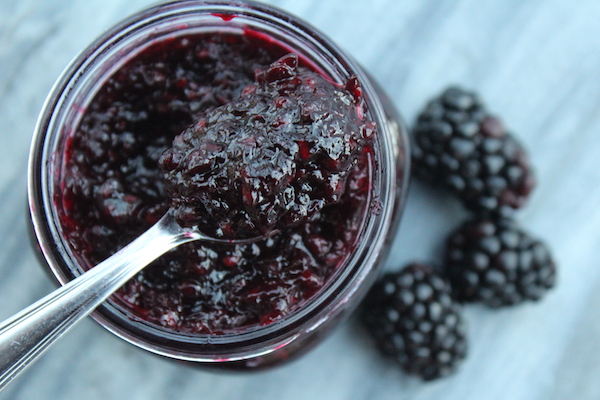
Other berries: The same 3-ingredient method works with raspberries, blackberries, and black raspberries (though blackberries have more pectin and need slightly less cooking). See my blackberry jam without pectin and raspberry jam for similar recipes.
Storage and Shelf Life
Depending on how you finish it:
- Water-bath canned: 12 to 18 months on the pantry shelf for peak quality. Once opened, refrigerate and use within about 3 weeks.
- Refrigerator (uncanned): Several weeks in a sealed jar. Keep cold.
- Freezer: Up to 6 months in a freezer-safe container with ½ inch of headspace for expansion.
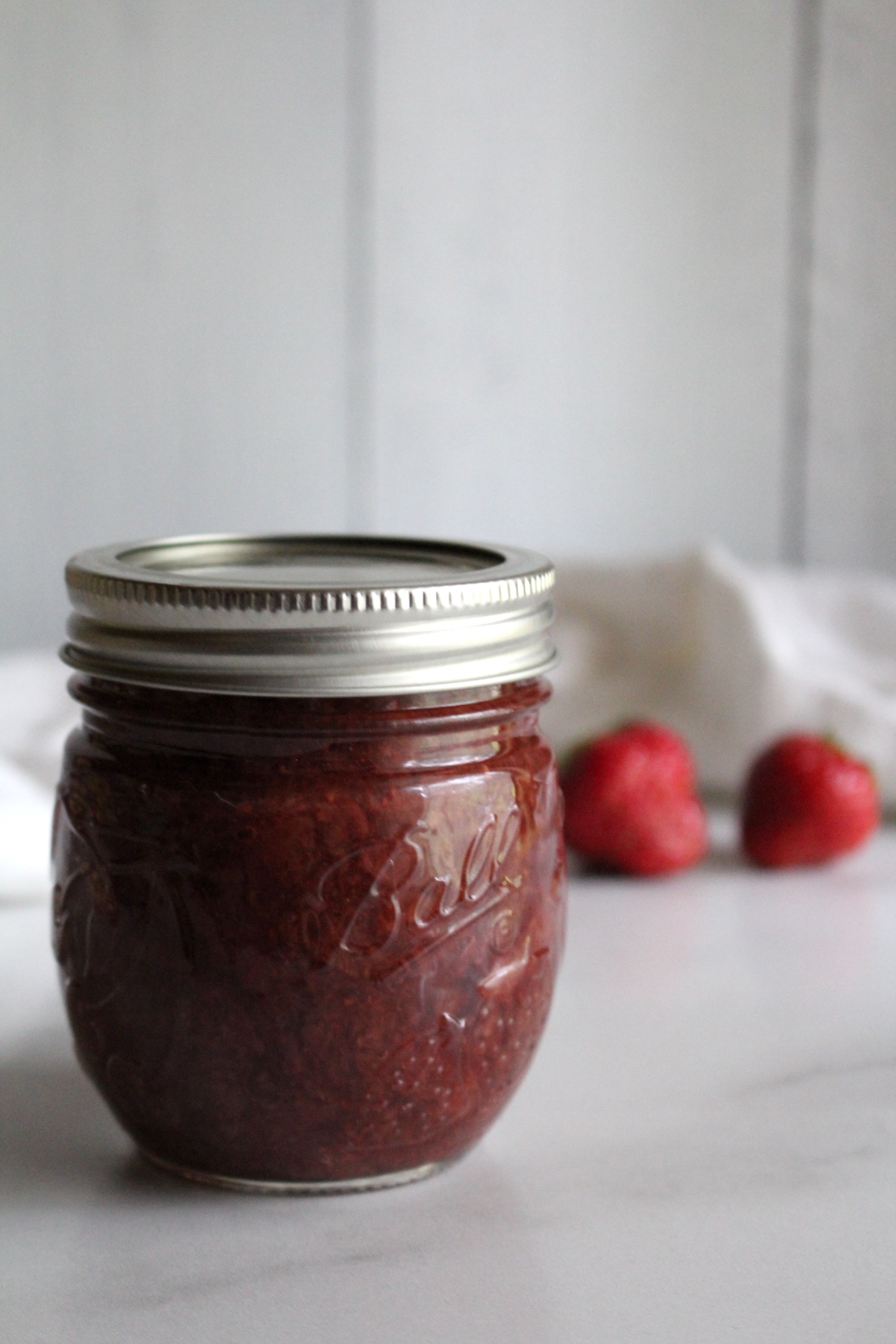
Canning is the best option if you’re making a full batch. A morning of work gives you 7 to 8 half-pint jars that last over a year. For small batches or if you don’t have canning equipment, refrigerator or freezer storage works fine.
Strawberry Jam FAQs
Three likely reasons: (1) You didn’t cook it long enough. The jam needs to reach 220°F at sea level, or 8°F above the boiling point of water at your elevation. (2) Your strawberries were too ripe, so they didn’t have enough natural pectin. Next time include ¼ to ⅓ slightly underripe berries. (3) The ratio was off. Less than 6 cups of sugar per 8 cups of mashed fruit typically won’t set properly. If your jam is already made and refuses to set, you can re-cook it with an additional tablespoon of lemon juice, which adds pectin and acid, and cook it longer.
Water-bath canned strawberry jam keeps 12 to 18 months on a pantry shelf at peak quality (still safe beyond that, just declining in color and flavor). Refrigerated jam keeps several weeks. Frozen jam keeps about 6 months. Once a canned jar is opened, refrigerate and use within 3 weeks.
Not recommended. Freezing strawberries reduces their natural pectin content by up to half, and strawberries are already low-pectin to begin with. The result is jam that simply won’t set properly without added commercial pectin. If you only have frozen fruit, use a pectin-based recipe instead.
The original old-fashioned recipe uses just strawberries and sugar, so technically no. But lemon juice makes a noticeable difference. It brightens the flavor, balances the sweetness, and adds both acid and pectin to help the jam set more reliably. Two tablespoons per batch is a small amount that pays back significantly in finished quality.
Yes, with the standard water-bath canning process. Strawberries are acidic enough (pH below 4.6) to be safely processed in a water-bath canner, and the high sugar content further inhibits spoilage. Process half-pint or pint jars for 10 minutes at sea level, adding 5 minutes for elevations above 6,000 feet. Full canning instructions are in the recipe card below.
Jam Recipes
If you tried this Strawberry Jam Recipe, or any other recipe on Practical Self Reliance, leave a ⭐ star rating and let me know what you think in the 📝 comments below!
And make sure you stay in touch with me by following on social media!
Old-Fashioned Strawberry Jam (Without Pectin)
Ingredients
- 8 cups strawberries, from about 4 quarts fresh fruit, around 4½ to 5 lbs
- 6 cups sugar
- 2 tbsp lemon juice, fresh or bottled
Instructions
- Prepare the fruit: Wash and hull the strawberries, removing tops and any bruised spots. Slice and mash until you have 8 cups of mashed fruit.
- Combine ingredients: In a deep, heavy-bottomed Dutch oven or stockpot (no more than half full, since this jam foams), combine the mashed strawberries, sugar, and lemon juice. Stir well.
- Bring to a boil: Heat over medium-high, stirring frequently to prevent scorching.
- Simmer until set: Boil gently for 45 minutes to 1 hour, stirring regularly and skimming foam. The jam is done when it reaches 220°F on an instant-read thermometer (at sea level; subtract 1°F per 500 feet of elevation), or passes the frozen plate test.
- Jar the jam: Once set, ladle into prepared jars leaving ¼ inch headspace. For refrigerator or freezer storage, cap and cool. For shelf-stable storage, continue to the canning step.
- Water-bath can (optional): Cap jars with 2-part lids to finger-tight. Process in a boiling water bath for 10 minutes (below 6,000 ft elevation) or 15 minutes (above 6,000 ft). Turn off heat, wait 5 minutes, then remove jars with a jar lifter.
- Cool and check seals: Let jars cool undisturbed on a towel for 12 to 24 hours. Check seals. Any unsealed jars should go in the refrigerator for immediate use.
Notes
Nutrition
Nutrition information is automatically calculated, so should only be used as an approximation.
Ways to Preserve Strawberries
A bumper strawberry crop can be preserved in many more ways than just jam:
- Strawberry Jelly: the silky, seedless cousin of jam, made by straining cooked fruit through a jelly bag
- Canning Whole Strawberries: preserve whole berries in light syrup for year-round desserts and sundaes
- Homemade Strawberry Wine: the old-world approach to putting up a serious strawberry harvest
- Sugar-Free Strawberry Jam: for diabetics, low-carb eaters, or anyone who wants fruit flavor without the sugar
Find the perfect recipe
Searching for something else? Enter keywords to find the perfect recipe!










Wonderful recipe. It reminds me of making jam with my grandmother and mother when I was very young. Thanks for the memory.
I love that it brought back memories of making jam with your grandmother and mother. Thanks so much for sharing!
Lovely recipes! Had to dredge through tons of AI slop sites to get here, but I’m so glad I did!
So glad you found us, and thanks for sticking with it! Happy canning!
Best jam!!! My husband requests it every year.
It’s my son’s favorite too. I’m so glad you like it!
can maple sugar be used?
Yes, you can use maple sugar, but it really concentrates and will dominate the flavor of the finished jam. It’ll also have a slightly softer set, and you’ll really need to watch it as it cooks to avoid scorching.
I used strawberries from my garden that were in the freezer about 6 months. I added half more lemon juice and cooked it to 221 degrees and the jam came out perfect! Great recipe thank you!
Wonderful! I’m so glad it turned out nicely for you =)
Very pleased with the results of this jam! Absolutely delicious! Thank you! Looking forward to trying more of your recipes!
Glad you liked it!
I love how easy This recipe is. I am very much a newbie to canning and preserving so easy is good! Because this doesn’t use any pectin, I would say it is a little sweet for my taste especially considering how sweet my garden fresh strawberries already are. I think I will try Your low sugar recipe next! Thank you again Ashley
You’re right, without the pectin it does need quite a bit of sugar to set. Try the low sugar recipe if you’d like to use less, and that one sets nicely with pectin added even with less sugar.
Best strawberry jam recipe I’ve tried!
So glad you enjoyed it!