
Affiliate disclosure: This post may contain affiliate links. Please see our Privacy Policy.
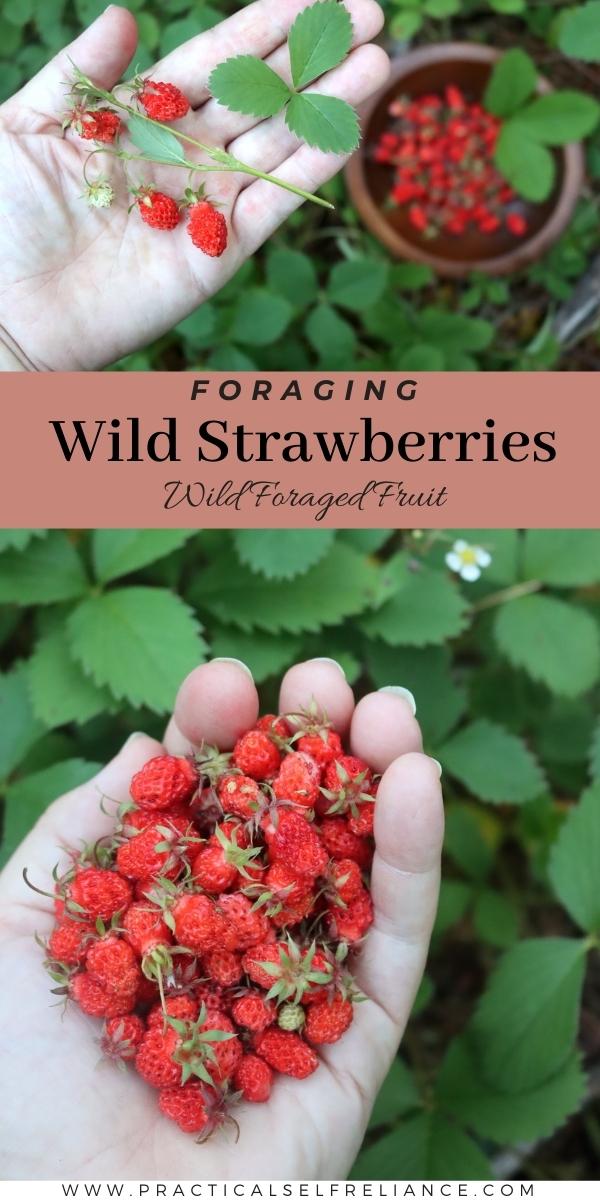
Wild Strawberries (Fragaria sp.) are tiny ruby-red fruits that pack the flavor of a grocery-store strawberry into a thumbnail-sized package, and they grow throughout the world in lawns, woodlands, fields, beaches, and mountains. Several different species are native to North America, Europe, and Asia, and all are edible. The flavor is intensely concentrated, often described as “more strawberry than a strawberry,” and many foragers consider wild strawberries one of the best wild fruits in the temperate world.
Learn how to identify wild strawberries, distinguish them from the bland Mock Strawberry (Potentilla indica), and find them in the unlikely places they grow.
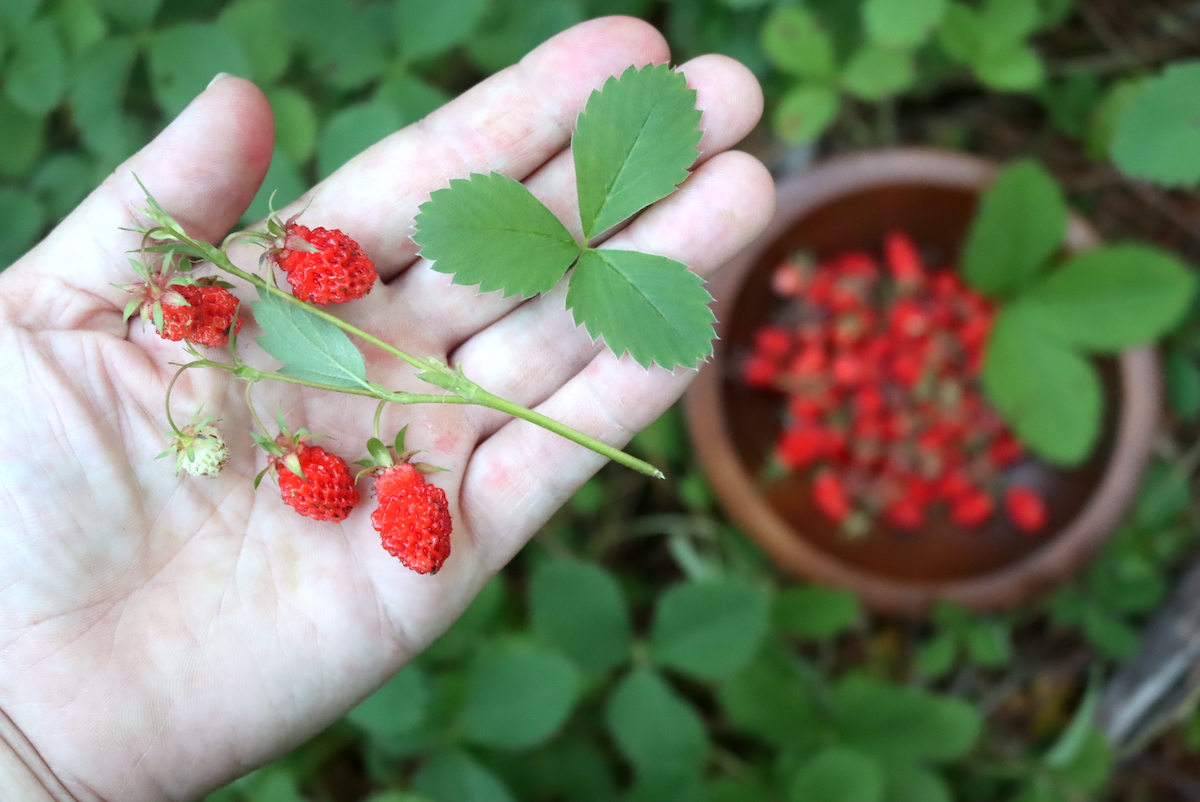
Table of Contents
- Notes from My Homestead
- What Are Wild Strawberries?
- Are Wild Strawberries Edible?
- Types of Wild Strawberries
- Where to Find Wild Strawberries
- When Do Wild Strawberries Ripen?
- How to Identify Wild Strawberries
- Wild Strawberry Look-Alikes
- How to Harvest Wild Strawberries
- Can You Grow Wild Strawberries?
- Ways to Use Wild Strawberries
- Wild Strawberry FAQs
- Wild Fruit Foraging Guides
Wild strawberries are one of the simple pleasures of summer, and they grow just about anywhere their seeds are dropped. They don’t mind part shade, and they’ll gladly fruit in sandy soil that doesn’t support lawn grass. They’re not picky about their environment, and they’ll grow with abandon given space.
The bright red berries are especially attractive to little ones, and my toddlers would spend hours scouring the lawn looking for these little jewels. It helps that they’re down low at a baby’s height and perfectly sized for little fingers.
My littles tend to pop them into their mouths as fast as they can find them, so it’s hard to know how many are harvested on a sunny summer afternoon. When I pick alongside them, I can usually accumulate a good-sized handful in about 5 minutes from a productive patch.
No wonder those little ones are hard at work peering into the grass!
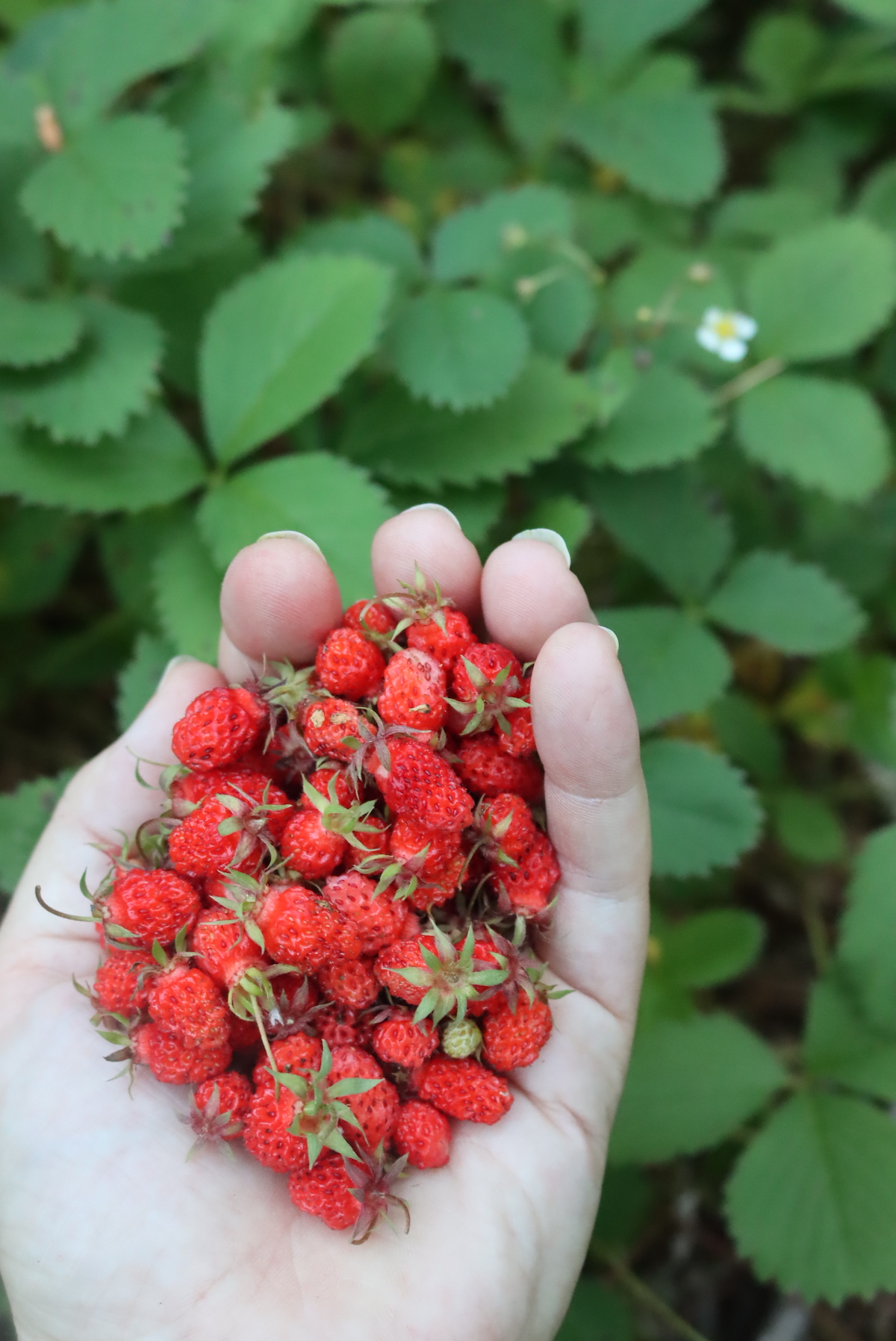
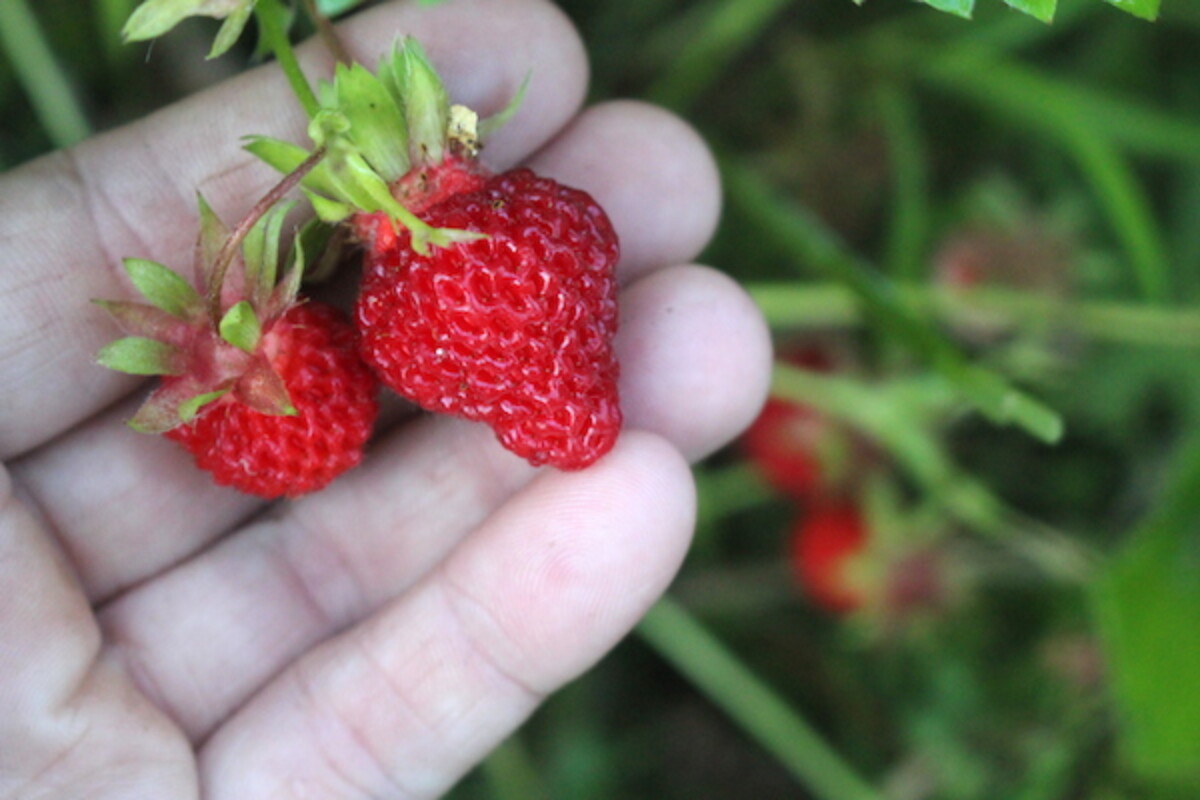
While most wild strawberries are quite small and intensely flavored, they do vary quite a bit based on the plant. Some are large and juicy, like cultivated strawberries, and occasionally you’ll find a plant that produces flavorless fruit. Generally, wild strawberries are more flavorful than cultivated strawberries, packing all the flavor of those big grocery store berries into a smaller package for a more intense bite.
If you look long enough, you’ll find some big juicy berries with all the intense flavor of a wild strawberry along with the size of a cultivated one. Those are downright perfect.
Notes from My Homestead

The wild strawberries here in Vermont are mostly Virginia Strawberry (Fragaria virginiana), and they pop up everywhere we let the lawn go a little wild. We have a south-facing slope by the chicken coop where the strawberries form a dense mat each summer, and the kids treat it like a personal candy garden from late June through July. The berries on that one patch are large enough that you can taste them properly without needing fifty at once, which is unusual for wild strawberries; most patches around here produce thumbnail-sized fruit that you have to harvest by the dozen to get any volume.
I’ve never managed to put enough wild strawberries away for jam in the same season, despite trying for years. The kids and the chipmunks always beat me to it. The closest I’ve gotten is freezing a quart or two over a couple of weeks, then mixing them with cultivated strawberries from our patch for a half-wild jam batch. The flavor that the wild ones bring even at 25 percent of the mix is remarkable; you taste the wildness in every spoonful, and the cultivated berries provide enough volume to make a workable batch. If I’m being completely honest, though, most wild strawberries in our household get eaten right at the source, warm from the sun, while the kids and I are sitting in the patch giggling.
What Are Wild Strawberries?
Wild Strawberries (Fragaria sp.) are low-growing, herbaceous, perennial plants that are members of the Rosaceae or Rose family (the same family as apples, raspberries, and roses). There are over twenty species of Wild Strawberries in the genus. Depending on the species and region, you may hear them called Alpine Strawberries, Woodland Strawberries, Wood Strawberries, Mountain Strawberries, Forest Strawberries, Beach Strawberries, or Common Strawberries.
Interestingly, strawberries are not true berries in the botanical sense. What we call a “berry” is actually a swollen flower receptacle, and what we call the “seeds” on the outside are actually achenes (each one a tiny dry fruit containing a single seed). True botanical berries (like blueberries, grapes, and tomatoes) have multiple seeds inside the fleshy fruit. In addition to reproducing sexually by seed, strawberries reproduce asexually by sending out stolons (also called runners) that root and form new plants.
Humans have eaten wild strawberries for much longer than cultivated varieties have existed. Archaeologists have found evidence of humans consuming strawberries dating back thousands of years, with the earliest archaeological records dating to the Mesolithic era (Middle Stone Age) between 10,000 to 5,000 BCE.
Different species of wild strawberries naturally occur throughout much of the world, including Europe, South America, North America, and Asia. Wild Strawberries are mentioned in Roman history as being used for medicinal purposes and have a long history of use in Chinese medicine.
Are Strawberries Native to North America?
Yes, wild strawberries are native to North America. Two of the three Fragaria species that gave rise to the modern garden strawberry are native to the Americas: the Virginia Strawberry (Fragaria virginiana) is native to most of North America from Alaska through the eastern United States, and the Beach Strawberry or Chilean Strawberry (Fragaria chiloensis) is native to the Pacific Coast of North and South America from Alaska to Patagonia. The third major species, Woodland Strawberry (Fragaria vesca), is native to the Northern Hemisphere broadly, including parts of North America, Europe, and Asia.
Native Americans were eating wild strawberries long before colonists arrived in the New World. Colonists recorded that some groups would mash and mix the berries with cornmeal and bake it into strawberry bread. This strawberry bread may have inspired the modern strawberry shortcake.
While wild strawberries were cultivated in some European gardens as early as the 1300s, it was not until the 1700s that the Chilean Strawberry (F. chiloensis) and the Virginia Strawberry (F. virginiana) were brought to France and crossed to create the ancestors of our modern Garden Strawberry (Fragaria × ananassa). The cross combined the size of the Chilean species with the flavor of the Virginia species. From this cross, the English and Americans developed our modern garden varieties. So every modern grocery-store strawberry is, in a sense, a hybrid of two North American species crossed in a French royal garden.
Are Wild Strawberries Edible?
Yes, the entire wild strawberry plant is edible. You can safely consume the roots, flowers, leaves, and fruit. Historically, humans have harvested and used wild strawberries for both food and medicine, with no known toxicity issues from any part of the plant.
Some species of Wild Strawberry, like the Musk Strawberry (Fragaria moschata), offer berries with intense aroma and flavor that gourmet food enthusiasts highly value. However, in other species, like the Wild Strawberry native to the Himalayas (Fragaria daltoniana), the berries have little to no flavor. Every wild strawberry plant tastes a bit different, but generally, wild strawberries in the US and Europe are intensely flavorful, just less juicy than their cultivated counterparts.
The leaves and flowers may be used in salads and are often used in herbal teas. These teas are high in vitamin C and antioxidants. Herbalists have used the teas to boost immunity, alleviate diarrhea, help with kidney and liver issues, and treat digestive issues. Reportedly, Minutemen used tea from wild strawberry leaves to stave off scurvy during the American Revolution.
The roots have also been used in herbal medicine, often as tea. Some Native American groups would use tea from the roots as a spring tonic and blood purifier.
Types of Wild Strawberries
There are over 20 species of Wild Strawberries worldwide, many of which will hybridize where their ranges overlap. It can sometimes be tricky to tell them apart, but thankfully they are all edible. The differences are mostly geographic and matter more for botanists than for foragers; if you’ve found a wild strawberry, the species name is interesting but not necessary for safe harvest.
- Woodland or European Strawberry (Fragaria vesca): Common throughout the Northern Hemisphere. The Woodland Strawberry has strongly flavored, rounded berries, light green trifoliate leaves, and white flowers lifted above the leaves. Often called “Alpine Strawberry” when cultivated, particularly in Europe. Some of the earliest evidence of humans consuming strawberries is of F. vesca.
- Virginia Strawberry (Fragaria virginiana): A tasty wild strawberry native to North America, ranging from Alaska through the eastern United States. It has sweet, small, round berries, white five-petaled flowers, and trifoliate leaves that are green on top and pale beneath. The fruit cluster is held below the leaves on stems shorter than the leaf petioles. This is the species you’ll find most often if you’re foraging in the eastern US or Canada. It was one of the two species crossed to create the Garden Strawberry.
- Chilean or Beach Strawberry (Fragaria chiloensis): Native to the Pacific Coast of North and South America from Alaska to Patagonia. The Beach Strawberry has relatively thick, glossy green leaves and white flowers. The fruit is red on the outside and white on the inside. It thrives in coastal environments above the tidal zone. It was the second species crossed to create the Garden Strawberry.
- Musk or Hautboy Strawberry (Fragaria moschata): Native to Europe and thrives along moist forest edges that protect it from temperature fluctuations. Berries are renowned for their intense flavor, often described as a combination of pineapple and raspberry. Cultivated commercially on a small scale in Italy.
- Daltonian Strawberry (Fragaria daltoniana): Native to the Himalayas. Edible but with bland fruit; mostly grown as an ornamental rather than for food.
How Wild Strawberries Differ from Garden Strawberries
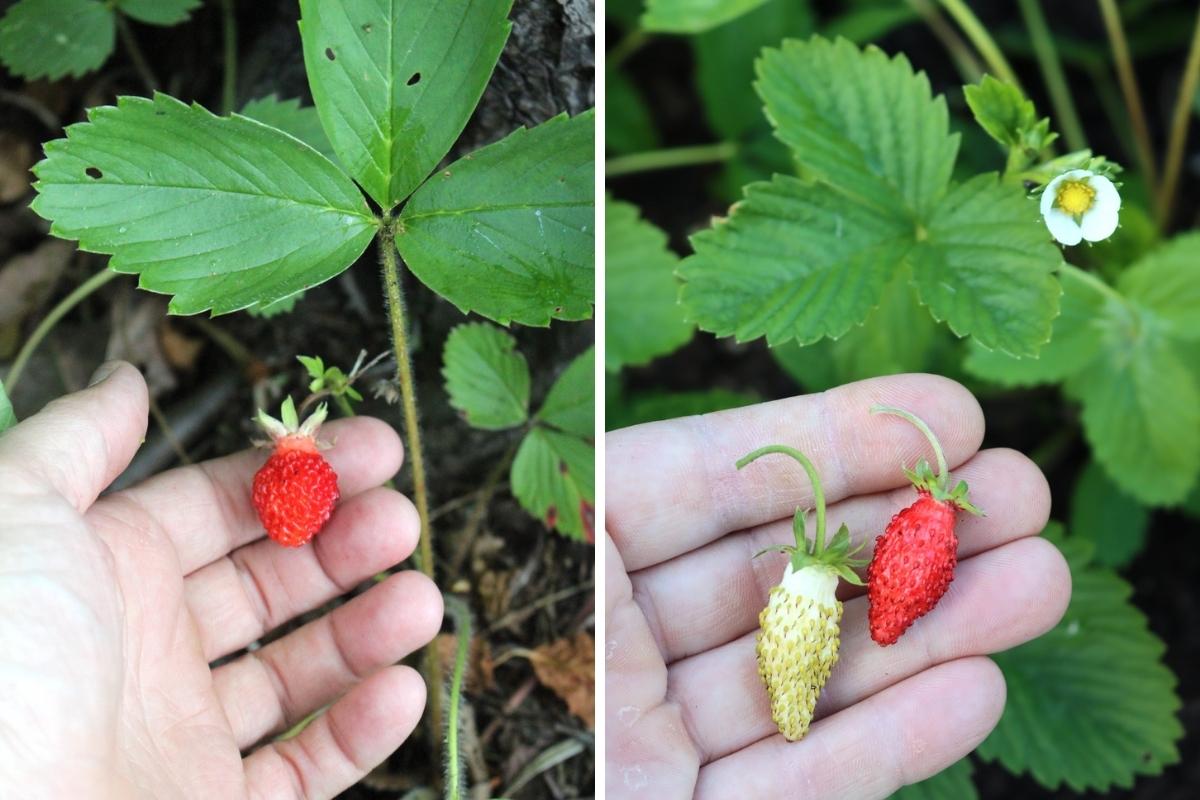
Wild Strawberry plants are generally smaller than Garden Strawberry plants. They also tend to have a more upright growth habit than our sprawling Garden Strawberries.
Wild Strawberry leaves are typically smaller and more astringent than the leaves of Garden Strawberries. Some herbalists feel that the leaves of Wild Strawberries contain more medicinal compounds and are better suited for herbal teas than the leaves of Garden Strawberries.
The fruit of Wild Strawberries varies with species, but they typically differ from the Garden Strawberry in a few ways. While it isn’t always the case, Wild Strawberries tend to be smaller than Garden Strawberries. Their small fruits also tend to be more dimpled, dense, and less juicy. Many species of Wild Strawberries also have fruit that is much more flavorful than that of Garden Strawberries. Gourmet cooks have noted that the fruit of wild strawberries has more concentrated sugars and different flavors, including more floral, tropical, and vanilla notes.
Wild Strawberries are delicate and have a very short shelf life. Unlike their cultivated cousin, the Garden Strawberry, Wild Strawberries haven’t been bred to hold up to transportation or to keep well in your fridge. It’s best to eat or preserve them soon after harvesting, ideally within a day.
Where to Find Wild Strawberries
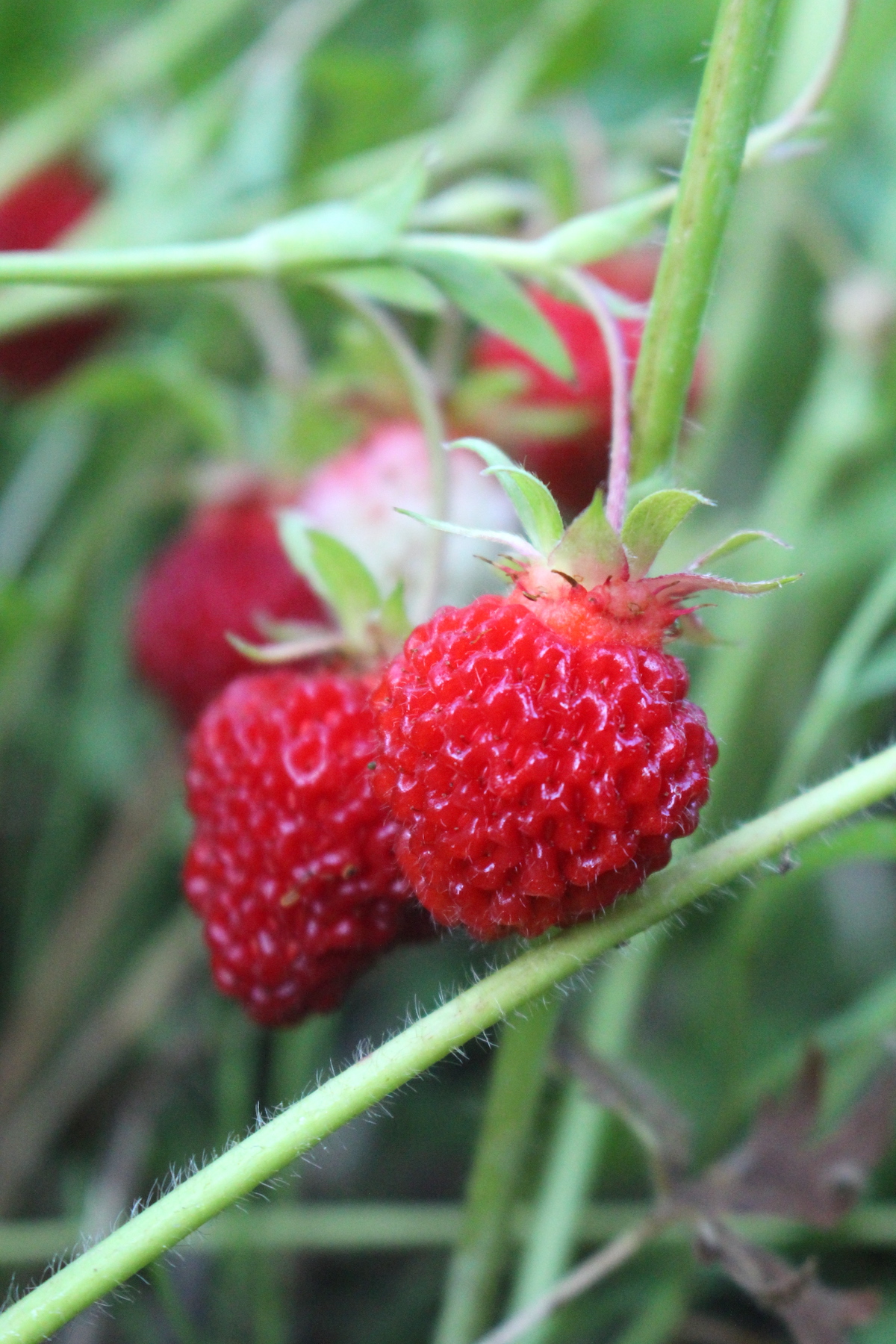
Species of Wild Strawberries can be found worldwide, including in Europe, Asia, North America, South America, and parts of Australia and Africa.
In the United States and Canada, Wild Strawberries (especially the Virginia Strawberry, Fragaria virginiana) are relatively common and widespread. The Woodland Strawberry has also naturalized in parts of the US and Canada, and the Chilean or Beach Strawberry can be found on the West Coast.
Wild Strawberries occur in a wide range of habitats:
- Lawns and yards (especially patches that don’t get a lot of mowing or fertilizer)
- Fields, prairies, and meadows with full sun to partial shade
- Forest openings, forest edges, and woodland clearings
- Banks of rivers and lakes
- Logging clearings and recently disturbed land
- Roadsides and trail edges (away from sprayed areas)
- Sandy beaches above the tidal zone (Beach Strawberry only)
- Cedar swamps, damp ledges, and hardwood forests (Woodland Strawberry preference)
Wild strawberry plants thrive in rich soil but tolerate degraded habitats. The plants grow at remarkably wide elevation ranges, from sea level (Beach Strawberry) up to high alpine zones (Alpine Strawberry, hence the name). If you’re hunting wild strawberries in a new area, look for sunny patches with good drainage on the edges of clearings; that combination is the most reliable indicator of a productive patch.
When Do Wild Strawberries Ripen?
The date that Wild Strawberries ripen varies throughout their range and with species. In the United States, you’re most likely to find Wild Strawberries between April and October. The general timing:
- Southern US (Florida, Gulf Coast): Bloom in late February to March, fruit in April
- Mid-Atlantic and Mid-South: Bloom in April, fruit in May
- New England, Upper Midwest, and Pacific Northwest: Bloom in May, fruit in June
- Northern Canada and Alaska: Bloom in late May to early June, fruit in July
- Mountain and high-elevation populations: Bloom and fruit later than lowland populations at the same latitude, often by 2 to 4 weeks
If you find a patch of Wild Strawberries, watch for them to blossom. The fruit should begin to ripen about one month after they flower. The plants will continue to bear sporadically through the summer until fall frost, with the heaviest production happening in the first 2 to 3 weeks of fruiting.
How to Identify Wild Strawberries
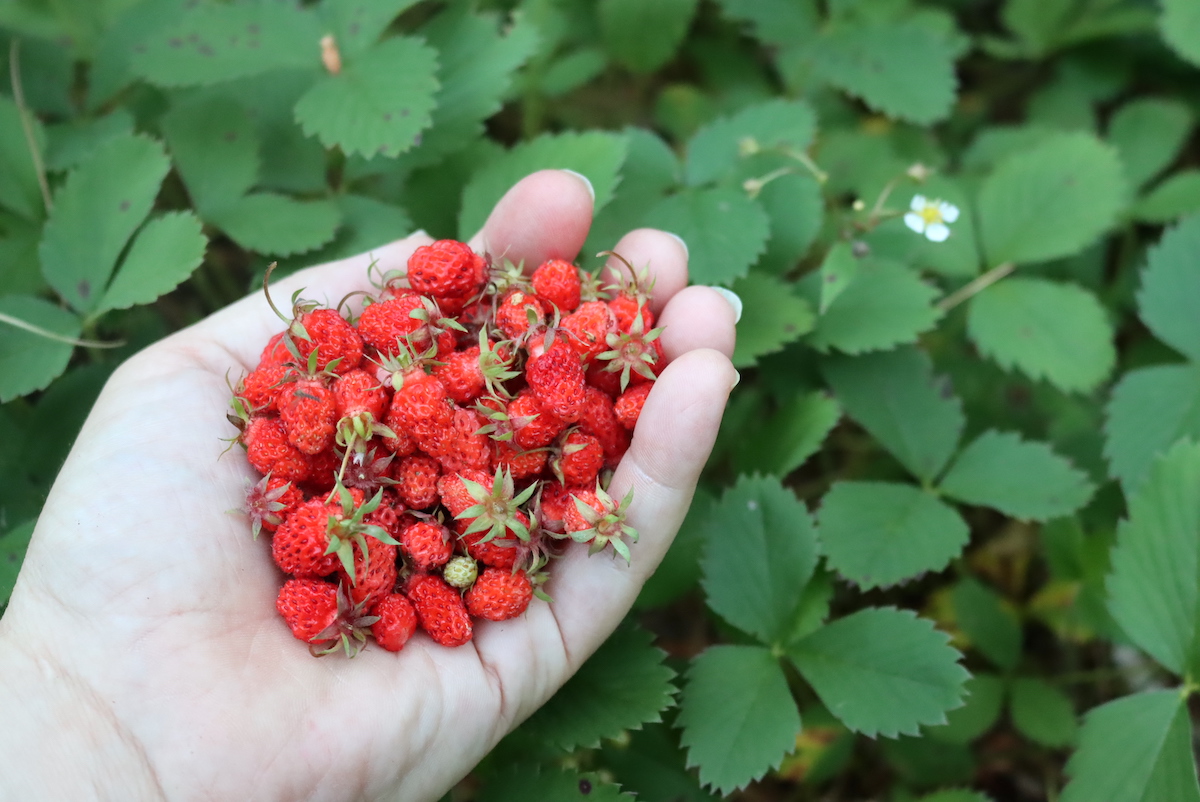
Wild Strawberries are small herbaceous perennial plants that can be hard to pick out from a distance. If you’ve grown or picked Garden Strawberries, you have a pretty good idea of what the plants look like. They’re fairly low-growing, reaching heights of up to seven inches, with toothed, green, trifoliate (three-leaflet) leaves, white blossoms, and runners that spread along the ground.
Wild Strawberry Leaves
Like Garden Strawberries, Wild Strawberries have trifoliate leaves. This means that each leaf is comprised of three leaflets attached at a central point on a small stem. The leaflets are typically oblong to oval and have toothed or serrated edges. The leaflet sizes vary by species, but the leaflets of Virginia Strawberries are often 2½ to 3 inches long and about 1½ inches wide.
The color of the leaves may vary with species and location. They may be light green, dark green, or display reddish tinges. They may also be dull or glossy. The undersides are generally paler than the tops and may have some silky hairs.
One useful field-test detail: the central tooth at the very tip of each leaflet is often shorter than the surrounding teeth in Virginia Strawberry (F. virginiana) and longer than the surrounding teeth in Woodland Strawberry (F. vesca). It’s a subtle difference but a reliable one if you have a hand lens or just sharp eyes.
Wild Strawberry Flowers
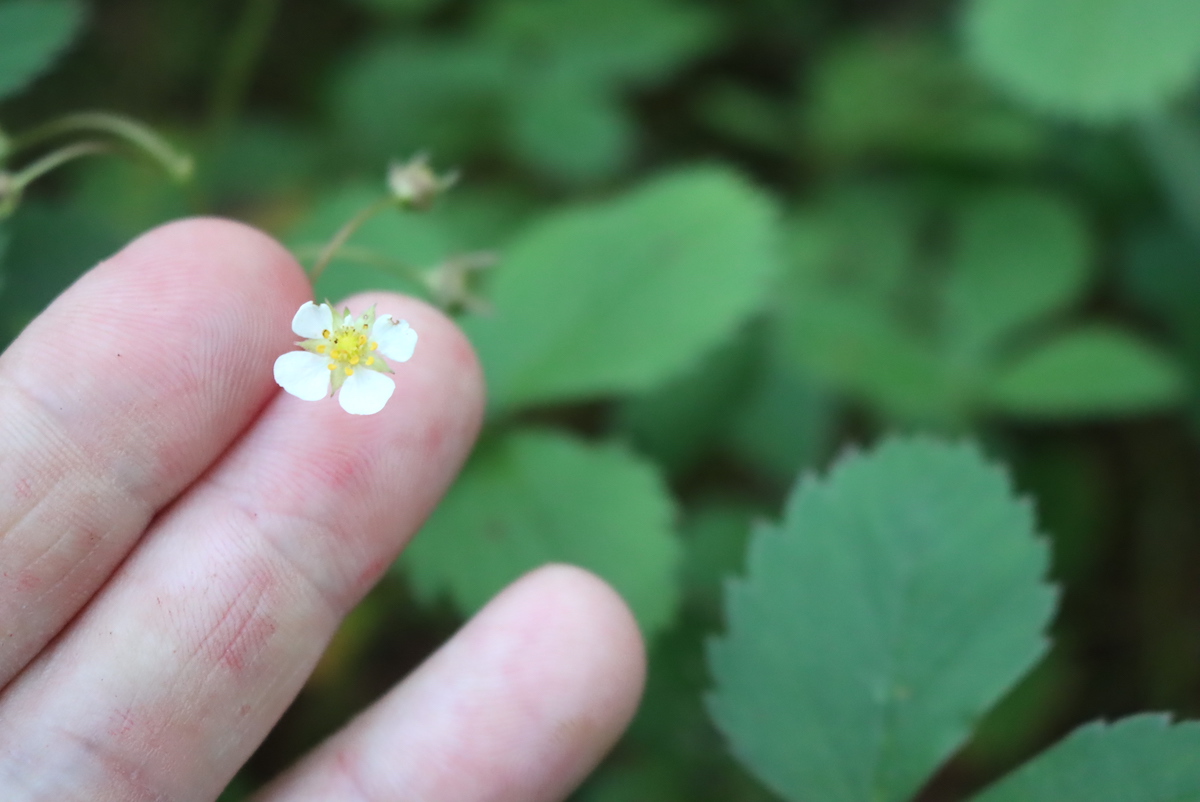
Wild Strawberries have white five-petaled flowers with numerous yellow stamens in the center. The flowers are generally about ¾ inches in diameter and have ten small green sepals under the petals. The white-flowered identification is critical because it’s the single biggest distinguishing feature between true wild strawberries and the Mock Strawberry look-alike (which has yellow flowers).
The flowers grow in small clusters at the top of a stem, and they poke up through the leaves for fertilization. After fertilization, depending on species, the developing fruit cluster either remains above the leaves (more common in Woodland Strawberry) or drops below the leaves on a shorter stem (more common in Virginia Strawberry).
Wild Strawberry Fruit
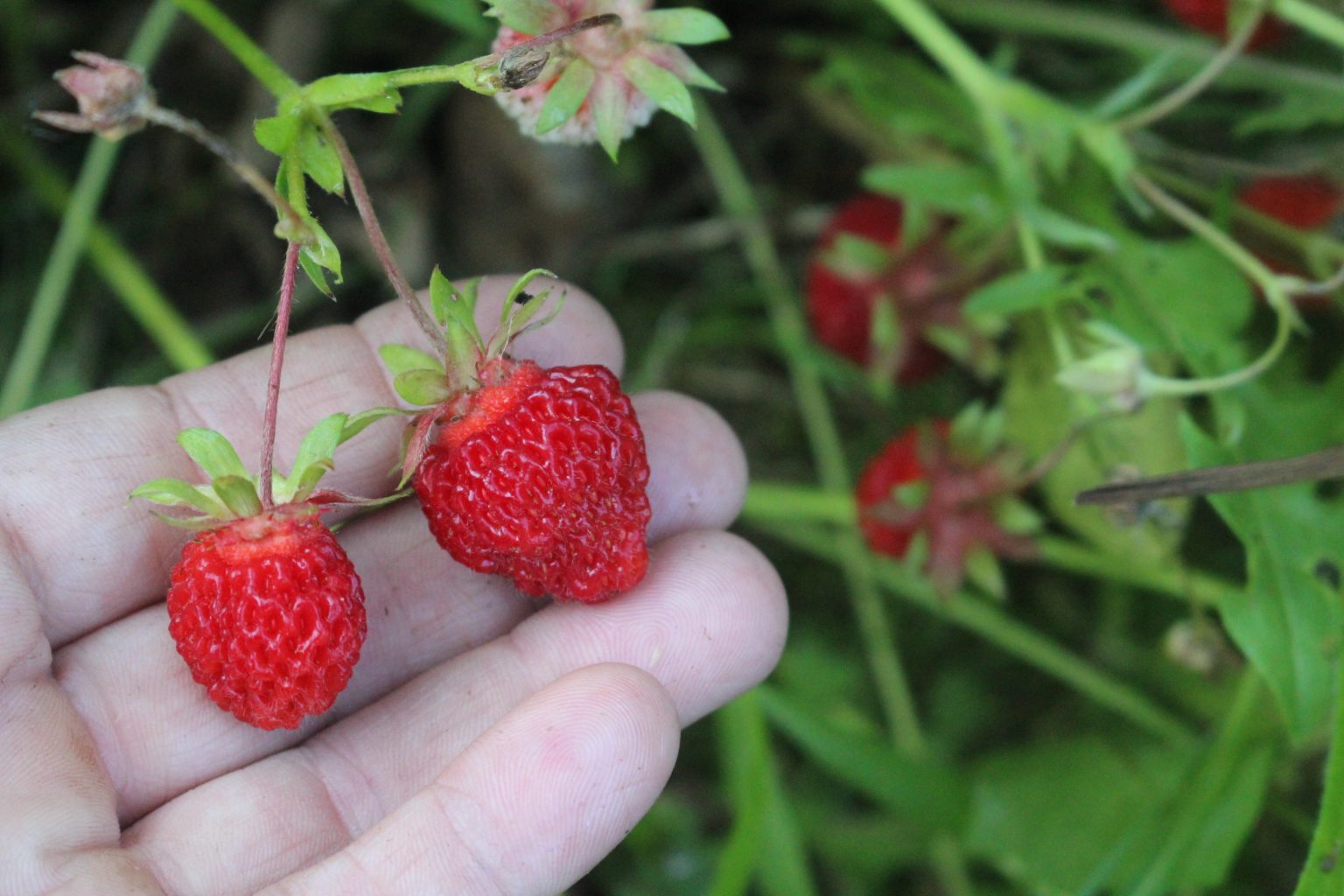
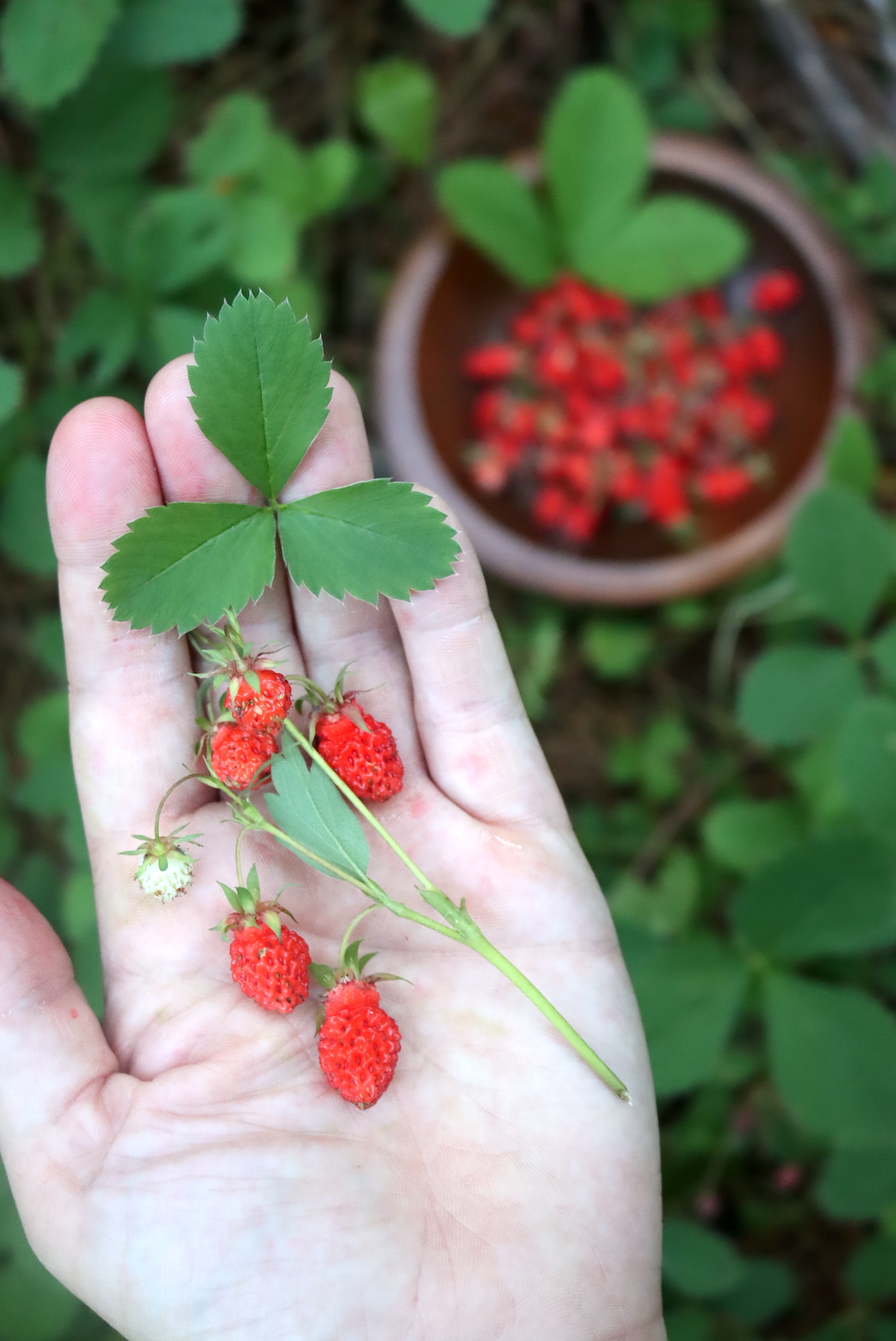
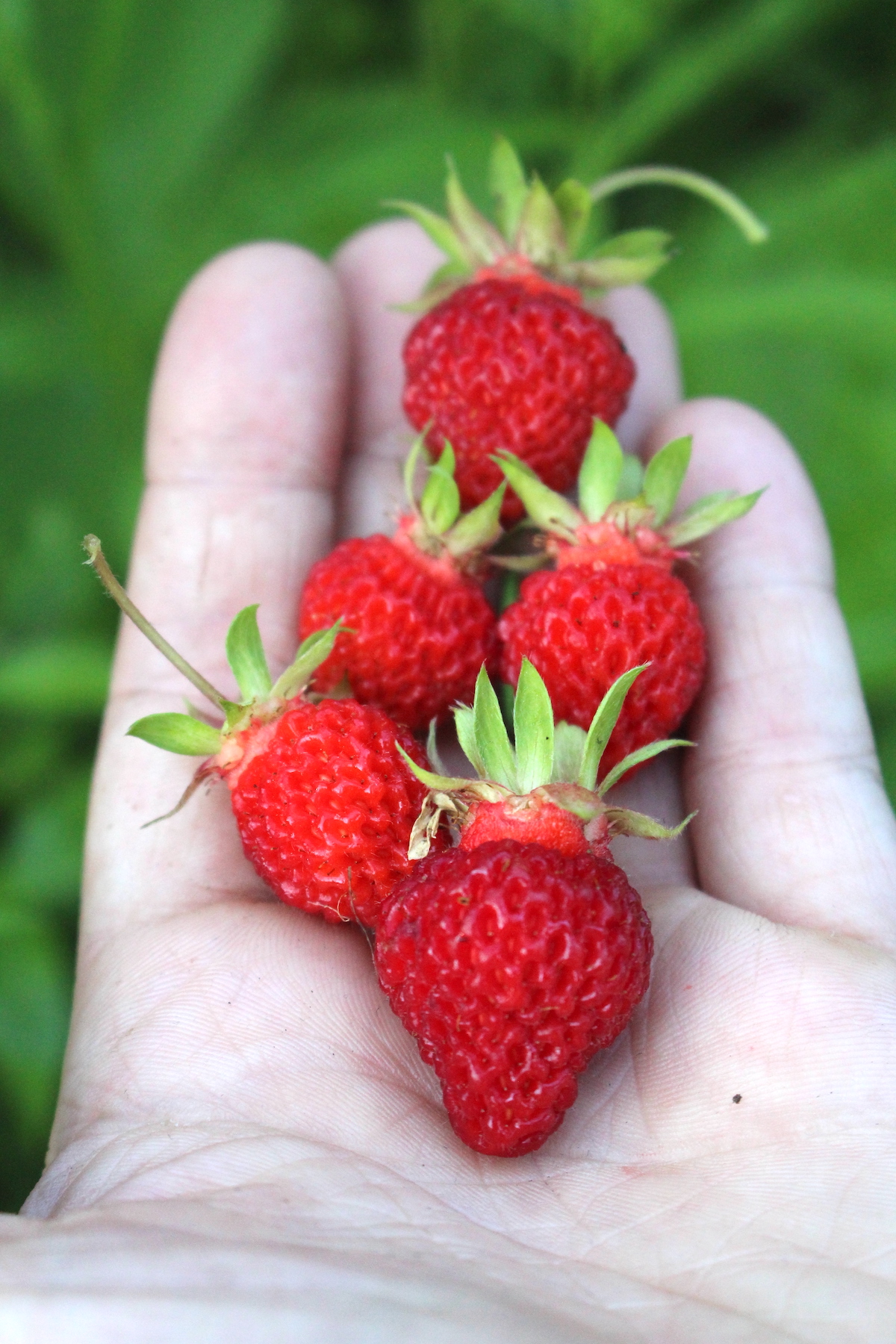
Wild Strawberry berries look very similar to those of Garden Strawberries but in miniature. They’re typically red and covered with seeds (technically achenes) on the outside, set into small dimples or pits across the surface. The dimpled seed arrangement is a key identifier; in true wild strawberries, the achenes are partially sunk into the flesh, while in Mock Strawberries they sit raised on the surface.
The fruit color is typically bright red, but some species or individual plants may have berries that are pink, dark red, or maroon. The fruits may be rounded, oblong, or somewhat conical depending on the species. The Beach Strawberry (F. chiloensis) is unusual in that the flesh inside is white even when the skin is fully red.
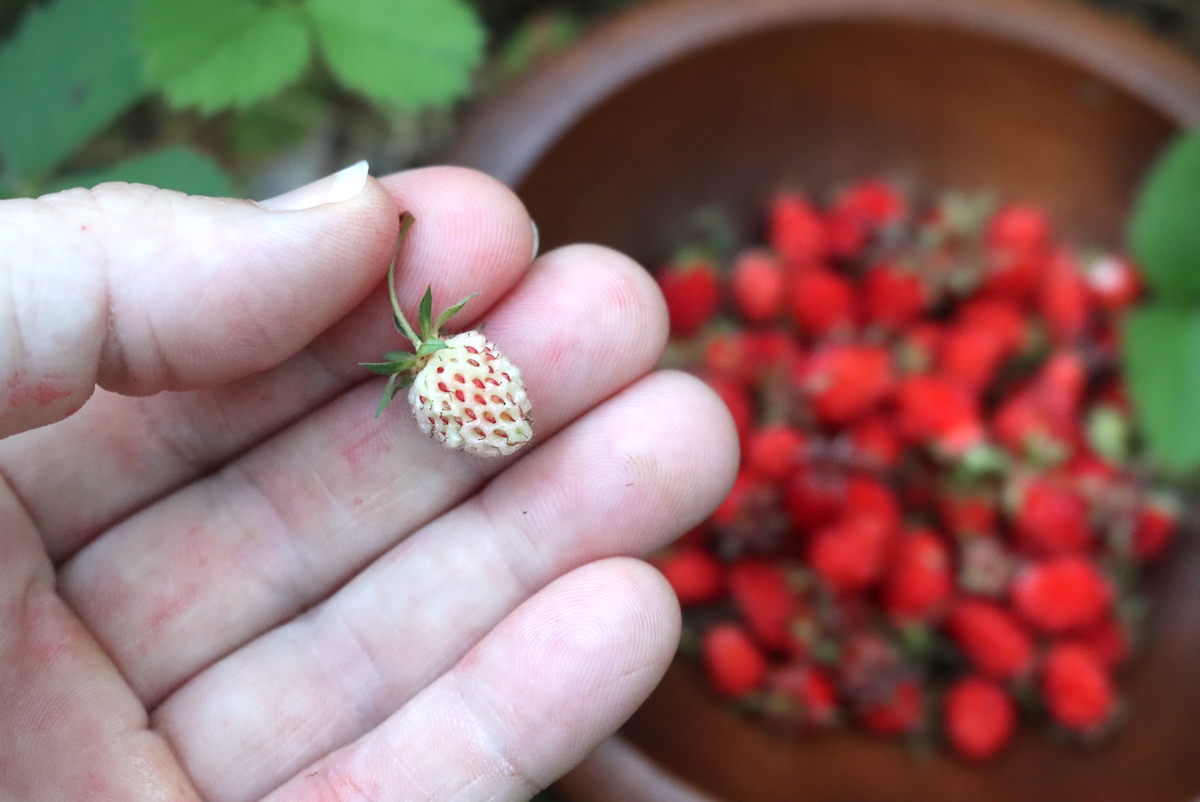
Occasionally, you may find strawberries that are still white even though they are ripe. In the wild, this phenomenon is known to occur as a mutation of the Woodland Strawberry (F. vesca). These white berries were first discovered about 300 years ago in the low Alps. They were a quick favorite of gardeners due to their incredible flavor, often described as strawberry mixed with pineapple or guava.
White berries may also occur as a cross between the Chilean Strawberry (F. chiloensis) and the Virginia Strawberry (F. virginiana). These are generally known as Pineberries. The lack of red coloration in the berries seems to discourage birds and insects, helping you get a bigger harvest. Some folks who are allergic to red strawberries also report no issues with white strawberries.
How Big Do Wild Strawberries Get?
Wild Strawberries are generally only about ¼ to ½ inch wide, though the berries may become quite large in ideal growing conditions. Some species, particularly when grown in cultivated patches, can produce fruit close to the size of small Garden Strawberries.
Size isn’t a good indicator when determining whether you’re looking at a Wild or Garden Strawberry. Often, Wild Strawberries are smaller than Garden Strawberries, but not always. Selecting for these size variations is what led to modern cultivated strawberries, so if you look carefully, you can often find wild strawberry plants with very large juicy fruits.
The fruits also vary widely in flavor. They may be very sweet with a classic strawberry taste, bland and mild, or sometimes more tropical or raspberry-like. Every plant produces slightly different berries, so taste-test a few from each new patch to assess the flavor before committing to a harvest.
Wild Strawberry Look-Alikes
Wild Strawberries are one of the easiest wild edibles to identify, and they have very few look-alikes. None of the common confusions are dangerously toxic. The most common look-alike is the bland but harmless Mock Strawberry, and the differences are obvious once you know what to look for.
Mock Strawberry (Indian Strawberry)
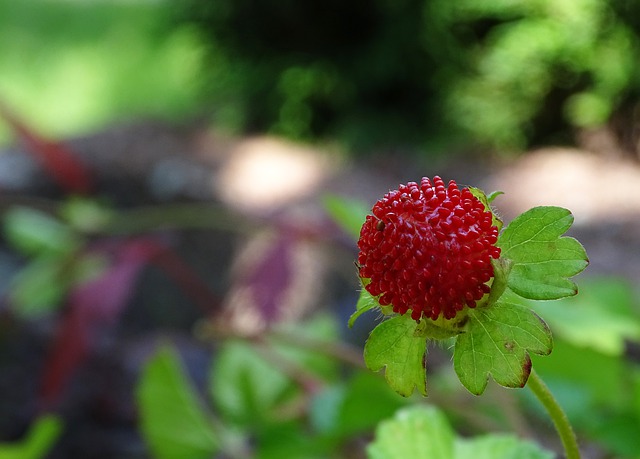
The Mock Strawberry (Potentilla indica, formerly Duchesnea indica), also called Indian Strawberry, False Strawberry, or Backyard Strawberry, is the most common wild strawberry look-alike. It’s a non-native invasive originally from Asia, now widely naturalized across most of the eastern and central United States. Mock Strawberry fruit is technically edible but bland, dry, and tasteless. The differences:
- Flowers: Mock Strawberry has yellow flowers; true wild strawberries have white flowers. This is the single easiest identification feature, and it works year-round when the plants are in bloom.
- Berry surface: Mock Strawberry seeds (achenes) sit raised on the surface of the fruit, like pin heads on a pin cushion. True wild strawberry seeds are sunken into small dimples on the fruit’s surface.
- Berry orientation: Mock Strawberry fruit is held upright, sticking up above the leaves. True wild strawberry fruit hangs down or is held at the leaf level.
- Berry shape: Mock Strawberry fruit is rounder and slightly bumpy in texture. True wild strawberry fruit is more conical or heart-shaped and has the dimpled smooth surface.
- Taste: Mock Strawberry tastes like nothing. Foragers describe it variously as “watery cardboard,” “wet sawdust,” or simply “absolutely flavorless.” True wild strawberries are intensely sweet and aromatic.
- Bracts: Mock Strawberry has three-toothed bracts that extend beyond the petals; wild strawberry bracts are smooth-edged and shorter than the petals.
Mock Strawberry is technically edible and won’t hurt you, but it’s so flavorless that most foragers consider it a disappointing find. Children often eat them with delight despite the lack of flavor; the satisfaction of finding “berries in the yard” carries the day.
Cinquefoils
Several Cinquefoil species (Potentilla spp.), close relatives of the Mock Strawberry in the same genus, can also be confused with wild strawberries based on leaf shape. Like wild strawberries, they’re in the rose family and have similar trifoliate or palmate leaves with toothed edges. None are dangerously toxic, and several have traditional herbal uses, but none produce the desirable strawberry-like fruit.
- Cinquefoils typically have five leaflets per leaf (the name “cinquefoil” means “five leaves”), while wild strawberries have three.
- Cinquefoil flowers are yellow (like Mock Strawberry); true wild strawberry flowers are white.
- Cinquefoils don’t produce a fleshy red fruit; they produce dry seed heads.
The leaf-count test (3 versus 5 leaflets) makes Cinquefoil distinct from wild strawberry even when neither is in bloom or fruit.
Goldthread
Goldthread (Coptis groenlandica) is a low-growing northern woodland herb that has three-lobed glossy evergreen leaves and white five-petaled flowers, which can superficially resemble wild strawberry leaves and flowers. Goldthread is not toxic, but it’s bitter and not a good food. The differences:
- Goldthread leaves are glossy, evergreen, and somewhat fan-shaped; wild strawberry leaves are matte, deciduous, and oval-toothed.
- Goldthread petals are thin and pointed; wild strawberry petals are rounded.
- Goldthread fruit looks like miniature pea pods, not red berries.
- Goldthread roots are bright yellow (the source of the common name); wild strawberry roots are pale brown.
How to Harvest Wild Strawberries
Wild Strawberry harvest is straightforward but slow because the fruit is so small. Each ripe berry is a separate two-finger pluck, and a productive patch will yield maybe a quart per hour for an experienced forager working steadily.
Practical tips:
- Harvest into a wide shallow container rather than a deep one. Wild strawberries are extremely soft and bruise easily, and a deep container will crush the bottom layer into mush.
- Pick fully ripe berries only. Underripe pink berries don’t continue to ripen after picking.
- Pick gently with two fingers and minimal pressure. The fruit should detach with a slight tug; if you have to pull hard, it’s not ready.
- Harvest in the morning when the fruit is cool and firm. Mid-day fruit warmed in direct sun is delicious eaten on the spot but turns to jam in a basket within an hour.
- Process or refrigerate within hours of picking. Wild strawberries don’t keep at room temperature for more than half a day.
- Plan multiple harvest trips over a 2 to 3 week window rather than one big harvest day. The plants don’t ripen all at once.
- Harvest from clean areas: yards that aren’t sprayed, woodland edges, fields away from busy roads. Avoid roadside patches where vehicle exhaust accumulates.
- Leave plenty for wildlife. Birds, chipmunks, and other small mammals depend on wild strawberries as a summer food source.
For longer-term storage, freeze whole berries in a single layer on a tray (so they don’t crush each other), then transfer to bags once frozen solid. Frozen wild strawberries are excellent in winter pancakes, smoothies, or baked into crisps. Dehydrating works too, and dried wild strawberries are intensely flavored and excellent in granola or muesli.
Can You Grow Wild Strawberries?
Yes, growing Wild Strawberries is similar to growing Garden Strawberries. Many species of Wild Strawberries were cultivated in backyard gardens before the breeding of Garden Strawberries. Some, like the Musk Strawberry (Fragaria moschata), are still commonly cultivated in some regions.
These days, you can find Wild Strawberry plants available for order online. However, if you have Wild Strawberries growing nearby, you can propagate them to get free plants for your garden. If you have a wild patch, you can grow wild strawberries from seed, or transplant strawberries from runners.
For dedicated patches, the cultivated form of F. vesca (called Alpine Strawberry) is widely available from seed catalogs and nurseries, and produces small intensely flavored berries continuously through the growing season rather than in a single big flush. They’re a favorite for permaculture borders, ornamental edibles, and shade gardens where regular strawberries won’t thrive.

Ways to Use Wild Strawberries
Wild Strawberries are excellent eaten fresh, and you’ll probably find yourself eating most of them while standing in the patch. However, if you’re a dedicated forager or find a particularly abundant patch, there are several tasty ways to use them.
Fresh berries make excellent toppings for yogurt, ice cream, cereal, and salads. The leaves can also be added to salads or used as a potherb. If you have enough berries to preserve, you can add them to jams, freeze them whole, or dry them for use in granola or muesli mixes. Additionally, you can bake them into crisps or pies with other seasonally available fruit.
You can also use Wild Strawberries medicinally. The leaves and roots can be used fresh or dried in teas and tinctures. The leaves contain high levels of vitamin C and were historically used to treat various conditions. The roots are thought to be a good tonic.
Berry juice was historically used for sunburn, sores, and other skin irritations. Some Native American groups also used the juice to cleanse their teeth by swishing it around in their mouth.
Wild Strawberry Recipes
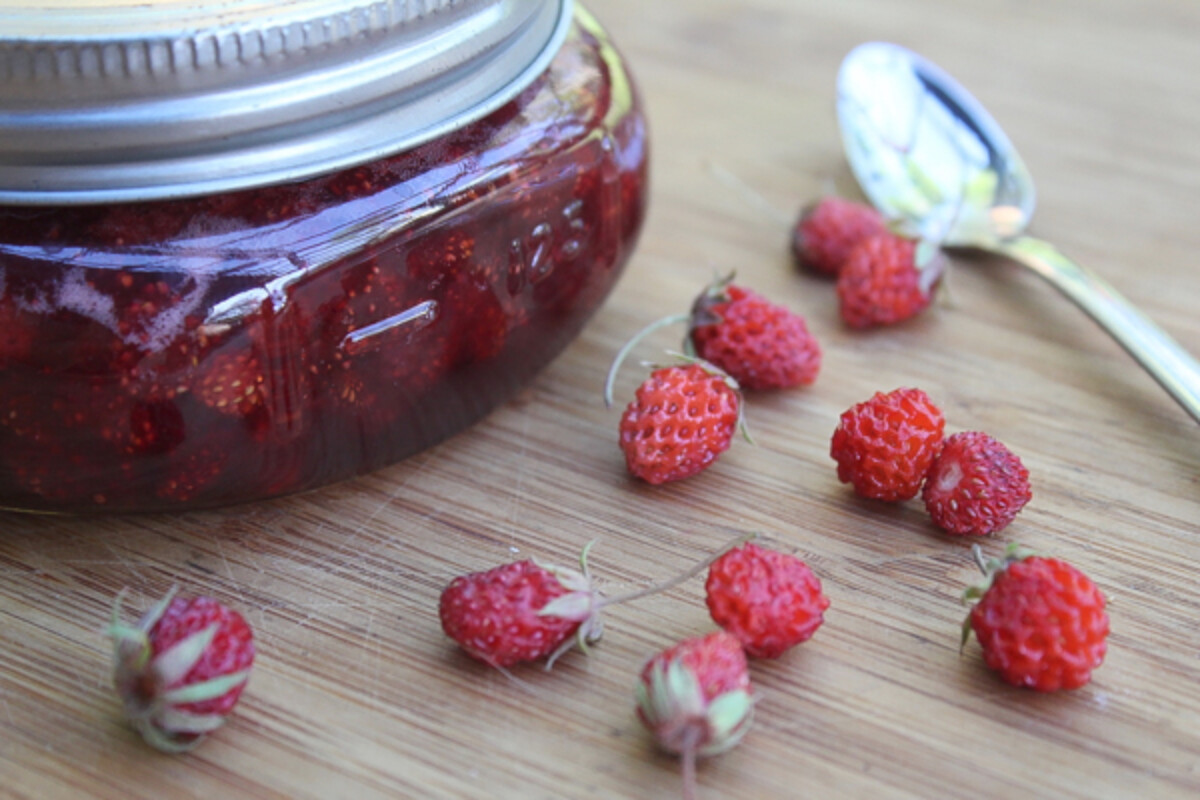
- One of the classic ways to preserve Wild Strawberries for long-term use is to can Wild Strawberry Jam.
- Try this Wild Strawberry and Thyme Ice Cream recipe from the BBC for a cool summertime treat.
- For medicinal value or just a refreshing beverage, check out Mother Earth Living’s Strawberry Tea, made with leaves and berries. It can be served hot or cold, and mint is an excellent addition.
- Impress your guests with these adorable Wild Strawberry Tartlets from Kitchen Stories.
- Create a custardy, creamy Wild Strawberry Pie with this recipe from Nigella.
If your wild strawberry harvest is small (as most are), consider blending it into a half-wild jam by combining wild and garden strawberries together. The wild flavor comes through even at modest proportions, and you’ll have enough volume for a workable batch.
Wild Strawberry FAQs
Yes, all true wild strawberries (Fragaria species) are edible. The entire plant is safe to eat, including the roots, flowers, leaves, and fruit. The berries are sweet and intensely flavored, often described as more flavorful than cultivated garden strawberries despite being much smaller. The leaves are commonly used for herbal tea (high in vitamin C), and the flowers are edible in salads. The most important thing is to make sure you’re looking at a true wild strawberry (Fragaria) and not the harmless-but-bland Mock Strawberry (Potentilla indica), which has yellow flowers instead of white.
True Wild Strawberries (Fragaria sp.) have white five-petaled flowers and produce sweet, intensely flavored red fruit with seeds (achenes) sunken into small dimples on the surface. Mock Strawberries (Potentilla indica, also called Indian Strawberry) have yellow flowers and produce bland, dry, tasteless red fruit with seeds raised on the surface like pins on a pin cushion. Mock Strawberry fruit also tends to be held upright above the leaves, while wild strawberry fruit hangs down at or below the leaf level. Mock Strawberry is technically edible but disappointingly flavorless, while wild strawberries are one of the most prized wild fruits in temperate climates.
Yes, two of the three Fragaria species that gave rise to the modern garden strawberry are native to North America: the Virginia Strawberry (Fragaria virginiana), found from Alaska through the eastern United States, and the Beach Strawberry (Fragaria chiloensis), found along the Pacific Coast from Alaska to Patagonia. The Woodland Strawberry (Fragaria vesca) is native to the Northern Hemisphere broadly, including parts of North America, Europe, and Asia. Native Americans were eating wild strawberries long before European colonists arrived. The modern garden strawberry was created in 1700s France from a cross of the two North American species.
Wild strawberries are typically about ¼ to ½ inch wide, much smaller than garden strawberries (which are usually 1 to 2 inches across). However, in ideal growing conditions, wild strawberries can occasionally produce fruit closer to the size of small garden strawberries. Selecting for these size variations is exactly how modern cultivated strawberries were developed. Size is not a reliable indicator for distinguishing wild strawberries from garden varieties; flavor, leaf size, and growth habit are more reliable diagnostic features.
Wild strawberries ripen at different times depending on latitude and species. In southern parts of the US they may ripen in April; in the mid-Atlantic in May; in New England, the upper Midwest, and Pacific Northwest in June; and in northern Canada and Alaska in July. The fruit ripens about one month after the white flowers bloom. Plants continue to produce sporadically through the summer until fall frost, but the heaviest production happens in the first 2 to 3 weeks of fruiting. The harvest window is short, so plan to revisit a productive patch every few days during the season.
Did you find this Wild Strawberry foraging guide helpful? Tell me in the 📝 comments below how you use wild strawberries on your homestead!
And make sure you stay in touch with me by following on social media!
Wild Fruit Foraging Guides
Find the perfect foraging guide
Searching for something else? Enter keywords to find the perfect foraging guide!










Almost every year I go to the country side and forage wild strawberries, as a matter of fact they are flowering as we speak. Where I live they are smaller than those in your photos but they taste amazing, very sweet and flavorful.