
Affiliate disclosure: This post may contain affiliate links. Please see our Privacy Policy.
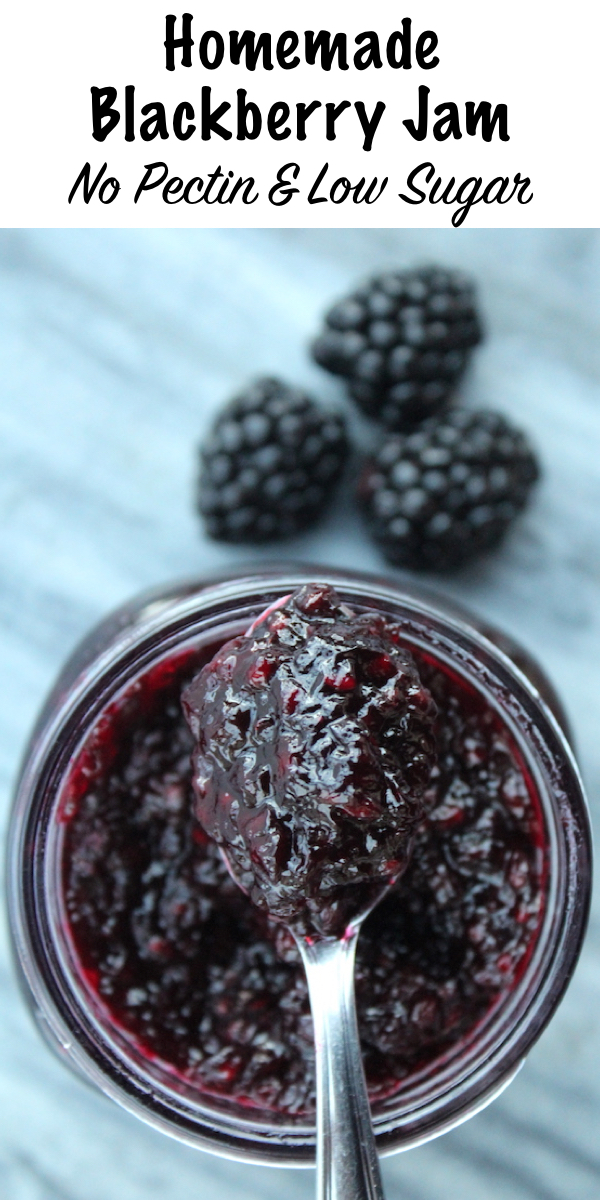
Homemade blackberry jam without pectin captures the deep, rich flavor of summer berries in a thick, spreadable preserve that comes together with just two ingredients. Blackberries are naturally high in pectin, so they set beautifully on their own with nothing more than sugar and a bit of patience at the stove.
Table of Contents
- Notes from My Kitchen
- Choosing Blackberries for Jam
- Sugar Options for Blackberry Jam
- Ingredients for Blackberry Jam
- How to Make Blackberry Jam
- Testing for Gel Stage
- Canning Blackberry Jam
- Altitude Adjustments
- Yield Notes
- Storage Options
- Recipe Tips
- Ways to Use Blackberry Jam
- Blackberry Jam FAQs
- Jam Recipes
- Blackberry Jam Recipe Without Pectin
- Canning Recipes
Blackberry jam is my husband’s absolute favorite preserve, and it’s the one jam we make every single summer without fail. I’ve been making homemade jam for years now, and this recipe remains one of the simplest and most foolproof in my collection.
Blackberries are naturally high in both acid and pectin, which means they gel easily without added thickeners. That makes this one of the best jams for beginners, and one of the easiest to adapt based on your personal taste. Even if you’ve never made jam before, this is a great place to start. My beginner’s guide to water bath canning covers everything you need to know about the canning process itself.
This particular jam works well as a low sugar preserve or with traditional amounts of sugar, and I’ve included instructions for both variations below. You can choose to use more or less, or anywhere in between.
Notes from My Kitchen

The beauty of this recipe is how forgiving it is. Unlike pectin-based jams where you have to follow exact ratios, blackberry jam without pectin gives you flexibility. Want it less sweet? Use less sugar. Prefer a firmer set? Cook it a bit longer. Once you’ve made this a few times, you’ll develop a feel for exactly how you like it. If you enjoy this recipe, try raspberry jam or strawberry jam using the same no-pectin method.
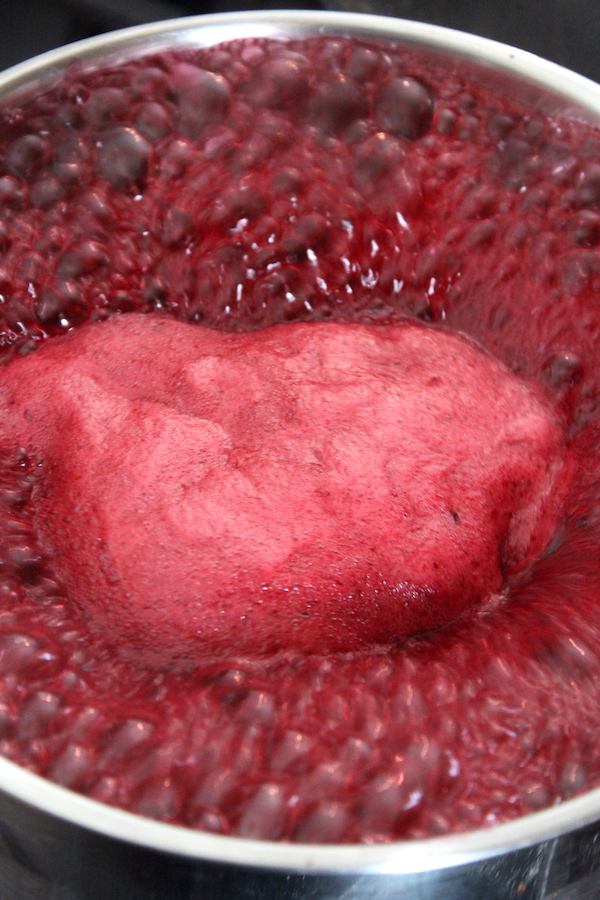
One thing I’ve learned: stay at the stove and stir constantly. Blackberry jam foams dramatically as it cooks, and it can overflow if you’re not paying attention. I keep a long wooden spoon in hand the entire time, stirring down the foam and scraping the bottom to prevent scorching.
Choosing Blackberries for Jam
Any kind of blackberry works here, whether wild, cultivated, or even frozen berries from the grocery store.
- Wild blackberries tend to have more pectin and firmer fruit. The berries often stay whole in the jam unless you choose to mash them. If you’re foraging wild blackberries (or related species like dewberries), be sure to pick them fully ripe. Slightly underripe berries can be pretty tart and don’t release juice as easily during cooking.
- Cultivated blackberries tend to be juicier and sweeter, and will fall apart into a smoother jam. If you’re using sweeter cultivated berries, you may want to add a splash of lemon juice for balance.
- Frozen blackberries have a bit less pectin since freezing breaks down pectin in fruit. The jam will still set with frozen fruit, but it may have a slightly less firm set and lower yield than with fresh.
I’ve made the equal parts sugar/blackberries and your low sugar recipe and yours is by far the best recipe I’ve come across. This is the first review I’ve ever left for any recipe that I’ve ever cooked! It’s that good!
Sugar Options for Blackberry Jam
This recipe works with just about any amount of sugar, which makes it incredibly versatile. Here are a few ratio guidelines to help you choose the right version for your taste:
- Perfect Blackberry Jam (Recommended): Use 4 cups sugar to 6 cups mashed fruit. This is the amount currently recommended by the National Center for Food Preservation and strikes a nice balance between sweetness and fruit flavor.
- Low Sugar: Use 2 cups sugar to 6 cups mashed fruit. A nice set, but reasonably tart and more fruit-forward. The perfect spot if you like low sugar but still want a high quality jam.
- Old Fashioned High Sugar (Traditional): Equal parts sugar and mashed fruit. Very sweet with a firm set and high yield. This is too sugary for my tastes, but some people really love those old fashioned candy preserves.
You can also use honey or maple syrup instead of sugar. Just keep in mind that they’re sweeter by volume, so start with about two-thirds the amount of sugar and taste as you go. A thermometer helps here since the visual cues are harder to read with alternative sweeteners.
No matter how much (or little) sugar you use, the jam will still be safe for water bath canning because blackberries are naturally high in acid.
Ingredients for Blackberry Jam
- Fresh Blackberries: You’ll need about 3 pounds of whole berries (12 cups as purchased) to yield 6 cups of mashed fruit. Any variety works, including wild, cultivated, or frozen.
- Sugar: Use 2-6 cups depending on your sweetness preference (see ratios above). The recipe as written uses 4 cups for a balanced flavor.
- Lemon Juice (Optional): 1-2 tablespoons of fresh lemon juice brightens the flavor and helps balance sweeter cultivated berries. Skip it if your berries are already quite tart. Since blackberries are naturally acidic enough for canning, fresh lemon juice works fine here (no need for bottled).
How to Make Blackberry Jam
Making blackberry jam without pectin is straightforward, but it does require your attention at the stove. Plan for about 30-40 minutes from start to finish.
Preparing the Berries
Rinse and sort your fresh blackberries, removing any stems, leaves, or damaged fruit. Use a potato masher to crush them in a large mixing bowl or directly in the jam pot. Generally, 2 cups of whole fruit yields about 1 cup of mashed fruit.
Cooking the Jam
Combine your mashed berries and sugar in a large, deep jam pot. If you’re using lemon juice, add it now. Bring the mixture to a boil over medium-high heat, stirring frequently. Blackberry jam tends to foam a lot, so keep a close eye and use a deep pot to prevent overflow.
Some people add a little butter (about ¼ teaspoon) to reduce foaming, which is considered safe even for canning, but I usually skip it. Staying present and stirring keeps the foam down naturally, and the National Center for Food Preservation notes that butter may cause off-flavors in long-term storage.
Continue cooking for 20-30 minutes, stirring constantly and scraping the bottom of the pot to prevent scorching. As the jam cooks, the foam will subside and the mixture will thicken and turn glossy. This is your cue that you’re getting close to gel stage.
Testing for Gel Stage
There are several reliable ways to test if your jam is ready:
- Freezer plate test: Before you start cooking, put a small plate in the freezer. When you think the jam is ready, spoon a little onto the cold plate, wait 30 seconds, and run your finger through it. If it wrinkles and holds a line, it’s done. If it runs back together, keep cooking.
- Temperature test: Use an instant-read thermometer. Jam sets at 220°F (104°C) at sea level. Subtract 2°F for every 1,000 feet of elevation above sea level.
- Sheeting test: Dip a spoon into the jam, hold it sideways over the pot, and watch how the jam falls. If it falls off in a sheet or a slow blob (not individual droplets), it’s likely ready.
- Don’t overcook! Jam can quickly go from perfect to too thick if you push it past the gel point. When in doubt, pull it off the heat sooner rather than later.
Canning Blackberry Jam
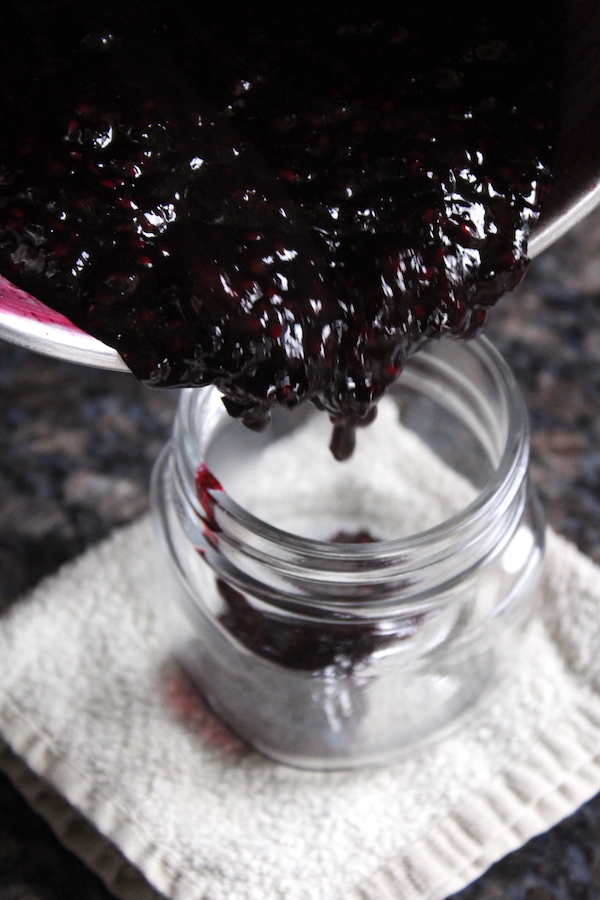
Once your jam reaches gel stage, remove it from heat and skim off any remaining foam if desired. Ladle the hot jam into prepared jars, leaving ¼ inch headspace. Wipe the rims clean, apply lids and rings, and process in a boiling water bath.
Altitude Adjustments
Processing times must be adjusted based on your elevation:
- 0-6,000 ft: 10 minutes
- Above 6,000 ft: 15 minutes
Yield Notes
Understanding blackberry measurements helps you plan your batch:
- 2 cups whole blackberries = 1 cup mashed fruit = about ½ pound
- 6 cups mashed blackberries + 4 cups sugar = about 5-6 half-pint (8 oz) jars
- Maximum batch size: This recipe can be doubled, but don’t increase beyond that. Larger batches don’t cook evenly and may not set properly.
Final yield depends on the berries’ moisture content and how thick you cook the jam. Longer cooking = thicker jam = lower yield.

Storage Options
You have several options for storing your blackberry jam:
- Canned jam: Properly sealed jars keep for 12-18 months in a cool, dark pantry. This is my preferred method because it means blackberry jam all winter long.
- Refrigerator jam: Let jars cool and store in the fridge. Use within 3-4 weeks.
- Freezer jam: Use freezer-safe containers with headspace for expansion. Lasts up to 6 months frozen.
- Once opened: Refrigerate and use within 2-3 weeks. Low sugar jams spoil faster once opened than high sugar versions, so keep that in mind.
Recipe Tips
- Removing seeds: If you prefer seedless jam, run the cooked berries through a fine mesh strainer or food mill before adding sugar. You’ll still keep the pulp for a proper jam texture, just without the seeds. For a completely smooth, seedless spread, make blackberry jelly instead by straining through a jelly bag.
- Foam management: Blackberry jam foams heavily during cooking. Stirring constantly helps, and you can add ¼ teaspoon butter if needed. Skim any remaining foam before jarring.
- Jam too thick? If your jam set too firm, stir in a bit of boiling water before using, or warm the jar to loosen it. Overcooked jam still makes a great glaze for cakes, roasted meats, or drizzled over ice cream.
- Jam didn’t set? The most common reason is undercooking. Make sure it reaches 220°F (at sea level) or passes the freezer plate test. You can recook runny jam by bringing it back to a boil until it hits the proper temperature.
- Flavor variations: Stir in a splash of Chambord or cassis liqueur after cooking, just before jarring. A pinch of cinnamon or cardamom gives warm, spiced notes. You can also mix in raspberries, blueberries, or cherries for a custom blend.
Ways to Use Blackberry Jam
Beyond toast and PB&J, blackberry jam is incredibly versatile in the kitchen. Swirl it into yogurt or oatmeal, use it as a filling for thumbprint cookies or layer cakes, or warm it slightly and drizzle over vanilla ice cream. It also makes a wonderful glaze for pork tenderloin or duck breast. If you find yourself with more jam than you know what to do with, check out my guide to 100+ ways to use up a jar of jam for more inspiration.
Blackberry Jam FAQs
Yes! Blackberries are naturally high in pectin, so they don’t need any commercial pectin to gel. With a bit of patience and the right sugar-to-fruit ratio, you can get a perfect set using just blackberries, sugar, and optionally lemon juice. This is one of the easiest jams to make without pectin.
The most common reason is undercooking. Without added pectin, this recipe relies on evaporation and temperature to set. Keep cooking until the jam reaches 220°F at sea level (or 8°F above your local boiling point) and passes the freezer plate test. If your jam is still runny after cooling, you can recook it by bringing it back to a boil until it reaches the proper temperature. Sometimes jam that looks thin while hot will still set once it cools completely.
You have two options. For seedless jam that still has pulp, run the cooked berries through a fine mesh strainer or food mill before adding sugar. This removes the seeds while keeping the fruit texture. For a completely smooth, seedless spread, make blackberry jelly instead by straining the juice through a jelly bag. You can also find a seedless blackberry jam recipe with detailed instructions.
Yes, when properly sealed in a water bath canner, low sugar jams last just as long as full sugar jams (12-18 months in the pantry). The canning process is what preserves the jam, not the sugar. However, once opened, low sugar jams spoil faster in the fridge. Expect to use an opened jar of low sugar jam within 2-3 weeks, whereas high sugar jams can last months refrigerated.
Many fruits have enough natural pectin to set without added pectin. Raspberry jam, strawberry jam, blueberry jam, and plum jam all work beautifully using this same basic method. Stone fruits and berries tend to have more natural pectin than tropical fruits, making them ideal for old-fashioned jam recipes.
Jam Recipes
If you tried this Blackberry Jam Recipe, or any other recipe on Practical Self Reliance, leave a ⭐ star rating and let me know what you think in the 📝 comments below!
And make sure you stay in touch with me by following on social media!
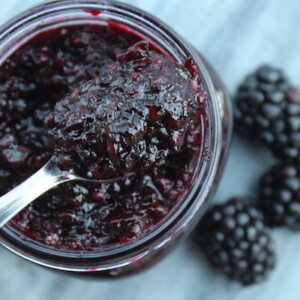
Blackberry Jam Recipe Without Pectin
Equipment
Ingredients
- 6 cups mashed blackberries, see note
- 4 cups granulated sugar
- 2 tablespoons lemon juice, optional, see notes
Instructions
- Prepare canning setup: Wash and sterilize 5-6 half-pint jars. Place lids in hot (not boiling) water. Prepare your boiling water bath canner and keep everything hot until ready to fill.
- Crush the berries: Rinse and sort fresh blackberries, removing any stems or debris. Use a potato masher to crush them in a large bowl or directly in the jam pot. Generally, 2 cups whole fruit yields about 1 cup mashed.
- Combine fruit and sugar: Place crushed blackberries in a large, deep jam pot. Stir in sugar and optional lemon juice. Mix thoroughly to help sugar dissolve before heating.
- Bring to a boil: Turn heat to medium-high and bring to a steady boil, stirring frequently to prevent scorching. Blackberry jam foams heavily, so stay nearby and stir often.
- Cook to gel stage: Continue boiling, stirring constantly, until jam thickens and reaches gel stage. This typically takes 20-30 minutes. Test using the freezer plate test (jam wrinkles when pushed) or an instant-read thermometer (220°F at sea level).
- Remove from heat and skim foam: Once gel stage is reached, remove pot from heat. Skim off any remaining foam if desired.
- Ladle into jars: Carefully ladle hot jam into prepared jars, leaving ¼ inch headspace. Wipe rims with a clean damp cloth, apply lids, and tighten bands to fingertip tight.
- Process in water bath canner: Place jars in boiling water bath canner, ensuring they're fully submerged with 1-2 inches of water above lids. Process for 10 minutes (15 minutes above 6,000 feet).
- Cool and store: Remove jars and let sit undisturbed for 12-24 hours. Check seals, label, and store in a cool, dark place for up to 18 months.
Notes
- Recommended (4 cups): Balanced sweetness with good fruit flavor
- Low Sugar (2-3 cups): More tart and fruit-forward; may take longer to reach gel stage
- Traditional High Sugar (6 cups): Very sweet with firm set; old-fashioned style
- Freezer plate test: Spoon jam onto a cold plate, wait 30 seconds, push your finger through. If it wrinkles and holds a line, it’s done.
- Temperature test: Jam sets at 220°F at sea level. Subtract 2°F for every 1,000 feet of elevation.
- Sheeting test: Dip a spoon in jam and hold sideways. If jam falls in a sheet (not droplets), it’s ready.
Nutrition
Nutrition information is automatically calculated, so should only be used as an approximation.
Canning Recipes
Find the perfect recipe
Searching for something else? Enter keywords to find the perfect recipe!









So tasty! I’ve never made jam before but figured I’d put those pesky blackberry plants to use, and it turned out great. It was a great first recipe to learn the “feel” of jam and watch the various turning points as it cooked down and evolved. I’m excited to see how it set when I crack open one of my canned jars tomorrow!
I did a 2:5 ratio with 1.5TBS fresh squeezed lemon juice and it cooked in about 25 minutes. I’m at 3100ft elevation and my house was 80 degrees. Hope this helps!
That’s wonderful. So glad you enjoyed the recipe.
Can I use raw honey in place of the sugar?
Since this recipe has no pectin, you really need the sugar for the jam to set. You can use something like Pomona’s Pectin if you would like to make it with honey.
Your post and replies in the comments are a wealth of information!
I attempted a measured 16 cup batch of blackberry jam with 4 cups of sugar. No other ingredients. I boiled for over an hour before it finally hit 118*F (I’m at ~1,000 ft above sea level) and sadly had reduced to 1/2 its volume. I confirmed that it had gelled with the freezer plate test. I canned barely 4 pints. I opened a jar today and it is runny, doesn’t taste like blackberries and has a weird chemically aftertaste. Ugh! Any ideas of what went so terribly wrong?
I have had great success with 16 cup batches of blueberries, with a cup of lemon juice and 8 cups of sugar. Maybe I should add more sugar and lemon juice to the blackberry batch?
I think you should be fine with that amount of sugar if you added the lemon juice.
Do you mash the berries down for faster cooking, should you strain the berries or will they eventually cook down to nothing, should it be simmering a little because mine at medium low isnt doing that
There is no need to mash or strain the berries. Just stir them to keep the bubbles down. If it isn’t bubbling then you probably need to turn the heat up just a bit.
I read through many of the comments/questions and I think it should be clarified about when to refrigerate or freeze after making without canning. All my freezer jam recipes say to leave on counter for 24 hours before putting in fridge or freezer when jar full and lidded. Several have asked you if it can be frozen instead of canned, and most answers are simply yes. Should this be left out for 24 hours to cool and set? I am doing this with my jars I just made and will freeze tomorrow. I hope this is the best decision! So glad to find recipe without added pectin.
I think it’s probably a good idea to let it sit out and cool down a bit before freezing. If the experts on freezer jam say to leave it on the counter for 24 hours then that is what I would do. This post isn’t really about freezer jam so that is why it doesn’t go into great detail on how to prepare the jam for the freezer.
It’s blackberry season here in CT. I’ve been picking like crazy this week and had another 4lbs or so this morning. I measured 13 cups of blackberries and added 3 cups of sugar. My thermometer wasn’t acting right and I never got a nice trace to show it was gelled, so gave up after almost 1.25 hours of boiling and hoped for the best. The weird part for me was that it never foamed up. The boil did make more of a plopping sound towards the end. I managed to get 6.5 half pints and I think it’s setting just fine. It’s still a little warm, so fingers crossed 🙂
That’s great. Hope the blackberry jam turns out for you.
If too thick and haven’t pressure canned could you recook with some added water
It’s possible that it might not gel again. You can warm it up and try to add a little water but I would work with small amounts at a time. You can also heat it and use for glazes and syrups etc. Here is a more in-depth article that might help.
Can I make this using frozen blackberries?
You can definitely use frozen berries but you will want to put them in the pot frozen. The faster they thaw, the less juice escapes which makes for a thicker jam.
Hello. I was wondering if I use 20 cups of blackberries then I use 20 cups of suger?
No, the sugar and blackberries should be weighed out to get the proper measurement. You can do equal parts if you want which will give you a very sweet jam or you can use as little as 1 part sugar to 5 parts blackberry.
Used 10 cups of berries, 1 cup of honey, 1/4 cup maple syrup, a pinch of salt, and a tablespoon of lemon. I wouldn’t add the lemon next time. It took 45 minutes to get to gel stage and I ran it through a food mill on medium to get half the seeds out and make it smooth. Only got 3 jars but they’re good! 🙂
Sounds delicious. If you don’t use the lemon, you will just need to add pectin.
Never made jam before and this recipe was so simple to follow and it turned out perfect! Thank you so much!
You’re very welcome. We’re so glad you enjoyed it.
Excellent post. I have a lot blackberries but didn’t want to make a high sugar jam. This is perfect. I would add a suggestion I’ve used with other jams to help control foaming. I too and reluctant to put butter in an otherwise vegan product, so I’ve found that a dab of coconut oil does exactly the same thing as butter, but remains vegan, and doesn’t affect the flavor at all.
Thanks for the great tip with the coconut oil. We’re so glad you enjoyed the post.
Love your blog! I think I messed up the jam. I followed directions but then I put in the fridge and it then took it out to test and it’s like a rock hard jelly slab!
Maybe I did not understand the consistency? Is it salvageable ?
Remaking stiff jams is not really recommended but there are some ways that you can use the product that you have in other ways. I found this article with some good ideas. https://nchfp.uga.edu/how/can_07/stiff_jelly.html
I found a lovely big strip of blackberries on my trail run this morning (Dullstroom, South Africa), so brought a bag home with me. This recipe works great, even I got it right first time! I used 1/3 ratio sugar and a tiny blob of butter. A big plus with trail running of course is that it allows you to keep track of what’s growing where, when and how. Thanks Ashley!
You’re very welcome. So glad the recipe worked so well for you.
Bad experience trying to make the jam. I had so much blackberries that I tried a 20 cup batch and I think that was my mistake. Way to much to try to cook and try to get it to gel. Never did and I kept it up for 1& half hours. I gave up and strained it and canned the syrup instead. Not what I wanted but not a total waste. Question for you… could I have added a box of pectin at that stage of cooking? I’m just disappointed with the whole thing.
Yeah, batch sizes that big are trouble. The fruit on the bottom cooks too hot, and the fruit on the top never gets hot enough to reach gel stage. No amount of stirring keeps it at an even enough temperature to work.
The trick is, most commercial pectin doesn’t work if you add it after you add in the sugar. Sure-Jell, for example, will only gel if you add it first and bring it to a boil, then add the sugar.
I believe Pomona’s pectin will work, but it has special instructions and two different parts. You add calcium water from in the package, and then mix the pectin with sugar to dilute it so it doesn’t clump. You’d be as little as 1/4 cup of sugar per tablespoon of pectin powder there. That should in theory work, though you’d be better off splitting it out into 4 to 6 cup batches and doing it one at a time with the pectin like that. Pectin still has trouble getting to the right temp in a batch that large.
Try it now…dump out 4 jars of jam (or 4 cups I should say) from the syrup you’ve canned into a pot, add calcium water and follow the instructions on the pomona’s box. You may yet save your blackberry syrup for jam.
The other option is liquid pectin, where the sugar is added before the fruit. Problem is, that needs 7 cups sugar to 4 cups fruit to make it gel…so it’s more like candy than jam.
Made it. First time making jam. It gelled up nicely in about 25 minutes. I used 4 cups berries & 1 cup sugar. I tasted the gel and it was pretty sweet. Next time I will try less sugar. Thank you for all of the tips.
You’re very welcome. I am so glad that the recipe worked well for you.
It’s lovely but SO SWEET! And i only put in 1 cup full of sugar. HOw can I make it less sweet, will it work with hardly any sugar?
It may work with less sugar but you may have to use pectin in that case.
I made this recipe last week and have ate about half the jam already. It’s too delicious to not eat quickly! I’m wanting to make more today. I am wondering if I could use raspberries instead of blackberries for this batch though?
Raspberries should work just fine.
Oh my goodness, this recipe is amazing!! I made my first batch of jam (any jam) and your directions were perfect. I wanted to taste the recipe first before I try canning so I made a half-recipe. It is honestly the best blackberry jam recipe I have ever tasted. Thank you so much for the recipe. I found your blog about a year ago and I always look forward to your posts!!
You’re so welcome. I am so glad you enjoyed the recipe.
Made jam with half the sweetener. Half sugar + 1/3 honey ~ 500gm of sweetener. Got two jars from 1kg of berries. It turned out great. Thanks so much for your great instructions. I am very pleased.
You’re welcome. So glad you enjoyed the recipe.
Can I fix the jelly if it got to hard? Can I reheat it and add water or anything?
Here is a very helpful article from the National Center for Home Food Preservation that talks about thinning stiff jams and jellies. It also give some great suggestions for other uses like syrups and toppings for ice cream or pancakes. https://nchfp.uga.edu/how/can_07/stiff_jelly.html