
Affiliate disclosure: This post may contain affiliate links. Please see our Privacy Policy.
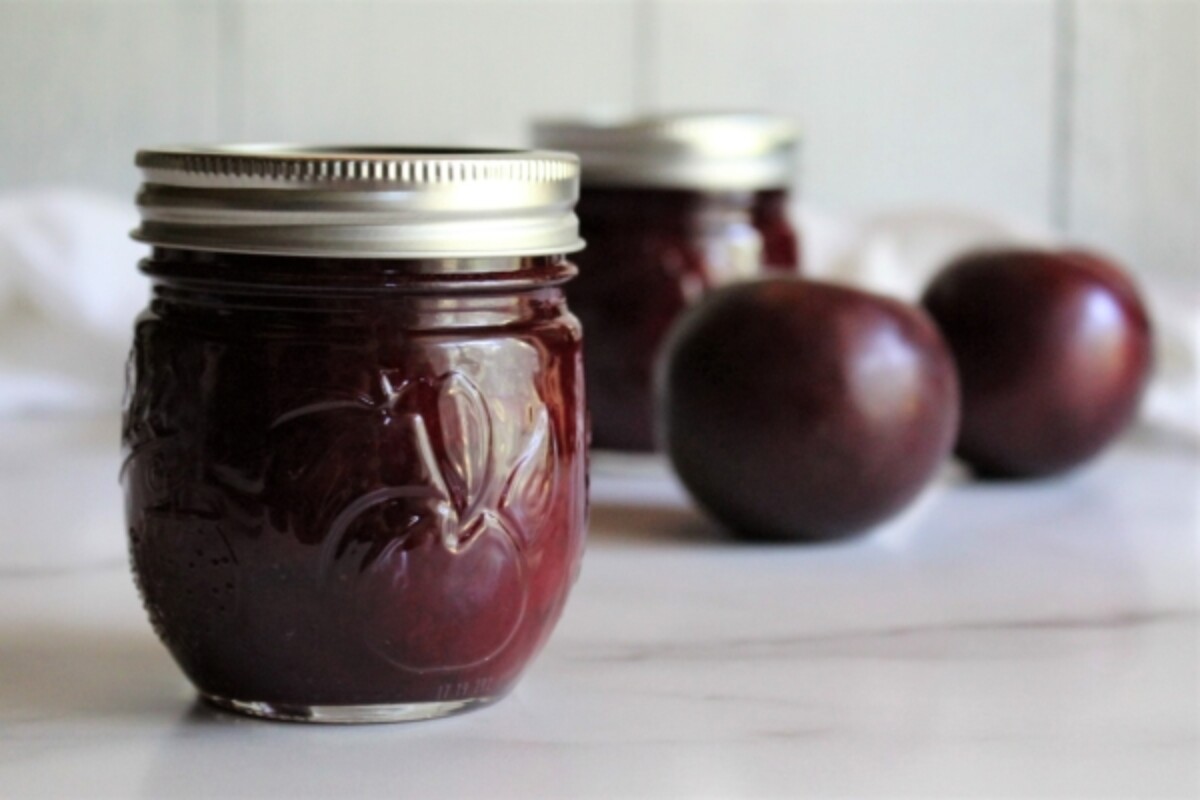
Plum jam turns a bucket of ripe summer plums into thick, glossy preserves with nothing but fruit and sugar in the pot. There’s no boxed pectin here, just plums simmered down until they set on their own.
This is a small batch, no-pectin jam that leans on the natural pectin in the plum skins to thicken. If you’re newer to preserves, it helps to read up on how to make jam from scratch before you start.
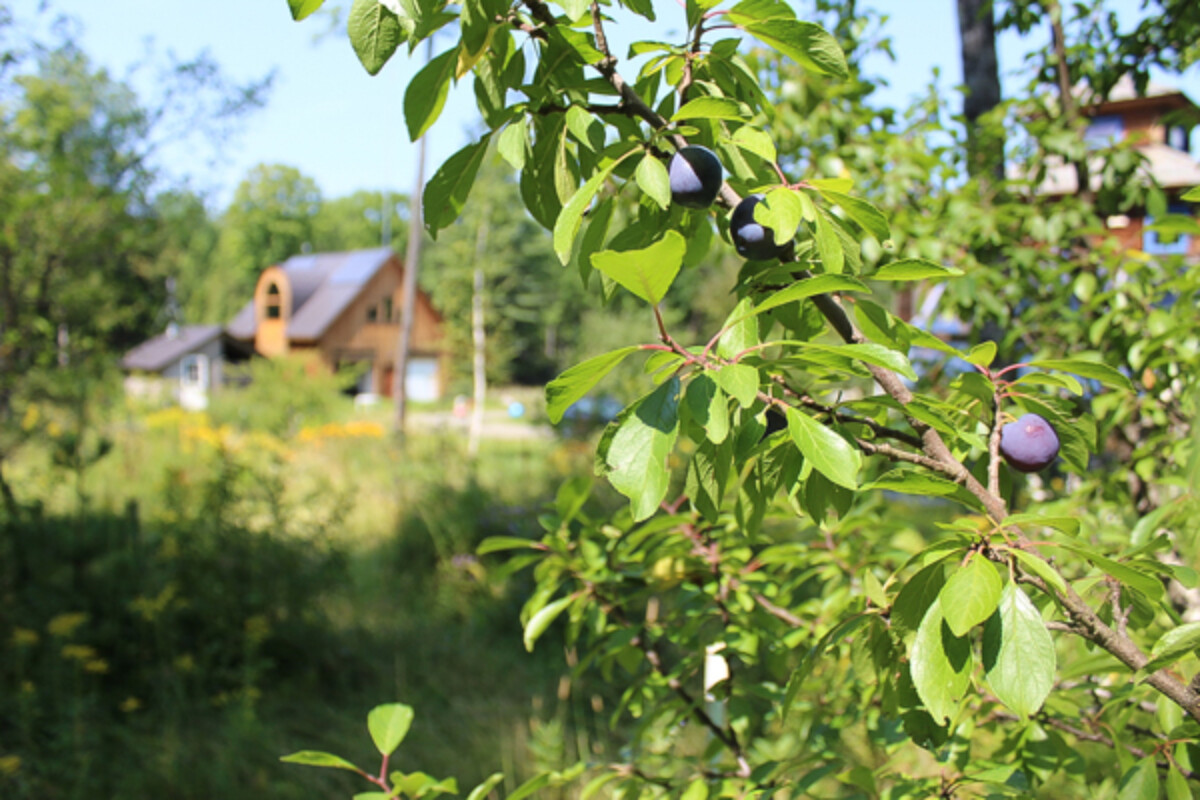
We grow bucket loads of plums every year here on our Vermont homestead, in every color, flavor, shape, and variety. The trees grow fast and start bearing in just a few years, thriving in our moist, shady woodland soils. Last count, we had around 30 trees, and it’s rare we see a year when we’re not buried in plums.
Rare, I say, but it does happen. Combine late frosts with a spring drought and a bumper crop of squirrels, and you’ve got a recipe for a plum-free summer. Some years, we get just a handful, and all of those go straight to fresh eating within seconds of picking.
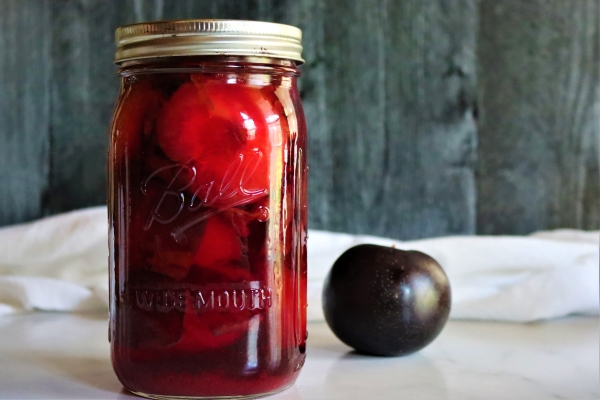
Crop failure or not, there’s no way I’m going a whole year without homemade plum jam. The recipe works with whatever you can get your hands on, including the gigantic, juice-filled California plums on the supermarket shelf. If you’re swimming in fruit, plums are just as good canned whole in light syrup or turned into smooth plum jelly.
If you’ve made my old-fashioned strawberry jam or raspberry jam, this works the same way. Cook the fruit with sugar until it gels, then can it or stash it in the fridge. No pectin packet, no fuss.
Notes from My Kitchen

The first time I made this jam, it was out of a kind of stubbornness. The squirrels had cleaned out our trees that year, so I broke down and bought a couple of bags of supermarket plums just to test my recipe on them. I figured those watery grocery store plums would never gel without help. They did, beautifully, and that batch made me trust this method for good.
These days I make a few different batches each plum season, because the variety changes everything. Our tart damsons cook down into something dark and almost winey, while the golden greengages off the back trees taste closer to apricot. Same two ingredients, completely different jam. I keep a row of each on the pantry shelf and pull whichever one fits my mood that morning.
Ingredients for Plum Jam
This is a two-ingredient recipe, which is part of why I love it. Everything comes down to the fruit, so the better your plums taste fresh, the better your jam will taste in January.
- Plums (pitted, skins left on): Taste your plums first. If you like the fruit fresh, you’ll like the jam. Sweet purple plums make a classic jam, tart damsons cook into something rich and complex, and golden greengages turn out light and apricot-like. The skins matter, since that’s where most of the natural pectin lives.
- Granulated sugar: Sugar does two jobs here. It sweetens, and it helps the jam gel and keep. I use a 2:1 ratio of fruit to sugar by weight, which is less than most recipes call for, so the plum flavor stays front and center. You can nudge it up for very tart fruit or down for very sweet fruit.
- Lemon juice (optional): I skip it with plum jam because plums are already well balanced and don’t need the extra acidity to shine. A splash brightens the flavor if you like, but it isn’t required for the jam to set or to can safely.
Plum variety is the single biggest thing that shapes your finished jam. If you’re working with wild fruit, my notes on foraging wild plums will help you tell the good ones from the merely edible. And if you end up with more than you can jam, plums also make a lovely plum wine and mead, with greengage plum wine and damson wine both worth a batch if you grow those varieties. But, of course, greengage jam and damson jam are darn good too!
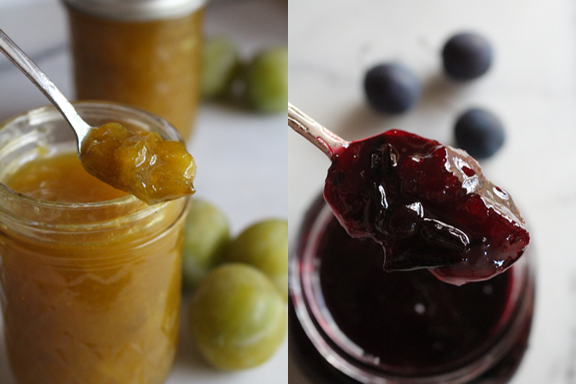
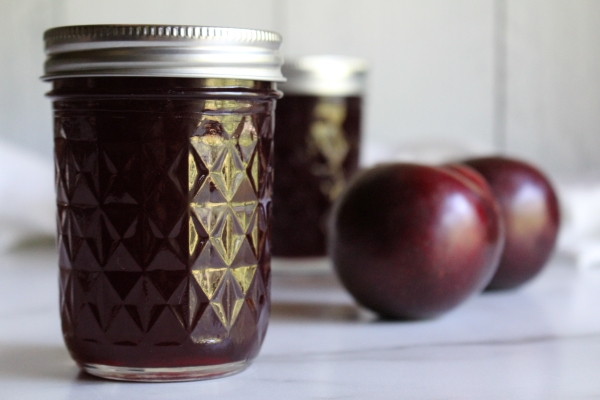
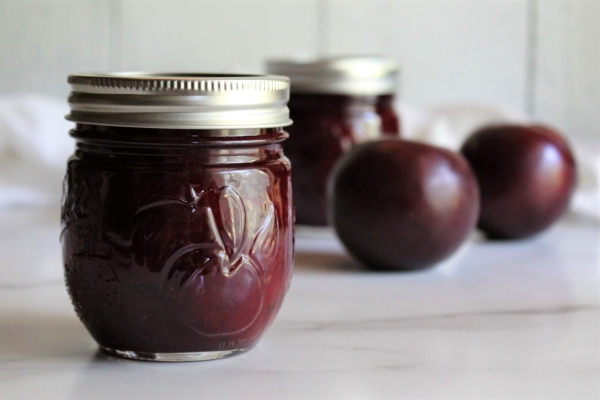
The finished color and flavor of your jam will depend on the plums you start with. Greengage plum jam (left) has a light flavor that’s a lot like apricot, while damson plum jam (right) is much more intense, almost like a red wine.
I made this and canned two and a half pints from two grocery store bags of plums. It is so easy! And delicious.
How to Make Plum Jam
Plum jam comes together in two stages: prep the fruit, then cook it down with sugar until it gels. The whole thing takes well under an hour of active time.
Preparing the Plums
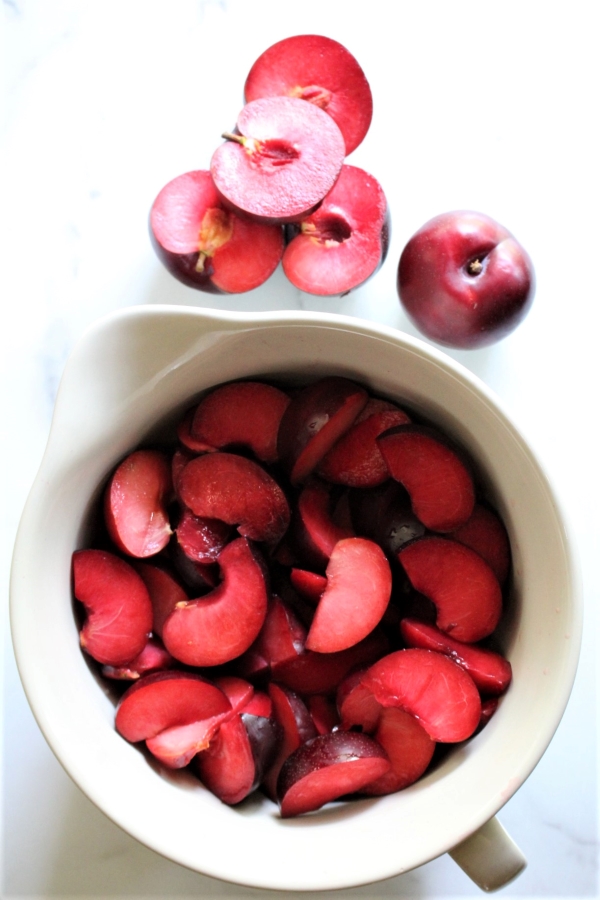
Pit the plums, but leave the skins on. The skins add a lot of color and a surprising amount of the flavor, and they’re loaded with the natural pectin that helps the jam set. All I do is pit and slice the plums before I start.
If you’d rather not see skins in the finished jam, you have a few options. Dice the plums small, down to 1/2 inch or so, and the skin pieces all but disappear. Puree the pitted plums first and they’ll blend right in, closer to a plum butter in texture. Or skip them entirely and make plum jelly instead, where the solids strain out and you’re left with a smooth, clear spread. For my taste, I like the skins and leave them just as they are.
Cooking the Jam
Place the plums and sugar in a deep, heavy-bottomed jam pot, with the fruit coming up no more than halfway. The jam foams up as it cooks, and a too-full pot will boil over. The plums release their juice quickly once they hit the sugar, so there’s no need to add water to get things going.
Bring it to a hard boil over high heat, which takes about 8 to 10 minutes. Once it’s boiling hard, turn the heat down to medium or medium-high to keep it from scorching, and stir often. After roughly 20 minutes at a boil, or 30 minutes of total cook time, the jam reaches gel stage. Start checking around 15 minutes, and know it can take as long as 40 to 45 minutes depending on your fruit.
At first it’ll look like plum soup, with chunks of fruit floating in a sea of juice. As it nears gel stage, the bubbles change from a frothy foam to glossy bubbles, and the jam visibly thickens. Once it’s there, ladle the finished jam into prepared jars.
Testing for Gel Stage
Since this jam sets without added pectin, you’re cooking it to a temperature rather than following a timer. There are two easy ways to know it’s ready.
- Thermometer test: Jam gels at 220 degrees F at sea level. That number drops about 1 degree for every 500 feet of elevation, so at 1,000 feet my jam finishes at 218 degrees F.
- Frozen plate test: Spoon a little jam onto a plate chilled in the freezer. The cold flash-sets it so you can see whether it’s gelled and how thick it’ll be once cooled.
- Keep the skins in: The skins carry most of the natural pectin. If you strain or peel the fruit, the jam will be much slower to set, which is the most common reason a no-pectin batch stays runny.
Canning Plum Jam
You don’t have to can this jam at all. Make it, let it cool, and store it in the refrigerator for a few weeks or the freezer for up to 6 months. I’m a fan of water bath canning because it saves freezer space and makes the jam shelf stable for year-round eating. If you’re brand new to it, start with my water bath canning for beginners walkthrough.
To can it, prepare a water bath canner before you begin. Once the jam reaches gel stage, ladle it into clean jars leaving 1/4 inch headspace. Wipe the rims, remove air bubbles, and recheck the headspace. Cap with two-part lids and process for 10 minutes for pints and half-pints. When the time is up, turn off the heat and let the jars rest in the canner for 5 minutes before lifting them out to cool. Check the seals after 24 hours.
Altitude Adjustments
Adjust your processing time for elevation:
- 0 to 6,000 feet: 10 minutes
- Above 6,000 feet: 15 minutes
Yield Notes
This is a single small batch, sized to gel reliably without pectin.
- Fruit: About 3 1/2 pounds of whole plums, or 3 pounds pitted, which is roughly 9 cups chopped.
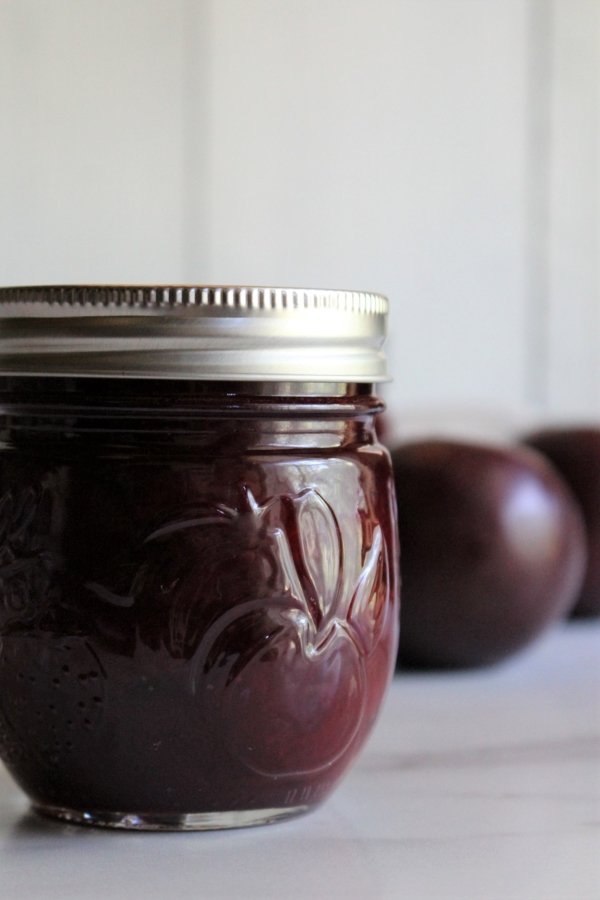
- Yield: About 4 half-pint (8 oz) jars.
- Don’t double it: A larger batch takes much longer to reach gel stage and often won’t set. If you want more, cook two single batches back to back instead.
Storage Options
However you make it, here’s how long plum jam keeps:
- Refrigerator: 3 to 4 weeks in a covered jar.
- Freezer: Up to 6 months.
- Canned: 12 to 18 months at room temperature in a sealed jar. Once opened, refrigerate and use within a few weeks.
Recipe Tips and Variations
- Vanilla plum jam: Stir the scraped seeds of a vanilla pod, or a few teaspoons of vanilla extract, into the jam once it’s reached gel stage. Don’t cook it in from the start or the flavor cooks off.
- Honey plum jam: Swap some or all of the sugar for honey for a richer, more floral jam. The set may be a touch softer, so cook to gel stage before jarring.
- Spiced plum jam: Drop 1 or 2 cinnamon sticks into the pot at the start and fish them out as the jam finishes. Cardamom, ginger, and a splash of dark rum all pair beautifully with plums too.
- Use the ripest fruit: Fully ripe plums have the fullest flavor and the most natural pectin, both of which help the jam gel.
- Going lower sugar: You can cut the sugar in half for a tarter, lower-sugar jam, though the yield drops and the cook time runs longer. To go lower than that, switch to a low-sugar pectin and substitute plums in place of peaches in my low-sugar peach jam recipe.
Ways to Use Plum Jam
Plum jam does all the usual jam jobs and a few special ones. It’s wonderful on toast, biscuits, and scones, swirled into oatmeal or yogurt, or spooned over pancakes. The deeper, winier batches made from damsons are especially good on a cheese board or melted into a pan sauce for pork.
When the pantry fills up faster than we can eat toast, I start baking with it. A jar of plum jam fills thumbprint cookies, glazes a tart, or stirs into a quick vinaigrette. If you need more ideas, I rounded up 100+ ways to use up a jar of jam to keep those shelves moving.
Plum Jam FAQs
You’ll need about 3 1/2 pounds of whole plums, which works out to roughly 3 pounds pitted, or 9 cups chopped. That makes about 4 half-pint jars of finished jam. Plan on a little more fruit if your plums have large pits.
No. Plum skins are naturally high in pectin, so a full-sugar batch with the skins left in will gel on its own once it reaches 220 degrees F. There’s no need for boxed pectin as long as you keep the skins and use enough sugar.
Yes, frozen plums work for jam. Freezing breaks down some of the natural pectin, so leave the skins on to make up for it, since the skins carry most of the pectin. I wouldn’t use frozen plums for jelly, where the solids get strained out.
The two most common reasons are too little sugar and removing the skins, since both the sugar and the pectin-rich skins are what make plum jam gel. It also won’t set if it never reached gel stage at 220 degrees F. If your jam turns out runny, you can pour it back into the pot and cook it longer to thicken it up. If you need more help, take a look at my guide to troubleshooting a jam that didn’t set.
Yes, you can swap some or all of the sugar for honey. It gives the jam a richer, more floral flavor. The set may be a touch softer than an all-sugar batch, so cook it until it passes the gel test before jarring.
Ways to Preserve Plums
If you tried this Plum Jam recipe, or any other recipe on Practical Self Reliance, leave a ⭐ star rating and let me know what you think in the 📝 comments below!
And make sure you stay in touch with me by following on social media!
Plum Jam (Without Pectin)
Equipment
- Canning Jars, Lids, and Rings
Ingredients
- 9 cups plums, chopped but not peeled
- 3 cups sugar
Instructions
- Place the plums and sugar in a heavy-bottomed jam pot, ensuring that they fill it no more than halfway (the jam will foam up during cooking).
- Turn the heat to high and bring the mixture to a boil, stirring frequently to avoid scorching (8-10 minutes).
- Once the plum/sugar mixture is boiling hard, turn the heat down a bit to medium or medium-high to prevent scorching or overflows. Continue to stir frequently, and cook until the jam reaches gel stage. (That’s 220 degrees when tested with an instant-read thermometer). It should take roughly 20 minutes at a boil, or 30 minutes total cook time, but can vary based on the fruit used.
- Once it reaches gel stage, ladle the mixture into prepared jars. Store in the refrigerator for immediate use, or freezer for up to 6 months. Or water bath can for long term storage.
Optional Canning Instructions:
- If canning, ladle the finished plum jam into canning jars, leaving 1/4 inch headspace. Cap with 2 part canning lids and process in a water bath canner for 10 minutes (pints & half pints). Adjust canning time to 15 minutes if above 6000 ft.
- Properly canned jam in sealed jars should last for 12-18 months at room temperature in the pantry without losing quality. Once opened, store in the refrigerator and use within a few weeks.
Notes
Nutrition
Nutrition information is automatically calculated, so should only be used as an approximation.
Jam Recipes
Find the perfect recipe
Searching for something else? Enter keywords to find the perfect recipe!










This is a fantastic recipe! I made 2 batches today, (back to back) and it all turned out quite well. I was hesitant to not use pectin, but it worked! I highly recommend. Thanks, Ashley!
I’m so glad you like it!
We have a diabetic in the family. I use sugar substitutes instead of regular sugar. Will this make a difference
You really need to use pectin if you aren’t using sugar in order to get the proper gel. You can use a product like Pomona’s Pectin with sugar substitutes. Just be sure that it is one that measures like sugar.
Would I be able to substitute the sugar for honey instead?
Yes, that’s fine. Enjoy!
Could I use honey instead of sugar for this recipe? Thanks!
Yes, that’s fine.
I followed this recipe but sadly my jam is more like a sauce. I had 9 cups of plums and 1 cup of sugar. Cooked until the glossy bit with no foam and then did the plate test. It seemed fine on the plate but I guess it froze because after 35 minutes of cooking and it thickening, this morning, it is just a jar of sauce. Can I pour it all back in the pan and cook more? How can I fix this?
It looks like you didn’t add the full amount of sugar which is very important to the gelling process. If you want to reduce the amount of sugar in the recipe you would want to add a low sugar pectin like Pomona’s Pectin.
Delicious! I added some dark rum and cardamom, so good! Thanks 🙂
You’re very welcome. So glad you enjoyed the recipe.
I made this and ended up with an extra pint. I cooked for 35minutes. Since I only had one cup of sugar, I used honey for the rest. Will that change the ability to gel or it’s shelf life? How long does it take for the jam to solidify after it is canned?
Tastes yummy! I hope it gets thicker as it sits on the shelf.
It could affect the ability to gel but it shouldn’t affect the safety or shelf life. It depends on the jam. You could pop it in the fridge. Sometimes that helps it to gel.
I had trouble getting the jam to gel. Admittedly I removed the skins, but you suggest above that should be fine too? But I did add lemon to one batch (cinnamon to another). At any rate, I started with more of a Greengage plum nectar and processed that at a simmer with the sugar for over an hour without it gelling very well on a frozen plate. So I added pectin in retroactively a half tablespoon at a time. Unfortunately I started getting gelatinous glops in my jam either from overcooking or pectin that would not mix, but the main mixture was not fully gelling for a while. The lemon mixture started to gel slightly first. I did see a glossy change in the texture even before fully gelling and eventually I got a decent gel with the lemon batch and a very light gel with the cinnamon batch, but I figured it would do and was tired of cooking! Any thoughts on what I did wrong!?
Removing the skins makes a big difference in the ability for it to gel since there is a large amount of pectin in the skin. Did you just put the pectin straight into the mixture? If so that’s probably what caused the clumping. You want to mix a quarter cup of sugar with 1 Tbsp of pectin before adding to the mixture.
How long do I process in the canner for quarts?
I’m not aware of a tested time for processing quart jars of jam. It’s probably because most people might not use the jam quickly enough after it has been opened before it goes bad.
Excellent recipe, so simple yet so good. I didn’t add lemon juice but I had some sparkling wine flavoring so I added that, perfect. And since I like it tart I only used 2 cups of sugar. Thank you, I will definitely make this again
You’re very welcome. We’re so glad you enjoyed the recipe.
Thank you so much for giving the amounts in volume and weight, especially the weight both whole and pitted for the plums! It makes it precise and so much easier to follow 🙂 Your site has not failed me, you’re always one of the best sources for good canning recipes.
Thank you! I’m so glad it’s helpful to you =)
I’ve been gifted buckets of prunes. Can I sub them for plums (I know prunes are plums but not all plums are prunes). I’ve also been gifted grapes. If I juice the grapes, can I sub grape juice for the sugar? What would be the ratio for grape juice to fruit?
“That results in a fruit to sugar ratio of 2:1 by weight or 3:1 ratio by volume.”
Thanks for your help. So excited to see a no pectin recipe!
The grape juice will most likely not have enough sugar in order to create a jam, especially without added pectin. The sugar is what causes the jam to gel. I have seen recipes for prune jam before, so you could probably do a quick internet search and find a recipe.
Hi Ashley,
I made this and canned two and a half pints from two grocery store bags of plums. It is so easy! And delicious.
Oleeta
That’s great! So glad you enjoyed the recipe.
What happens with the skins? Do they cook down and are they included in the final product?
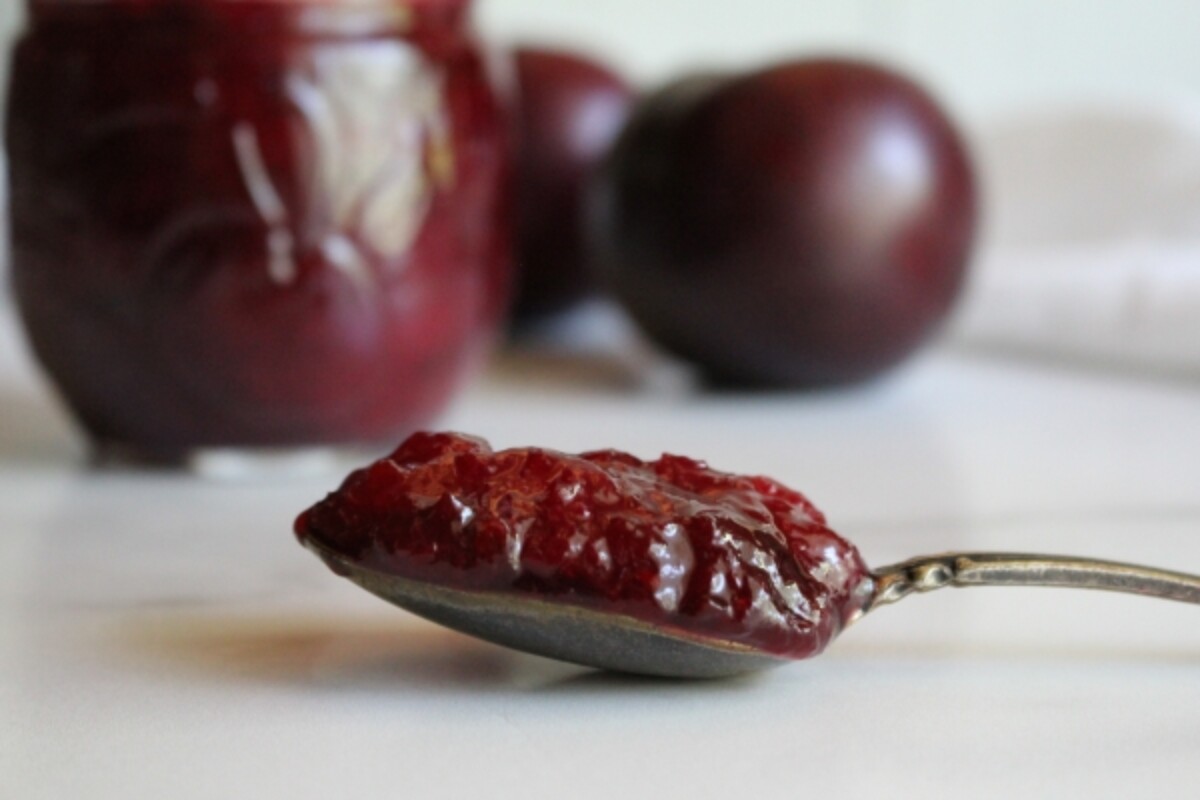
They break apart in the final product somewhat, but they’re still in there. In my picture of the damson jam in the article, you can see a skin sitting right there on the spoon. In that batch, I just pitted the plums with a cherry pitter and then made the jam from the whole plums, so the skins are more noticeable. They add good texture/body to the finished jam in my opinion, and they’re barely noticeable I find. That said, you can minimize them in the jam by dicing your plums pretty small to start. The smaller the skin pieces at the beginning, the more likely they are to completely disintegrate or not be noticed at all in the jam. Even just slicing the plums into 1/8 slices around the plum I find they pretty much fall apart and you can’t really find them in the finished jam.
Thank you! The jam looks so good. This was a good picture year for us, so I will make your jam:).
You’re welcome. So glad you enjoyed the recipe.
This was so easy to make. I did add the dark rum. I also make my own vanilla, so I had a jar with the vanilla beans to use. So very good. I had an extra jelly jar of jam only half full that I used the Ball screw on lid to ‘test’ the morning after. Delicious.
My plums are very hard to get the pit out.
I’ve found that if I leave them in until they’re
Cooked down the seeds are easy to remove.
Is this an ok practice or will the pits alter the flavor.
Have you tasted the plums after cooking them down to see what they taste like? If the plums taste ok then your jam should be fine.
My mother always cooks seeds in especially small varieties. Strains out most, but leaves a few in.
I have bags of frozen, pitted plums from last summer. Will those work just as well?
Probably…but it might not set quite as well. Freezing reduces the pectin in fruits. For jam, they’re probably still ok so long as you leave the skins in (since they’re the highest in pectin), but I wouldn’t try making jelly where you strain out the solids. Good luck and let me know how it goes!