Affiliate disclosure: This post may contain affiliate links. Please see our Privacy Policy.
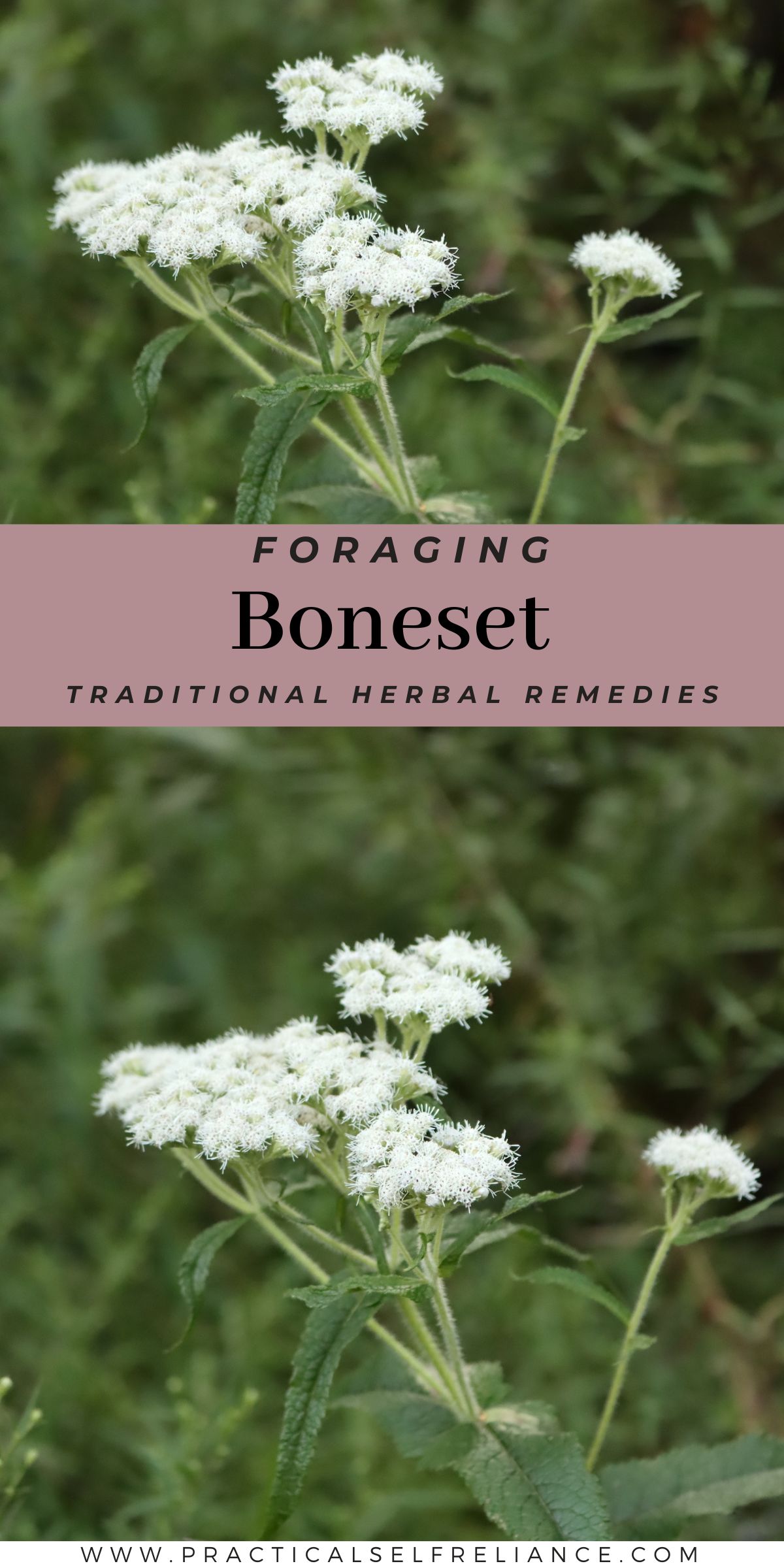
Boneset is a native wildflower of wet meadows and ditches, topped with fuzzy white flower clusters in late summer. It’s an old-time fever remedy, and despite the name, it isn’t an herb for broken bones. The leaves make it easy to identify, since each pair wraps right around the stem.
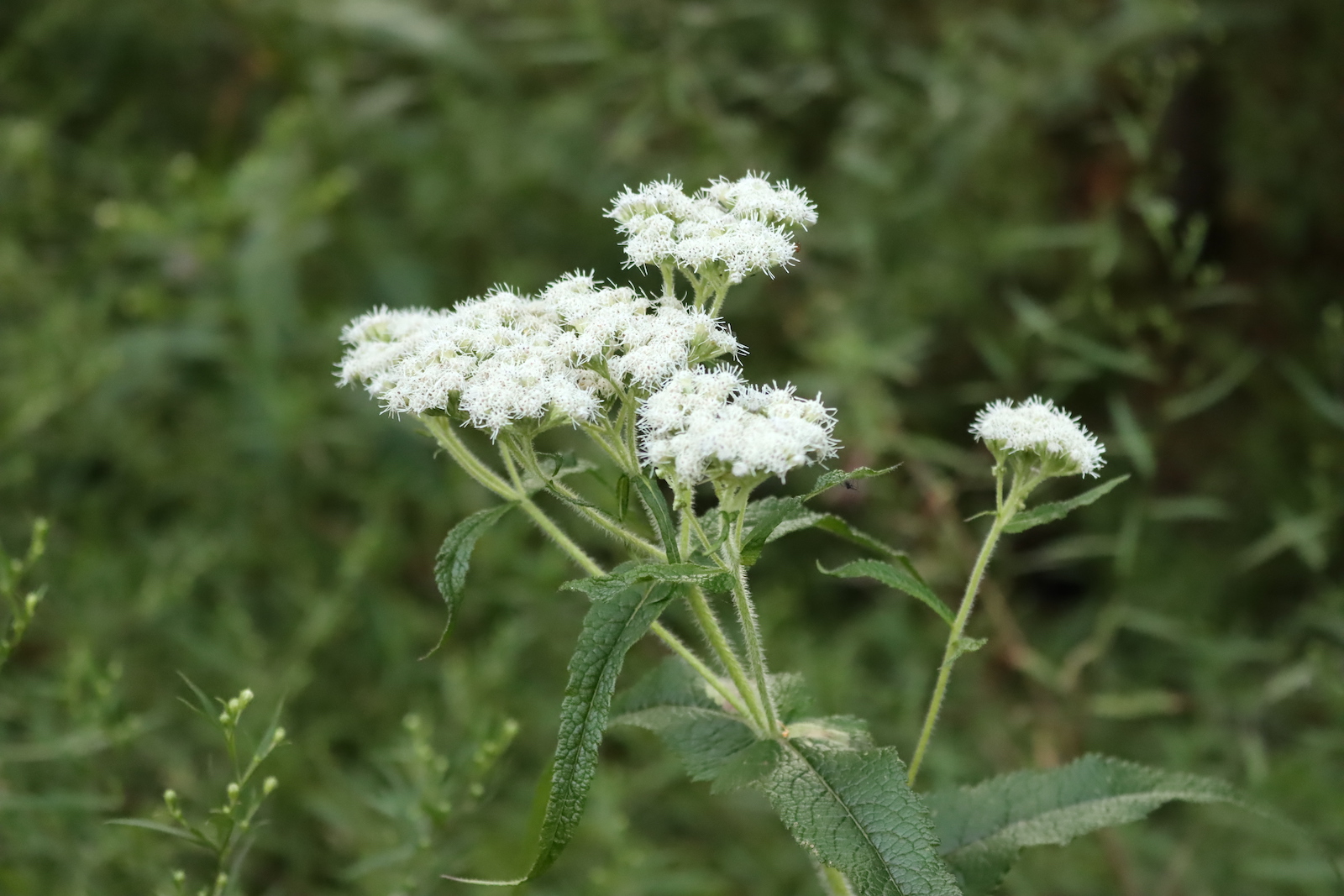
Boneset grows all over New England, here in Vermont included, anywhere the ground stays wet. By late summer, its white flower clusters stand out in marshes, along stream banks, and in roadside ditches.
It has a long history in American folk medicine. Native Americans used it for a long list of ailments, and settlers in the 1700s and 1800s considered it a cure-all, especially for fevers and the flu.
The name trips a lot of people up. It most likely comes from break-bone fever, an old name for a fever so painful it felt like your bones were breaking. The herb with the old reputation for broken bones is comfrey, which also went by boneset in some old herbals.
People don’t use boneset much these days, partly because of concerns about the liver. It’s still worth getting to know, though, since it feeds a lot of pollinators and has a few look-alikes worth learning to tell apart.
Notes from My Homestead

Last winter, my husband slipped on the ice and broke his foot. He came home from urgent care in a cast and on crutches, facing eight weeks off his feet, and he asked me to hit him with every herbal remedy I had.
A few well-meaning friends suggested boneset, and with a name like that, it sounds like exactly the right herb. It’s a fever remedy, though, so I stuck with comfrey salve, St. John’s wort oil, and a lot of home-canned bone broth instead. Boneset stayed out in the meadow where it belongs.
What Is Boneset?
Boneset (Eupatorium perfoliatum) is a native perennial in the aster family (Asteraceae), along with goldenrod and sunflowers. It’s a wetland plant of eastern North America.
The species name perfoliatum refers to the leaves, since the stem seems to grow right through them. The genus name honors Mithridates Eupator, an ancient king of Pontus known for his knowledge of medicinal plants.
Old herbals and medical books give it plenty of other names, including thoroughwort, agueweed, feverwort, and Indian sage. Ague was an old word for a fever with chills, so two of those names tell you exactly what people used it for.
Identifying Boneset
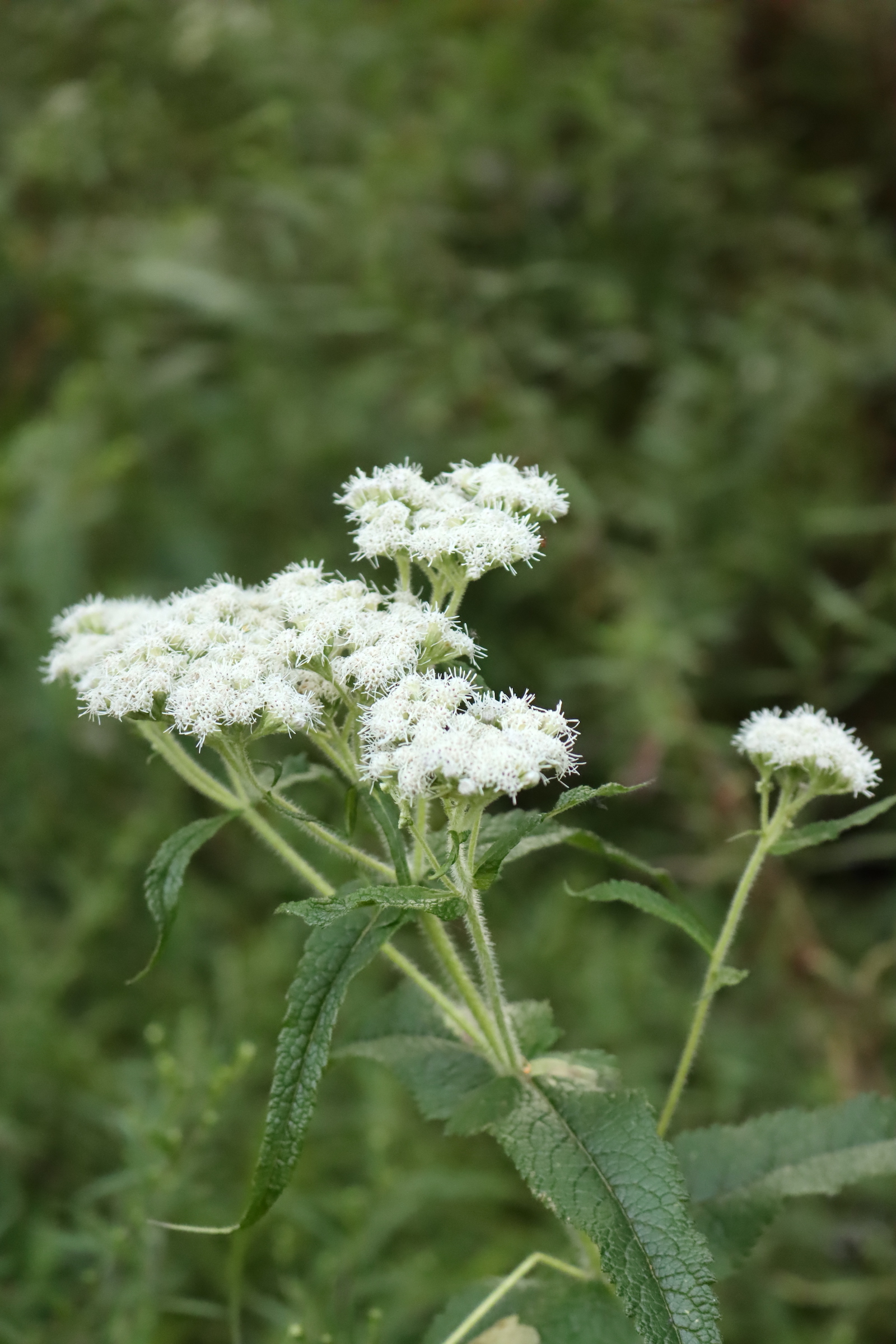
Boneset is easy to identify once you look at the leaves. Each pair joins at the base and wraps all the way around the stem, so the stem looks like it’s poking straight through one long leaf.
That one feature rules out nearly every look-alike. Still, check the stem, the flowers, and the habitat too before you trust a match. Herbal Academy’s Botany and Wildcrafting Course helped me build my own identification skills, and it’s a good place to start if this is new to you.
Leaves
Boneset leaves are long and narrow, with a tapering point and fine teeth along the edges. They grow in opposite pairs, now and then in threes, usually 2 to 6 inches long, and the biggest can reach about 8 inches.
The surface looks wrinkled and deeply veined, and the undersides are fuzzy and dotted with tiny glands. The fused base, where each pair wraps around the stem, is the first thing to look for.
Stems
Boneset grows 2 to 5 feet tall on a stout stem covered in long white hairs. The stem stays mostly unbranched until it nears the top, where it splits into the flower clusters.
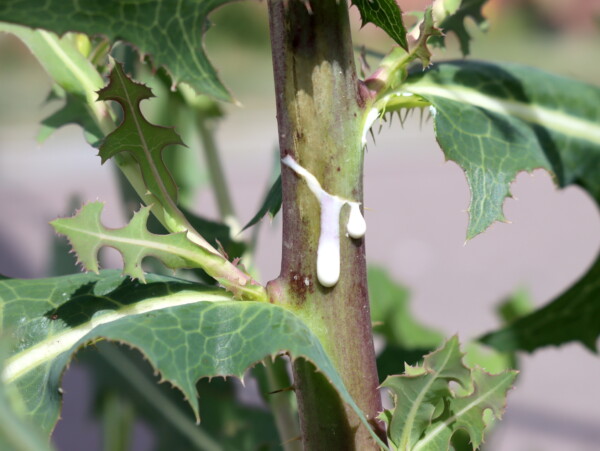
The sap is clear and watery, not milky. Boneset spreads by underground rhizomes, so you’ll often find it in small colonies rather than as a single plant.
Flowers
Each fuzzy white head is a bundle of tiny tube-shaped flowers, with no petals around the edge. The heads gather into flat-topped clusters, 2 to 8 inches across, at the top of the plant.
The flowers are fragrant, and they bloom from July into September, sometimes later. For more white wildflowers to compare, my guide to weeds with white flowers has more than 40 of them.
Seeds
After the flowers fade, each head turns into a cluster of tiny, dark, ribbed seeds, each about 1/16 inch long.
Every seed has a tuft of fine white bristles on top, so the wind can carry it off in the fall.
Boneset Look-Alikes
Plenty of wildflowers have white, flat-topped flower clusters, so boneset can be hard to pick out from across a meadow. Up close, the leaves sort them out, since none of the common look-alikes have leaves fused around the stem.
White snakeroot is the one to take seriously. Water hemlock makes the list because it’s deadly and grows in the same wet ground, not because it’s a close match.
White Snakeroot
White snakeroot (Ageratina altissima) has fuzzy white flower clusters a lot like boneset’s. It’s also highly toxic, and it’s the plant behind milk sickness. People got sick from drinking milk from cows that had grazed on it.
Its leaves grow in pairs, but each one sits on a stalk up to about 3 inches long, and the leaf itself is much broader than a boneset leaf, with no fused base. It’s mostly a woodland plant, though it can turn up along wooded stream banks, so check the leaves rather than relying on habitat. Older books call it Eupatorium rugosum.
Joe Pye Weed
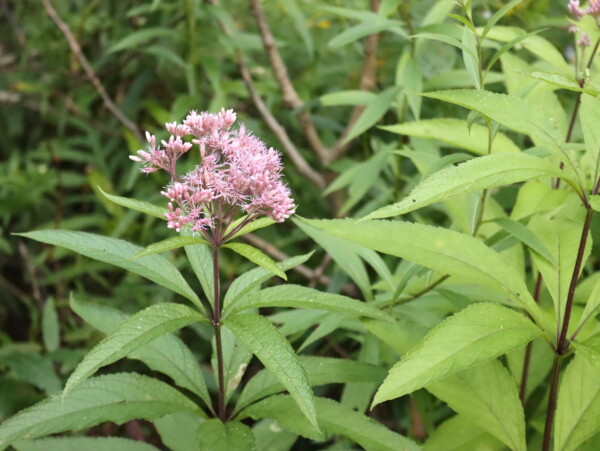
Joe Pye weed (Eutrochium spp.) is boneset’s close cousin, and the two often grow side by side in wet meadows. It even belonged to the same genus until botanists moved it into Eutrochium in 2004.
Joe Pye weed flowers are dusty pink to purple instead of white. Its leaves grow in whorls of three to seven around the stem. Boneset leaves come in pairs, or now and then in threes, and their bases always join around the stem.
Water Hemlock
Spotted water hemlock (Cicuta maculata) doesn’t look much like boneset up close. I include it because it grows in the same wet meadows and ditches, it has white flowers, and it’s highly toxic and can be fatal if eaten.
Its tiny white flowers grow in umbrella-shaped clusters, and its leaves split into many leaflets. The hollow stems often carry purple streaks or blotches. My guide to Queen Anne’s lace and its look-alikes covers water hemlock in more detail.
Yarrow
Yarrow (Achillea millefolium) has flat-topped clusters of small white flowers, and from a distance it can pass for a short boneset. It’s another old fever herb, too.
The leaves tell them apart right away. Yarrow leaves are soft and feathery, cut into many fine segments, while boneset leaves are long, toothed, and fused around the stem. Look closely at a yarrow flower head, and you’ll see a ring of tiny petals around the edge, which boneset doesn’t have.
Other Bonesets
A few close relatives also go by boneset or thoroughwort, including tall boneset (Eupatorium altissimum), upland boneset (Eupatorium sessilifolium), and late boneset (Eupatorium serotinum). Some of them have stalkless leaves, but only true boneset has its leaves fully fused around the stem.
Boneset may also cross with its relatives. A 2018 study of boneset samples suggested some were hybrids with related species, or mixed with them, which is one more reason to check every feature.
Where to Find Boneset
Boneset likes wet ground and plenty of sun. Look for it in marshes and swamps, along the shores of rivers and lakes, at the edges of wetlands, and in roadside ditches.
It handles some shade and short floods. It shares that wet ground with plants like blue vervain and jewelweed.
Go Botany records it in every New England state, and its range covers most of eastern North America, north into Quebec and Nova Scotia and west to Texas and the Dakotas.
When to Find Boneset
Boneset blooms from July through September, and sometimes into October. That’s the easiest time to find it, when the white clusters stand up above the meadow grasses.
The seeds ripen from September into November. It’s a good one to look for on a summer foraging walk, and it’s still around for the start of fall foraging season.
Why Is It Called Boneset?
The most common explanation for the name is break-bone fever, not broken bones. A Kansas State University Extension guide traces the name to its historical use for break-bone, or dengue, fever.
Break-bone fever was the common name for an epidemic that swept Philadelphia in 1780. Benjamin Rush, a Philadelphia doctor, wrote that the pains in the head, back, and limbs were so severe that most people called it the break-bone fever. Medical authorities later decided it was dengue, though a 2016 history of the outbreak points out that’s hard to prove.
Fevers like that came with a deep, aching misery. The Eclectic Materia Medica, a 1922 medical text, lists deep-seated aching, the so-called “bone pains,” among the signs that called for boneset. So the name most likely points to fever aches, not fractures.
Some sources tell a different story. The Virginia Native Plant Society says early herb doctors wrapped the fused leaves into the bandages around splints, following the old idea that a plant’s shape shows what it’s good for. Either way, there’s no evidence that boneset helps a broken bone heal.
To make things more confusing, comfrey went by boneset too. The old reference book A Modern Herbal lists boneset and knitbone among comfrey’s old names, and it calls comfrey a famous medieval remedy for broken bones. When people talk about an herb for broken bones, comfrey is usually the one they mean.
Is Boneset Edible?
No. Boneset isn’t a food plant. It’s bitter, and North Carolina State University Extension lists it as mildly toxic, causing vomiting and a laxative effect in large doses.
It also contains pyrrolizidine alkaloids, a group of compounds that can damage the liver. They’re the same group of compounds that keep comfrey to external use only. A 2018 study found them in all 49 boneset samples it tested, and the tinctures and hot water teas had high concentrations.
Some people also get a skin rash from handling it. If you’re foraging for something to eat, my list of wild edible plants is a better place to start.
Boneset Medicinal Uses
Boneset’s long history as a medicine centers on fevers. People drank it as a hot tea to bring on a sweat, and in larger amounts, it made them vomit. People took a cold infusion as a bitter tonic.
It was a flu remedy, too. The Eclectic Materia Medica says Eclectic doctors used it in every influenza epidemic, including the 1918 pandemic.
Modern research is mostly lab work. A 2011 review pulled together lab and animal studies showing anti-inflammatory effects, plus activity against the malaria parasite. The same review said the human data showed some promise for colds but didn’t meet modern standards.
A 2016 lab study found that a boneset extract kept flu viruses from attaching to cells in a dish. That’s interesting, but it’s a long way from a proven remedy.
The pyrrolizidine alkaloids are the real problem. The authors of the 2018 study called for caution until researchers can better define their toxicity, and the Kansas State guide notes that liver warnings may limit the plant’s use.
Between the alkaloids and the lack of human research, boneset isn’t an herb for long-term use, and it isn’t one for broken bones. Its history as a fever remedy is interesting, but modern research hasn’t shown it to be safe or effective.
Come cold and flu season, I make elderberry syrup and ginger oxymel instead. My list of natural remedies for cold and flu has plenty more ideas, and so does my bigger list of medicinal plants and their uses.
Ways to Use Boneset
These days, boneset is mostly a plant for wet gardens and pollinators. It suits rain gardens and low spots that stay damp, and deer and rabbits tend to leave it alone.
Bees, wasps, and butterflies visit the flowers, and swamp sparrows eat the seeds. Several moth caterpillars feed on the leaves, too. It’s a natural fit for a bed of pollinator-friendly medicinal herbs.
You can grow it from boneset seeds. They sprout better after about 30 days of cold stratification, and they need light to germinate, so press them onto the soil surface rather than burying them.
A Note from Your Family Herbalist
I’m a family herbalist, trained by more than 20 years of hands-on work with medicinal plants and rounded out with coursework through the Herbal Academy of New England. That means I know my way around the plants in this post, and I’ve personally made and used the remedies I write about, often many times over. But there’s a real difference between knowing what works on my homestead and knowing what’s right for you.
Medicine is a personal affair. Every body is different, every medical history is different, and herbs interact with medications, pregnancy, nursing, and existing health conditions in ways no general blog post can anticipate. Even mild medicinal plants like chamomile cause allergic reactions in some people, so what sits comfortably on my own medicine shelf might not be the right choice for yours.
For guidance tailored to your situation, there are three directions I’d point you:
- See a local clinical herbalist. A practicing clinical herbalist can take your full health picture into account, recommend the right herb and dose for you, and adjust the protocol as you go. Ask around at your nearest food co-op, herb farm, or natural-foods store; most communities have at least one.
- Talk to your doctor before adding any new herb to your routine, especially if you take prescription medications, are pregnant or nursing, or are managing a chronic condition. A good doctor will welcome the conversation.
- Educate yourself, the way I have. The Herbal Academy of New England runs the courses I credit with sharpening my own practice. Their Introduction to Herbal Medicine course is where I’d start. I’ve also taken and recommend their Mushroom Course and their Botany and Wildcrafting Course. All three are well-paced and easy to follow at home.
Boneset FAQs
A few more questions about boneset, from broken bones to tea.
No. Boneset’s name most likely comes from break-bone fever, and people used it for fevers and flu, not fractures. A broken bone needs a doctor first. Comfrey is the herb with the old reputation for bone injuries, and when my husband broke his foot, I used comfrey salve on the intact skin around it for the soreness and swelling.
Hot boneset tea was a traditional fever remedy, but it isn’t a tea I’d recommend. A 2018 study found potentially liver-toxic pyrrolizidine alkaloids in every boneset sample it tested, with high concentrations in hot water teas, and there isn’t enough research to establish a safe amount to drink.
No, they’re two different plants. Comfrey went by boneset and knitbone in old herbals, and it’s the one with a history for broken bones. True boneset is a native wetland wildflower with white flowers and leaves fused around the stem, while comfrey has big, hairy leaves and drooping, bell-shaped flowers.
Yes, for the most part. North Carolina State University Extension lists it as resistant to deer and rabbits, and the U.S. Department of Agriculture notes that livestock find the leaves too bitter to graze.
More Foraging Guides
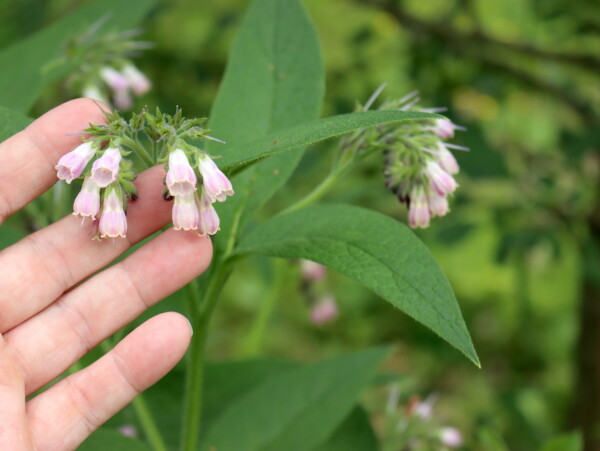
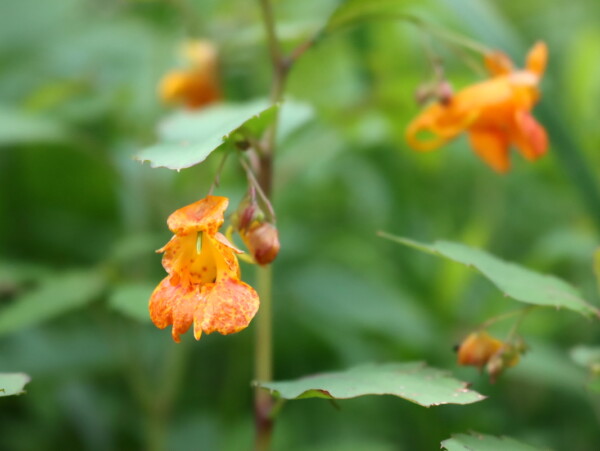
Three more medicinal plants to find in damp ground.

Did you find this boneset foraging guide helpful? Tell me in the 📝 comments below how you use boneset on your homestead!
And make sure you stay in touch with me by following on social media!
Herbal Remedies for Cold and Flu
More ways to stock the medicine cabinet for winter.


Find the perfect foraging guide
Searching for something else? Enter keywords to find the perfect foraging guide!