
Affiliate disclosure: This post may contain affiliate links. Please see our Privacy Policy.
Bugleweed (Ajuga reptans) is a mint-family wild edible that grows in dense purple-green carpets across lawns, forest edges, and forgotten garden corners. The young leaves and flowers add a lightly bitter bite to salads, and the plant has been used for centuries in European folk medicine as a topical wound healer.
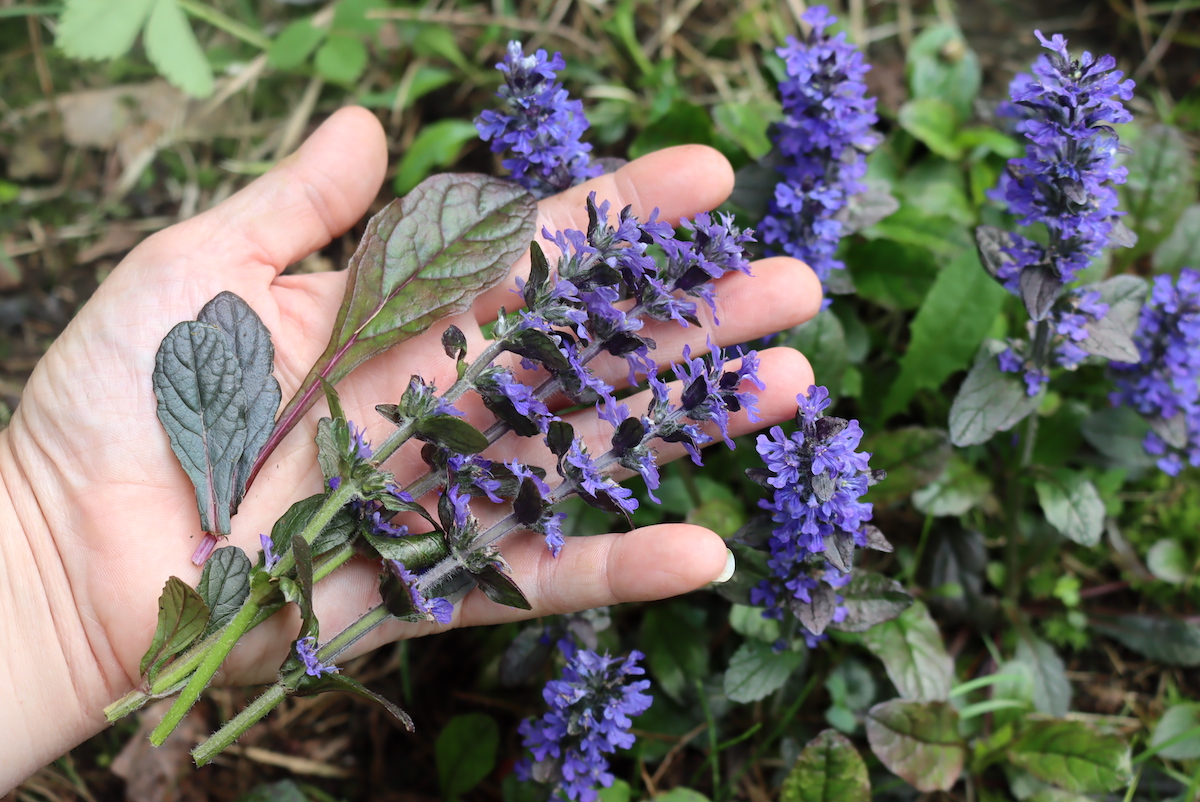
Table of Contents
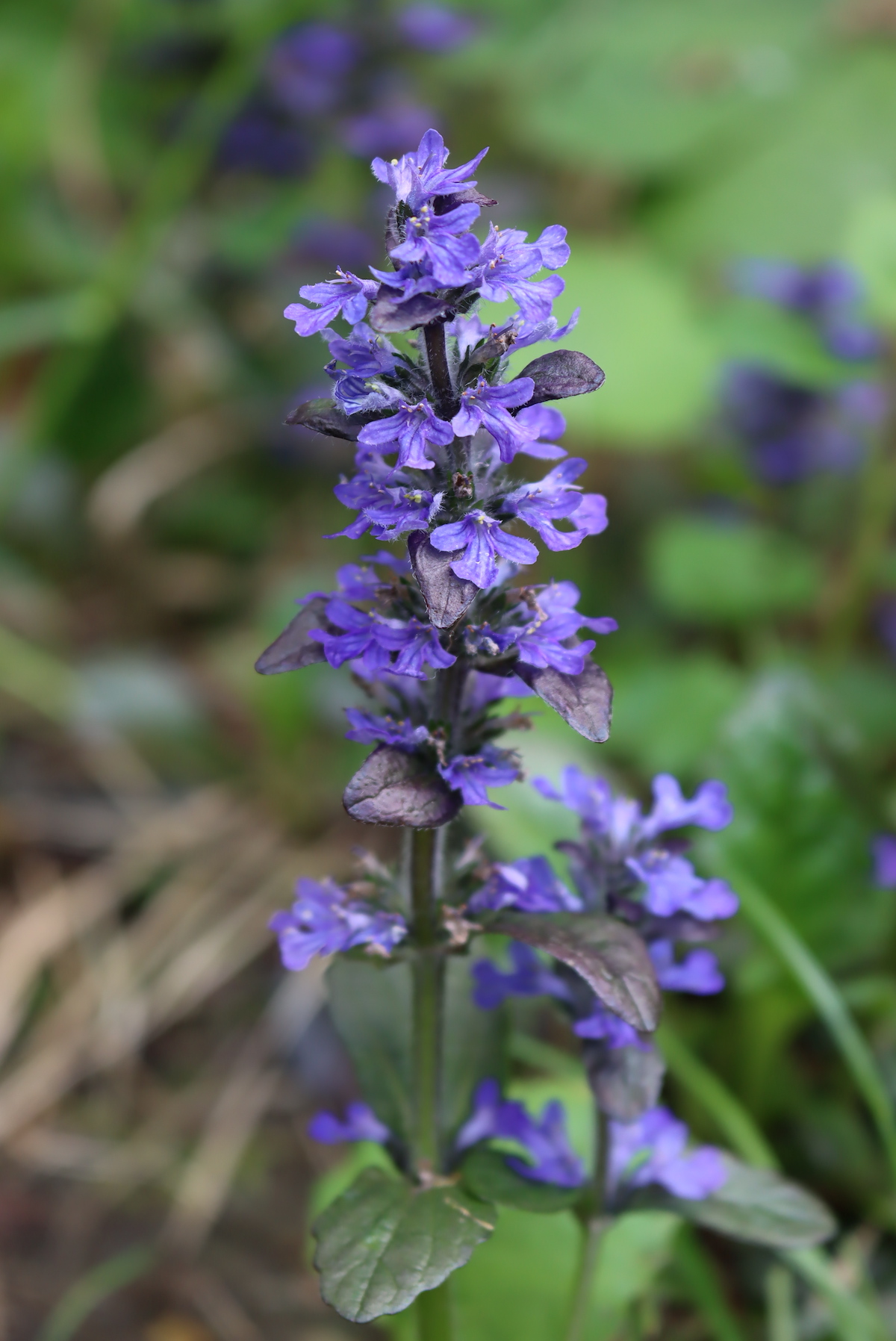
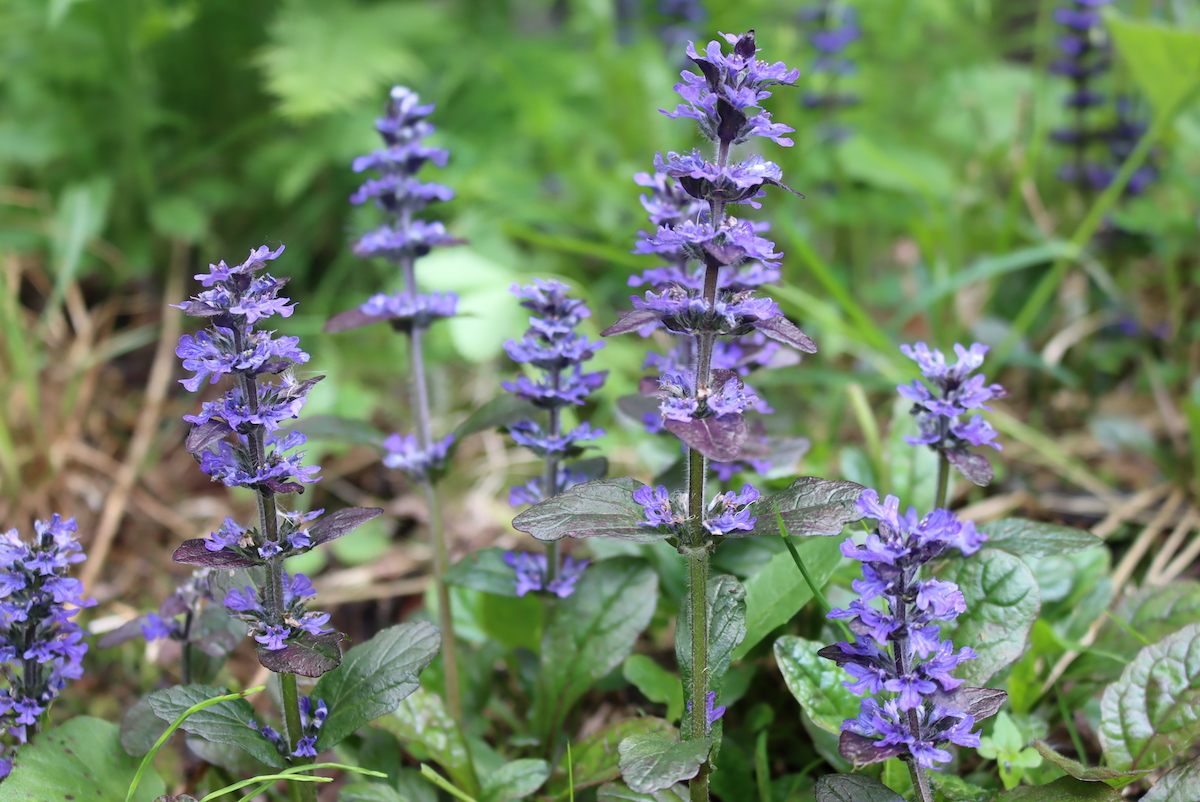
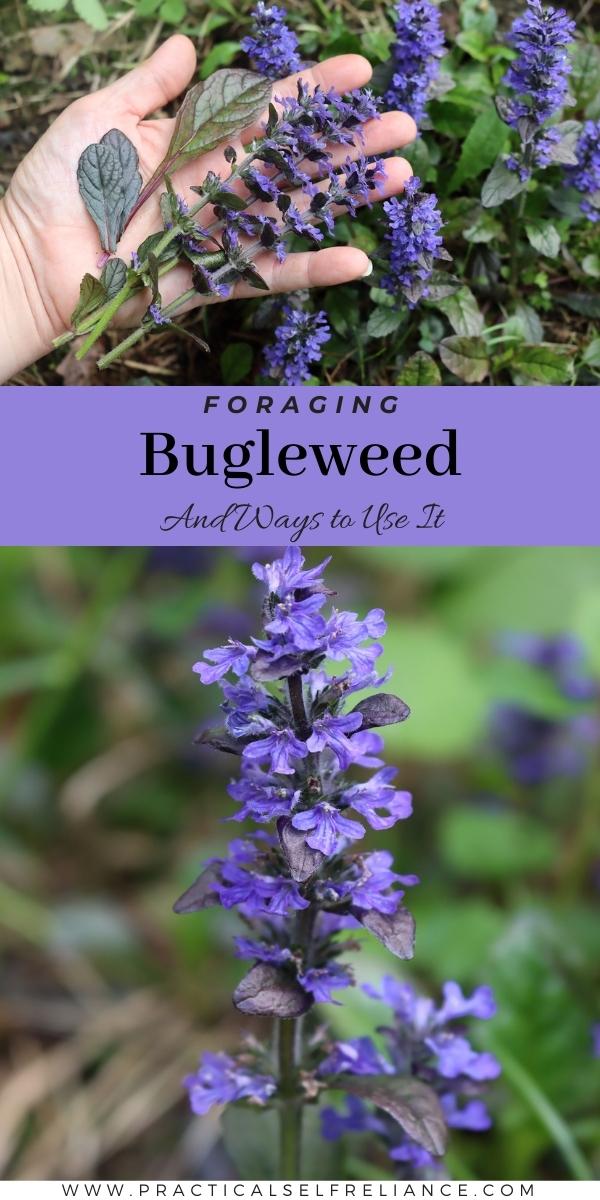
Bugleweed is one of the easier wild edibles to spot once you know what you’re looking for. The basal rosettes stay low and tight to the ground, their shiny leaves flushed with purple or bronze depending on the light. In May and June the plant sends up short flower spikes covered in whorls of tiny blue-violet blooms, and a healthy patch can blanket a whole slope or shady corner in color.
It’s also one of those plants with a muddled history in English herbal writing, because at least three unrelated plants share the common name “bugleweed.” This post is about Ajuga reptans, the European groundcover that has naturalized across much of North America. If you want the thyroid-regulating medicinal herb, that’s a different plant entirely, and I’ll sort that out below.
Notes from My Homestead

One spring I set myself a project to learn every wild edible lawn weed I could find. I scoured soccer fields, pastures, sidewalk edges, and old parks looking for new species, and in the end I found the most variety within fifty feet of my own back door. Bugleweed was one of the very first new plants to turn up. Those dark purple leaves stood out against the green so plainly that I spotted it on a walk to the compost pile before I knew its name.
Now I watch for it every year. The first flush of blue-violet flower spikes in May is a dependable little signal that spring has really settled in here in Vermont. The patch I know best has spread itself across a shady corner where nothing else wants to grow, and I leave it alone for the pollinators. A little goes a long way in a salad, and I’d rather let the bees have most of it.
What is Bugleweed?
Bugleweed (Ajuga reptans) is a low-growing herbaceous perennial in the mint family (Lamiaceae), native to Europe, northern Africa, and western Asia. It’s been widely planted as an ornamental groundcover and has naturalized across much of North America, where it’s considered invasive in some states.
The genus Ajuga includes around 300 species, but A. reptans is the one most people in North America mean when they say bugleweed. It goes by many common names, including bugle, blue bugle, common bugle, carpet bugle, carpet bugleweed, carpetweed, bugleherb, Carpenter’s herb, and, traditionally, St. Lawrence plant.
Other Plants Called “Bugleweed”
“Bugleweed” is one of the more frustrating common names in English-language herbal writing, because it’s been applied to several unrelated plants. This is not a look-alike problem (these plants don’t resemble each other in the field) but a naming problem, and it’s the single biggest source of bad information on the internet about what bugleweed actually does.
All of these other “bugleweeds” look completely different, so if you’re here based on the pictures and description, then we’re good. If you’re here on name, you might need to double check. Here’s the short version of who’s who.
- Ajuga reptans (European bugleweed, common bugle, carpet bugle). This is the plant in this post. It’s a low mint-family groundcover with shiny rosettes and blue-violet flower spikes. Traditional medicinal uses are external: wound healing, staunching bleeding, and easing bruises.
- Lycopus virginicus and Lycopus americanus (Virginia bugleweed, American bugleweed). These are completely different plants, also in the mint family, native to North America. They grow taller and lankier in wet places, with small white flowers. This is the plant herbalists mean when they talk about bugleweed for hyperthyroidism, Graves’ disease, or reducing prolactin. If an herbal book recommends bugleweed for thyroid issues, it almost certainly means Lycopus, not Ajuga.
- Lycopus europaeus (gypsywort). A European cousin of American bugleweed, with similar medicinal uses. Confusingly, “gypsywort” has also been applied to Ajuga in some older sources, which is part of how the medicinal confusion got started.
- Other Ajuga species. A. genevensis (blue bugle), A. chamaepitys (yellow bugle or ground pine), and Himalayan species like A. bracteosa and A. integrifolia all have their own traditional uses. They share chemistry with A. reptans but are not identical to it, and studies on one species don’t automatically transfer to another.
The practical takeaway: if you’re foraging Ajuga reptans (the carpet groundcover), you have a mild wild edible and an old European wound-healing herb. You do not have a thyroid medication. That distinction matters, because the claims tangle together all over the internet.
Is Bugleweed Edible?
Yes, Ajuga reptans is edible, with some caveats. Young shoots and leaves can be eaten raw or cooked, and the flowers are fine raw or brewed into tea along with the leaves. Older leaves get tough and bitter, so they’re better added sparingly to cooked dishes like soups, stir-fries, and casseroles than eaten fresh.
It’s never been a staple food, and for good reason. Even the young leaves are on the astringent side, and a whole salad of bugleweed would be unpleasant. Think of it as a wild green to use in small quantities for color and character, not a base green like chickweed or lambsquarters.
A few safety notes apply. Avoid harvesting from lawns or roadsides that may have been treated with herbicides, pesticides, or dog traffic. If you’re on medication, have a chronic condition, or are pregnant or nursing, talk to your healthcare provider before using bugleweed medicinally, even topically. And as with any new wild edible, start with a small taste to rule out individual sensitivity before eating a larger portion.
Bugleweed Medicinal Benefits
Ajuga reptans has a long history in European folk medicine, and modern research has begun to back up several of its traditional uses. It’s important to keep in mind that the well-documented benefits of Ajuga reptans are different from the well-documented benefits of Lycopus virginicus (American bugleweed). For the thyroid and hormonal uses, see the plants-called-bugleweed section above.
For Ajuga reptans specifically, traditional uses center on topical wound care. Nicholas Culpeper, the well-known 17th-century English herbalist, recommended it highly as an ointment or plaster for wounds, and the old common name Carpenter’s herb comes from a reputation for staunching the nicks and cuts that happen on a job site. A 2025 peer-reviewed pharmacological study of A. reptans herb extracts found that the plant reduced bleeding time by up to 40% and produced complete wound healing in experimental animals within nine days, which is pretty striking support for the traditional use.
The plant also shows anti-inflammatory and antioxidant activity. Research on Romanian Ajuga reptans has attributed these effects to a combination of iridoid glycosides (especially 8-O-acetylharpagide), phenylpropanoid glycosides like teupolioside and verbascoside, and flavonoids, with bugleweed extracts performing comparably to diclofenac on some inflammation markers. It’s also been used traditionally as a mild astringent for diarrhea and mouth sores, which fits with the high tannin content.
Antimicrobial activity is another documented effect. Extracts of A. reptans inhibit the growth of several Gram-positive bacteria, which is part of why the traditional wound-healing use makes biological sense. A Turkish study on three Ajuga species found antimicrobial activity across the genus, with notable effects against Staphylococcus aureus and several other common wound pathogens.
Across Europe and the Mediterranean, traditional herbalists have used A. reptans for a fairly consistent set of indications: wound healing and minor bleeding, bruises, mild inflammation, sore throats (as a gargle), and skin complaints.
In Romanian folk medicine it’s also been used as a sedative; in Turkish tradition (where it’s known as “mayasıl otu”) it’s used as an astringent and mild tonic. Modern pharmacological research has focused mostly on the wound-healing, anti-inflammatory, and antioxidant claims, which is where the evidence is strongest.
What Ajuga reptans is not traditionally used for is hyperthyroidism, prolactin regulation, PMS, or as a heart tonic. Those are all documented uses of Lycopus virginicus, which shares a common name but nothing else. I want to underline this, because it’s the single most common mix-up in popular herbal writing about bugleweed.
Where to Find Bugleweed
Bugleweed is native to Europe, northern Africa, and parts of western Asia, and it’s naturalized widely across the eastern, midwestern, and Pacific Northwestern United States, plus eastern and western Canada. Here in Vermont it’s especially common in old dooryards, abandoned homesteads, and any shady spot where someone once planted it as a groundcover and then moved on.
Look for it in waste places, rough pastures, woodland edges, old gardens, and shady lawn corners. It prefers full to partial shade and tolerates quite a range of soils, though it does best in humus-rich, well-drained ground with steady moisture. Heavy, waterlogged clay can give it crown rot. In full sun it still grows but more slowly, and the foliage often takes on a deeper purple or bronze cast, which is why some cultivars are marketed specifically as sun tolerant.
Because it spreads aggressively through stolons (runners), a small patch can turn into a large one in a few seasons. In some states it’s listed as invasive, and you’ll often find the biggest naturalized stands around former homesites. If you’re foraging, a stand that’s pushing into a woodland or old pasture is usually a better ethical choice than thinning someone’s intentional ground cover. It’s also worth knowing the other edible lawn weeds likely growing right alongside it.
When to Find Bugleweed
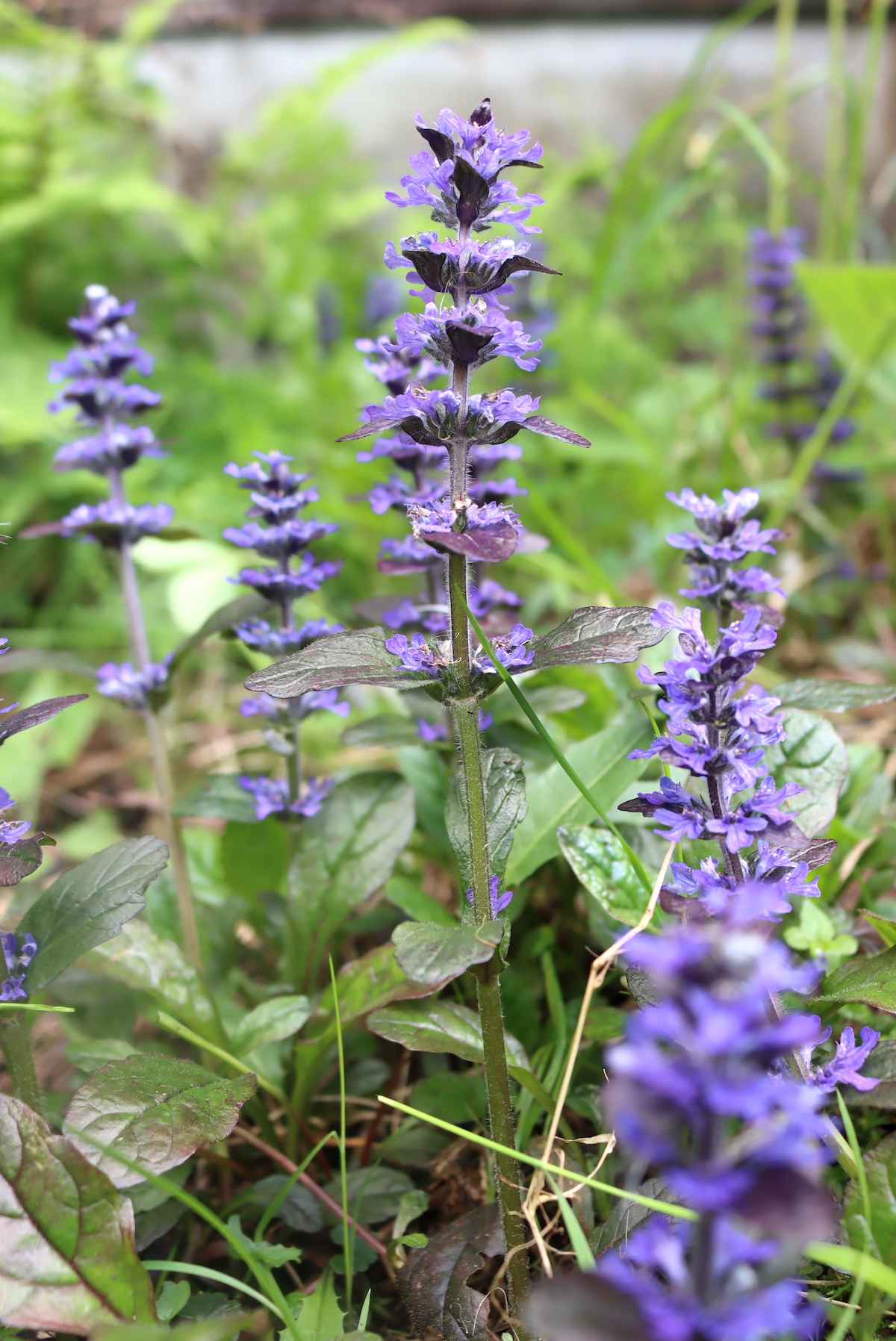
Bugleweed is evergreen in mild climates and semi-evergreen in cold climates, meaning the rosettes can often be found year-round even in Vermont, though they die back somewhat over the worst of winter. New growth kicks in very early in spring, and in most of the northeast, the flower spikes appear from early May into mid-June. Farther south, expect flowering to start earlier; farther north or at elevation, later.
The plant is easiest to identify in flower. Once the spikes fade and die back in midsummer, all that’s left is the basal rosette of leaves, which is still perfectly recognizable but looks more like a generic ground cover. If you’re new to the plant, flag a patch in May while it’s blooming so you can come back for it later in the year when you need it.
Identifying Bugleweed
Bugleweed spreads by stolons that root at the nodes, which is why a single plant can quickly form a dense carpet of connected rosettes. This carpet-forming habit is part of what earned it the common name carpet bugleweed, and it’s one of the quickest clues to ID: if you’re looking at a patch of identical rosettes linked by visible above-ground runners, you’re probably looking at an Ajuga.
In spring the flower spikes make identification easy. The rest of the year, you’re working mostly from leaves and growth habit, so it helps to know each feature in detail.
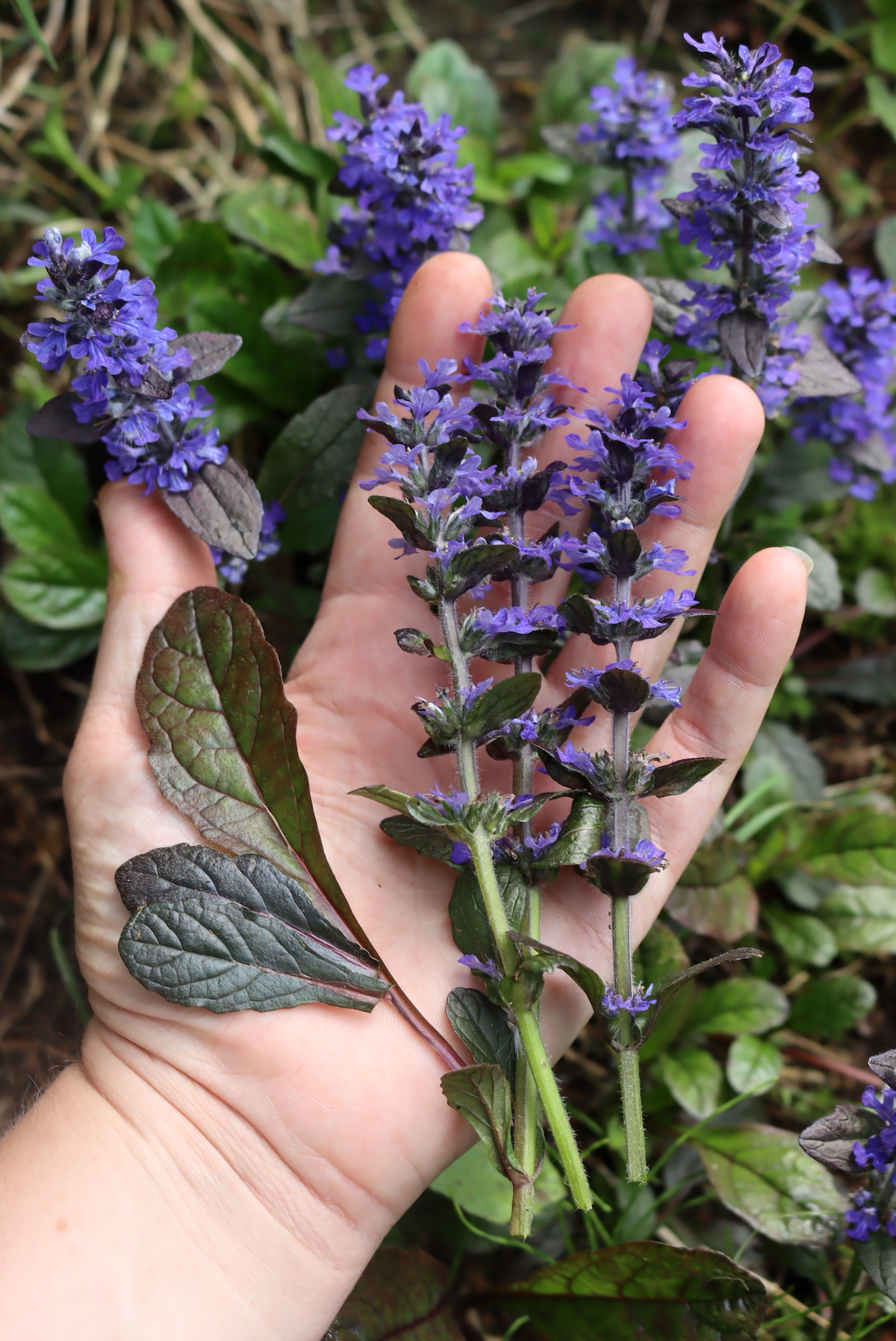
Bugleweed Leaves
The leaves are shiny, dark green with purple or bronze highlights, and grow 4 to 8 inches long in mature plants. They’re elliptical to ovate (egg-shaped with a rounded tip) with shallow, rounded teeth along the margins, and feel smooth rather than hairy.
The rosette leaves stack on top of each other directly from the base of the plant, and the leaves on the flower stems and stolons are arranged in opposite pairs (classic mint-family arrangement). Cultivated varieties often have more dramatic color variation, but wild A. reptans runs consistently dark green flushed with purple.
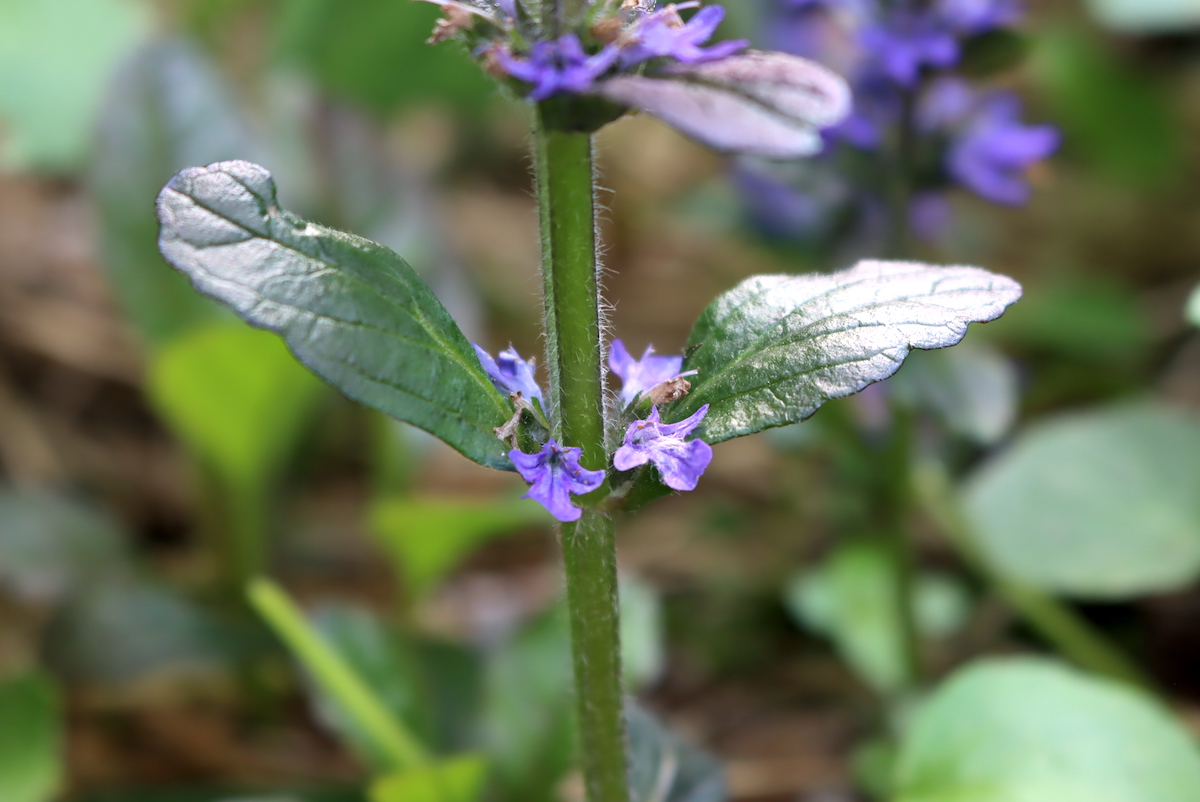
Bugleweed Stems
Like other mints, bugleweed has square stems, which is an important family-level check. The flower stems grow 4 to 14 inches tall, and range from yellowish-green to green to distinctly purplish depending on sun exposure.
The plant also sends out horizontal stolons, which carry leaves in opposite pairs and put down roots wherever the nodes touch soil, launching new rosettes.
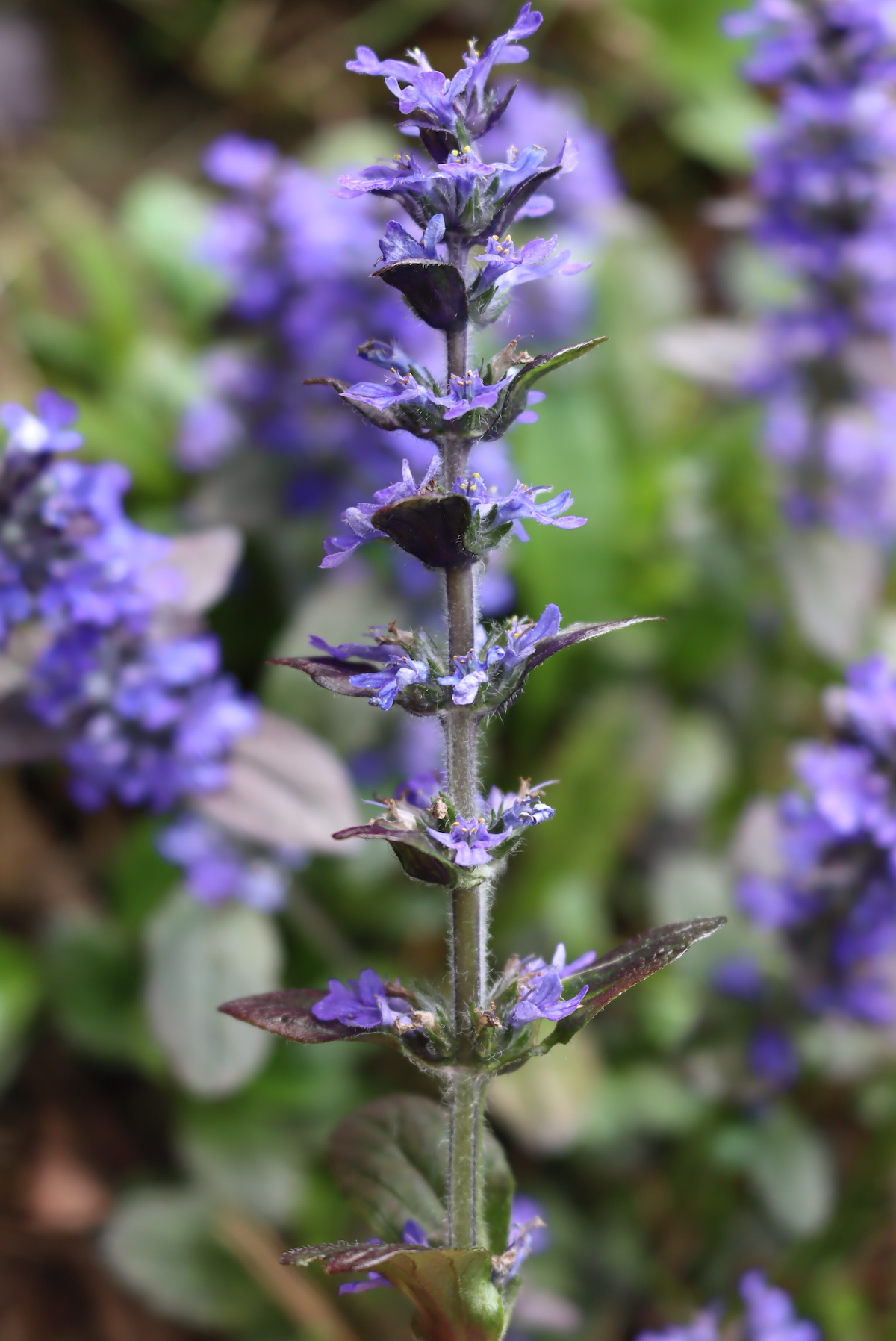
Bugleweed Flowers
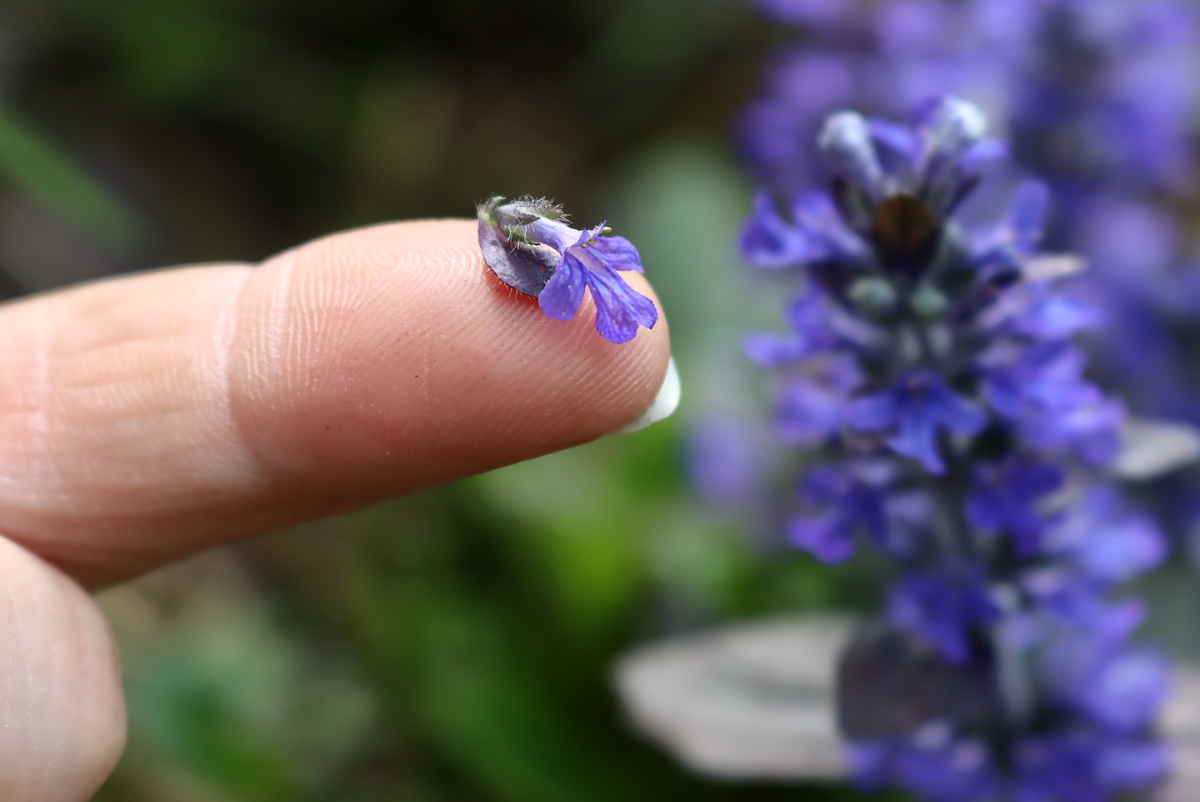
Bugleweed blooms in mid- to late spring, producing whorls of tiny blue-violet flowers arranged in tiers along the 4- to 14-inch flower stem. Each individual flower shows bilateral symmetry, with a five-lobed corolla whose lower lip carries dark veins, and four stamens tucked inside. Bees love the flowers, and so do early-season butterflies. I’ve watched fritillaries work a patch of bugleweed right alongside dandelions in my yard.
If you’re trying to ID from flower color alone, know that you’re looking for blue-violet rather than pink, white, or yellow. This is worth underlining because a lot of closely related mint-family weeds also have small tubular flowers, and color is one of the faster narrowing cuts. For more on distinguishing similar weeds, see my guide to weeds with purple flowers.
Bugleweed Look-Alikes
Out in the field, Ajuga reptans is most often mistaken for other small purple-flowered members of the mint family: purple dead nettle (Lamium purpureum), hummingbird mint (Agastache sp.), and catmint (Nepeta sp.). None of these are dangerous to confuse with bugleweed (they’re all edible or at worst non-toxic), but telling them apart matters for knowing what you’ve got.
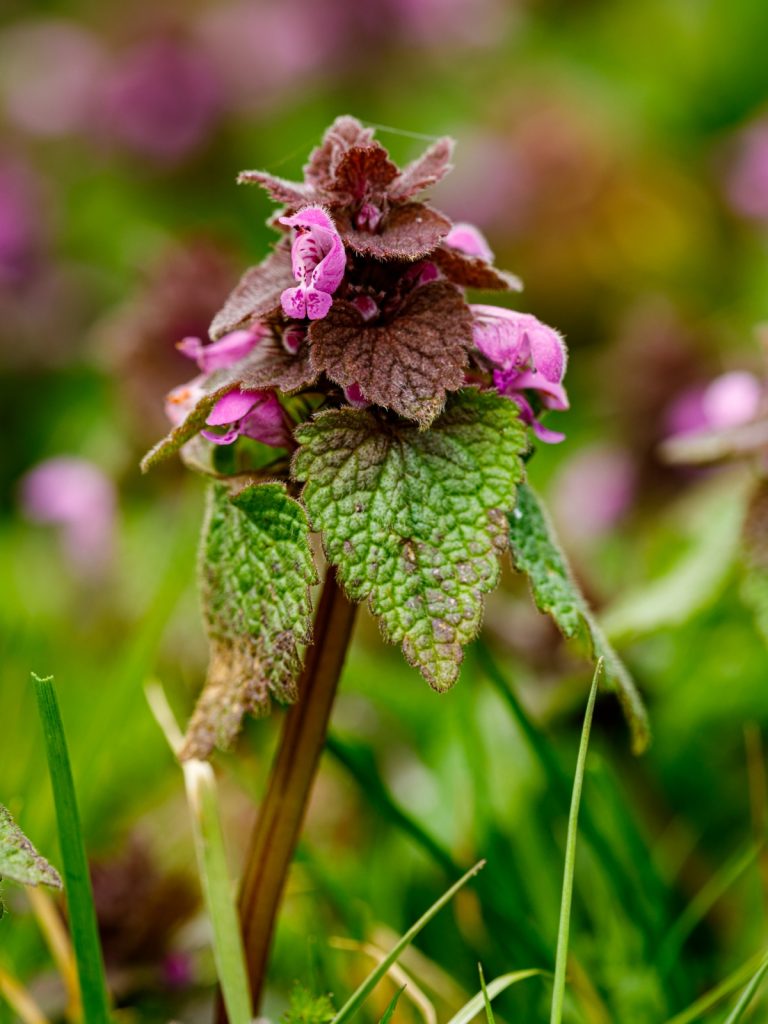
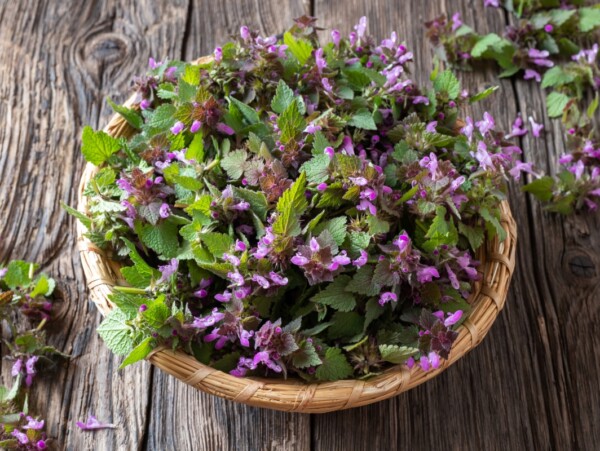
Purple Dead Nettle (Lamium purpureum) is probably the most common confusion, since it grows in the same kinds of places and flowers at a similar time. Key differences:
- Purple dead nettle has small, soft, fuzzy leaves. Bugleweed leaves are larger, smooth, and shiny.
- Purple dead nettle’s upper leaves transition from green to purple-red or pink; bugleweed leaves are uniformly dark green with purple highlights throughout.
- Purple dead nettle leaves attach to the stem with a short stalk (petiole); bugleweed leaves are sessile or nearly so, attached directly to the stem.
- Purple dead nettle grows upright (4 to 12 inches); bugleweed grows mat-forming with flower spikes rising out of basal rosettes.
If you’re curious about purple dead nettle as a wild edible in its own right, it’s worth knowing because the two often grow together. It has its own ways of being useful, and you can see a full rundown of 10 ways to use purple dead nettle. Another close cousin is henbit (Lamium amplexicaule), a small Lamium with similar timing and habitat but clasping leaves that hug the stem.
Some varieties of Hummingbird Mint (Agastache sp.) have purple flower spikes that can look superficially similar to bugleweed:
- Agastache leaves attach with a petiole rather than directly to the stem.
- Agastache leaves have pointed tips; bugleweed leaf tips are rounded.
- Agastache is a tall, upright plant (2 to 5 feet at maturity); bugleweed is a low mat.
Catmint (Nepeta sp.) can also draw a second glance at first, especially when the flowers are both blue-ish:
- Catmint leaves are fuzzy or downy and often silver- or gray-green; bugleweed leaves are smooth, shiny, and dark green with purple.
- Catmint leaf margins have sharp serrations; bugleweed margins are shallow and rounded.
- Catmint stems are downy, often with the same silver-gray cast as the leaves.
If you’ve been using this post because you were hoping bugleweed would be the thyroid herb, the look-alike to read about is actually Lycopus virginicus, which I covered in the name-confusion section above.
It’s a taller, lankier, white-flowered wetland plant and doesn’t look anything like Ajuga in the field.
Ways to Use Bugleweed
Given how bitter the older leaves get, I mostly use bugleweed for two things: a little color and bite in spring salads, and the traditional external preparations. A handful of young leaves and a few flower spikes tossed into a mixed wild-greens salad is exactly the right dose. Older leaves wilt down fine in soups, quick-cooked greens, or stir-fries, though the bitterness always stays noticeable.
It pairs well with sweeter spring greens like chickweed, wild violet leaves, and young dandelion.
Bugleweed Medicinal Preparations
Because the documented medicinal effects of Ajuga reptans are largely topical (wound healing, antimicrobial, anti-inflammatory), most preparations are external. You can use fresh leaves as a simple poultice, crushed and applied directly to a minor cut or bruise, or work the dried herb into a herbal healing salve or herbal infused oil for longer-term use.
If you’ve made a plantain salve before, the method is essentially the same: infuse the dried herb in oil for several weeks, strain, and combine with beeswax. Bugleweed and plantain actually pair well together in a simple first-aid salve, because plantain brings its famous drawing action and bugleweed adds mild astringent and antimicrobial properties.
For internal use, a mild tea of the dried leaves can be made for sore throats or as a gentle astringent, though it’s bitter enough that most people want honey. If you prefer an alcohol-based preparation, follow the same method as any herbal tincture, or make an alcohol-free glycerite. Start with small doses, especially if you’re trying it for the first time, and keep in mind that the internal medicinal tradition for A. reptans is much thinner than the external one.
For other mint-family wild weeds with medicinal use, you may also want to look at self-heal and ground ivy, both of which pair well with bugleweed in a home herbal first-aid kit.
Bugleweed FAQs
Yes, when people talk about bugleweed as a groundcover or lawn weed, they almost always mean Ajuga reptans, also called carpet bugleweed or common bugle. The confusion comes in because the common name “bugleweed” has also been applied to Lycopus virginicus, a completely different North American mint-family plant used as a thyroid herb. If you have the low, mat-forming plant with shiny leaves and blue-violet flower spikes, you have Ajuga.
The best-documented benefits of Ajuga reptans are topical: wound healing, staunching minor bleeding, and mild anti-inflammatory and antimicrobial action, especially against Gram-positive bacteria. Peer-reviewed research has confirmed the traditional European uses that earned it names like “Carpenter’s herb.” It’s also been used as a mild astringent for sore throats and minor digestive complaints. Note that the thyroid and hormonal benefits often attributed to “bugleweed” actually belong to Lycopus virginicus, not Ajuga.
Yes, you can brew a mild tea from fresh or dried Ajuga reptans leaves and flowers. It’s decidedly bitter and astringent, so most people sweeten it with honey. A cup of bugleweed tea has traditionally been used for sore throats and as a gentle astringent, but it’s not a pleasant drinking tea and has never been a culinary staple.
Yes, carpet bugle (another name for Ajuga reptans) is edible in small quantities. Young shoots, leaves, and flowers can be eaten raw in salads or added to cooked dishes. Older leaves get tough and bitter and are better for cooking than raw use. It’s not a base salad green, but it adds color and a mildly bitter bite to mixed wild-greens dishes.
There isn’t good safety data on Ajuga reptans in pregnancy or nursing, and because it’s been used medicinally as a mild astringent and sedative in traditional European herbalism, caution is warranted. Talk to your healthcare provider before using bugleweed in any form if you’re pregnant, nursing, taking medication, or managing a chronic health condition. This advice applies especially because older herbal writing often confuses Ajuga with Lycopus, which has documented effects on thyroid hormones and prolactin.
Did you find this bugleweed foraging guide helpful? Tell me in the 📝 comments below how you use Ajuga on your homestead!
And make sure you stay in touch with me by following on social media!
More Edible Wild Weeds
Find the perfect foraging guide
Searching for something else? Enter keywords to find the perfect foraging guide!
Herbal Remedies from Wild Weeds











Thank you, Ashley! I found Bugleweeed last year and I rinsed and dried it out. The opened the jar a few days ago and it smelled wonderful! I have been searching for a way to put it to use. I appreciate the information that you share. I’ll be making a salve with it and pairing it with plantain and self-heal.
So glad it’s helpful to you!
Excellent article, it explains why my hyperthyroidism is still the same but all my cuts and bruises have healed nicely!
Would the Lycopus Europaeus be ok for graves disease as i cant find Virginicus here (to grow) in the UK?
Cheers, Del
Hi Del, Lycopus europaeus and Lycopus virginicus are closely related species in the same genus, which is why I mention them together in the post. For anything related to treating Graves’ disease, please work with a qualified clinical herbalist or naturopath alongside your GP. Wishing you well!
Thanks Ashley, will see who I can find around me, will check out your other pages too ❤️
Hi ashley . I took a course on herbs at the adirondack folk school and have been hooked ever since.i cannot tell you how valuable your posts ,and website has been to me.just wanted to say thank you for sharing your incredible knowledge with us novices. Have an awesome day
Thank you so much Janine! I’m so glad it’s helpful to you =)