
Affiliate disclosure: This post may contain affiliate links. Please see our Privacy Policy.
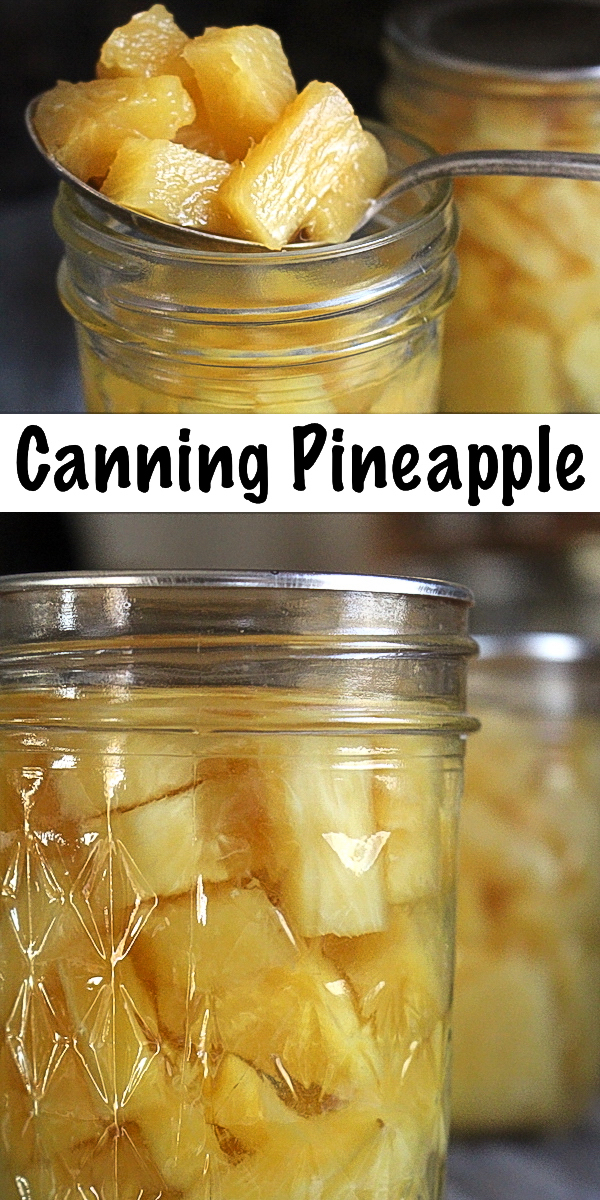
Canning pineapple is one of the easiest water bath canning projects—and once you taste home-canned pineapple, you’ll never go back to the store-bought stuff. Pineapple is naturally high in sugar and acid, which makes it ideal for safe home canning without added preservatives.
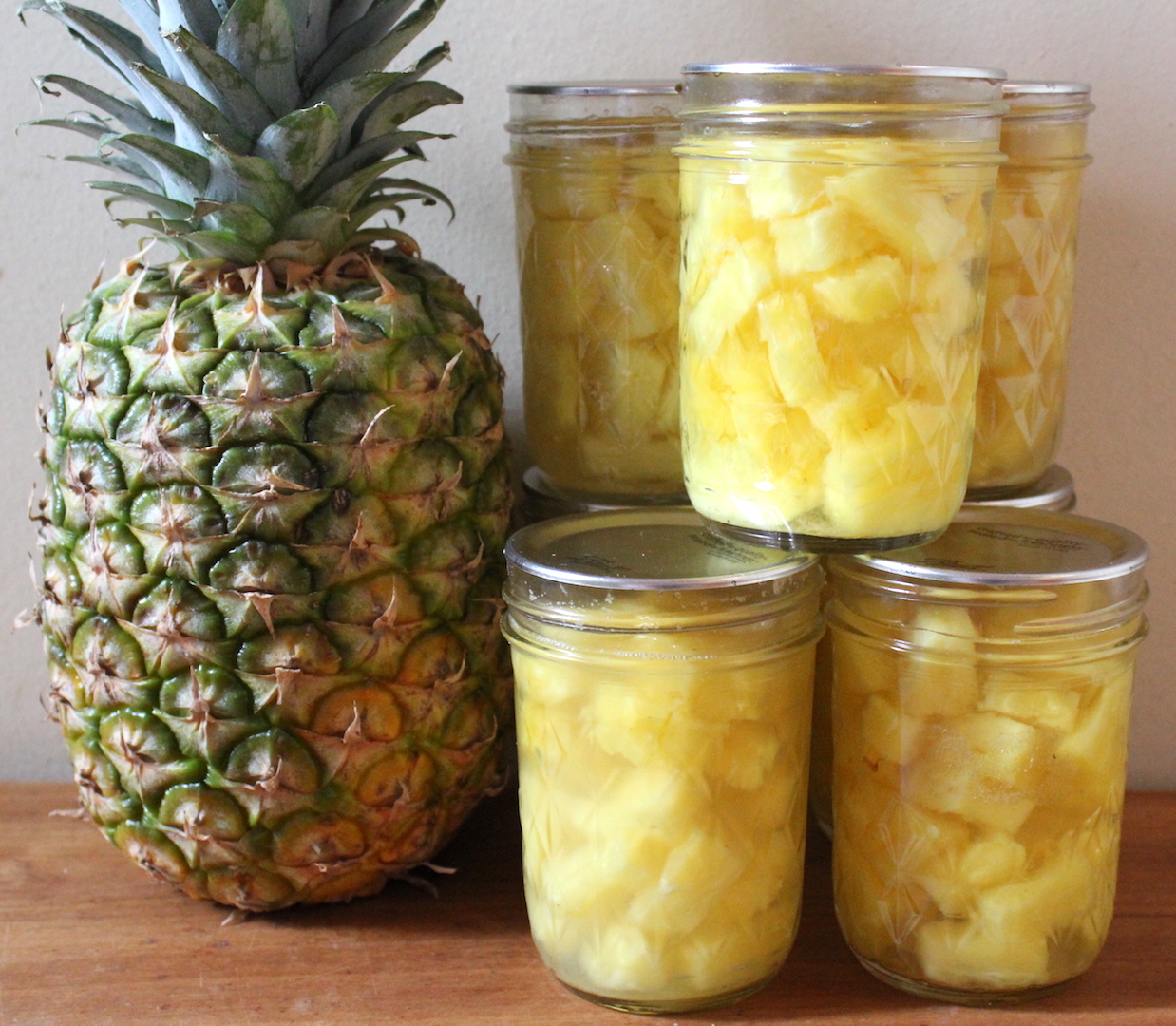
You might be wondering why you’d can pineapple in the first place. Most of us aren’t growing it in the backyard, and it’s easy to buy year-round. But there’s one word that makes it worth the effort: taste. Home-canned pineapple is juicy, flavorful, and never watery or metallic like the canned versions from the store.
Beyond the incredible taste, canning pineapple is a great way to stock your pantry with peak-season fruit at a bargain price. In midwinter, pineapples are often dirt cheap—even here in Vermont, they can drop from $5 each to $1.50 or less in January. That’s the perfect time to buy a case and preserve them for the months ahead.
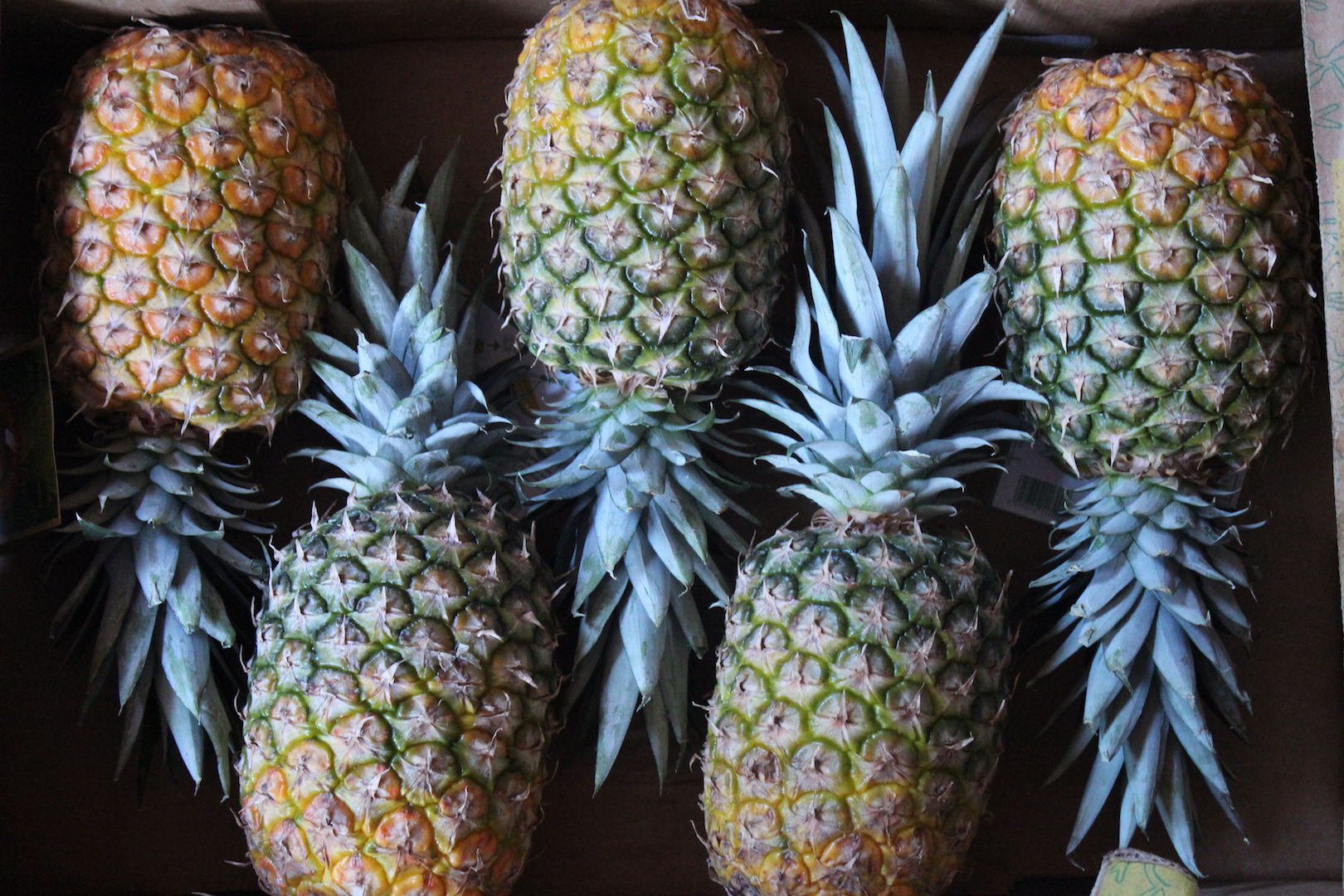
How to Prepare Pineapple for Canning
Start by cutting off the top and bottom of the pineapple. Slice vertically down the sides to remove the peel and eyes. Save those peels!
You can use them to make homemade tepache or pineapple scrap vinegar—perfect zero-waste projects for winter.
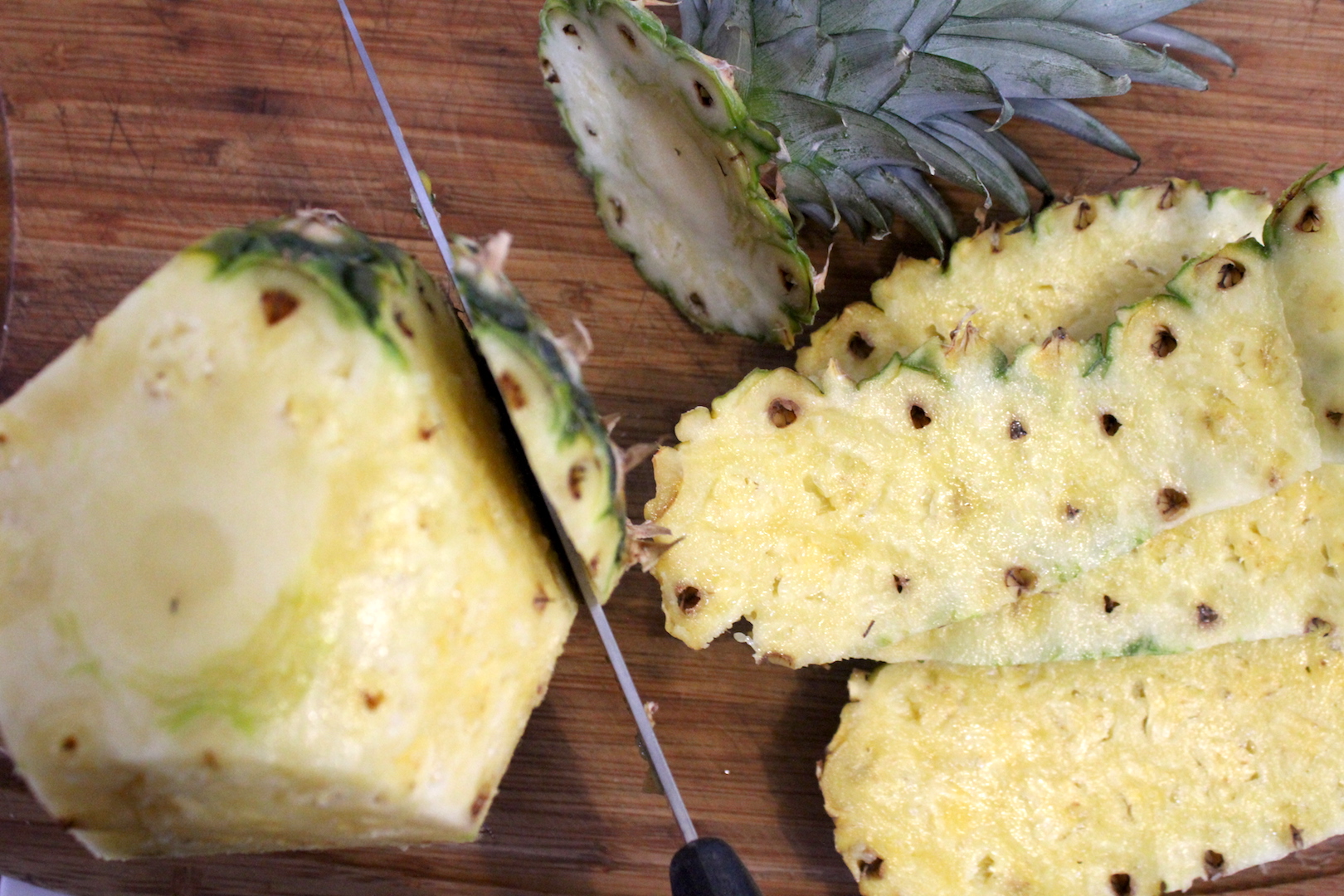
Next, cut out the tough core from the center of each slice.
Don’t toss it—you’ll use the cores to make pineapple juice for canning liquid.
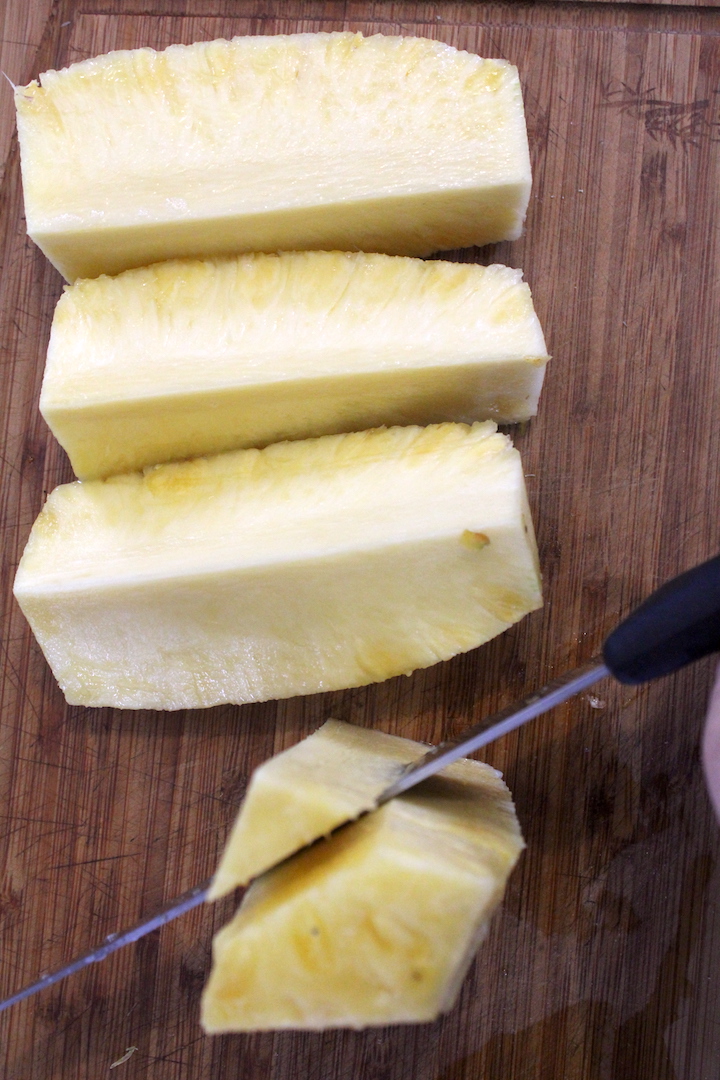
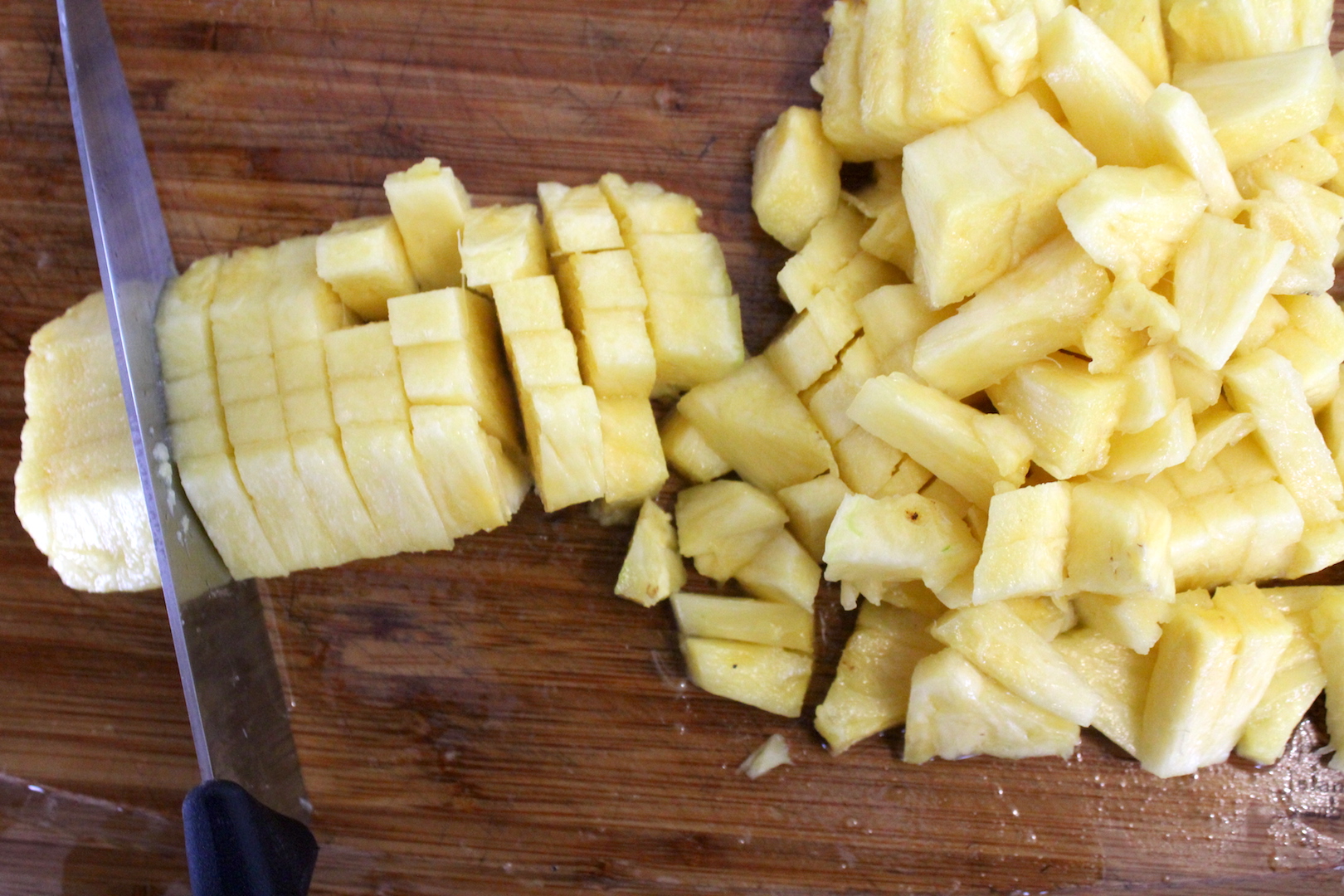
Chop the peeled pineapple into chunks, tidbits, or crushed pieces depending on how you plan to use it.
I prefer small chunks—they’re the right size for pizza, stir-fry, or baking.
Hot Pack vs. Raw Pack Pineapple
Pineapple can be hot packed or raw packed into jars:
- Raw Pack: Fill jars with fresh pineapple chunks and top with boiling water, juice, or syrup. It’s fast and easy, but the fruit may discolor over time due to trapped air.
- Hot Pack: Simmer pineapple in the canning liquid for 10 minutes before packing. This drives off excess air and helps preserve flavor and color for long-term storage.
According to the University of Alaska Cooperative Extension, hot packing is recommended for pineapple. It yields better color and shelf life, especially if you’re planning to store the jars more than a few months.
That said, I’ve had good luck with raw packing too, and though I’ve made it both ways, you really can’t tell the difference.
Choosing a Canning Liquid
You have several options when choosing a liquid to can pineapple:
- Water – Works, but can leach flavor from the fruit.
- Juice – Pineapple juice, apple juice, or white grape juice all work well.
- Light Syrup – If you want a sweeter result, you can use extra-light, light, or medium syrup.
Personally, I prefer to avoid syrup since pineapple is already so sweet. Canning in juice gives the best balance of flavor and simplicity.
Making Pineapple Juice from Scraps
To save money, use the reserved cores to make your own pineapple juice. Just simmer chopped cores in water for 10–15 minutes, then strain. One pineapple core yields enough liquid for about 4 pint jars. On average, you’ll need about 2 to 2½ cups of hot canning liquid per whole pineapple.
How to Can Pineapple
Start by preparing your pineapple. Slice off the top and bottom, then stand it upright and cut vertically down the sides to remove the peel and eyes. Cut out the tough core from each section and set those aside—they’re full of flavor and can be simmered to make pineapple juice for your canning liquid.
Chop the remaining pineapple flesh into your desired size: large chunks, small tidbits, or finely crushed pieces. Keep in mind how you plan to use it—larger pieces are great for snacking or stir-fries, while smaller chunks or crushed pineapple work well in baking and sauces.
Next, prepare your canning liquid. You can use water, juice, or a light syrup, but for the best flavor, I recommend pineapple juice made from the cores. Simply chop the cores and simmer them in water for 10 to 15 minutes. Strain the liquid and keep it hot until you’re ready to can. Plan for about 2 to 2½ cups of liquid per whole pineapple, and always prepare extra to avoid running out mid-batch.
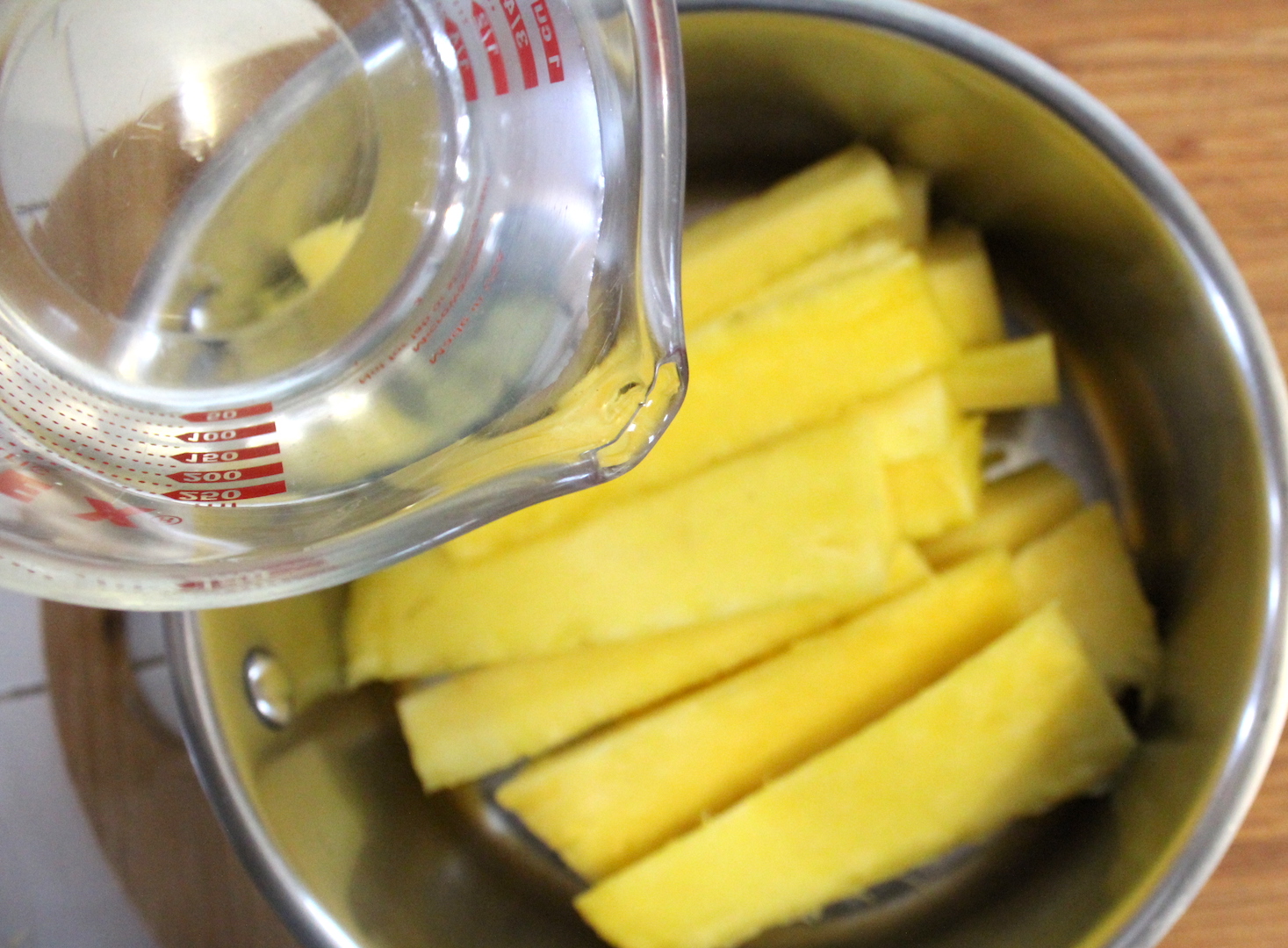
Decide whether you’re doing a hot pack or raw pack.
For a hot pack, combine the chopped pineapple and canning liquid in a stockpot and simmer for 10 minutes. Then pack the hot fruit into warm jars, leaving ½ inch of headspace, and ladle the hot liquid over the top to cover.
For a raw pack, fill hot jars with raw pineapple pieces and top with boiling liquid—again leaving ½ inch of headspace. Raw packing is faster, but hot packing results in better color and shelf life, especially for long-term storage.
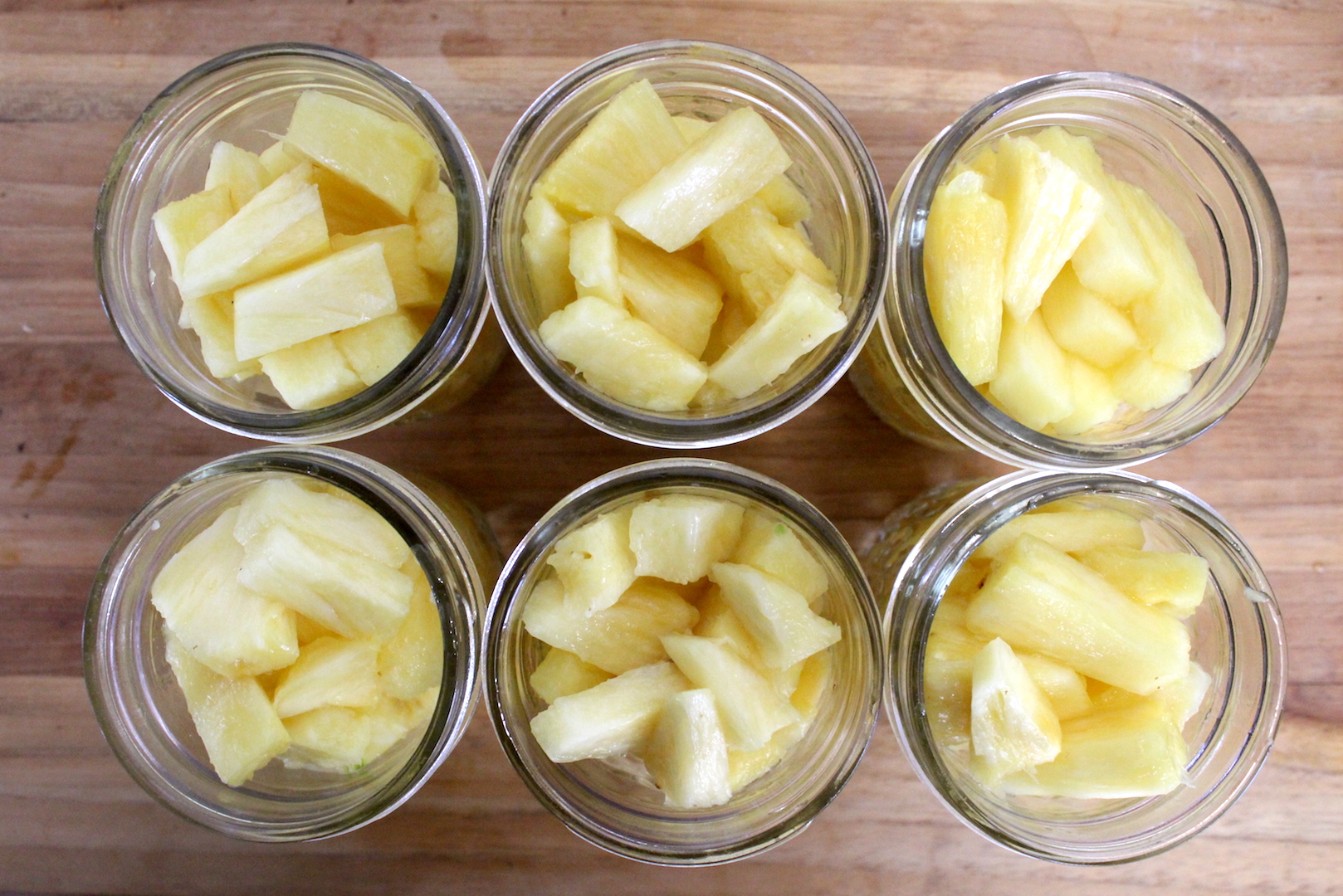
Remove any trapped air bubbles, adjust the headspace if needed, and wipe the jar rims clean. Apply lids and rings until fingertip-tight. Process the jars in a boiling water bath canner—15 minutes for pints and half-pints, or 20 minutes for quarts. Be sure to adjust processing time for altitude. Once the time is up, turn off the heat and let the jars rest in the canner for 5 minutes before removing them to cool.
Let the jars cool undisturbed for 12 to 24 hours. Check seals, remove rings, and store your canned pineapple in a cool, dark place. Properly sealed jars will keep for at least 12 to 18 months, and often much longer.
Altitude Adjustments
Increase processing time based on your elevation:
- 1,001–3,000 ft: 20 minutes for pints and 25 minutes for quarts
- 3,001–6,000 ft: 20 minutes for pints and 30 minutes for quarts
- 6,001–8,000 ft: 25 minutes for pints and 35 minutes for quarts
Canning Pineapple
Equipment
Ingredients
- Whole Pineapples, Each pineapple yields about 2-3 pints
- Water, Juice or Syrup (roughly 2 to 2.5 cups per pineapple)
Instructions
- Prepare a boiling water bath canner, jars, lids, and rings. Keep jars warm until ready to fill.
- Peel and core the pineapples, reserving the cores. Chop fruit into desired size. To make canning liquid, simmer the cores in water for 10–15 minutes, then strain.
- Hot Pack: Simmer pineapple chunks in canning liquid for 10 minutes, then pack into hot jars and cover with the hot liquid, leaving ½ inch headspace.
- Raw Pack: Pack raw pineapple into hot jars, then pour boiling water or juice over top, leaving ½ inch headspace.
- Remove air bubbles, adjust headspace, and wipe jar rims. Apply lids and rings until fingertip-tight.
- Process half-pints and pints for 15 minutes or quarts for 20 minutes in a boiling water bath canner. Adjust for altitude (see below).
- When time is up, turn off the heat and let jars rest in the canner for 5 minutes. Remove jars and cool undisturbed for 12–24 hours. Check seals, label, and store in a cool, dark place.
Notes
Altitude Adjustments
Increase processing time based on your elevation:- Under 1,000 feet in elevation: 15 minutes for pints and 20 minutes for quarts
- 1,001–3,000 ft: 20 minutes for pints and 25 minutes for quarts
- 3,001–6,000 ft: 20 minutes for pints and 30 minutes for quarts
- 6,001–8,000 ft: 25 minutes for pints and 35 minutes for quarts
Nutrition
Nutrition information is automatically calculated, so should only be used as an approximation.
More Fruit Canning Recipes
Looking for more canning recipes? Here are a few more fruits to can at home:











It’s a wonderful work you have done. If we do raw pack, how much should be shelf life, I opened a pack after 4 months( done by raw method), it was wonderful. In how many months, left over air will discolor pineapple?
It is possible that they may discolor more with raw pack versus hot pack but that doesn’t mean that they always will. The shelf life doesn’t really change with the discoloration, they just may not look as appealing.
I did the hot pack method today. I thought I did a good job of preparing my pineapples and had gotten rid of the eyes. The jars look beautiful and I see that in my left over juice there are some of those little pineapple seeds. Preboiling must have the benefit of removing these as they are on the bottom of the pan.
That’s very interesting.
Can we use frozen pineapple?
I think frozen pineapple should be fine although I haven’t personally tried it. Let us know how it works for you.
Did you find out if you could use frozen pineapple?
Love this stuff ! As I was working on getting more things about this, the article has helped me to solve various clarifications. Thanks for the great content.
You’re welcome. So glad you enjoyed the content.
How long can you store after sealing?
It’s often recommended to eat within a year for the best quality. After that, the quality will begin to deteriorate but will still be safe to eat as long as it is stored properly and none of the seals have been broken.
Came across this and found pineapples fort $2.99. I bought just one to try. Used the core to make the syrup. Great money savers. I got 5 Half pints from the one. Will go back and buy more! Easy directions to follow.
Wonderful, so glad it worked out for you!
Hello. I’ve used bottled lemon juice, sugar, and water to make a light simple syrup. This also helps eliminate browning of pineapple. I use about a quarter cup of lemon juice to 2 cups sugar and 9 cups of water.
excellent directions and recipe
Can you use citric acid to prevent browning, should you and id so about how much? Thaks Ashley, I think your blog is amazing by the way!!
I’ve honestly never had fresh pineapple brown, it seems to have enough acid in there to prevent oxidation all on its own.
Can u use canned pineapple juice to can fresh pineapple???
Yes you can but it does increase the cost significantly.
Can the juice derived from the pineapple cors be preserved by canning also.
You certainly could although I am not sure what the taste would be with just the cores themselves. I think it would be worth trying.
What can the extra juice be used for? (juice after simmering cores).
Hmm…good question. I bet it’d make a really good pineapple rice!
Use it for jello
pineapple will not let jello set
“jello” warns you when making a mold with pineapple
Fresh pineapple is said to keep jello from setting because it contains Bromelain. Cooking deactivates the Bromelain, leftover cooked juice is fine to use in jello.
You give times for half pints and quarts but not pints. What time do you recommend for pints?
Oops, thanks, I’ll correct that. Process times for both pints and half pints are the same.
Thank you!
You’re welcome.
Doing this this week. This is probably obvious to canners, but should the jars be hot when I fill them?
Thanks.
Cheers
Joan
Yes, you do want your jars to be hot.
Will be trying this recipe this weekend using the pineapple core water and raw pack method. Thanks so much for sharing this recipe!
You’re welcome!
How much water do you add to the cores? I have 6 that I bought at Costco but I’m not sure how much water to add to the cores. Also, once you boil the cores fir the canning liquid, can they still be used with the peels to make teoache?
You will need approximately 2 to 2.5 cups of canning liquid per pineapple that you’re canning, so you will want just enough water to for that amount of liquid. The cores really aren’t necessary for the tepache and most of the flavor will probably be gone after using them for the canning liquid.
Found $1.99 pineapples the other day at the store, so I tried your method for caning. Everything went great, and all the jars sealed! (Yeah!) I haven’t tried a jar yet, but they look delicious!
Thank you for your post, we will try it!
Do the pineapples need to be ripe before canning? They were on sale for $.98 so I bought 3, 1 to eat now and 2 for canning. However they’re not ripe yet. So should I wait before canning them?
Ideally, they should be just barely ripe. Overripe pineapples will fall apart, and underripe ones won’t have the best flavor. That said, a bit underripe can still be canned since the cooking helps to soften them. You might want to add a tiny bit of sugar though since they won’t be as sweet as a ripe one. But yes, ideally you’d wait and let them ripen.
Lived in Hawaii for years….once picked, pineapples WILL NOT ripen further. (it may get softer, but will not get sweeter) The best pineapples to buy are a uniform golden color (not green). When you get them home, stand them on their “head” overnight. It helps redistribute the juices from the bottom where they settle thanks to gravity.
Thank you for your comment Lisa. I didn’t know that.
Aren’t they delicious when they are picked when they are completely golden? You haven’t had pineapple until you get them when they are completely golden. Also, when you get them fresh picked, the days they stay good also changes. 3 days on the counter is assuming they were picked in Hawaii or Honduras, shipped, sorted and distributed prior to you getting them. I’m fortunate enough to grow my own. Without intervention, they tend to all come in during June and July. My freezer is full of gallon ziploc bags of pineapple chunks, so now I’m trying to find other ways to store them up.
I’m wondering with the cores as to why boil them in water vs. a food processor and then filter the liquid? And if using this fresh juice, why does it need to be boiled, and not just poured on at room temp?
You can certainly try to extract the juice in this way as long as you have enough liquid to fill the jars to the correct level. You can use a raw pack method or a hot pack method to can pineapple safely but your liquid does need to be hot as this is how the recipes are tested. If the liquid is not hot it could affect the temperature of the food during the processing time.
Can I cold pack without any added liquid?
No. You need some kind of liquid in with the pineapple.
After cooking the cores to make the canning liquid could i just throw it all in the Vitamix and use?
Yeah, that would work. Your canning juice would be a bit pulpy that way instead of clear, but you’d get more flavor incorporating them with the Vitamix. Just make sure you add enough water that it’s still a canning juice with the cores blended up, instead of a slurry/jam consistency. Great idea!
Mmmmmmmm!! These look delicious! I’m going to put this on my to-do list. Seems easy enough! Thank you!