
Affiliate disclosure: This post may contain affiliate links. Please see our Privacy Policy.
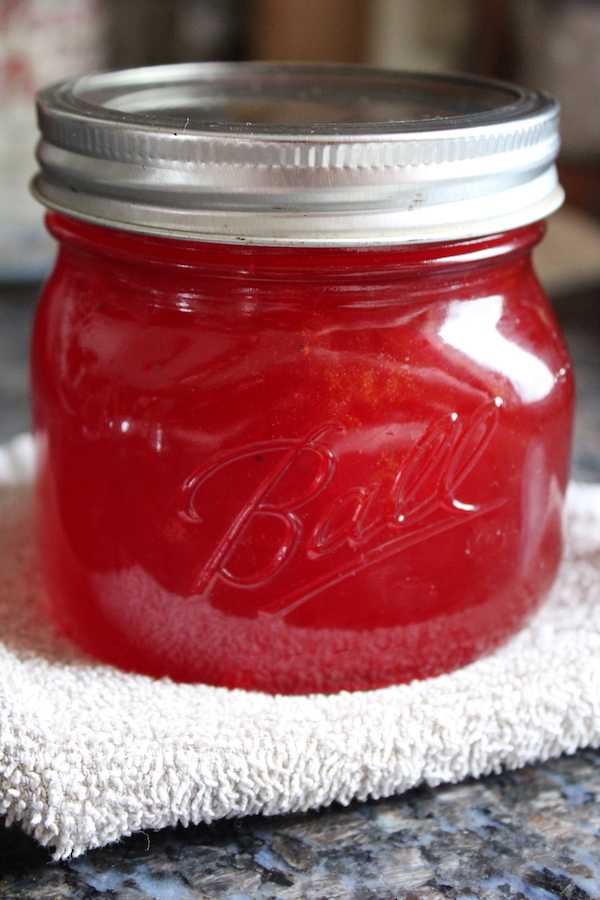
Prickly pear jelly turns the bright fuchsia juice of cactus fruit into a smooth, deep-pink preserve with a flavor that’s hard to describe, warm and earthy with a hint of tropical sweetness.
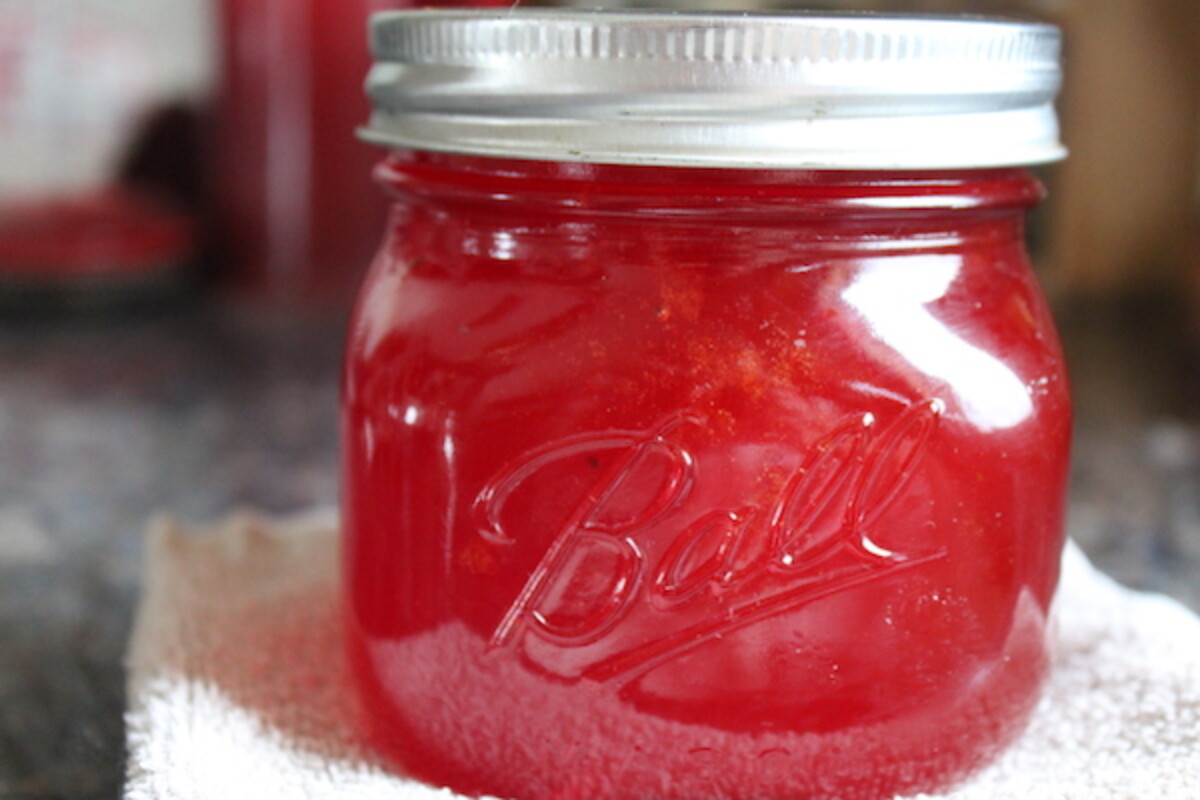
Table of Contents
- Notes from My Kitchen
- Why Prickly Pear Jelly Needs Lemon Juice
- Ingredients for Prickly Pear Jelly
- How to Make Prickly Pear Jelly
- Don’t Overcook Pectin Jelly
- Canning Prickly Pear Jelly
- Altitude Adjustments
- Yield Notes
- Storage Options
- Recipe Tips
- Pectin Options
- Prickly Pear Jelly Variations
- Ways to Use Prickly Pear Jelly
- Prickly Pear Jelly FAQs
- Prickly Pear Jelly Recipe
- Jelly Recipes
Prickly pears (also called cactus pears or tunas) are the fruit of the Opuntia cactus, native to the American Southwest and Mexico. They’re harvested in late summer and fall, but they keep surprisingly well and grocery stores in colder climates often carry them as a fall novelty next to dragon fruit and kiwano melons.
We actually grow a cold hardy prickly pear cactus here in Vermont, but I’ve yet to harvest fruit. Still, I wanted to test a recipe so I can know what to expect once our cactus grow a bit more.
This tested recipe is adapted from the UC Master Food Preservers of Solano and Yolo Counties, with additional guidance from New Mexico State University Cooperative Extension Guide E-217. Both are tested-recipe sources, which matters because prickly pear fruits are not acidic like most fruits, and they have a pH that’s well above the line for safe canning (pH 5 to 7). It’s especially important to use a tested recipe for prickly pear canning recipes.
In general though, the recipe is straightforward once the juice is extracted, and the finished jelly is one of the most beautiful things you can put in a jar.
Notes from My Kitchen

I grew up picking prickly pears in my grandfather’s backyard for fun. We’d play with them, but I never knew you could eat them, and I don’t come from a family of cooks, let alone jelly makers. The first time I made prickly pear jelly I was already living clear across the country in the northeast, far from the land of cactus.
Even up here in Vermont, grocery stores will often carry prickly pears as a fall novelty, sitting next to the dragon fruit and kiwano melons. They keep surprisingly well, too. I’ll admit I forgot about a batch on the counter for two weeks before I got around to making jelly, and they were still good as the day they came home.
Why Prickly Pear Jelly Needs Lemon Juice
This is the only jelly on the blog where lemon juice is required for safety, not just flavor.
- Prickly pear is low-acid. Most fruits used for jelly (apples, berries, grapes, peaches, rhubarb) are naturally acidic with a pH below 4.6, which makes them safe for water bath canning. Blueberry jelly and strawberry jelly are good examples of high-acid fruit jellies that don’t need added acidification for safety. Prickly pear juice has a pH of 5 to 7, which is well above the safe water-bath canning threshold.
- Acidification is required for safety. Per NMSU Extension, prickly pear products must be either pressure canned or acidified with bottled lemon (or lime) juice and processed in a water bath. This recipe uses the second method.
- Use bottled lemon or lime juice. Bottled juice has a guaranteed and consistent acid level, which is what makes the recipe safe. Fresh lemon juice varies in acidity and isn’t an acceptable substitute when canning prickly pear jelly.
- Stick to the recipe ratios. The 1/4 cup of bottled lemon (or lime) juice per 3 cups of prickly pear juice in this recipe comes from a tested recipe. Don’t reduce the lemon juice below this amount if you’re canning the finished jelly.
Ingredients for Prickly Pear Jelly
This prickly pear jelly recipe yields about 6 half-pint jars and uses just four ingredients:
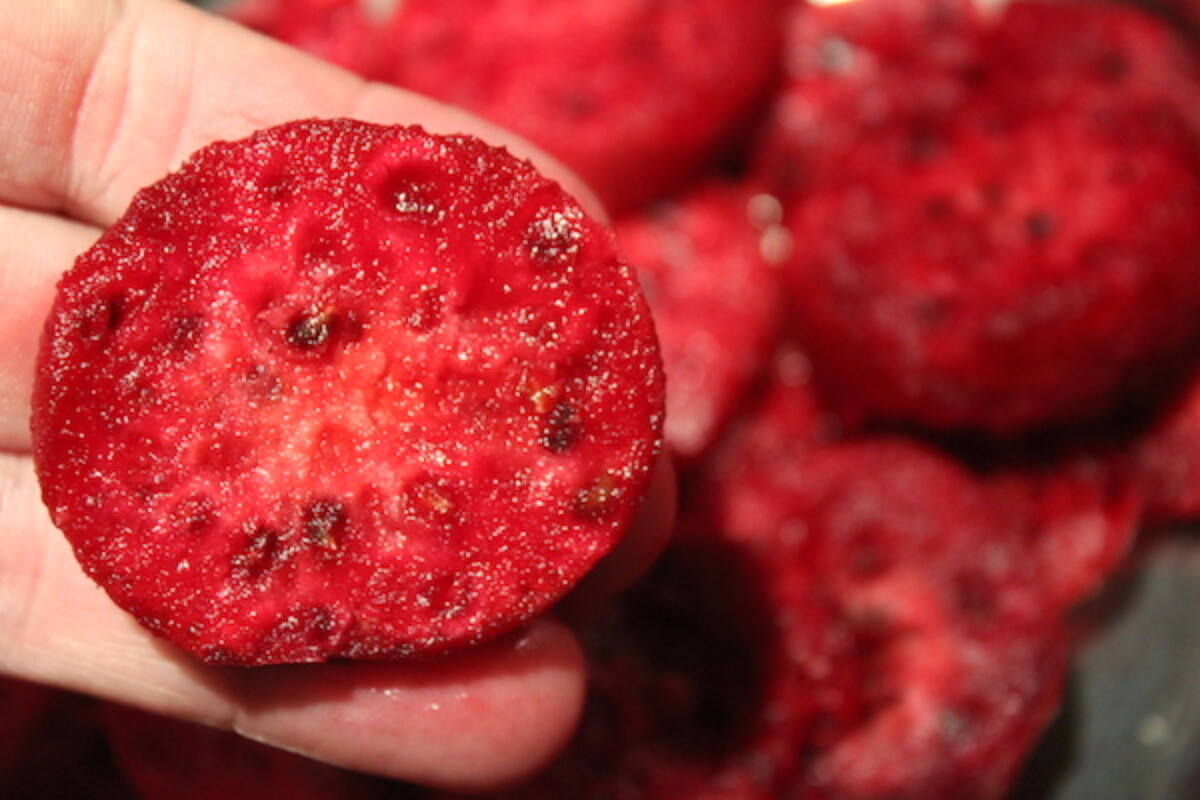
- Prickly pear juice: Extracted from fresh or frozen prickly pear fruit (instructions below). Use ripe fruit with deep red to burgundy color. Both wild-foraged and grocery store prickly pears work. About 3 to 4 pounds of fruit yields the juice for one batch.
- Bottled lemon or lime juice: Required for safe water bath canning, since prickly pear is low-acid (pH 5 to 7). Both lemon and lime work; lime gives a slightly more aromatic finish. Use bottled juice rather than fresh because the acid level is consistent, which matters here for safety.
- 1 box (1.75 oz) powdered fruit pectin: Use Sure-Jell (yellow box) or Ball Classic regular powdered pectin. Prickly pears contain no meaningful natural pectin, so commercial pectin is essential. Don’t substitute liquid pectin, which requires different ratios. For a low-sugar version, see Pectin Options below.
- Granulated sugar: Don’t reduce the sugar with regular powdered pectin; the jelly won’t gel. To use less sugar (or honey or maple syrup), see Pectin Options below for the NMSU-tested low-sugar recipe. The recipe card has the specific amount.
How to Make Prickly Pear Jelly
Prickly pear jelly comes together in two stages: extracting the juice from the fruit (which takes most of the time), and then cooking the jelly itself, which only takes about 15 minutes once the juice is ready.
Extracting Prickly Pear Juice
Wear gloves. Prickly pears are covered with tiny barbed spines called glochids, even on commercially-sold fruit, which are difficult to remove from skin. Heavy gardening gloves protect you while handling the fruit. Tongs help when transferring fruit to and from the pot.
Rinse the prickly pears in hot water to wash off dirt and surface debris. Cut off the blossom and stem ends, then peel the fruit. The skin is a distinct layer that comes away easily once you score it lengthwise. Slice the peeled fruit into large chunks.
Place the chunks in a heavy-bottomed pot with about 1 cup of water (just enough to keep the fruit from scorching). Bring to a boil, then reduce to a simmer for 10 minutes, mashing occasionally with a potato masher to break the fruit down and release the juice. The liquid will turn bright fuchsia.
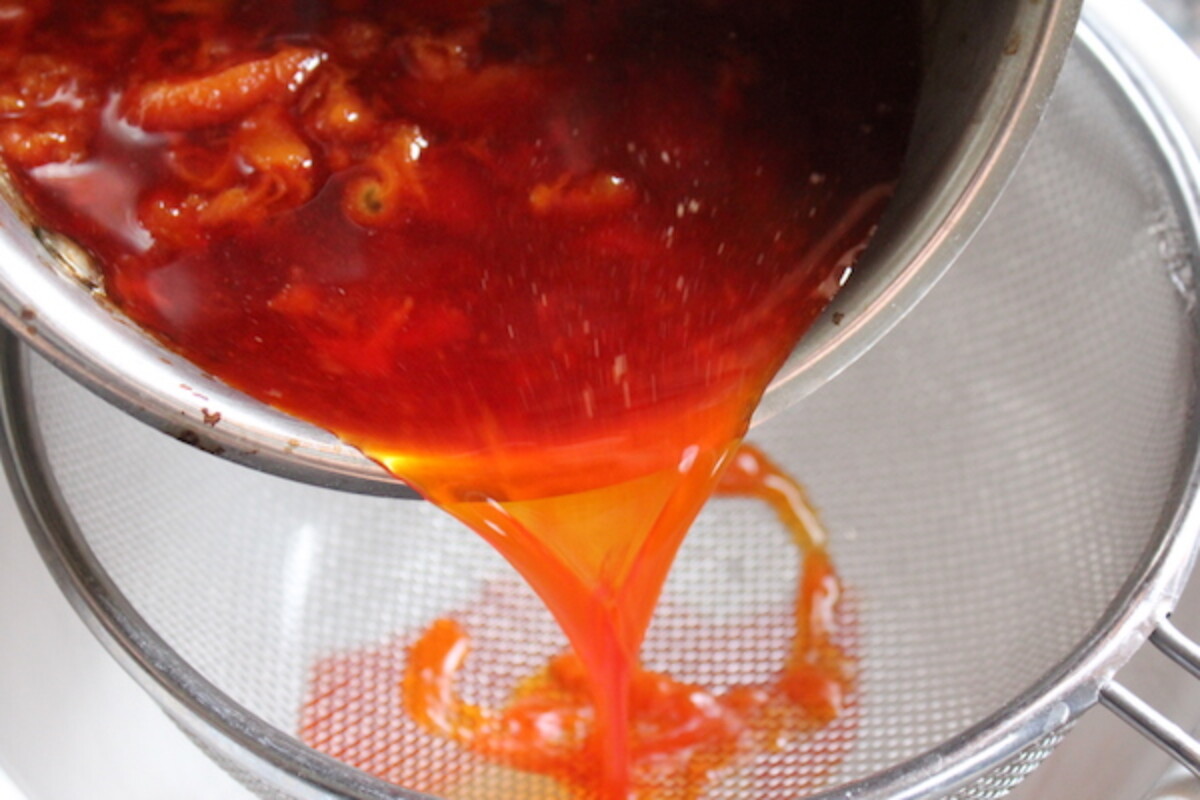
Strain the cooked fruit through a jelly bag or a fine-mesh strainer lined with several layers of dampened cheesecloth set over a deep bowl. Let it drip undisturbed for at least 2 hours. Don’t squeeze the bag; squeezing releases solids that cloud the finished jelly. The seeds are very hard and not edible, so straining well is important. Measure the juice for the recipe (the recipe card has the specific amount).
Cooking the Jelly
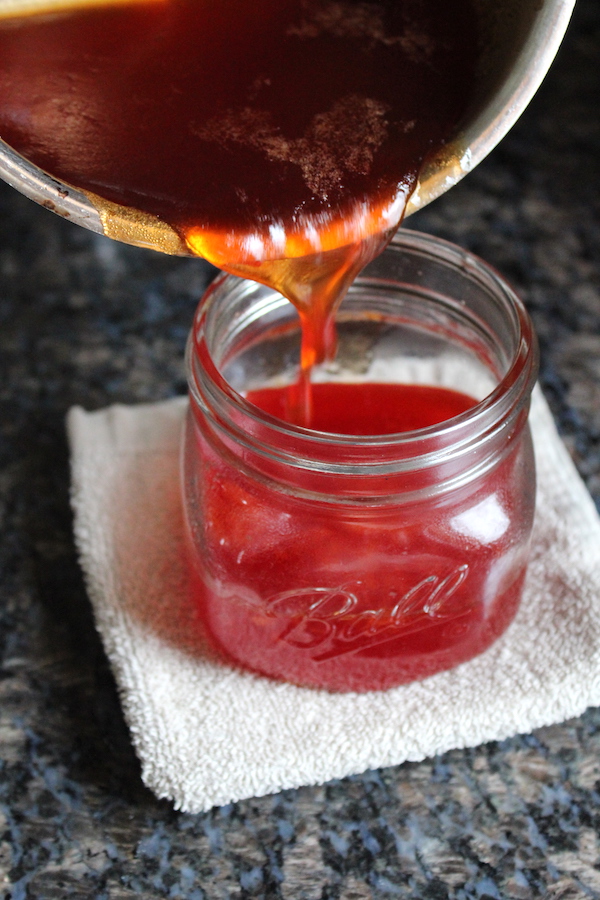
Order matters with powdered pectin. Combine the prickly pear juice and bottled lemon (or lime) juice in a heavy-bottomed jam pot. Whisk in the powdered pectin until fully dissolved. Bring to a hard rolling boil over high heat, stirring frequently.
Add the sugar all at once and stir constantly until fully dissolved. Return to a hard rolling boil that can’t be stirred down, and boil hard for exactly 1 minute. Remove from heat and quickly skim off any foam. Ladle the hot jelly into prepared half-pint jars, leaving 1/4 inch headspace, wipe rims clean, and apply two-piece canning lids fingertip tight.
Don’t Overcook Pectin Jelly
Pectin jelly works on chemistry, not on cooking time. A few things to know:
- The jelly looks thin in the pot when you take it off the heat, and that’s normal. Pectin sets as the jelly cools, not while it’s boiling.
- Trust the timing. A hard rolling boil for exactly 1 minute after the sugar fully dissolves is all you need.
- Skip the thermometer and freezer plate test. Those are for old-fashioned no-pectin jellies. Pectin recipes set on chemistry, not on temperature.
- Give the jars 24 to 48 hours to fully set before declaring failure.
Canning Prickly Pear Jelly
With the bottled lemon or lime juice added for acidification, this prickly pear jelly is safe for water bath canning. The acid brings the pH below 4.6, the threshold for safe water-bath processing. If you’re new to canning, start with my beginner’s guide to water bath canning before you fire up the canner.
Process the filled jars in a boiling water bath canner for 10 minutes (adjusting for altitude). When the timer goes off, turn off the heat and let the jars sit in the canner for another 5 minutes before lifting them out (this helps prevent siphoning). Cool on a towel for 12 to 24 hours, check seals, and refrigerate any unsealed jars. Sealed jars keep on the pantry shelf for 12 to 18 months.
Altitude Adjustments
Processing time depends on your elevation:
- 0 to 6,000 feet: 10 minutes
- Above 6,000 feet: 15 minutes
Yield Notes
Here’s what you can expect from this recipe:
- 3 to 4 pounds of prickly pear fruit = about 3 cups of strained juice (one batch)
- 3 cups prickly pear juice + 1/4 cup bottled lemon or lime juice + 1 box pectin + 4 1/2 cups sugar = about 6 half-pint (8 oz) jars
- Don’t double the recipe. Larger batches don’t heat evenly and may not set properly. Make two single batches back-to-back instead.
Storage Options
Not committed to water bath canning? You have several options:
- Refrigerator jelly: Let jars cool to room temperature, then store in the fridge. Keeps for 3 to 4 weeks. If you’re not canning, you can reduce the lemon juice if you want a milder flavor, since the safety acidification is only required for water-bath canned jars.
- Freezer jelly: Use freezer-safe straight-sided jars and leave 1/2 inch headspace for expansion. Lasts up to 12 months frozen.
- Canned jelly: Water bath processed jars keep for 12 to 18 months in a cool, dark pantry. This is what I prefer because it gives you shelf-stable jars to enjoy long after prickly pear season is over. For more foraged-fruit recipes like this one, see my collection of wild-fruit posts.
Recipe Tips
- Wear gloves the whole time you’re handling the fruit. The tiny glochids (barbed spines) come off easily and embed in skin. Heavy gardening gloves work well, and tongs are helpful for transferring fruit.
- Frozen prickly pears work too. Per the NMSU guide, freezing the whole fruit and then thawing actually makes juice extraction easier because freezing breaks down the cell structure. Frozen fruit will keep for up to 12 months and can be juiced any time you’re ready.
- Use a deep pot. Prickly pear jelly foams quite a bit when it reaches a rolling boil. A deep pot prevents overflows.
- Don’t squeeze the jelly bag. Squeezing releases pulp that clouds the finished jelly. The deep fuchsia color is the whole point, so let gravity do the work.
- Be patient with setting. Prickly pear jelly can take 24 to 48 hours to fully set. Some batches may take up to a week. Don’t call it a failure until you’ve given it time. If it’s still not set after that, read through my guide to troubleshooting an unset jelly.
Pectin Options
Standard powdered pectin (this recipe): Requires the full sugar amount in the recipe card. Use Sure-Jell (yellow box) or Ball Classic regular powdered pectin. Adapted from the UC Master Food Preservers tested recipe.
Low sugar pectin (NMSU tested recipe): Use Sure-Jell Low Sugar (pink box) or Ball Flex Batch Low Sugar. Combine 4 cups prickly pear juice + 1 package low-sugar pectin in a 5-quart pot. Bring to a rolling boil. Add 1/4 cup bottled lemon juice and 3 cups sugar. Bring to a hard boil and boil 3 to 4 minutes. Process 10 minutes in a boiling water bath at 1,000 to 6,000 feet, or 15 minutes at 6,000 to 10,000 feet. Yields about 5 half-pint jars.
Pomona’s Universal Pectin: Pomona’s works with any amount of sugar (or none). The set is softer, more like Jello. Read how to use Pomona’s Pectin first, since the process is different. The Pomona’s brand published a tested low-sugar prickly pear jelly recipe on their website that’s worth following directly.
Liquid pectin: Not recommended. Requires more sugar for the same volume of juice and the texture is inconsistent.
Prickly Pear Jelly Variations
Prickly pear juice is a flexible base for flavor twists. Once you’ve made the basic recipe, try one of these:
- Prickly Pear Lime Jelly: Replace the bottled lemon juice with the same amount of bottled lime juice (per the UCCE tested recipe, both are acceptable). The lime adds a brighter, more aromatic finish that works especially well with the warm earthy notes of the fruit.
- Spiced Prickly Pear Jelly: Add a cinnamon stick, 4 to 6 whole cloves, and a pinch of allspice to the prickly pear chunks while extracting the juice. Strain them out with the pulp. Lovely on cheese boards or alongside roasted pork.
- Prickly Pear Vanilla Jelly: Split a vanilla bean and scrape the seeds into the prickly pear juice before adding pectin, or stir in pure vanilla extract right after removing the jelly from heat. The vanilla rounds out the earthy flavor of the fruit.
- Prickly Pear Pomegranate Jelly: Replace half the prickly pear juice with bottled 100% pomegranate juice (which is naturally very acidic and helps balance the lower acidity of prickly pear). The combo gives you a deeper red color and more complex flavor. See my pomegranate jelly recipe for more detail on working with pomegranate juice. Keep the lemon juice the same as in the master recipe for safe canning.
- Prickly Pear Hibiscus Jelly: Steep 2 tablespoons of dried hibiscus flowers in the hot prickly pear juice for 10 minutes before adding pectin, then strain them out. The hibiscus adds tartness, a deeper red color, and a floral note that works beautifully with the fruit.
Ways to Use Prickly Pear Jelly
Prickly pear jelly is showy enough to put out for guests. Spread it on toast, biscuits, scones, or warm cornbread, melt it down as a glaze for pork tenderloin or grilled chicken, or pair it with goat cheese and crackers for an appetizer. A spoonful stirred into seltzer or a margarita makes a quick southwestern cocktail, and the deep pink color makes it a standout on a holiday cheese board.
For more inspiration, I have a guide to 100+ ways to use up a jar of jam or jelly. And while you’re working with prickly pears, the NMSU guide has tested recipes for prickly pear simple syrup and prickly pear pickled brine that are worth a look. For more water bath canning recipes, my full canning collection has plenty of ideas to keep your shelves stocked.
Prickly Pear Jelly FAQs
Prickly pear has a distinctive flavor that’s hard to compare to anything else. It’s warm and earthy with hints of tropical sweetness, sometimes described as a cross between watermelon and bubblegum, or melon and kiwi. The flavor is mild, not strongly tart, and the fuchsia juice has a beautiful color. Made into jelly, the flavor concentrates and the cooked sugar brings out the earthy notes most strongly.
Most fruits used for jelly (apples, berries, grapes, peaches, rhubarb) are naturally acidic with a pH below 4.6, which is the threshold for safe water bath canning. Prickly pear is the exception in the jelly world: its juice has a pH of 5 to 7, which is too low-acid for water bath canning on its own. Bottled lemon or lime juice is added in this recipe to bring the pH below 4.6 and make the jelly safe to can. This is per the New Mexico State University Extension and the UC Master Food Preservers tested recipes.
No, prickly pears contain no meaningful natural pectin. That’s why this recipe relies on commercial powdered pectin (Sure-Jell or Ball Classic) for a reliable gel. Without added pectin, you’d just get prickly pear syrup instead of a true jelly. This is true of both fresh and frozen prickly pear fruit.
You’ll need about 3 to 4 pounds of prickly pear fruit to extract 3 cups of strained juice for one batch. Counts vary by fruit size, but plan on roughly 8 to 12 medium fruits. If you’re foraging or have access to a prickly pear cactus, you can freeze the whole fruit (with spines intact) and juice them later. Frozen fruit actually extracts more easily because freezing breaks down the cell structure.
Yes. Many grocery stores, especially larger chains and Latin American markets, carry prickly pears (sometimes labeled cactus pears or tunas) in the produce section as a fall novelty fruit, often next to dragon fruit and kiwano melons. They keep surprisingly well at room temperature for a couple of weeks, and even longer in the refrigerator. You can also find frozen prickly pear puree online if fresh fruit isn’t available.
If you tried this Prickly Pear Jelly recipe, or any other recipe on Practical Self Reliance, leave a ⭐ star rating and let me know what you think in the 📝 comments below!
And make sure you stay in touch with me by following on social media!
Prickly Pear Jelly
Ingredients
For Prickly Pear Juice:
- 3 to 4 lbs fresh or frozen prickly pear fruit, about 8 to 12 medium fruits
- 1 cup water
For Prickly Pear Jelly:
- 3 cups strained prickly pear juice, from above
- 1/4 cup bottled lemon or lime juice
- 1 box powdered pectin, 1.75 oz Sure-Jell or Ball Classic regular powdered pectin, 6 Tbsp bulk pectin
- 4 1/2 cups granulated sugar
Instructions
Extract the Juice:
- Wear heavy gardening gloves throughout. Rinse the prickly pears in hot water to wash off dirt and surface debris. Cut off the blossom and stem ends, then peel the fruit by scoring the skin lengthwise and pulling the peel away. Slice the peeled fruit into large chunks.
- Place the chunks in a heavy-bottomed pot with 1 cup of water. Bring to a boil, then reduce to a simmer for 10 minutes, mashing occasionally with a potato masher to break the fruit down and release the juice.
- Strain the cooked fruit through a jelly bag or fine-mesh strainer lined with several layers of dampened cheesecloth set over a deep bowl. Let it drip undisturbed for at least 2 hours. Don’t squeeze the bag; squeezing releases solids that cloud the finished jelly.
- Measure 3 cups of strained juice for the next stage.
Make Prickly Pear Jelly:
- Prepare half-pint canning jars by washing in hot soapy water, rinsing, and keeping warm. Have lids and rings ready.
- Combine the prickly pear juice and bottled lemon or lime juice in a heavy-bottomed jam pot. Whisk in the powdered pectin until fully dissolved.
- Bring to a hard rolling boil over high heat, stirring frequently. Add the sugar all at once and stir constantly until fully dissolved. Return to a hard rolling boil that can’t be stirred down, and boil hard for exactly 1 minute.
- Remove from heat and quickly skim off any foam.
Canning Prickly Pear Jelly:
- Ladle the hot jelly into prepared half-pint jars, leaving 1/4 inch headspace. Wipe rims clean and apply two-piece canning lids fingertip tight.
- Process the filled jars in a boiling water bath canner for 10 minutes (adjust for altitude — see notes).
- When the timer goes off, turn off the heat and let the jars sit in the canner for another 5 minutes before lifting them out. This helps prevent siphoning.
- Cool on a towel for 12 to 24 hours, check seals, and refrigerate any unsealed jars. Sealed jars keep on the pantry shelf for 12 to 18 months.
Notes
Nutrition
Nutrition information is automatically calculated, so should only be used as an approximation.
Jelly Recipes
Find the perfect recipe
Searching for something else? Enter keywords to find the perfect recipe!









For those interested about the science behind jelly making – there is a really great infographic at this link.
https://www.compoundchem.com/2014/09/22/what-makes-jam-set-the-chemistry-of-jam-making/
Being the science geek – I’ll be bringing the pH testing strips home to check the pH of my juice. 🙂
Thanks for the science based recipe. As a scientist and a jelly maker – I really appreciate the attention to detail. The last thing I would ever want to do is poison people with something I’ve made. I also use the steam canner, which has been approved by university home economics folks…
Thank you! Have fun with the pH strips, but keep the lemon juice exactly as written no matter what they read. Home strips aren’t precise enough to adjust a canning recipe (and that deep pink juice makes the colors hard to read anyway), and the amount here comes from the tested recipe. Steam canning works for this one too, since it’s an acidified recipe with a short processing time. Happy canning!
I haven’t made the jelly yet but this is the best article & recipe. I am currently harvesting my prickly pear cactus fruit daily as they are ready. I found that putting them in a fine mesh strainer and washing them, while swirling them in the strainer, gets all the fine, hair like glochids off. I pick about 9 per day. I’m freezing them and will make the jelly when I get enough. I am not going to peel them. I plan to soak the pulp in vodka for a day or two, then stain, to make a flavored vodka. I’ve done that with boysenberry pulp and it turned out very well.
Thanks so much! Freezing them actually helps, since it breaks down the cells and they’ll release juice more easily when you thaw them. No need to peel if you’re straining the juice anyway. The prickly pear vodka sounds great, let me know how it comes out!
I’m so glad that the University of New Mexico and California extension food preservers put out a tested recipe for this. Before their testing, all the recipes were mostly a lemon juice jelly simply colored with prickly pear. Now you have just enough acidity to make it safe, and it adds just the right amount of acidity for a tasty jelly. Perfect!
According to the directions on the Pomonas Universal Pectin, they recommend that you use 1/2 cup lemon juice for every 4 cups of fruit. I think this an acceptable amount for the preservation of the jelly without it tasting too much like lemon.
I would like to subscribe to your newsletter
That’s great Sarah! Just go to the website at http://www.practicalselfreliance.com and on the right hand side of the page, you will see a box that says “Subscribe Here!”. Just enter your email address in the field below that and click the button that says “Subscribe”.
Here is an article that you might try that shows how to fix a runny jam. https://foodinjars.com/blog/canning-101-how-to-save-runny-jam/
Skip the slicing and dicing and peeling.. rinse your fruits in a water bath with a little bit of vinegar and soak for about 30 minutes. Drain, rinse and cover with enough water to boil. Don’t mash fruit. Boil until the pears become pale pink. Strain through a flower sack or triple thickness cheesecloth.
What is the target (recommended) pH for the recipe? The acidity level is mentioned several times without stating the intended target.
Low acid foods have a pH value that is higher than 4.6 and high acid foods have a pH of 4.6 or lower. In order to safely water bath can, foods must be acidic. It’s not necessary to know the specific pH level. You simply need to know which foods are low acid and which are acidic. Low acid foods either need to be pressure canned or acidified by adding lemon juice, vinegar or citric acid.
I am allergic to citric acid. Can I use ascorbic acid insttead?
Ascorbic acid is often used as a pre-treatment to prevent browning of certain fruits and vegetables but from what I have read, you cannot rely on ascorbic acid to increase the acidity in your canning recipe.
Is it safe to can the juice (with the lemon added) to make jelly with later?
Good question, and I assume so? I’ve never tried that and there’s not a “tested” recipe for it, so obviously use your best judgment… but I honestly don’t see why not.
I’m so sorry that happened. I am not sure what would have caused that to happen. Did you change the recipe in any way or did you follow it exactly as it is written?
This amount of lemon juice is required to bring the pH to a safe level for canning. You can try using citric acid instead of lemon juice or you can reduce the lemon juice as much as you want as long as you are going to refrigerate it rather than canning it.
Has anyone ever used the peels for something? Jam, alcoholic beverage, dried?
It seems such a waste to throw it away.
That’s a really good question. I am not aware of any uses for the peels but I also haven’t researched it thoroughly. If you find some good information on it please come back and share.
I have steeped the peels in boiling water overnight, and made a kind of juice out of it! Unfortunately added too much lemon juice, but I think the flavor would be good otherwise. Next time I will freeze the juice as is instead of trying to up to acidity to can it.
Sounds great. Thanks for updating us.
You’re welcome
They compost well if that’s available for you.
Hi Ashley, I have 3 cups prickly pear juice. Can I use white grape juice to make up the difference?…and would the grape juice up the pH enough to make it safe?
I don’t see why you couldn’t add some grape juice into the recipe but I would still add the lemon juice to be sure that it is safe to can or you could leave it out if you want to refrigerate it.
Hello; I would like to make some prickly pear jelly (gelée) to be in a frozen dessert. How much citric acid/lemon juice should I add? What about Pectin and gélatine sheets? Are there any changes to the recipe I should follow so the structure will stand up when defrosted?
I did a quick internet search for frozen dessert recipes that include jelly. It looks like there are quite a few recipes out there that do in fact use jelly or jam. I would just use the recipe as is and try it out.
Just wondering why the fruit needs to be peeled. If you’re cooking and straining it wouldn’t the tiny stickers be softened and strained out?
You know, that’s a darn good question. I’ve just always seen it peeled before use, but that does seem unnecessary for a jelly. Next time I make it I’ll try it without peeling.
You can just steam the fruit snd then you just strain all the trash and needles out. I am reading that you can even blend the trash and use it in some syrups because the nutrients are pretty great. I sont know for sure. I just have seen some people even use the seeds in other things.
I boil my fruit, without peeling, in a water bath. I strainer everything off, 5 times through strainers and cheesecloth. I add the juice to lemonade. I am making this jelly recipe as we speak with the juice
I made it and did not peel it and there were NO pricklies. I suggest this since it takes up so much time to peel it.
Thank you for the suggestion. It makes perfect sense.
Hi, I have a question. I use a sugar substitute that has a one to one ratio for recipes. Can something like this be used suscessfully in this recipe? Thank you for your time and attention.
Artificial sweeteners should not be used in place of sugar in jelly recipes because the sugar is needed for gel formation.