
Affiliate disclosure: This post may contain affiliate links. Please see our Privacy Policy.
Dandelion wine captures the very essence of summer in a bottle, and it’s one of those old-fashioned recipes that deserves a spot in your cellar. This recipe is adapted from the Foxfire Books, and I’ve been making it more than 15 years.
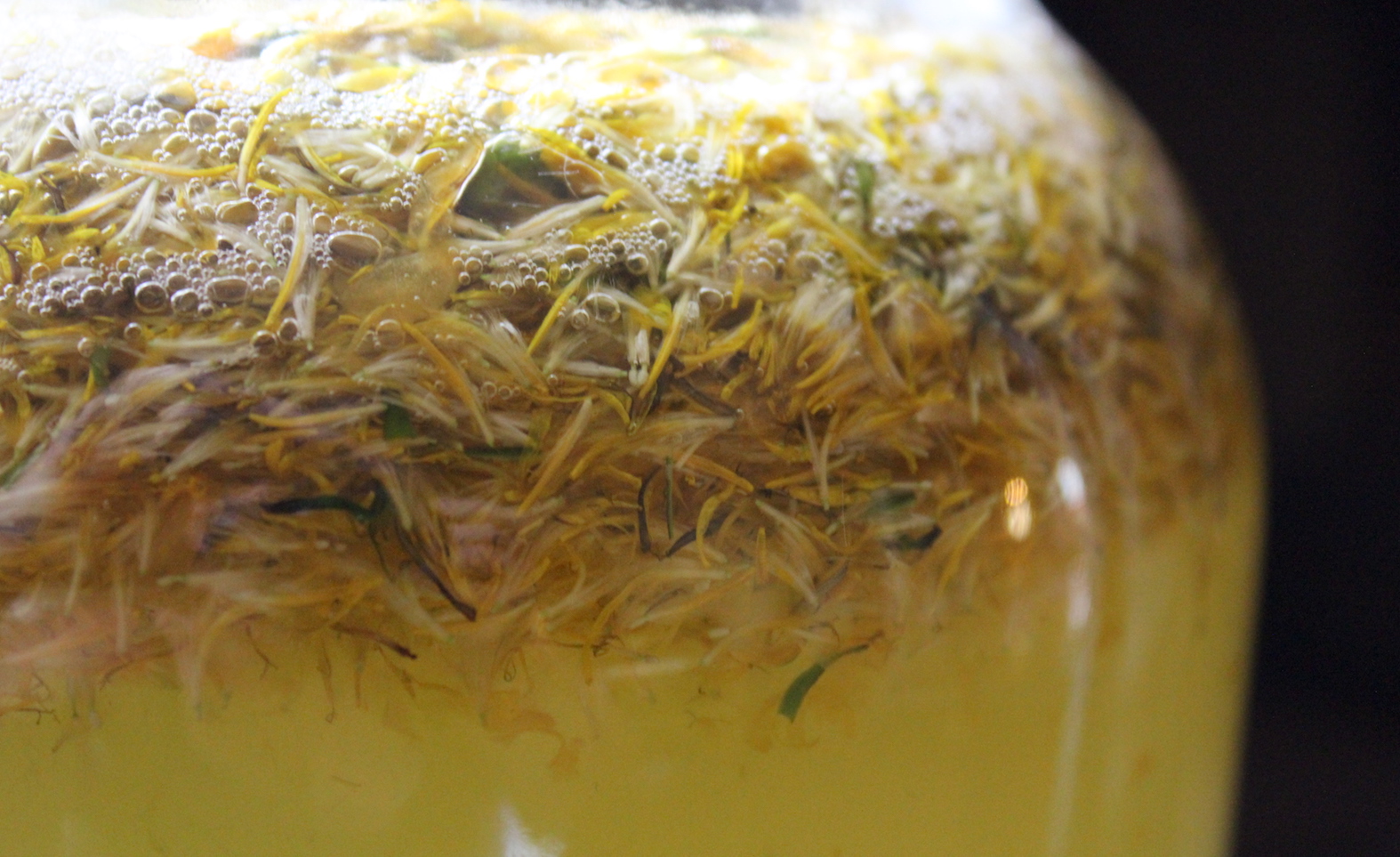
Making dandelion wine goes back centuries in European folk tradition, and early settlers brought the practice to America where it became a staple of rural homesteads.
This sweet, floral wine has subtle notes of honey and citrus, and if you’ve ever wondered what sunshine would taste like if you could sip it on a cold January evening, this is pretty close. My recipe is adapted from the Foxfire Books, those wonderful collections of Appalachian folk knowledge that have been inspiring homesteaders for generations.
If you’d prefer to use honey instead of sugar, you can make dandelion mead instead, which has even more body and complexity.
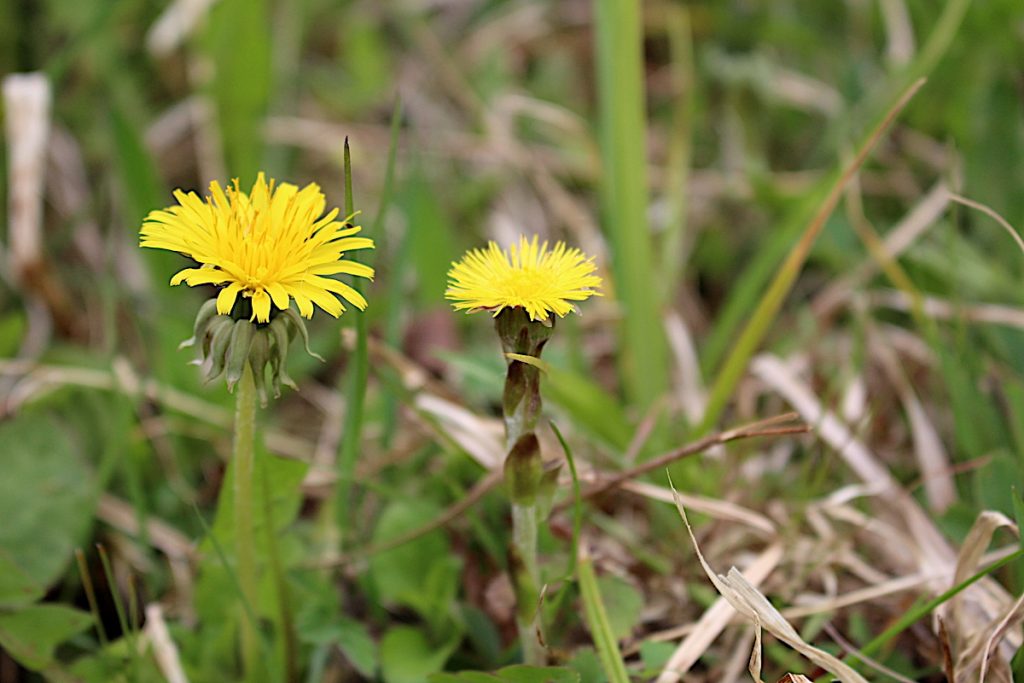
Just be sure you have actual dandelions before you harvest. I’ve seen plenty of people mis-identify coltsfoot or hawkeye blossoms as dandelions, and those are not tasty at all. This guide to identifying dandelions and avoiding lookalikes will keep you on track.
Notes from my Kitchen

My husband and I made our very first batch of dandelion wine together on our first date, a full 5-gallon batch that we fermented and bottled that spring. I’ll tell you what, there’s plenty of courting you can do while sitting across from each other cleaning dandelion petals for hours on end. By the time we’d finished separating all those tiny yellow petals from the bitter green bits, both of us knew we had something.
We’re still drinking a bottle of that wine every year on our anniversary, 15 years later, with just 5 more bottles left to go. Every sip takes me right back to that warm spring afternoon, sitting on the porch with a bowl of dandelions between us, falling in love over the most old-fashioned project imaginable.
I’ve been using your dandelion wine recipe since 2020, doing 2 gallons a year. It always turns out wonderful!
Ingredients for Dandelion Wine
Like all homemade country wines, dandelion wine is really just about creating a balanced fermented beverage with enough sweetness to be tasty, enough acidity to add bright flavor, and enough body to make it feel like a proper wine. The dandelion petals bring the flavor and color, and the other winemaking ingredients fill out the recipe with a balance of acidity, sweetness and body.
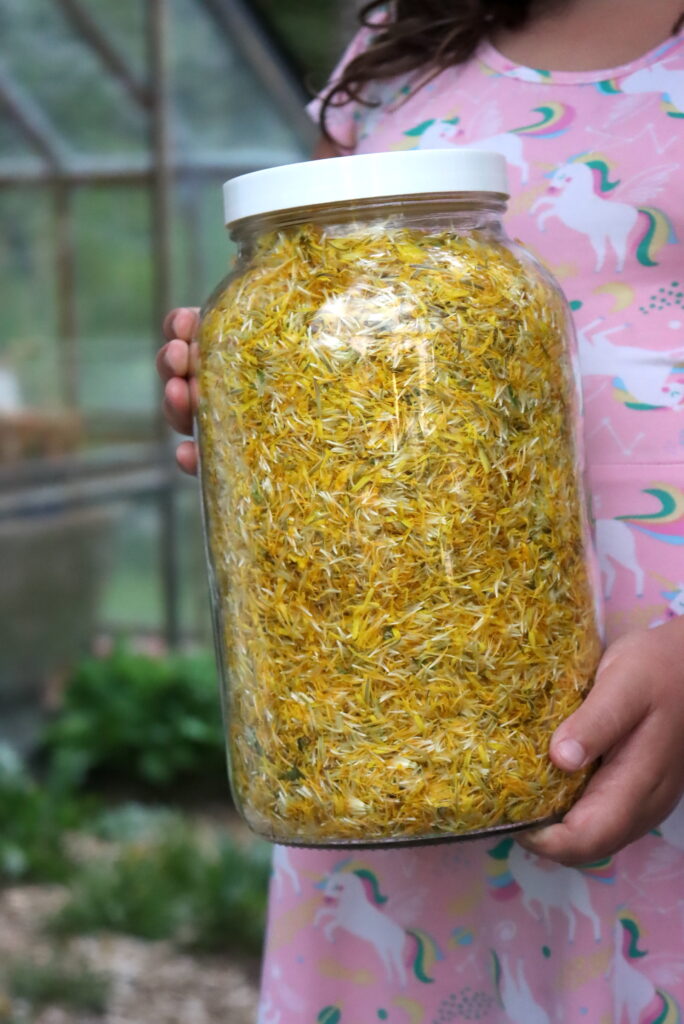
- Dandelion petals – You’ll need about a quart of cleaned petals for a one-gallon batch, which comes from roughly 3 to 4 quarts of whole flower heads. Only use the yellow petals because the green sepals underneath have a bitter, milky sap that will ruin the delicate flavor of your wine. Fresh or frozen petals both work well, just clean the petals before you freeze them. Dried petals tend to lose flavor, so freeze them until you have enough.
- Sugar – The dandelion petals themselves don’t have nearly enough natural sugar to ferment into wine, so you need to add sugar for the yeast to convert into alcohol. About 3 pounds (5 to 6 cups) per gallon gives you a nicely balanced wine with some residual sweetness. The yeast eat most of this sugar during fermentation, so the finished wine won’t taste as sweet as you might expect. To convert the recipe to a homemade honey mead, substitute honey which adds its own lovely character.
- Water – This creates your wine base. If your tap water tastes strongly of chlorine, use filtered or spring water instead since chlorine can inhibit your yeast.
- Oranges and lemon – The juice and zest from citrus serves double duty here. First, it provides the acidity your yeast need to ferment properly (flower petals are neutral pH on their own). Second, the bright citrus notes complement the sunny flavor of dandelions beautifully. Three oranges and one lemon per gallon is the sweet spot. Don’t skip it, since the wine needs acidity for safe fermentation.
- Wine yeast – Different yeast strains produce different flavors and alcohol levels, so the strain you choose actually matters quite a bit. See the yeast section below for my recommendations.
- Yeast nutrient – Here’s something a lot of people don’t realize: yeast can’t survive on sugar alone. They need nitrogen and other micronutrients that grapes provide naturally but flower petals don’t. Without yeast nutrient, your fermentation might stall or produce off-flavors. You can substitute a handful of raisins (the yeast will get nutrients from them), but powdered yeast nutrient gives more consistent results.
You won’t need tannin powder for dandelion wine since we’re going for a light, delicate floral character rather than a full-bodied wine. The citrus provides all the structure you need.
Yeast for Dandelion Wine
The yeast strain you choose really does make a difference in your finished wine. Different yeasts contribute different flavor esters as they ferment, and their alcohol tolerance determines both your final alcohol percentage and how much residual sweetness you’ll have. Good options for dandelion wine:
- Red Star Cote des Blancs – A slow fermenter that really preserves the delicate floral notes in flower wines. It has a lower alcohol tolerance (12 to 14%) which means more residual sweetness in your finished wine. This is my top pick for dandelion wine.
- Lalvin D47 – Adds fruity and floral character with hints of spice. A moderate fermenter with 15% alcohol tolerance.
- Lalvin EC-1118 – Champagne yeast with a neutral profile. Go with this one if you prefer a drier wine, as it has an 18% alcohol tolerance and will ferment out more of the sugar.
One packet treats 5 gallons, so you only need about a teaspoon per gallon batch. And whatever you do, don’t use bread yeast. It’ll make your wine taste like bread and only tolerates around 5% alcohol anyway.
Equipment for Dandelion Wine
Beyond your ingredients, you’ll need some basic winemaking equipment:
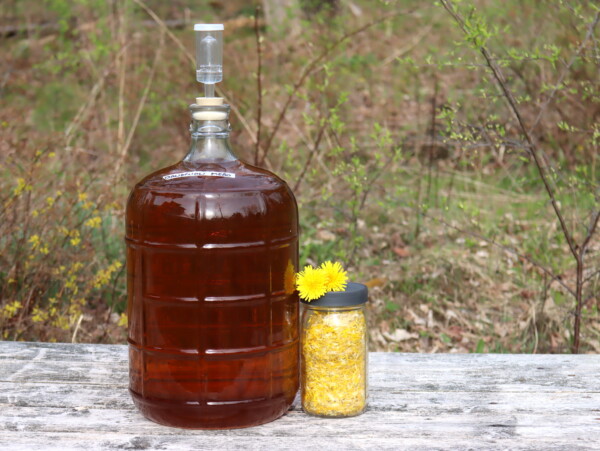
- Wide-mouth glass carboy or fermentation crock (the wide mouth is essential for flower wines since you’ll be fermenting with petals in there, and they’re much easier to clean out afterward)
- Narrow-neck glass carboy for secondary fermentation
- Airlock and rubber stopper to seal the container so CO2 can escape during fermentation, but contaminants can’t get in to turn it into vinegar
- Auto-siphon for moving the wine to a clean container to leave sediment behind, and for bottling.
- Wine bottles, corks, and corker (or flip-top Grolsch bottles for small batches)
- Brewing sanitizer to keep everything clean
If you’ve ever tried to clean flower petals out of a narrow-neck carboy, you’ll understand why I’m so insistent on the wide-mouth option. Those petals will glue themselves to the inside of the neck and you’ll be scrubbing with a bottle brush for ages.
Start with a wide mouth carboy until the petals come out of the container, then transfer to a narrow neck if possible to minimize the surface area in contact with air during the next stage of fermentation. (A wide mouth carboy will work for both in a pinch.)

How to Make Dandelion Wine
The process here follows the same basic method as any small-batch fruit wine or flower wine. If you’re brand new to winemaking, I’d recommend reading through my beginner’s guide to making homemade wine first, which walks you through everything in more detail. For mead variations with honey, check out my guide on how to make mead.
Harvesting and Cleaning the Petals
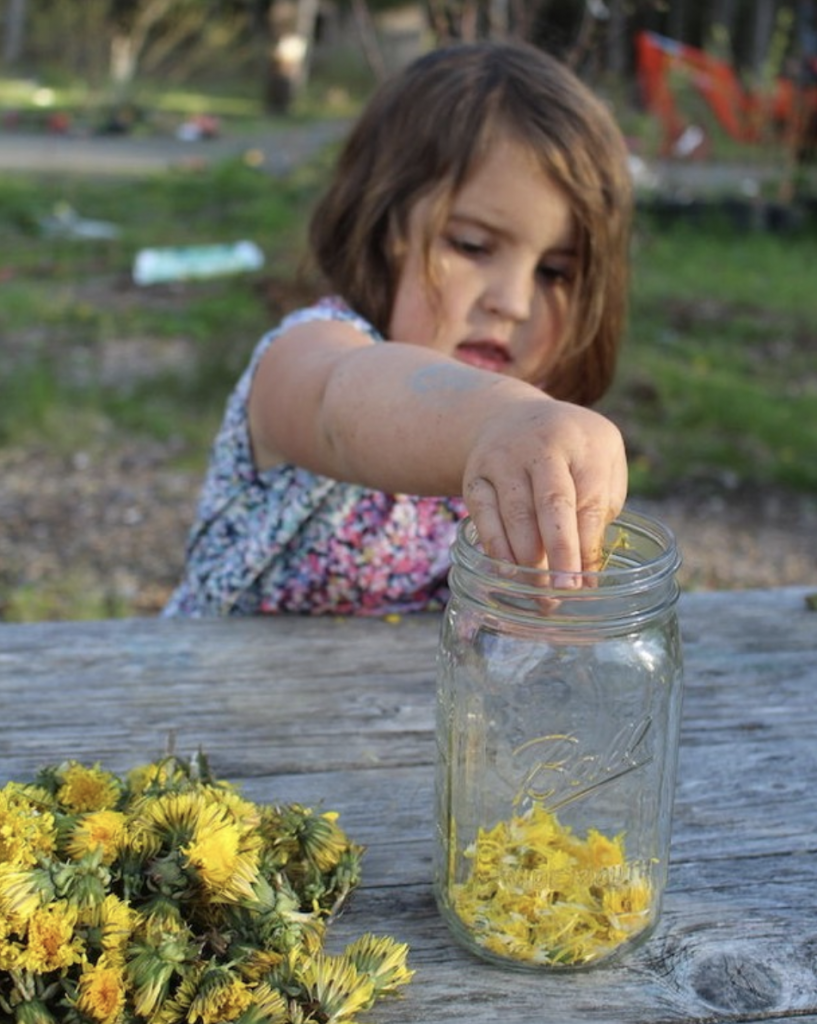
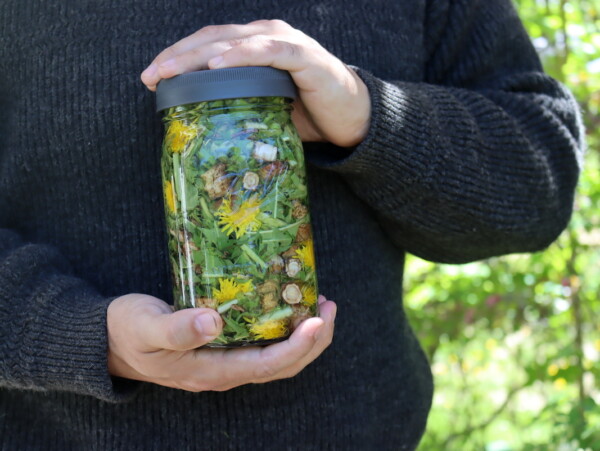
The real work in making dandelion wine isn’t the picking. It’s the cleaning. You need to separate just the yellow petals from the bitter green sepals underneath each flower head, and there’s really no way around the fact that this takes a while. A quart of cleaned petals takes about an hour of patient work, so plan accordingly and maybe enlist some help.
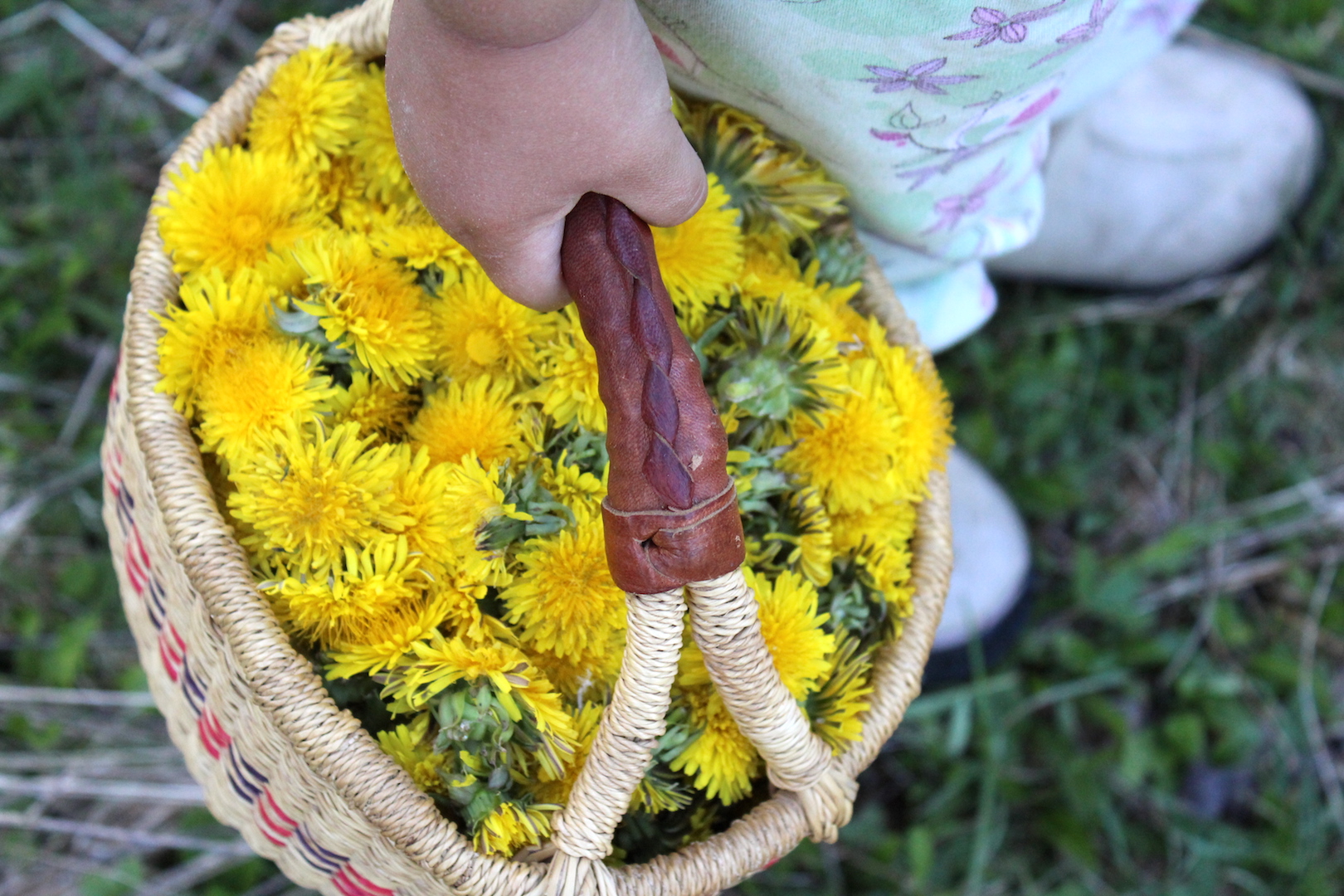
Kids are excellent dandelion pickers, and I’ve successfully bribed mine with promises of dandelion ice cream, dandelion cookies, and dandelion gummy bears over the years. There’s a reason I have so many dandelion recipes and specifically, dandelion flower recipes in my back pocket, and that reason is wine.
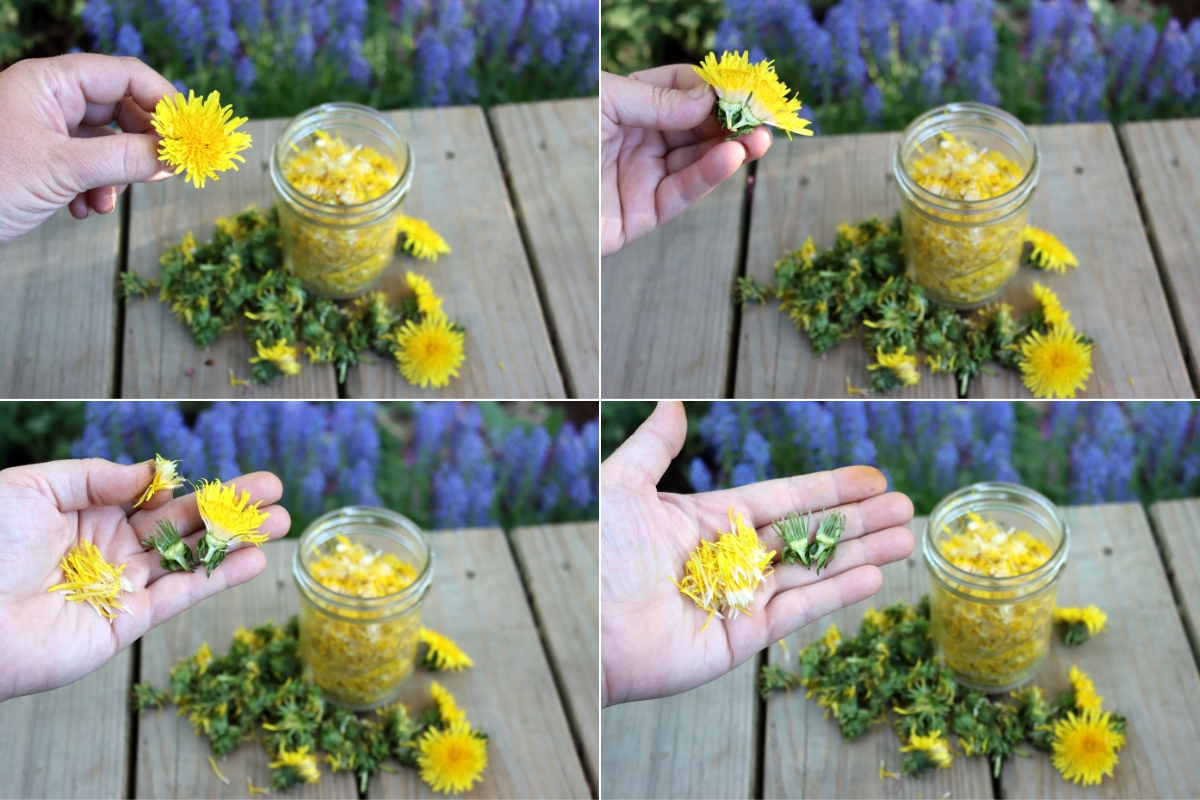
The simplest method starts by breaking the dandelion flower in half (vertically, through the stem). Once it’s open like that, it’s easy enough to pull out the petals and discard the green sepals.
Mixing the Must
This recipe uses a cold infusion method, which preserves more of the delicate floral flavor than making a dandelion tea first. Bring your water and sugar to a boil on the stove, stirring until the sugar dissolves completely, then let it cool to lukewarm.
Place your cleaned dandelion petals in your sanitized wide-mouth fermentation vessel along with the citrus juice and zest, then pour the lukewarm sugar water over everything.
Add the yeast nutrient and stir to combine.
Pitching the Yeast
Once your must has cooled to room temperature (anything below 90°F is fine), rehydrate your yeast by sprinkling it into a small amount of warm water and letting it bloom for 5 to 10 minutes.
Pour the activated yeast into your fermentation vessel, then top off with enough water to fill the carboy while leaving about an inch of headspace for bubbling.
Seal with an airlock.
Primary Fermentation
Within a day or two, you should see active bubbling as fermentation kicks in. Let the wine ferment with the dandelion petals in there for about 10 to 14 days.
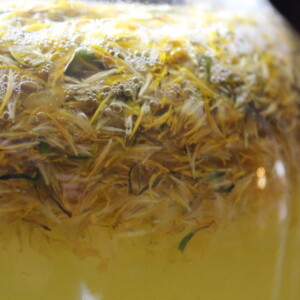
The petals will float to the top, and that’s perfectly normal. If they bubble up into your airlock and clog things up, just remove the airlock, clean it out, and put it back on.
Racking to Secondary
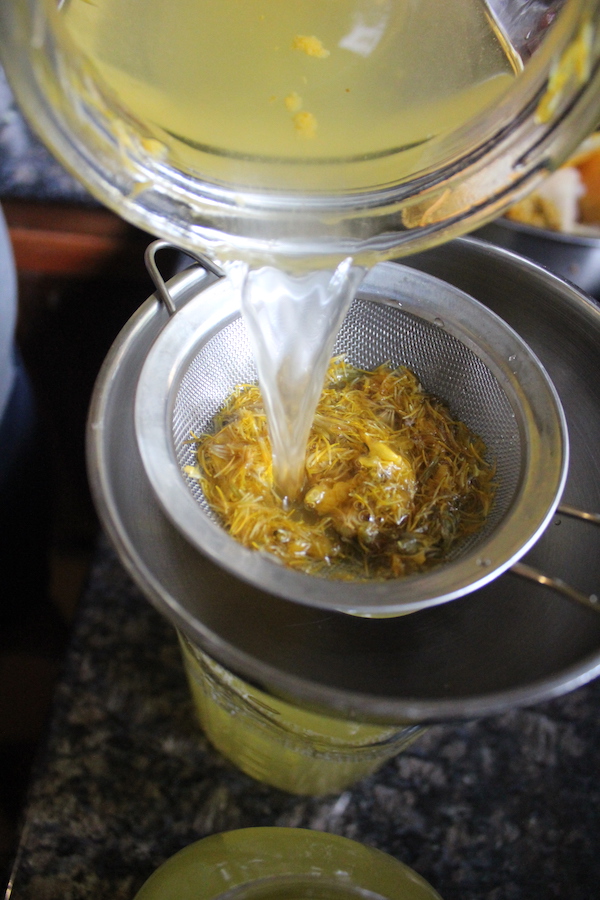
When the bubbling slows down (usually after 10 to 14 days), it’s time to rack the wine into a clean narrow-neck carboy for secondary fermentation. Scoop the floating dandelion petals off the surface first, then use your siphon to transfer the liquid while leaving the sediment at the bottom behind. Pop an airlock on top and stash it somewhere cool and dark.
Let it ferment in secondary for at least 6 to 8 weeks. Check the water lock periodically to make sure the water hasn’t evaporated.
Bottling and Aging
Once secondary fermentation is done and your wine has cleared, give it a taste. If it’s too dry for your liking, you can backsweeten by stabilizing the wine first with a Campden tablet and potassium sorbate, then adding simple syrup to taste.
Siphon the wine into clean bottles, leaving the sediment behind one more time, and seal with corks or flip-top lids. Try to let your dandelion wine age for at least 2 months before drinking, though honestly, 6 months is even better. The flavors really smooth out and integrate with time, and by January you’ll have liquid sunshine in a glass just when you need it most.
Tips for the Best Dandelion Wine
- Pick on a sunny day. Dandelion flowers open wide in full sun and close up on cloudy days or in the evening. You’ll get more petals per flower if you pick when they’re fully open.
- Use only the yellow petals. I can’t stress this enough. The green parts will make your wine bitter. Take the time to separate them properly.
- Try a tiny batch first. If you’re not sure you want to commit to a full gallon, divide the recipe by 4 for a one-quart micro batch wine. All you need is a quart mason jar and a mason jar fermentation kit.
- Be patient with aging. Dandelion wine tastes rough when it’s young. Give it at least 6 months in the bottle and you’ll be rewarded with something truly special.
- Consider making mead. If you swap out the sugar for honey, you get dandelion mead which has even more body and complexity. It takes longer to ferment (honey is harder for yeast to digest), but the results are spectacular.
- Try other flower wines. Once you’ve mastered dandelion wine, check out lilac wine, violet wine, or elderflower wine for more floral adventures.
Frequently Asked Questions
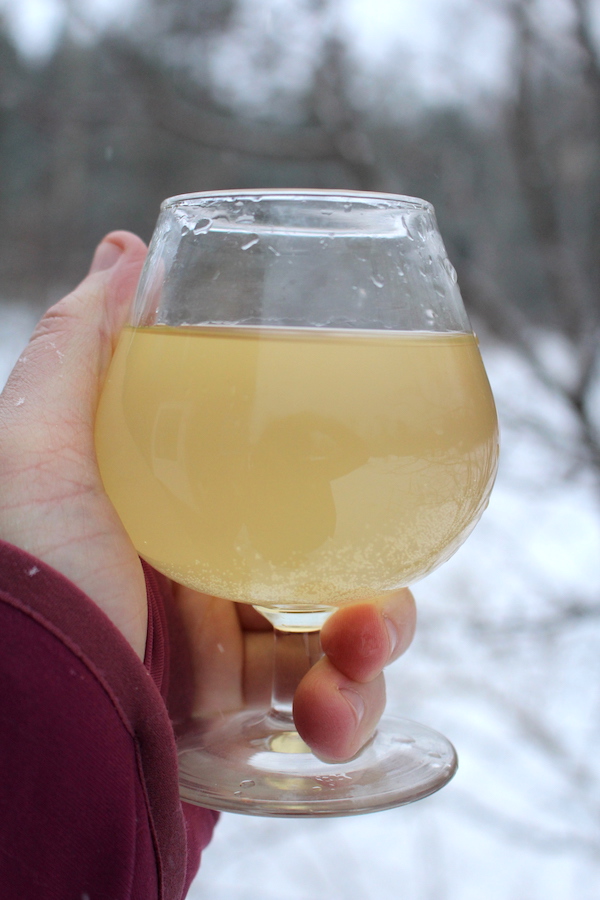
If you’ve done it right, dandelion wine tastes sweet, mild, and floral with subtle notes of honey and citrus. You can almost feel the sunshine splash against your tongue. It should go down smooth with no hints of bitterness. If yours is bitter, the green sepals probably got into the batch.
The green sepals have a milky, bitter sap that will ruin the delicate floral flavor of your wine. You’ll end up with something that tastes more like dandelion greens than sunshine in a bottle. It’s tedious work to separate the petals, but it’s absolutely worth taking the time to do it properly.
You can technically drink it after just a couple weeks of bottle aging, but it’ll taste rough and won’t do justice to all your hard work. I’d recommend at least 2 months, and 6 months is even better. The flavors really smooth out and integrate over time, and by midwinter you’ll have something truly special to sip.
The final sweetness depends on your yeast choice and how much sugar you use. Yeasts with lower alcohol tolerance (like Cote des Blancs at 12-14%) will leave more residual sugar and produce a sweeter wine. If you want it sweeter, you can add a bit more sugar (start with 1/4 cup extra per gallon), or backsweeten after fermentation by stabilizing the wine first with Campden tablets and potassium sorbate, then adding simple syrup to taste.
Dandelion wine uses sugar as the fermentable, while dandelion mead uses honey instead. Mead takes longer to ferment since honey is more complex for yeast to digest, but you get lovely honey notes alongside the floral dandelion flavor, plus more body and better mouthfeel. You can also split the difference and use part sugar, part honey.
Absolutely! Freezing actually works well for dandelion petals and helps preserve them if you’re collecting over multiple days. Just thaw them before adding to your must. The flavor won’t be quite as bright as fresh petals, but it’s still very good. Don’t dry the petals, they lose flavor that way, freezing is much better.
Dandelion Recipes
If you tried this Dandelion Wine recipe, or any other recipe on Practical Self Reliance, leave a ⭐ star rating and let me know what you think in the 📝 comments below!
And make sure you stay in touch with me by following on social media!
Dandelion Wine
Equipment
Ingredients
- 3 quarts water, approximate, more to fill
- 3 pounds sugar , roughly 5 to 6 cups
- 1 quart cleaned dandelion petals, packed, from roughly 3-4 quarts blossoms
- 3 medium oranges, juice and zest
- 1 medium lemons, juice and zest
- 1 tsp yeast nutrient
- 1 packet wine yeast, see notes
Instructions
- Bring the water and sugar to a boil in a saucepan. Stir to dissolve the sugar and cool to lukewarm.
- Place the dandelion petals, citrus juice and zest into a one-gallon fermentation vessel. Add the yeast nutrient and pour the lukewarm sugar water over the top.
- Dissolve a packet of champagne yeast or other wine yeast in lukewarm water. Allow it to stand for 5 minutes to rehydrate and then pour it into the wine. Top off with a bit of extra water to fill the carboy, but be sure to leave at least an inch of headspace.
- Cap with an airlock and ferment for 10 to 14 days, or until fermentation slows significantly.
- Scoop off the floating dandelion petals, then siphon the wine into a clean container, leaving the sediment behind. Allow the wine to ferment in secondary for at least 6 to 8 weeks, checking the water lock periodically to ensure the water hasn’t evaporated.
- Bottle the dandelion wine in corked wine bottles for longer storage, or flip-top Grolsch bottles for small batches you’re not planning on storing long.
- Allow the wine to age in the bottle at least 2 months before drinking, ideally 6 months or more. During aging, keep bottles somewhere cool like a basement or closet on the north side of the house (65 to 68 degrees F is ideal, but room temp is fine).
Notes
Nutrition
Nutrition information is automatically calculated, so should only be used as an approximation.
Winemaking Recipes
Find the perfect recipe
Searching for something else? Enter keywords to find the perfect recipe!










Can I add white raisins, to the one gallon batch after straining the peddles and CITRUS ?
What amount of raisins do you suggest adding based on the recipe you provided and when should they be added? Thanks!
If you’re using raisins, they’re added at the beginning with the dandelion petals (and filtered out before secondary, just like the petals). I’d add a good-sized handful, around 1/8 to 1/4 cup.
Hey! So I was wondering about varying the sugar amount in this recipe. I wanted a dry wine, not a sweet one and I saw recipes with anywhere from 1 1/2 lbs of sugar to 3 lbs. I went with 1 1/2 lbs as I wanted a dry wine. However, after two weeks it is pretty sour! I put it into carboys, but is there a way to adjust the sweetness now that it has already finished fermenting? Will it mellow with time?
With that little sugar, it’s going to be sour. I like dry wine too, and I’ve tried reducing the sugar down really far like that, but it just results in sour wine at a certain point. For a dry wine, I’d try 2 1/4 to 2 1/2 pounds sugar, and even then avoid champagne yeast since that really eats up sugar fast. Choose a milder wine yeast that’s less agressive.
If you’re just two weeks in, there’s plenty of time to adjust the sugar and still salvage the batch. Filter out the dandelion petals (if you haven’t done that yet), and add more sugar. The yeast are still alive in there and will revive if fed. Make a sugar syrup on the stove with sugar and water, just enough to dissolve it. Allow it to cool completely all the way down to room temperature, and then add it to the carboy.
Cap it with a water lock and watch it because it’ll likely ferment vigorously for a few days. Given that you started with 1 1/2 pounds, I’d add in 3/4 to 1 full pound and try that. Allow it to ferment for a few more weeks, then try it. Good luck!
Thanks so much! It has been about a month. Is that too long? Can I reactivate my yeast with a pinch or two of white wine yeast if need be? Thanks.
Hi, I just put my dandelion wine into secondary….after about 8 weeks in primary (time seems to have gotten away from me). There was nothing moldy going on and everything looked pretty great. It also actually smelled really lovely! I tasted it as I racked it into secondary (discarding all the petals and not dredging up the settled and it is slightly sour. At this point, could I do the above regarding adding more room temp simple syrup, or do I just need to let this batch do its thing and see what happens.
Thanks
R
You can definitely add more simple syrup if you want to sweeten it. That may kick off more fermentation, so you’ll need to let it go another few months before bottling. This recipe in particular results in a pretty sweet wine, so I hope you didn’t get any vinegar contamination to cause the “sour” taste.
I left a good inch of headspace and it overflowed everywhere… twice. I took out the petals that had oxidized, cleaned the top and all around and mixed the petals back in. This is day 2… and I ok to keep fermenting? The yeasts are obviously very happy about something, lol.
I used Champaign yeast and raisins instead of yeast nutrient
Wow, that’s crazy! Yes, it’s ok to keep fermenting and it’ll be fine (albeit messy). Sounds like you have a really active ferment. Are you using a narrow neck fermenter? Sometimes that’ll cause clogs with the flower petals and result in overflows (which is why I’m using the wide mouth now). Lacking a wide mouth fermenter, it might make sense to do the primary in a bucket instead.
Hi, there!
Thanks for this recipe, This is my first attempt at wine making, I’ve been intrigued by dandelion wine for a number of years and have decided to make it a project. I brewed it up on Tuesday, it’s now Saturday and I’ve got a few questions-
First, I got everything in the gallon jar, poured in the nutrient and the dissolved yeast, At this point I had an inch of clearance and capped off with water lock. I didn’t stir (like I said-complete newbie, I didn’t see anything about stirring, so I didn’t!) The result was, immediately started bubbling rapidly and soon was bubbling all out the top of the lock. I did some quick research, found a you tube video which showed I should have indeed stirred it, so I did that, cleaned the lid and water lock and recapped. An hour or so later, the same thing – bubbling out the top. More research, found some recommend just covering the jar with cloth for about 3 days to let the excess CO2 escape more easily. So I id that, Obviously, not stirring was and issue, but did I have it too full? There was just an inch when I started.
Then, last night when I went to re-cap again, I noticed the flowers are all floating on top. So, I stirred again before re-capping. Now everything is bubbling and fermenting fine, but the flowers are still floating. The liquid is now about to the shoulders of the jar, and the flowers are on top, about up to the lid. I thought I had the right 1 quart amount of petals, but mine seems to have a lot more than what your pictures show. Will it hurt the flavor of the wine if the petals are floating, not IN the liquid? Also, concerned about bacteria after reading a previous comment. Should I add more water or remove some of the petals? Or both?
I hope I haven’t completely ruined my batch. Is there any way to tell at this point? If I have, I may be able to still get enough flowers to try again.
Thanks again! This newbie really appreciates your help!
Anne
Hey Anne, everything you mention is totally normal. I usually don’t have issues with overflows when I use a 1” headspace to start, especially with the wide mouth fermenter. That said, sometimes a batch is really vigorous and can overflow. Some people suggest, as you say, not capping it and just leaving it covered with a towel for the first few days. That’s a perfectly fine method too. At that point, so much CO2 is coming off that it has positive pressure and it’s pushing any possible contaminants away from the wine with the continuous flow of CO2 rising, so it’s not a big deal to have it open covered with a towel. Once it calms down though, get the water lock on.
As to the floating petals, that’s also perfectly normal. They tend to trap CO2 bubbles and then float a bit. That’s not an issue, provided they’re filtered out after primary, which is what I suggest. Left in too long, anything above the waterline will eventually mold so that’s why you have to remove those after primary once they’ve flavored the wine. Don’t worry, there’s still plenty in the liquid and it sounds like everything is going as it should with your batch.
Hi! I just started this recipe on Saturday, excited about it! I am a little concerned because i’m about 48 hours in from adding the yeast and i don’t see any bubbling happening yet… my house is cooler around 68 degrees. How long should i expect it to take before it starts bubbling? OR should I add more yeast? I’m doing a 1 gallon batch and added a packet of white wine yeast along with 1 tsp of yeast nutrient. I waited for the mix to cool down to about 95 degrees before putting the yeast in but i’m thinking maybe it was still too hot and I killed it. 🙁 any advice?
Occasionally it can take more than 48 hours to see bubbles, especially if it’s cool in the house…but at 72 hours I’d start to worry and add more yeast. You never know how that yeast was stored before it got to you, and there’s always a chance you have a bad packet.
I started a batch dandelion wine today, and afterwards was wondering: Why isn’t sterilizing the equipment/absolute cleanliness super important in this process, as it is in beer brewing (where you sterilize every pot/cup/spoon/carbuoy)? Or is it just as important and thus my batch prob will go awry…
What is the different between a water lock & air lock? And the difference between an airlock and a carboy. I’m not sure about the instructions and if I need both airlock and carboy.
An airlock and a water lock are the same thing, so you only need one of those. They just go by both names, even though it may seem contradictory. It uses water to lock out air, so that’s the reasoning for why it’s called different names by different people.
A carboy is the glass or plastic vessel that holds the wine. It’s basically just a fancy name for a brewing container. You need a carboy (sometimes two if you want to “rack” or transfer the wine into a clean one half way through the ferment), and one water-lock/air-lock, along with a bung of some sort that fits the carboy so that the water/air lock can attach.
So I saw that you have lilac wine on this wonderful blog, and this dandelion wine. I was wondering if you ever made honeysuckle wine? I feel like it might be delightful, and was thinking about using grapefruit as the acid. Thoughts?
I think that’d be amazing!
Cool! I just want to make sure I don’t make something gross haha!
Hello Ashley,
My friend and I have tried this recipe this week and I have followed your instructions to yhe letter. I woke up today and my wine bubbled out a bit and created a puddle on top of my lid. Is there anything I may do so that this does not happen the whole time? Thank you so much for this recipe and any pointers you can throw my way ☺
Sorry my response is so late, but that is a common issue. Simply clean and re-sanitize your airlock and it should be fine.
You mention the use of raisins, but the recipe does not say how many to use. Please clarify???
If you choose to add raisins instead of yeast nutrient, I’d suggest a handful of around 1/8 to 1/4 cup. Add them in primary and then filter them out with the dandelion petals.
Why there no mention of washing them?!
Because I don’t =)
Hey –
I read elsewhere that if I can’t pick enough dandelions for a gallon batch in one sitting, I could just freeze the petals until I have enough. Wondering how that might affect the flavor of the finished product. Thoughts?
Hi Ashley, thanks for this recipe. I’m really excited to give it a try. I’m definitely curious about trying the cold infusion. I read so much out there about the importance of sanitizing everything, but then I wonder how everything in this wine mixture is going to stay sanitized when the petals aren’t cleaned and boiled. Is there a danger in some other bacteria taking over during the fermenting process since the petals aren’t cleaned and boiled?
That’s a great question. Failure to sanitize your equipment can cause outside bacteria, mold etc. to spoil your batch or ruin the taste. If you are picking dandelions from a clean area, the only bacteria that should be present is what is natural to the flower and is not harmful. If you are boiling the petals, you would be losing a lot of the flavor and benefits from the dandelion.
So I picked my dandelions yesterday and didn’t have enough time to pluck the petals out… They closed up over night and are a bit brown on the ends. Are they still good to use do you think?
Yup, totally fine. They close up quick! We’ve saved them overnight and plucked them the next day without issue. Just break them in half and then the petals come right out.
Perfect! Great to know. Thanks for the reassurance! Much appreciated…
Hey good morning! Is there any benefit to using weights to keep the petals submerged during the ferment? Thank you!
I don’t, largely because any weight I’ve added to my winemaking just sinks past the fruit and plops to the bottom. The main risk with fruit/flowers/solids of any kind above the water level is that they could mold eventually, which is why you filter them out after the initial primary fermentation. If you forget it in primary too long, you might be in trouble with flowers floating above the water line, but generally, weights aren’t required if you get it racked over on time.
Hello! How would this recipe change if did make a five gallon version? Just times it all by 5 and use a whole pack of yeast? Assuming I can get enough helpers! 🙂
Yup, that’s pretty much it! When we did it, I started the ferment in a plastic bucket fermenter, and put the dandelion petals in a drawstring brewing bag which made it much easier to pull them out at racking time. Then we racked it into a glass carboy with a narrow neck for aging in secondary. Definitely, use a siphon, and don’t try to cheat just pouring it over at that quantity.
But yes, same recipe for 5 gallons. Enjoy!
Hi! Love the recipe and plan to try it 🙂 Is there a second fermentation between steps 4 and 5 that should occur? Just want to make sure I’m not missing something.
Thanks!
Yes! I just went back and checked the recipe and you are correct! I talk about a secondary ferment in the text of the article, but there was a sentence missing in the actual recipe card. Fixed now. It should be racked and then ferment in secondary for at least 6-8 weeks, or much longer if you prefer (6 months).
I should note, that not all recipes you can find online include a secondary ferment, and several say to bottle and drink the wine after a 2-4 week initial ferment. That’s an option, but it increases the risk of blown corks (since there’s still a lot of fermentable sugar).
Perfect! Thank you. I’ve ordered my supplies and can’t wait to try it out! I’ll update you on how it goes 🙂
Hi again! I have to thank you again for these great recipes and for you responsiveness to all the questions! I’ve made a 1/2 gallon of the dandelion wine 5 days ago and added 1/2 tsp yeast nutrient, no raisins. I found that I had quite the overflow on day 2 so I cleaned out the airlock and removed a bit of the petals on the top and gave it a stir. I haven’t seen much bubble action since. It seems pretty much done now. Any ideas what is happening? Did I ruin my batch by opening it up or do you think the second fermentation will give it wake up? Thanks again!
You’re right on schedule! It’s warm out at the moment (at least here) so primary ferments are going a bit faster in my kitchen. I have a watermelon wine, pineapple wine, and lemon balm mead just finishing up primary on my counter and they all went FAST. Heavy bubbling and a bit of overflow on day 2, then a clean out and now around day 4/5 they’re pretty quiet. Often my house is very cool, and primary ferments, especially early in the spring for dandelion season take longer, but not this time.
It’s time to rack both yours and mine over into secondary, filter out all the solids at the top (dandelion petals) and leave the yeast sediment behind. If the water level is low after you rack it, add a bit more filtered (unclorinated) water to top it off, re-attach the water lock and let it ferment in secondary.
Ideally, get it somewhere cooler for secondary because you want to slow it down at this point. The slower the secondary goes, the better the finished flavor will be. Mine are all moving down into my cool basement today, but a cool pantry or closet works well too. Just keep an eye on the waterlock, try to check it each week. You shouldn’t have overflows after this point, but sometimes the water will evaporate out of the water lock before secondary is finished.
Good luck with your brew, it sounds like you’re right on track.
This is great news! Thank you! I will rack this weekend and move it to my basement for “the long wait”…lol. I can’t tell you how much I appreciate your instruction through all this! The clarification is invaluable to this newbie! 😉
No worries, happy to help =)
I made this recipe and it’s turning out well! A problem I’m having is that even though the fermentation showed it had stopped (no gas coming through airlock for a day or two)), I bottled and then after a week, one of my three bottles of wine blew its cork while in storage! Once opened, we saw it was super carbonated and we had to open the other two bottles to release gas, they were also super carbonated! Advice??
So a couple of things could be at work here…
Secondary fermentation: When I make dandelion wine, I always rack it over into a secondary fermentation step before bottling. That means pouring it into a new container, leaving the sediment behind, re-attaching the water lock and allowing it to ferment slowly for another 2-3 months before bottling. I talked about this in the article, but I made an error when typing up the recipe card (that I’ve now fixed). Sorry about that.
That said, there are plenty of dandelion wine recipes online that bottle the whole thing up after a quick primary ferment of just 2-3 weeks, but then they suggest keeping the bottles somewhere cool like a basement. Either way, I think it’s a good idea to keep the bottles out of the summer heat during aging.
Second thing, if you used raisins instead of yeast nutrient it can take a bit longer for everything to ferment properly.
If you’re still having issues, store them in the refrigerator until you’re ready to drink them. It sounds like your ferment needed a bit more time, and I do apologize for the error in the original recipe.
You say use flip tops if storing fir a short time. What us short and why?!
I have dandelion wine that my husband and I made on our first date still in the basement (5-gallon batch). We open a bottle up every year for our anniversary…and we’ll be celebrating 10 years in just a few weeks. Those bottles, for long multi-year storage, do best corked because wine needs to “breathe” as it matures and ages. This batch gets better every year.
Anyhow, I’d say if you’re planning on storing it longer than a year, a corked bottle is best. If you’re going to drink it after it’s just had a short time to bottle condition, then Grolsch bottles are easy to use.
Thank you and sorry for all the typos.
Do you know what your starting specific gravity was?
Nope, I haven’t used a hydrometer on this recipe in particular. If you do make it and test it, let me know.
We have frozen some dandelion heads with the hopes of giving this a try. Have you ever used frozen petals before??
Not personally, but I know many people who say they freeze them until they have enough with great results.
This sounds like new knowledge to me..I had a random thought then one thing read to another..Now here we are..Would love to make this dandelion thing…The ingredients though..Don’t know if i can get them in Kenya.
Help an interested fella..😁
Depends on what ingredient you’re missing. If you can’t get dandelions, you ‘re out of luck. Really no substitute. But anything else – including yeast- can be “fudged”.
Yeppers!! No problem!!
John P.
I need some help. Was exhausted when I put my D. wine together & just realizse I used way too much sugar. No moreDandelions in bloom. Think I can even things out with some Burdock root boiled in a gallon of water?
I just put a batch together this morning. The SG on this was 1.130.
I just made this last night, and the reading was higher than my refractometer could read. My guess is somewhere around 35 brix.
Really looking forward to tasting how this turns out! Thanks for the recipe!
Thanks for posting and the idea of small batch wines. I love to try unique flavours, whereas my boyfriend does not. I want to try the dandelion small batch wine in the Spring 🙂 and have bookmarked your blog posts. I have some 1 quart light green jugs from distilled water, do you think I can use these to make the wine in?
Wonderful! I’m glad you’re going to give it a try. I’m not familiar with the type of jug you’re talking about, but really any jug would work provided you can find some way to airlock it so that gasses can escape but contaminants cannot get in. I have friends who make wine “hobo style” in 2-liter soda bottles with a balloon attached to the top as an airlock. If you put a teeny tiny pinprick in it, the gasses can escape but it keeps contaminants out. That said, many people prefer fermenting in glass because they think that the plastic gives off flavors, and they worry about some type of plastic related contamination.
Regardless, if there’s a will there’s a way, and it’s totally possible to make wine without buying any equipment what so ever.
I would just like to make a few comments. I had an old recipe from my father a new paper clipping and I always make my dandelion wine this way. But it never said to pop the petals off I always use the whole head. Never, never has my wine been bitter it’s green and tastes a little like spinach. In the recipe it said though to pick the heads only when it was sunny and the dandelions are open fully otherwise it may be bitter. I think people are doing a lot of work they don’t need to. I tasted the water before adding anything else this time to make sure I am right and yes it’s not bitter at all. After all, how would you know after putting all that lemon juice in it lol so yes it’s a different recipe but I do believe clipping the petals is a waste of time.
Thanks for sharing that. It’s great that you enjoy the taste without having to remove the petals. It can definitely take a bit of time to get that job done. I think most people prefer the taste of the petals alone as it has a much sweeter taste. Many people compare the taste of dandelions to that of honey and prefer that over spinach, especially in a wine.
i would be glad to give my recipe if anyone is interested.
for some older recipes go to archive.org and search it 🙂
Your recipe, is it a 5 gallon bucket or 1 gallon carboy for fermentation? And once dandelion tea is added and pitched yeast do you too off with water for fermentation?
You’re more than welcome to share the recipe.
recipe is as follows. pick 1 gallon of dandelion heads not the stems but a few stems wont hurt. pick only when the sun is out and flower is completely opened. rings them off well and boil a gallon of water on the stove. when the water comes to a rolling boil put the dandelion heads in and let them boil on medium for 20 minutes. then strain the dandelions out into a bucket for fermenting. add 5 pounds of sugar and stir to dissolve. cut in to fours 2 lemons and 2 oranges squeezing the juice in to the fermentor and drop the whole fruit in. cool down to at least 80 degrees and put the yeast can (it could even be bakers yeast but a wine or cider yeast is probably best) let ferment for 3 days. the recipe then said it should be done and ready to bottle but i would wait and make sure because i have had exploding bottles before, remember this is a very old recipe. let age for 6 months and strain it again in to other bottles and drink. it gets better with age. i know this for certain 🙂 but i just rack it from the fermenter in to bottles when its completely done fermenting one time.
CAN YOU GET BY WITH LESS SUGER THAN SUGESTED SO DOES NOT GET TOO SWEET
Well I for one am!! I really did NOT see ANY recipe[ at ail!! Correct me if I am wrong … ???
John P.
Here is a post with 60+ Dandelion recipes for you. https://practicalselfreliance.com/dandelion-recipes/
Is there a recipe for the quart wine of this ? I want to try small first ? And I maybe just blind in all this and not seeing it .
We have a post for making small batches of wine here. https://practicalselfreliance.com/small-batch-wine/ This can be adapted to any recipe.