
Affiliate disclosure: This post may contain affiliate links. Please see our Privacy Policy.
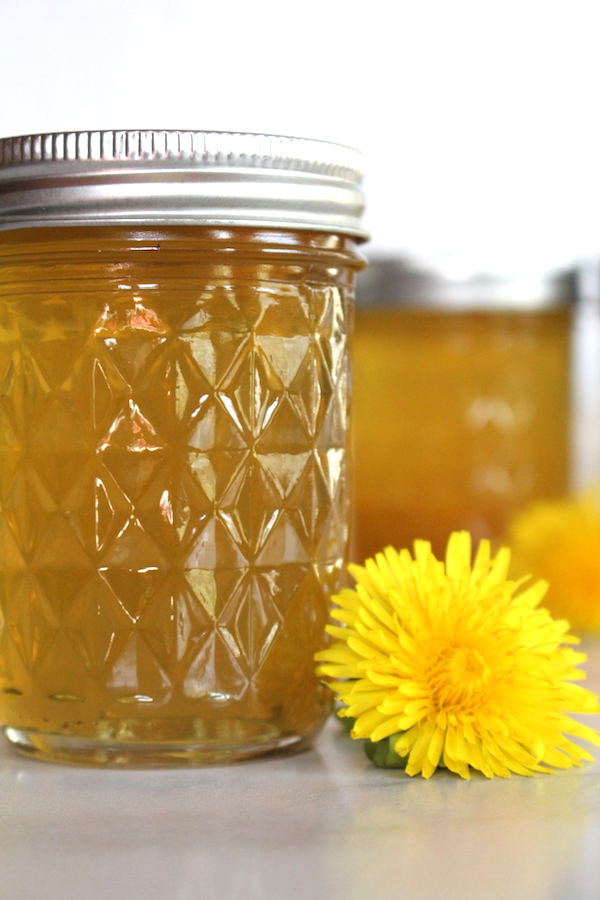
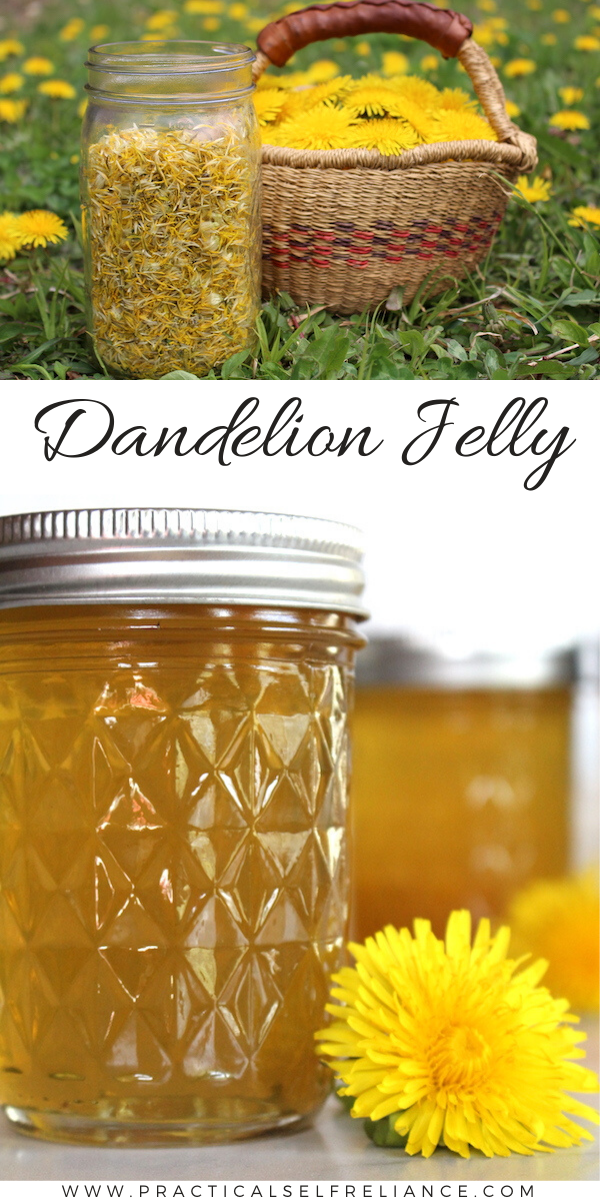
Dandelion jelly is like sunshine in a jar, and it’s the perfect way to brighten your morning toast.
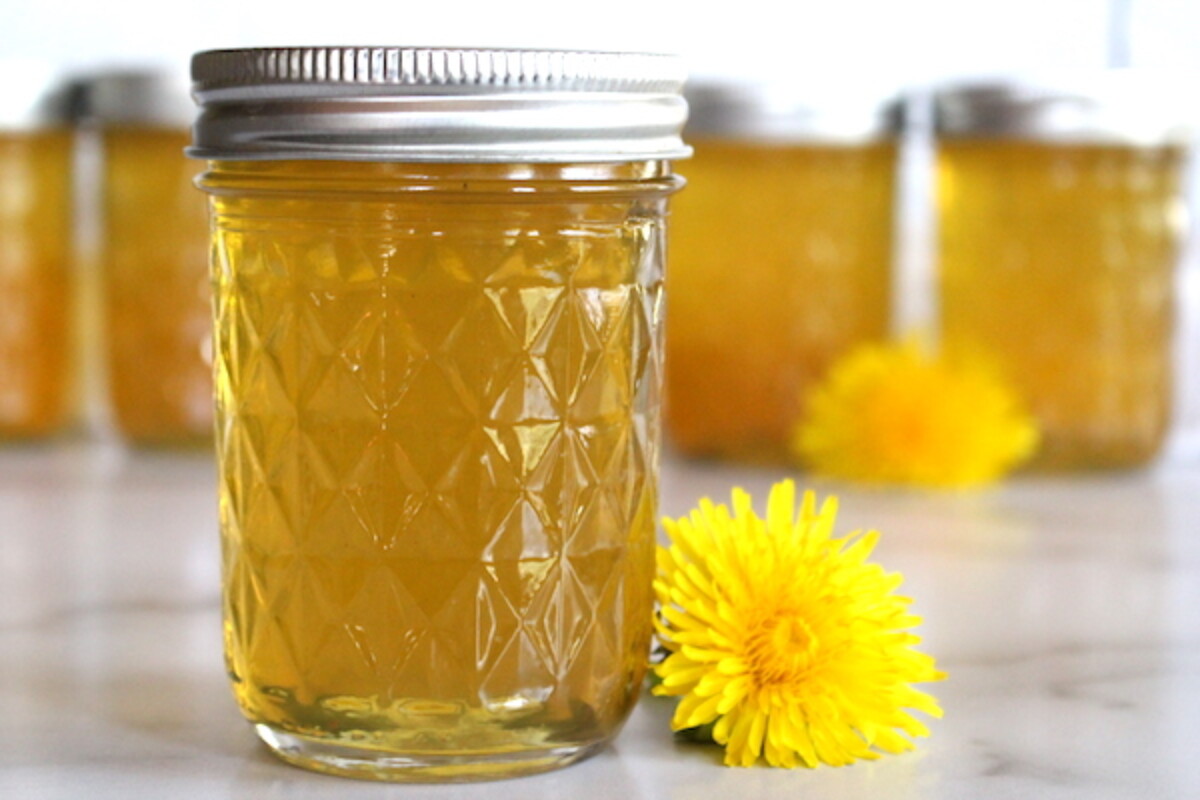
Homemade flower jellies are easy to make, and just about everyone has access to plenty of dandelions.
I make dozens of varieties of homemade jelly every year, but my resident 5-year-old jelly judge tells me that dandelion jelly is her new favorite. That’s really saying something because she’s pretty partial to homemade strawberry jelly.
What Does Dandelion Jelly Taste Like?
Light floral honey, brightened with a few rays of sunshine and then turned into a simple homemade jelly.
If you’d like to try it yourself before you go through the effort of making it, there are a number of small boutique sellers on Etsy that make it each spring. It’s truly a labor of love, so I’m incredibly happy that they’re willing to spread that love with the world in their shops.
Ethically Harvesting Dandelions
Every time I whip out dandelion recipes I inevitably get a few people that cry, “Save the dandelions for the bees!!!”
Believe it or not, harvesting actually stimulates MORE flowering in dandelions (and many other flowers). For every dandelion you take, that same plant will send up several more in the following days. More for the bees, and more for humans too.
Most people consider dandelions to be an invasive weed, and they declare war on them every spring. Try making a jar of dandelion jelly for a dandelion-hating neighbor or relative and see if you can change their mind.
In the spring of 2020, people found themselves stuck at home and with a lot of free time on their hands. Dandelion jelly recipes went viral and thousands of people learned overnight that a once hated weed is actually a tasty edible.
Some people, in areas where the war on dandelions was so effective that they became rare, even decided to plant dandelion seeds!
Imagine that, tell people something’s edible, and instead of trying to eradicate it, they’ll plant it!
It’s a small step, but maybe a few jars of tasty dandelion jelly will convince a few more people to let their lawns go to the flowers. Or at least skip mowing them until the bees (and the jelly makers) have had their fill.
Of course, it’s true that many of the same places that are food deserts for humans also happen to be food deserts for bees. Places covered in concrete as far as the eye can see. But places like that aren’t exactly “pristine foraging grounds” and I wouldn’t recommend harvesting there anyway.
Choose a clean, unsprayed location that has dandelions growing as far as the eye can see. Once you’ve tasted homemade dandelion jelly, hopefully your own backyard will become that dandelion-filled location as you let the bright yellow flowers take over each spring.
Don’t harvest all the dandelions, but that’s true anytime you’re out foraging. Ethical foraging applies to all wild foods, even the common dandelion.
How to Make Dandelion Jelly
Making dandelion jelly isn’t all that different than any homemade jelly. A few simple ingredients, a few minutes of cooking, and then a bit of patience as the jelly cools and sets to a smooth spread.
The basic steps are simple:
- Harvest dandelion flowers (or purchase them dried)
- Separate yellow dandelion petals from green parts
- Brew dandelion petal tea
- Boil dandelion tea with pectin and lemon juice
- Add Sugar
- Pour into jelly jars and seal
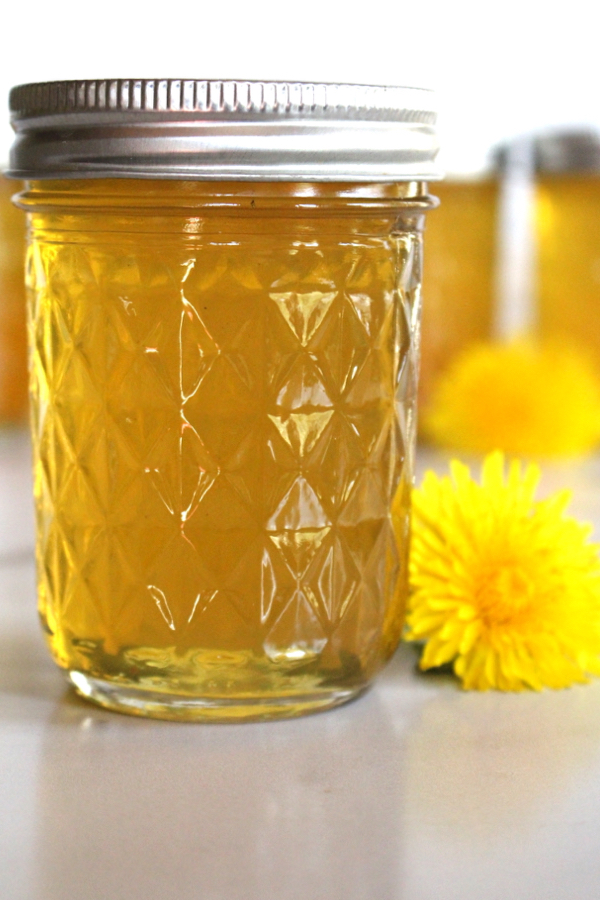
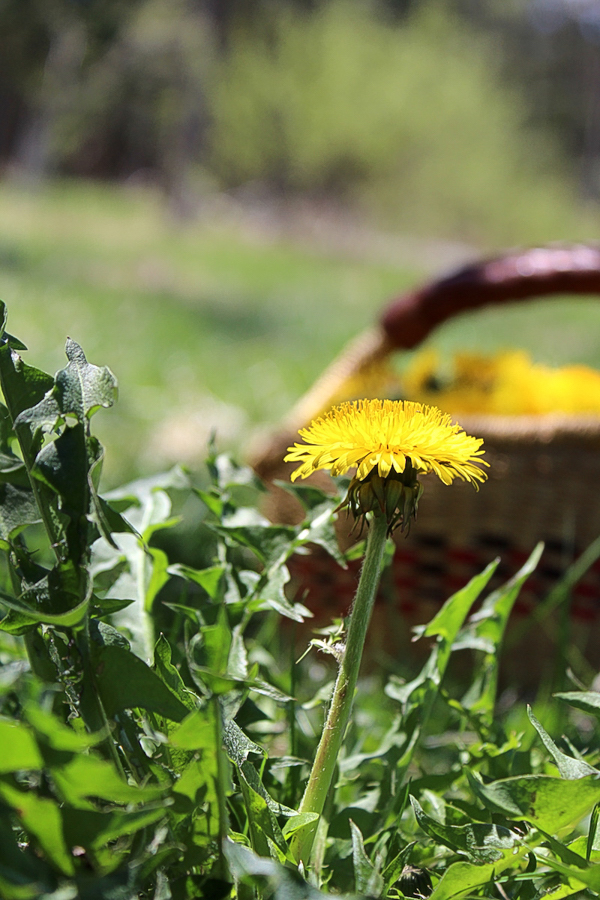
Harvesting Dandelions for Jelly
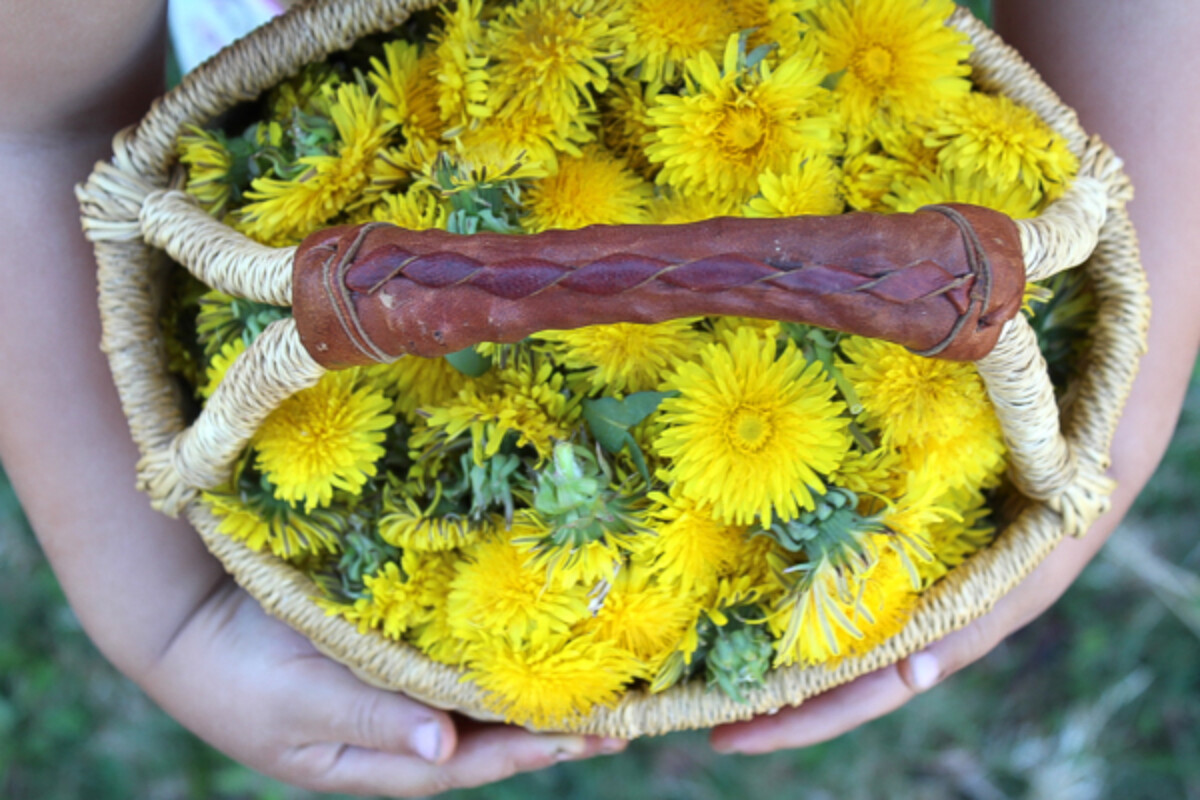
Believe it or not, harvesting enough dandelions for jelly is pretty quick. It took me no more than 10 minutes to harvest all the flowers I’d need, with just a tiny bit of help from children.
If you just don’t have access to dandelions, believe it or not, you can actually purchase them dried for this project. You’ll still have to clean them though, so it doesn’t save much time.
The time-consuming part is separating the petals from the green parts. I do it by tearing each flower in half and then pulling out the yellow petals while leaving the green sepals behind.
It took me about an hour to separate the petals. Settle down at a picnic table in the shade (or plop yourself in front of a movie in the evening), and you’ll be done before you know it.
It takes about 8 cups of whole dandelion flowers to make 4 cups of petals (fluffy) or 2 cups packed for this dandelion jelly recipe. By weight, the whole flowers I harvested were roughly 1/2 pound (200 – 250 grams) before processing.
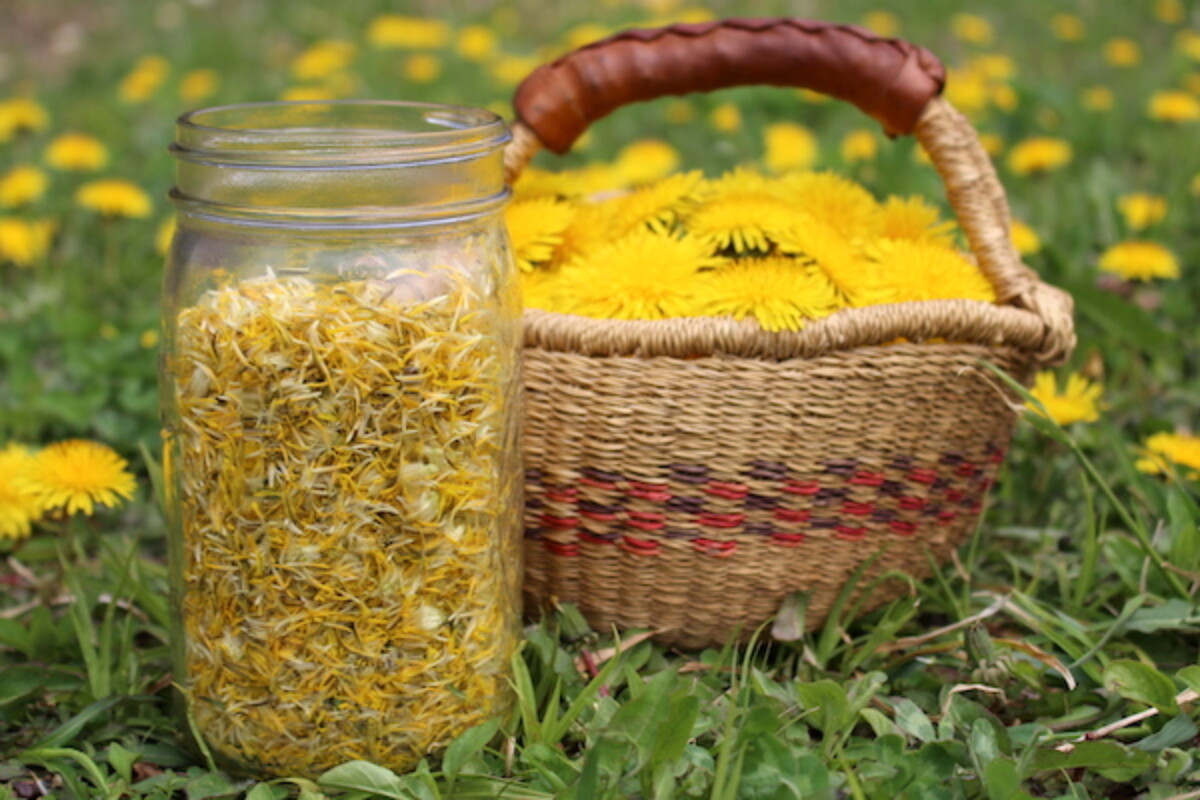
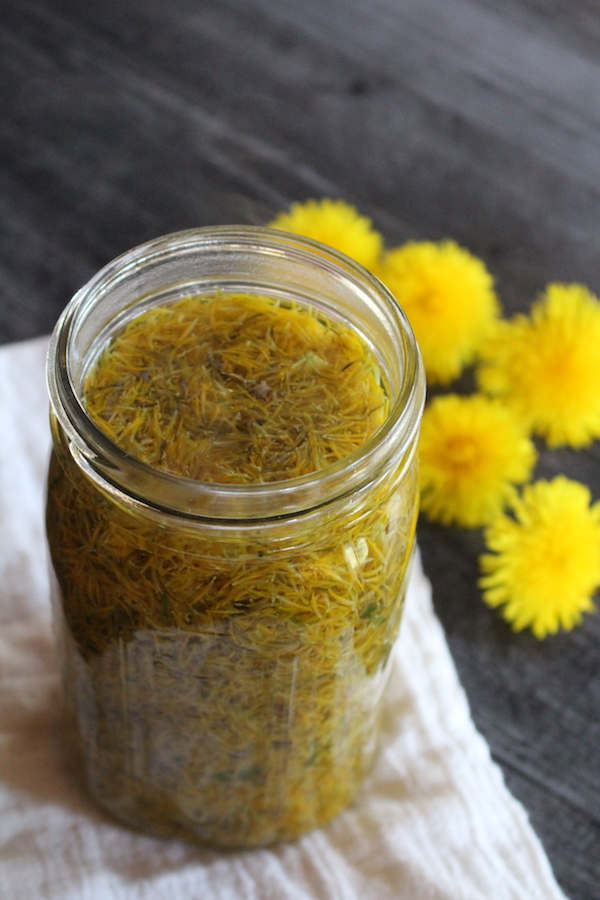
Making Dandelion Tea
Once you have clean dandelion petals, the next step is making dandelion petal tea. Pour 4 cups boiling water over 4 cups of dandelion petals (not packed) or 2 cups packed petals.
I find that a quart mason jar works perfectly because it holds ever so slightly more than a quart. That means it’s the perfect size to measure and then hold both the fluffy dandelion petals and the boiling water.
Simply fill the jar with your cleaned dandelion petals, and then pour boiling water over the top until it’s full.
Allow the tea to steep for at least an hour, or up to 24 hours, before straining.
Pectin for Dandelion Jelly
Once you have dandelion tea, the next steps depend on your choice of pectin.
Generally, I’m in favor of making jam without added boxed pectin, but sometimes that’s just not possible. Pectin is a part of a fruit’s structure, but it’s just not part of a dandelion flower’s structure.
In the past, I’ve used other techniques to get the jam to gel, including citrus seed pectin and green apple pectin. Both are extracted from fruits at home and then used to gel jams and jellies. The problem is, while they can help low pectin fruits gel, they’re not really designed to gel flower jellies that have absolutely no pectin of their own.
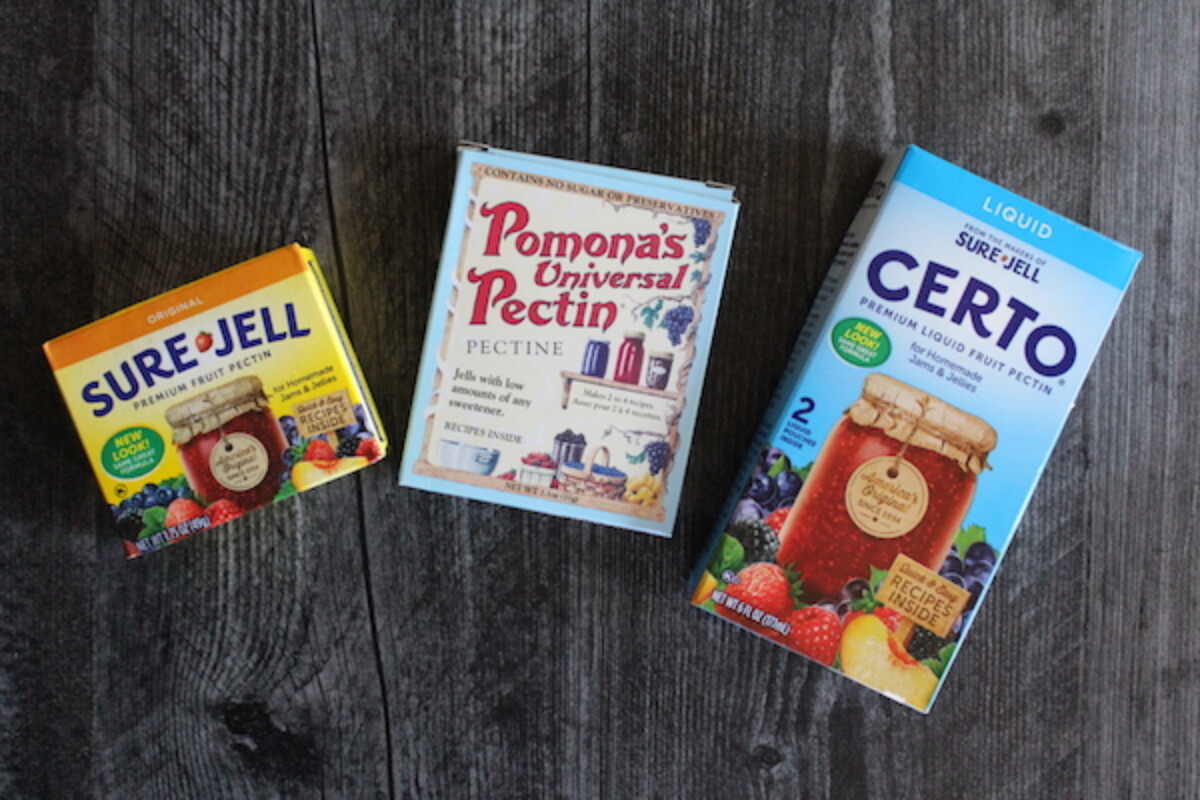
When making dandelion jelly, you’re going to have to add boxed pectin of some sort. There are a lot of choices out there, and each of them will set to a different finished jelly texture (and will require different amounts of sugar).
- Sure-Jell ~ The most common type of pectin available, it requires a good bit of sugar to set jam. You’ll need a minimum of 4 cups of sugar to properly set 4 cups of dandelion tea, resulting in 6 cups of finished dandelion jelly.
- Liquid Pectin ~ Little pouches of already liquified pectin are preferred by some for convenience. I avoid them because they contain preservatives (sodium benzoate) and liquid pectin requires substantially more sugar to gel. Use 2 pouches of liquid pectin (1 full box) along with a full 7 cups of sugar for every 4 cups of dandelion tea.
- Pomona’s Universal Pectin ~ Designed for low and no sugar recipes, this pectin doesn’t require sugar to gel. The box comes with 2 ingredients, the pectin powder, and calcium that’s used to activate the pectin (instead of sugar). Follow the directions on the box for steps, but use 4 tsp. pectin and 4 tsp. calcium water. Add as much or as little sugar as you’d like.
Making Dandelion Jelly
You’ve harvested the petals, spend the better part of an afternoon cleaning them, and decided on your pectin source. Great, time to make the jelly!
Pour the strained dandelion tea into a jam pot. You should have 3 1/2 to 4 cups of tea. Be sure to wring out the petals to get every last bit of moisture (and flavor) out of them.
Add 2 tablespoons of lemon juice (or 1/2 teaspoons of citric acid) along with a full box of Sure-Jell pectin. Don’t add the sugar yet!
(If you’ve chosen a different pectin source, follow the directions on the box. Pomona’s pectin, for example, is added later in the process along with the sugar.)
Bring the mixture to a hard boil on the stove over high heat.
Once the mixture is rapidly boiling, add in 4 cups of sugar and stir to dissolve. Bring the mixture back to a hard boil and cook, boiling rapidly for 1-2 minutes before pouring into prepared jars.
Seal the jars and allow the jelly to cool and set up overnight. Be patient, jelly can take 12-48 hours to completely set.
Dandelion Jelly Recipe Variations
I really wanted the honey flavor of the dandelion petals to shine through, so I went with straight dandelion jelly.
You can, of course, combine flavors and choose other fruits or flowers that compliment the subtle flavor of dandelion.
This recipe includes lavender flowers, which I bet taste really lovely along with dandelion’s honey flavor notes.
Wild violet flowers bloom at the same time as dandelions, so I considered adding them as well. They’d impart a beautiful purple color, and believe it or not, they taste like fresh ripe berries!
I learned that when I made violet jelly this spring. The flavor is absolutely delightful, but it’ll overpower the flavor of your dandelion jelly so I’d suggest making that separately.
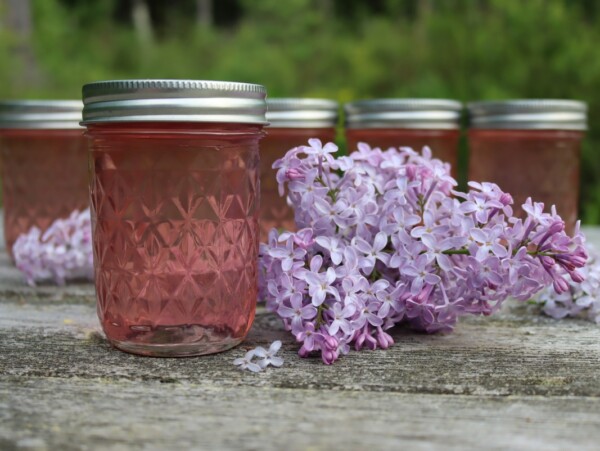
The same goes for other spring floral jellies, like lilac jelly.
The most compelling combination, in my opinion, might be strawberries, but we’re a strawberry jelly-loving family. The All-New Ball Book of Canning and Preserving includes a recipe for roasted strawberry chamomile jelly, and I think dandelion petals would be a stunning substitution in place of the chamomile.
Canning Dandelion Jelly Safely
Canning is completely optional, and it’s perfectly fine to make this as a refrigerator jelly for immediate use. The jelly will keep in the refrigerator for several weeks, or the freezer for up to 6 months.
I’m always short on fridge space, so I usually opt to can my homemade jam and jelly. That way, I can keep it on the pantry shelf for year-round use (just refrigerate after opening).
You’ll notice that this recipe for dandelion jelly includes a bit of lemon juice (or citric acid). While most fruits are acidic in their own right, making them ideal for water bath canning, dandelion petals don’t really alter the pH much.
Jelly needs to have a pH of 4.6 or below for safe water bath canning, so a few tablespoons of lemon juice or 1/2 teaspoon of citric acid are required.
Even if you’re not canning dandelion jelly, a bit of acidity helps brighten the flavor. I went with lemon juice, and you really can’t taste the lemon at all. For a more neutral flavor, choose citric acid.
Start by preparing a water bath canner before you begin boiling the jam. Prepare the dandelion jelly as you otherwise would, but then fill canning jars leaving 1/4 inch headspace.
Cap the jars with 2 part canning lids and then process in a water bath canner for 10 minutes. Remove the jars to cool on a towel on the counter, and check seals after 24 hours.
Store any unsealed jars in the refrigerator for immediate use. Properly canned and sealed jelly jars will keep at room temperature in the pantry for 12-18 months.
(If you’re not familiar with canning, I’d suggest reading my beginner’s guide to water bath canning before getting started. Make sure you have all the right canning supplies on hand too.)
Dandelion Jelly
Equipment
- Ball Regular Mouth Canning Jar 8 oz. 12 pk
- Sure Jell Premium Fruit Pectin For Homemade Jams And Jellies, 100% Natural 1.75 oz (2 Packs)
Ingredients
- 4 cups dandelion petals, or 2 cups packed petals
- 4 cups sugar
- 2 Tbsp. lemon juice, or 1/2 tsp citric acid
- 1 box Powdered Pectin, 1.75 ounces, such as Sure Jel
- Boiling Water
Instructions
- Harvest roughly 8 cups of dandelion flower heads. Carefully remove just the yellow petals, discarding the green portions. You should have roughly 4 cups petals (not packed) or 2 cups petals (packed).
- Make a dandelion petal tea by pouring 4 cups boiling water over the cleaned flower petals. Allow the tea to steep for at least an hour, but as long as 24 hours.
- After steeping, strain the petals, ringing them out to get every last bit of liquid. Measure the liquid, you should have 3 3/4 to 4 cups of dandelion tea.
- Pour the dandelion tea into a heavy-bottomed saucepan. Add lemon juice and pectin, and bring the mixture to a boil over high heat. (Note: Do not add sugar yet.)
- Once the mixture is rapidly boiling, add the sugar and stir to combine.
- Allow the mixture to return to a hard boil, and boil 1-2 minutes before removing from heat.
- Pour the jelly into prepared jars, seal and allow the jelly to cool and set for at least 12 hours. (Sometimes jelly takes as long as 48 hours to fully set, be patient.) Store in the refrigerator.
Canning Dandelion Jelly (optional):
- Prepare a water bath canner before you begin cooking the jelly. Be aware that the lemon juice or citric acid is required for safe canning.
- Prepare the jelly, and then pour into canning jars leaving 1/4 inch headspace. Process in a water bath canner for 10 minutes before removing to a towel on the counter to cool completely.
- Check seals after 24 hours and store any unsealed jars in the refrigerator for immediate use. Properly canned and sealed jars will last in the pantry for 12-18 months.
Notes
Dandelion Recipes
Looking for more tasty ways to use dandelions?
- Dandelion Wine
- Dandelion Shortbread Cookies
- Dandelion Ice Cream
- Dandelion Gummy Bears
- Dandelion Tincture
- Dandelion & Burdock Herbal Bitters
Jelly Recipes
How about more canning recipes to keep your jelly cupboard full?
- Blackcurrant Jelly
- Rhubarb Jelly
- Prickly Pear Jelly
- Hawthorn Jelly
- Chokecherry Jelly
- Raspberry Jelly







Is this recipe safe for pint size jars?
Yes. Pints process for the same time as half pints. Enjoy!
It is very delicious .
I am so pleased with how this recipe turned out. I ended up with 5 cups of liquid instead of the 4 on the recipe, but I still kept the pectin amount the same, but just boosted the sugar content by a half cup. I canned using the water bath instructions. Thank you for this easy recipe! I can’t wait to try your other floral jelly recipes.
I’m so glad you like it!
In the equipment needed, is says 2 boxes of pectin but in the ingredients, it says one box. I made it using the ingredients directions, which calls for 1 box. The jelly is pretty much liquid. I did see it can take 12-48 hours to set up and it has only been 4 hours. Am I just being too impatient? I’d really hate for this not to work because it took FOREVER plucking dandelion petals. Any information or advice would be greatly appreciated!!!
Hi! The recipe is correct with 1 box of pectin for 4 cups of liquid. I just looked at the post and don’t see 2 boxes listed in the equipment section, so let me know where you spotted it and I’ll take another look.
Four hours is too early to panic. Dandelion jelly is one of the slower setters because dandelion tea has zero natural pectin (unlike fruit jellies). Give it the full 48 hours before judging.
If it’s still liquid after 2 days, you can save it: pour the jars back into a pot, add another box of pectin and a bit more lemon juice, bring to a rolling boil, stir in 1/4 cup more sugar, boil 1 minute, and rejar. Your petal-plucking labor will not be wasted!
You can find more information on troubleshooting jellies here: https://creativecanning.com/troubleshooting-jelly-set/
Love this one and the violet jelly definitely plan on making more of both for family and friends, but curious how long they last opened in the fridge?
This one should last 2-3 weeks opened in the fridge.
I’ve made this twice now. I absolutely love the taste. The first is awesome but so far on this second batch it isn’t jelling. I put it in jars about 10 hours ago and the jars have sealed but the content is still liquid! Help!!
Jellies can take up to 48 hours to set, so give it a bit more time. After that, here’s a guide to troubleshooting jelly set: https://creativecanning.com/troubleshooting-jelly-set/
I have made both violet and dandelion jelly for a few years now with great success. A delicious sign of spring
Excellent! I’m so happy you like them =)
Do you wash the petals before processing them?
Personally, I don’t, but it’s pretty clean back here as my yard is isolated on our homestead, 1/2 a mile from the nearest dirt road (and 4 miles from the nearest paved one). If you’re in town, you may want to rinse them.
Just finished a double batch. Tastes delicious. I hope it gels. I used the canning method. My next project is lilac jelly as I have no violets, but do have lilacs. Then on to peony jelly.
Wonderful! All three are delicious, and I hope you enjoy them as much as we do!
This recipe is awesome. My first time making jelly and using pectin. I also made the wild violet jelly. I would love to send you a picture of the results.
The flavor is so tasty for both jellies.
Wonderful, so glad you liked it!