
Affiliate disclosure: This post may contain affiliate links. Please see our Privacy Policy.
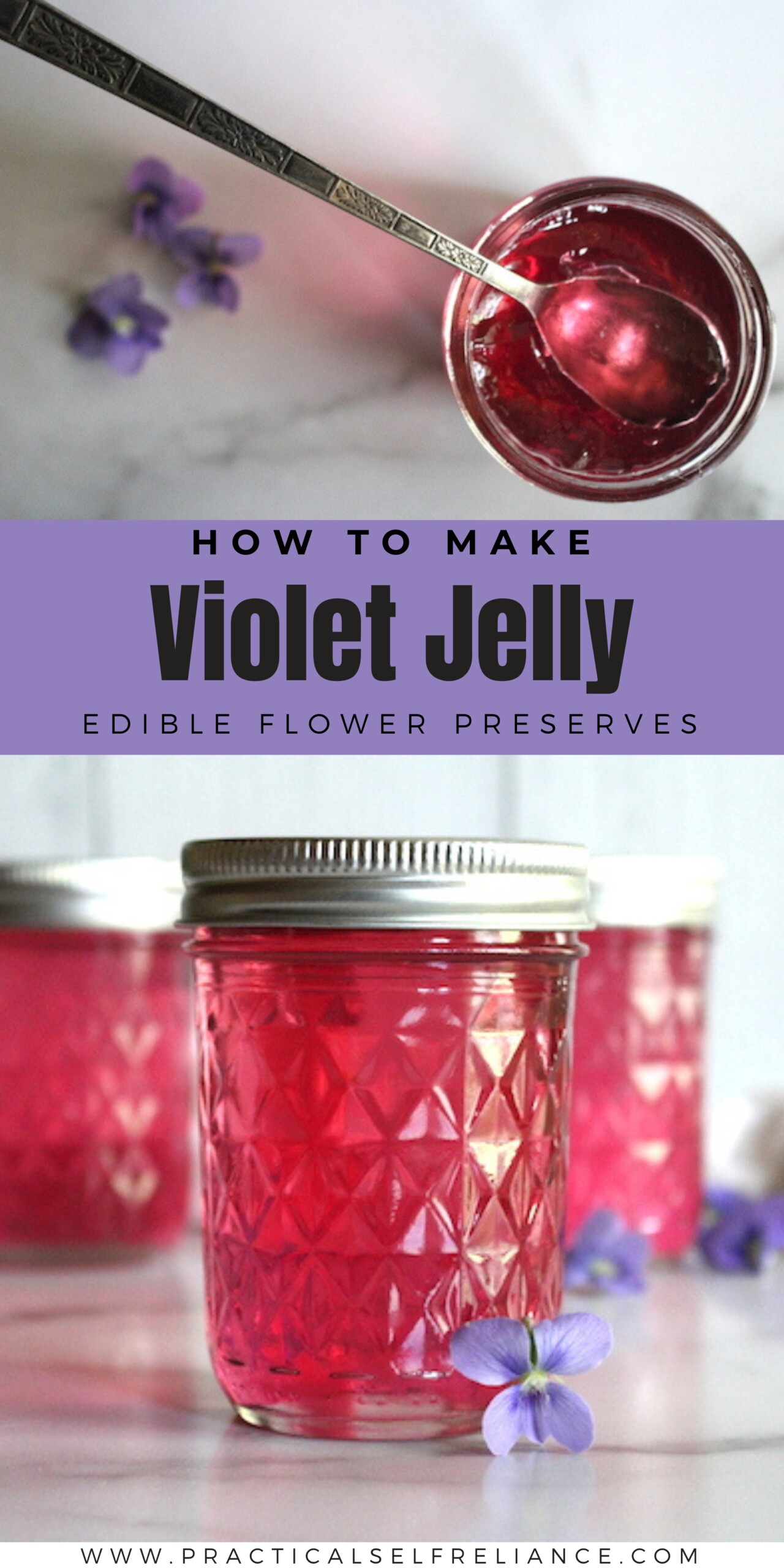
Violet jelly is an easy homemade flower jelly that will add stunning color to your toast, biscuits, and scones. Believe it or not, these bright spring blooms taste like fresh berries, making an exceptionally jelly long before the first fruit harvest of the season.
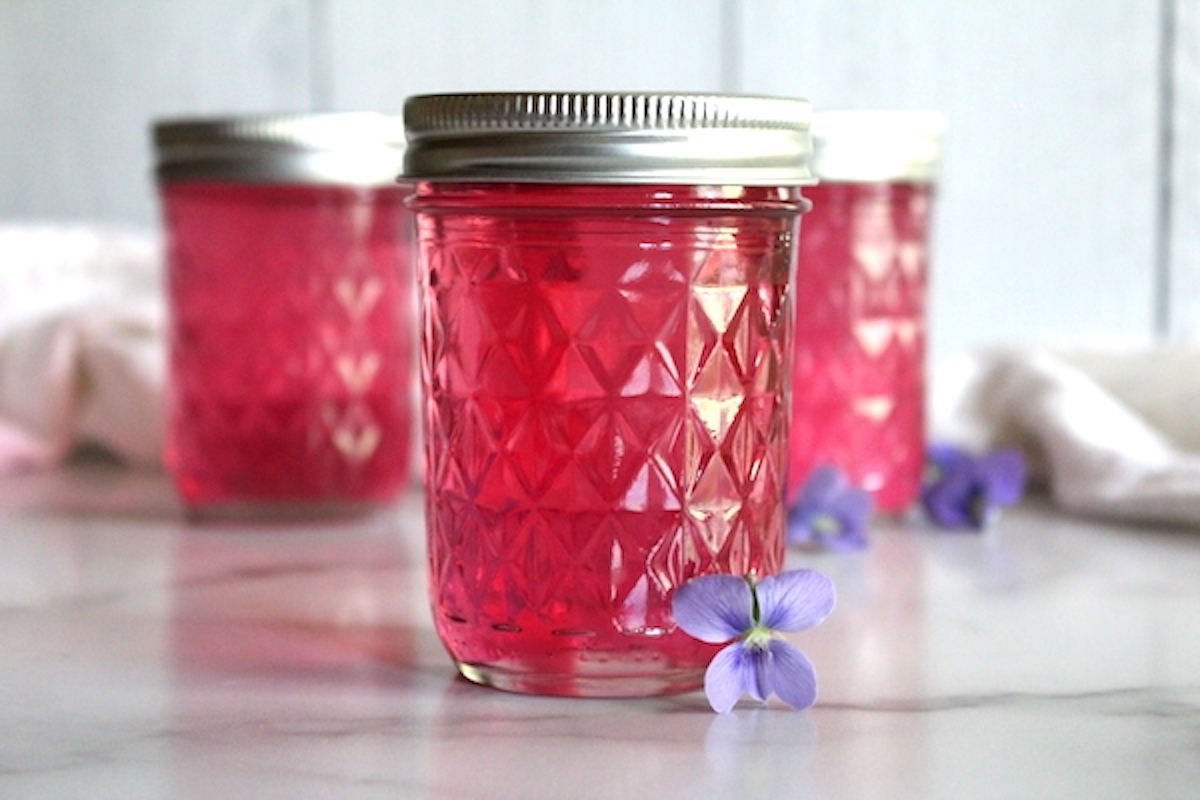
Table of Contents
- Notes from My Kitchen
- What Does Wild Violet Jelly Taste Like?
- Identifying and Harvesting Wild Violets
- Ingredients for Wild Violet Jelly
- How to Make Wild Violet Jelly
- Don’t Overcook Pectin Jelly
- Canning Wild Violet Jelly
- Altitude Adjustments
- Yield Notes
- Storage Options
- Recipe Tips
- Pectin Options
- Ways to Use Wild Violet Jelly
- Violet Jelly FAQs
- Ways to Use Wild Violets
- Violet Jelly Recipe
Wild violets are one of the first things to bloom on our Vermont homestead each spring, and they grow in such abundance along our woods’ edges that the kids and I can fill a quart jar with flowers in about an hour. That single jar is enough for a full batch of violet jelly, and the whole project has become one of our regular spring foraging rituals.
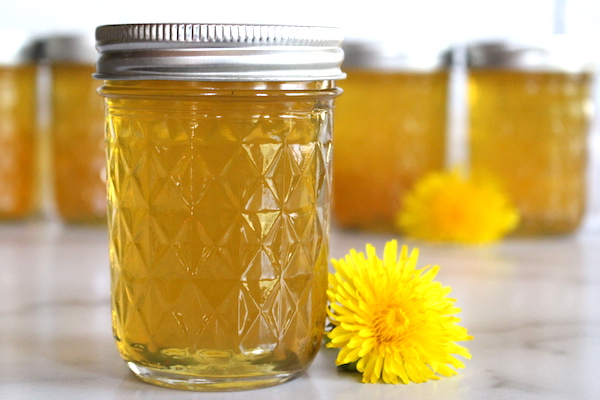
This is essentially a flower jelly. We started making them with dandelion jelly, and the success of that batch kicked off a whole season of experimenting with nearly every edible flower we could get our hands on. Some were underwhelming, but violets stand out. The technique works with most flowers once you’ve got it down, but the flavor here is genuinely surprising, more like fresh berries than anything floral.
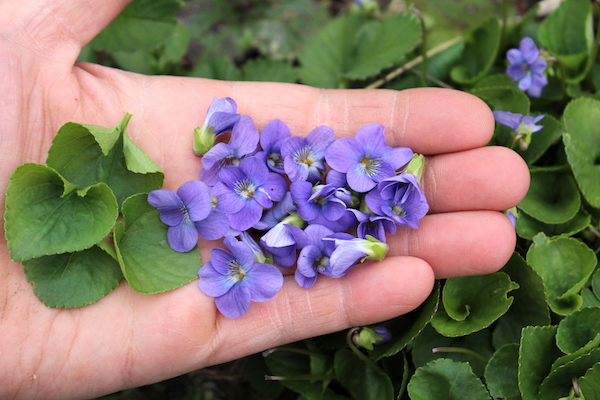
The wild violets we use are the common purple ones in the Viola genus that grow in lawns and along woods’ edges across most of North America. They’re not the same plant as the African violets you’d buy as a houseplant, so it’s worth confirming you’ve got the right one before you start picking. Wild violets are easy to identify once you know what to look for, and both the leaves and flowers are edible.
Notes from My Kitchen

The first year I made this jelly, my kids were two and four, and I put them to work harvesting flowers. They sat in the violet patch for the better part of an hour, perfectly content, picking blossoms one at a time and dropping them into a mason jar. It was the kind of slow, low-pressure foraging that’s hard to beat with little ones, and they were absolutely delighted when the turquoise violet tea turned bright pink the moment we added lemon juice.
We’ve made this jelly every spring since, and I genuinely look forward to the first violets pushing up through the leaf litter each May. It’s become one of those rituals that marks the start of the foraging season here in Vermont, alongside ramps, fiddleheads, and the first dandelions opening in the lawn.
What Does Wild Violet Jelly Taste Like?
Wild violet jelly doesn’t taste anything like the perfumed violet candies you might find at a candy shop. Instead, it tastes surprisingly like fresh berries, with bright notes of blueberry and raspberry layered over a gentle floral sweetness. The same plant compounds that give wild violets their purple color also give blueberries and blackberries theirs, and that family resemblance carries through into the finished jelly.
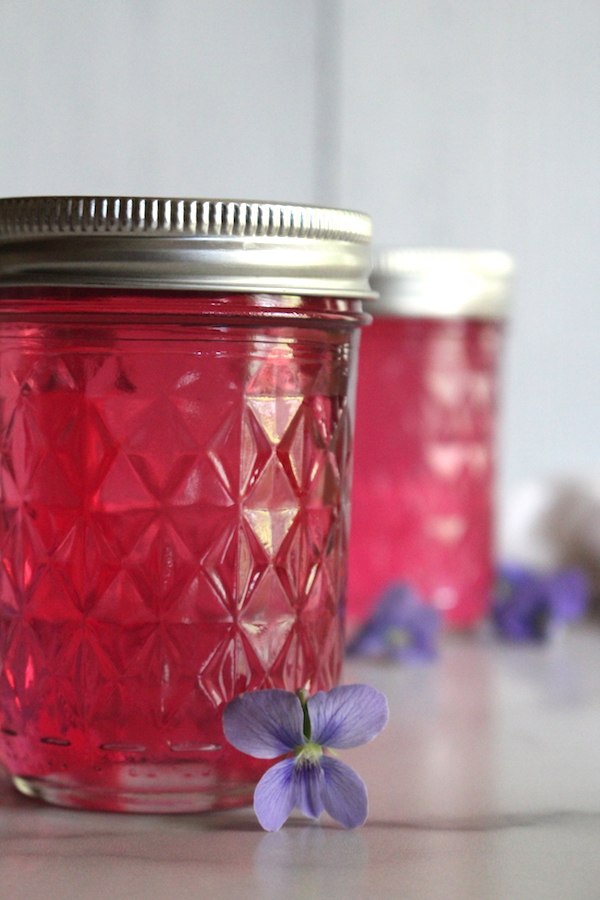
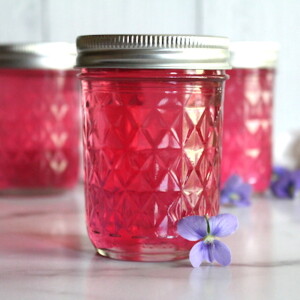
The texture is smooth and spreadable, with a clear pink-to-magenta color that catches the light beautifully on a breakfast table. If you use predominantly white violets, the flavor leans more toward honey and the finished jelly takes on a pale golden color instead. A mix of purple and white violets gives you something in between, with both berry and honey notes.
Identifying and Harvesting Wild Violets
Wild violets in the Viola genus are easy to identify and incredibly common. The leaves are heart-shaped with a slightly serrated edge, and the flowers have five petals in a rough star shape. Color ranges from deep purple to violet, white, or a combination, depending on the variety and growing conditions. They prefer moist, shady spots and are often tucked along woods’ edges, under trees, or on the north side of buildings.
Here in Vermont, wild violets bloom from late April through June. In warmer climates like the Pacific Northwest, they can start blooming as early as February, and in mild parts of California they’ll bloom right through winter. Look for fresh, fully open flowers without any wilting or browning. Pick only the blossoms, leaving the stems and leaves behind for the next round of blooms.
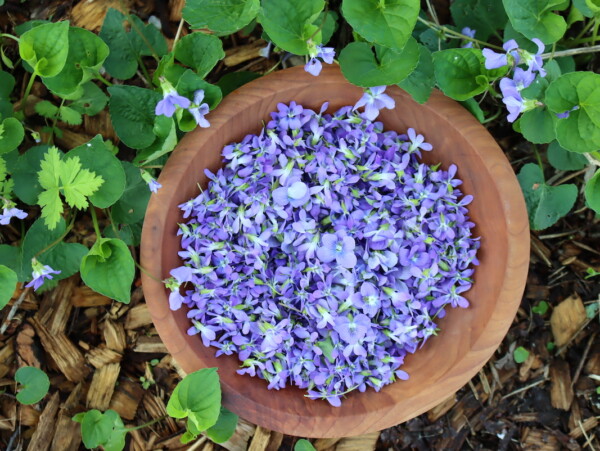
You’ll need about two cups of loosely packed violet flowers for a single batch of jelly. If you fill a quart mason jar about halfway with flowers, that’s roughly the right amount. The flowers are small and it takes a while to gather enough, but kids are surprisingly good at this job. A bigger harvest opens up plenty of other options too, from candied flowers and syrups to violet wine and dozens of other ways to use wild violets.

Ingredients for Wild Violet Jelly
This recipe is essentially a floral tea set with pectin. The flowers are steeped in boiling water to extract their color and flavor, then lemon juice, pectin, and sugar transform the strained tea into a vibrant pink jelly.
- Wild violet flowers: Just the flowers, no stems or leaves. Fresh flowers give the brightest color and the strongest flavor, but you can also keep harvested flowers in the fridge for a day or two if you need to batch your picking sessions.
- Water: Used to make the violet tea. Filtered or spring water works well, since heavily chlorinated tap water can mute the floral flavor.
- Bottled lemon juice: This serves several roles. It brings the pH down to a safe level for water bath canning (flowers aren’t naturally acidic the way fruit is), it triggers the dramatic color change from turquoise to pink, and it brightens the flavor. Bottled is recommended over fresh for predictable acidity in canning recipes.
- 1 box (1.75 oz) powdered pectin: Standard powdered pectin like Sure-Jell or Ball Classic works perfectly here. Don’t substitute liquid pectin, which uses a completely different method and requires much more sugar. See the Pectin Options block below for low-sugar alternatives.
- Granulated sugar: Plain white granulated sugar is what works with standard pectin. The sugar both sweetens the jelly and helps the pectin set, so don’t try to reduce it without switching to a low-sugar pectin formulated for that purpose.
If you only have a small handful of violets, you can scale the recipe down by harvesting the same ratio of flowers to water and adjusting the rest proportionally. Just don’t try to double the batch, since larger batches of pectin jelly often fail to set properly.
“I made wild violet jelly for the first time 3 years ago. I made it to gift for Mother’s Day. People are shocked a little flower jelly can be so good and it’s always requested of me! This year I plan to make scones and clotted cream for Mother’s Day brunch to serve with this. Thanks for the recipe!”
How to Make Wild Violet Jelly
The process has two main stages: steeping the violet flowers in boiling water to make a strong tea, and then cooking that tea with lemon juice, pectin, and sugar to set it into jelly. Total hands-on time is under half an hour, with a long passive steep in the middle.
Making the Violet Tea
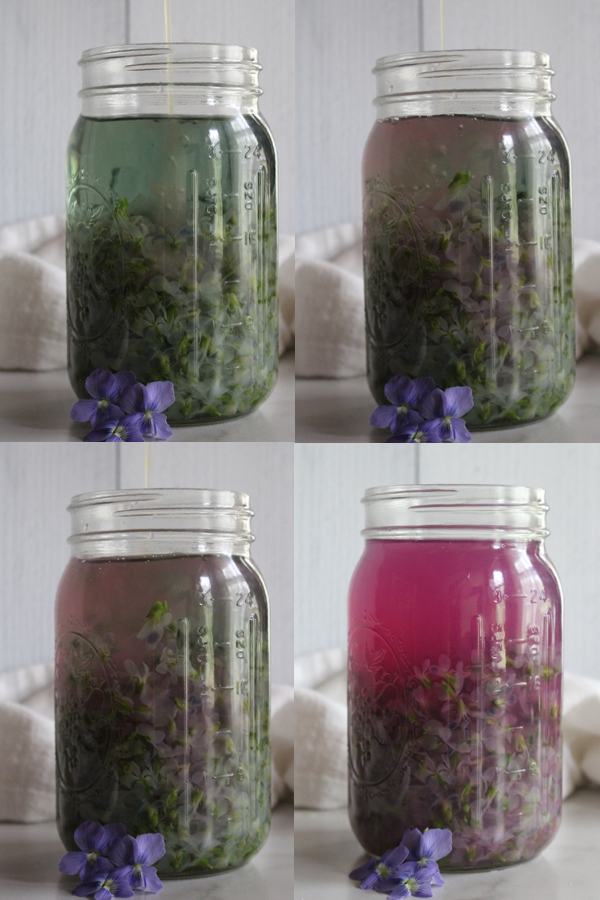
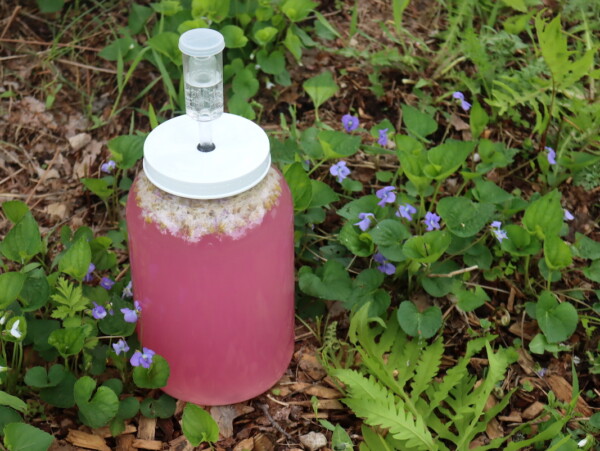
Pack the violet flowers loosely into a quart mason jar. Pour freshly boiled water over the flowers, cover the jar, and let it steep for at least four hours or overnight. The longer the steep, the deeper the flavor and color extraction. The tea will be a startling turquoise or blue-green color at this stage, which is completely normal.
Once the tea has steeped, strain out the flowers and squeeze them gently to extract every bit of liquid. The flowers will look bleached and limp at this point, having given up their color to the tea. If you have a few extra fresh violets, you can add them right at the end of the steep for an extra burst of color.
If you can’t make the jelly right away, the strained violet tea will keep in the refrigerator for three to four days. Several readers have asked about this because foraging the flowers and making the jelly on the same day can be a lot, and splitting it across two days works just fine.
Cooking the Jelly
Pour the strained violet tea into a deep saucepan and add the bottled lemon juice. The color will immediately shift from turquoise to pink, which is one of those small kitchen miracles that never gets old. Whisk in the powdered pectin and bring the mixture to a hard rolling boil that you can’t stir down.
Once it’s at a hard boil, add all the sugar at once, stirring constantly until it dissolves. Return the mixture to a hard rolling boil and let it boil for exactly one minute, then remove it from the heat. Skim off any foam from the surface, since it won’t dissolve back in and can leave a cloudy layer on top of the jars otherwise.
Don’t Overcook Pectin Jelly
Pectin jellies set as they cool, not while they’re cooking. If you’ve made no-pectin jams before, you might be tempted to cook this longer or test for gel stage with a freezer plate or thermometer, but neither of those tests applies to pectin recipes.
- Follow the box-pectin method exactly: hard boil with pectin and lemon, add sugar, hard boil one minute, then off the heat.
- The hot jelly will look thin and watery when you ladle it into jars. That’s exactly right.
- The set develops over 24 to 48 hours as the jars cool. Don’t open or test a jar before then to check if it set.
- Cooking the jelly longer than one minute after adding sugar can actually break the pectin and prevent setting.
Canning Wild Violet Jelly
Canning is optional, but it lets you enjoy violet jelly year-round and pack jars away as shelf-stable gifts. If you’d rather skip water bath canning entirely, just ladle the jelly into clean jars, cap them, and store in the refrigerator (good for three to four weeks) or freezer (six months).
Ladle the hot jelly into prepared half-pint jars, leaving 1/4 inch of headspace. Wipe the rims clean, apply two-part canning lids, and process in a boiling water bath for 10 minutes. Once the processing time is up, turn off the heat and let the jars rest in the canner for five minutes before lifting them out to cool. Check seals after 24 hours and store any unsealed jars in the refrigerator. A basic set of canning supplies (a canner, jar lifter, funnel, and half-pint jars with two-part lids) is all you need for this recipe.
Altitude Adjustments
Adjust processing time based on your elevation:
- Below 6,000 feet: Process for 10 minutes.
- Above 6,000 feet: Process for 15 minutes.
Yield Notes
A few specifics on the finished batch:
- One batch yields about 6 half-pint (8 oz) jars of finished jelly, or 6 cups total.
- Two cups of loosely packed violet flowers and 4 cups of water makes enough tea for one batch.
- Don’t double this recipe. Larger batches of pectin jelly often fail to set because the boiling action isn’t strong enough to activate the pectin evenly. Make two single batches back-to-back instead.
“This is the third year I’ve made this jelly. My daughter is named Violet and I make this every year in honor of her. Thanks for sharing this recipe!”
Storage Options
How you store violet jelly depends on whether you’ve canned it or not:
- Refrigerator: 3 to 4 weeks in a sealed jar, whether canned or not.
- Freezer: Up to 6 months in freezer-safe jars (leave 1 inch of headspace for expansion).
- Canned and shelf-stable: 12 to 18 months in a cool, dark pantry. Once opened, refrigerate and use within 3 to 4 weeks.
Recipe Tips
A few notes from years of making this jelly:
- White violet variation: White wild violets are also edible and make a pale golden jelly with honey notes instead of berry flavor. A mix of white and purple gives you a beautiful in-between color and flavor.
- Johnny jump-ups and garden violas: Both work in place of wild violets. Same family, similar flavor. Avoid yellow wild violets, since some sources note they can cause mild digestive upset.
- Citric acid substitution: If you’d prefer a “pure” violet flavor without the lemon, you can substitute 1 teaspoon of citric acid powder for the 1/4 cup of bottled lemon juice. The acid is still needed for safe canning and for the color change.
- Lime juice swap: Bottled lime juice can replace the lemon juice if that’s what you have on hand. Acidity is similar, and the result is just as safe to can.
- Don’t double the recipe: This is the most common cause of jelly that doesn’t set. Make two single batches back-to-back if you want a larger total yield.
- If your jelly doesn’t set: Give it the full 48 hours first. Most “didn’t set” jelly turns out to be jelly that just needed more time. If it really didn’t set, you can re-batch it with fresh pectin following the directions inside the pectin box.
Pectin Options
Standard powdered pectin like Sure-Jell or Ball Classic Pectin is what this recipe is written for. One 1.75 oz box per batch, with 4 cups of sugar. Several long-time readers have noted that Sure-Jell seems to give the brightest pink color in the finished jelly, though both brands produce a properly set product.
For a lower-sugar version, use Sure-Jell Low Sugar Pectin (pink box) or Ball Flex Batch Low Sugar Pectin. Each comes with its own instructions inside the box, and you can typically reduce sugar to 2 cups or substitute with a sugar replacement like Splenda.
Pomona’s Universal Pectin works differently from standard pectins and uses calcium water to trigger the set, allowing you to use as little as 3/4 cup of sugar per batch. Follow Pomona’s directions for mint jelly when adapting this recipe, since both are herbal teas set into jellies. Their pectin is also the right choice if you want to sweeten with honey or maple syrup instead of granulated sugar.
I don’t recommend liquid pectin for this recipe. It requires nearly a 2-to-1 ratio of sugar to liquid and follows a different method (sugar in first, pectin at the end). The end result is sweeter and stickier than a standard pectin jelly, and most flower jelly recipes are written for powdered pectin anyway.
Ways to Use Wild Violet Jelly
The most obvious use is on toast, biscuits, scones, or English muffins, where the bright pink color is half the appeal. It’s also lovely spooned onto cream cheese with crackers, swirled into Greek yogurt, or melted as a glaze for shortbread cookies or a wheel of brie. A spoonful stirred into hot tea or sparkling water makes a quick floral drink, and a thin layer between cake layers turns a simple pound cake into something that feels distinctly special.
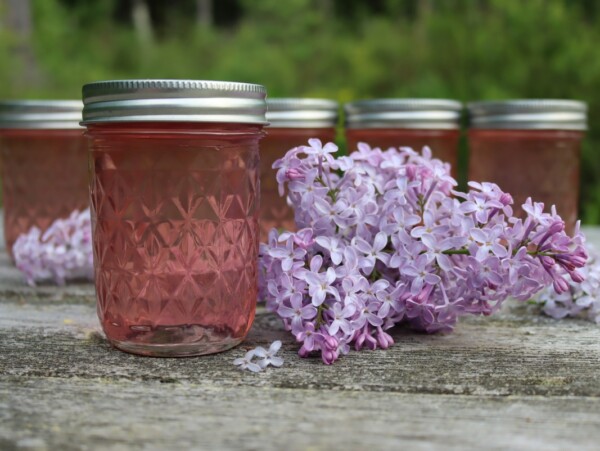
On a homemade jelly shelf, violet sits beautifully alongside spring’s lilac jelly, early summer’s strawberry jelly, and fall’s elderberry jelly. Each has its own moment, and there are plenty more once you start working through jam and jelly recipes.
Violet Jelly FAQs
You need about 2 cups of loosely packed wild violet flowers for a single batch of jelly. Filling a quart mason jar about halfway with flowers gets you to the right amount. The flowers are small, so plan on spending an hour or so harvesting unless you have a really prolific patch.
Pectin jelly sets as it cools, typically over 24 to 48 hours after canning. The jelly will look thin and watery in the jars right after processing, which is completely normal. Don’t open or test a jar to check the set before the full 48 hours have passed, since opening the seal too early can cause it to fail.
Yes, white wild violets are edible and make a pale golden jelly with honey-like flavor instead of the berry notes you get from purple violets. A mix of purple and white violets gives you a finished jelly somewhere in between, with both flavor profiles and a softer pink color.
The most common reasons pectin jelly doesn’t set are doubling the recipe, adding sugar before the pectin has come to a full hard boil, not maintaining a hard rolling boil for the full one minute after adding sugar, or using pectin that’s past its expiration date. Give the jelly a full 48 hours to set before declaring it a failure, since pectin jellies sometimes need the full window. If it still hasn’t set, walk through the steps for troubleshooting jellies that didn’t set and re-batch with fresh pectin.
No, don’t double pectin jelly recipes. Larger batches don’t heat evenly and the boil action isn’t vigorous enough across the whole pot to activate the pectin properly. The most reliable way to get a larger total yield is to make two single batches back-to-back rather than one double batch.
Ways to Use Wild Violets
If you tried this Violet Jelly Recipe, or any other recipe on Practical Self Reliance, leave a ⭐ star rating and let me know what you think in the 📝 comments below!
And make sure you stay in touch with me by following on social media!
Violet Jelly
Ingredients
- 2 cups Wild Violet Flowers
- 4 Cups Water
- 1/4 Cup Lemon Juice, bottled if canning, or citric acid, see notes
- 1 box Powdered pectin, 1.75 oz Pectin or 6 Tbsp. (Such as Sure-Jell)
- 4 Cups Sugar
Instructions
- Pack the wild violet flowers loosely into a quart mason jar. Pour the boiling water over the flowers, cover, and let steep for at least 4 hours or overnight. The tea will turn a striking turquoise or blue-green color.
- Strain the violet tea through a fine-mesh strainer into a measuring cup, pressing gently on the flowers to extract all the liquid. You should have about 4 cups of violet tea. If you’re slightly short, top up with cool water.
- Pour the strained violet tea into a deep saucepan and stir in the bottled lemon juice. The color will immediately shift from turquoise to pink. Whisk in the powdered pectin until fully dissolved.
- Bring the mixture to a hard rolling boil that you can’t stir down, then add all the sugar at once, stirring constantly until it dissolves.
- Return to a hard rolling boil and boil for exactly 1 minute. Remove from heat and skim off any foam from the surface.
- Ladle the hot jelly into prepared half-pint jars, leaving 1/4 inch headspace. Wipe rims clean, apply two-part canning lids.If canning, process in a boiling water bath for 10 minutes (15 minutes above 6,000 feet elevation).
- Once the processing time is up, turn off the heat and let the jars rest in the canner for 5 minutes before lifting them out to cool on a towel-lined counter. Check seals after 24 hours.
- For refrigerator jelly (no canning): Ladle the hot jelly into clean jars, cap, and refrigerate once cool. Keeps 3 to 4 weeks in the refrigerator. The jelly will fully set within 24 to 48 hours of cooling.
Notes
Nutrition
Nutrition information is automatically calculated, so should only be used as an approximation.
Jelly Recipes
Find the perfect recipe
Searching for something else? Enter keywords to find the perfect recipe!








Thanks for the recipe. I’m in northwest Connecticut and found lots of violets this year. I find them on the edges of woods and often under pine trees. I’ve just made a batch of violet jelly following your recipe. The lids have popped/sealed, just waiting for jars to cool now. I used a mix of purple and white violets, and Surejell. Cheers, Sidney
You’re very welcome. Hope you enjoy your jelly.
I am lucky that my violets will actually peek up out from under a snow cover. They are such a delight! I have been allowing my back yard to become more of a wooded garden of natures’ choice. The violets white & purple grow quite heavily along with dandelions & several other eatable weeds. My two girls have an abundent supply of greens. They give me 2 eggs a day even through their first winter. I didn’t add extra lighting. Guess my babies will have to share the flowers with me. Of course I will have to turn over the boards for a worm treat!
I have learned so much from your blog & your recipes have been a great source of fun & learning for my kids as well. I thought it was worth noting that halfway through making this recipe, I realized I only had 2 C sugar (and regular pectin, none of the low-sugar kind). I was worried it wouldn’t set but decided to carry on, figuring in the worst case scenario I would just have some delicious violet syrup instead of jelly. But the jelly set just fine with 2 C sugar and the taste was a perfect balance of sweet and tart. (I used citric acid, not lemon juice, if that makes a difference flavor-wise). Thanks for a great recipe, just in time as we are down to our last jar of grape jam from last summer.
That’s wonderful. Thank you for sharing. I’m so glad it worked out for you.
New to canning jellies and jams! When cutting the sugar in half, does this decrease the duration of shelf life for the jelly? Thank you!
It will decrease the shelf life once opened, but not when it’s still sealed in the jar. Sealed on the panty shelf, they’ll last just fine, and high or low sugar makes not difference. Once opened and in the fridge, a high sugar jam or jelly will last a lot longer, while a low sugar one will spoil after a week or two.
Ashley, I clicked on the link for tinctures and landed on someone else’s page. I was going to buy the knives there but I realized they had stainless steel blades.
I could use ceramic knives (I never knew there was a difference with cutting herbals!)
So, 1) Do you have a link for ceramic knives? I love your posts so I’d like to support you. And
2) Do you have your own link for tinctures? Hers was very similar to posts you have shared in years past so I am not worried about using it.
Thanks so much!
I’m sorry but I can’t seem to find the links that you’re talking about on the Violet Jelly post. Is there another post that you were looking at?
I made wild violet jelly for the first time 3 years ago. I made it to gift for Mother’s Day. People are shocked a little flower jelly can be so good and it’s always requested of me! This year I plan to make scones and clotted cream for Mother’s Day brunch to serve with this. Thanks for the recipe!
That sounds so lovely. Thanks for sharing.
Made this yesterday. Gorgeous, mild and tasty! Made exactly according to recipe, turned out great. Thanks for the lovely recipe. So pretty.
You’re very welcome. We’re so glad you enjoyed it.
I have no source of wild violets. Could you use commercially dried violets purchased from a mail order house that are made for potpourri?
I would not recommend doing that. There are probably other places online where you might be able to purchase them but you need to be sure that they are produced for human consumption if they will be used for a food product.
Hi, thanks for this recipe! I love all things edible flowers. I haven’t had great success with violets however. I have read there is a fragrant variety that grows mainly in Europe. Just to clarify, the violets you made this jelly with are the ones commonly found in America? I live on the East coast and have lots of the wild violets but they have no smell, and I have found it difficult to make them taste good! I would love to try this jelly because I’d love to make something with them that was actually good. Thanks! KC
You’re welcome. Yes, this recipe was made using common wild violets.
would yellow wild violets work too? our purple violets aren’t blooming much this year for some reason, but there’s a TON of yellow ones around our property
You can use any edible flower to make jelly. I have seen some articles that suggest that yellow violets are edible but that they can cause some gastrointestinal issues. You want to be sure of your identification and then do a little more research to make sure.
Do you know if I could use white violets and have the same flavour? Any idea what the colour would be like? I seem to have a bumper crop of white violets in my back yard grass. They might not be “wild”, if so, can they still be used for jelly?
I am not sure what the flavor or color would be. I would definitely try it out if you are sure that they are in fact violets and then let us know how it goes.
I used predominantly white violets as well and its tastes like some surreal honey. I was worried the lemon juice would over power it but there is a slight tang but the overall flavor is wild. Can’t put my finger on it. The color is golden. I tripled the batch because I had so many.
Sounds wonderful. So glad you enjoyed the recipe.
I made my jelly this afternoon and it’s been sitting cooling for about 6 hours now. I confess I have one jar I’m consistently checking (no more than once every couple hours) and it has still not even got a hint of setting. How long does ittaketoset?
I should note that as a diabetic I used a low sugar pectin that only required 1/4 cup sugar to set and then used Splenda for the rest in the recipe.
Jellies can take up to 48 hours to set, regardless of the type of pectin. I’ve had some take quite a while, so be patient with it.
I am basically working my way through your entire blog, I just LOVE it! ☺️ We live in NH so our seasons are pretty on point with yours & we have the same wild edibles which is fantastic! We’ve just begun collecting violet flowers today & will continue to collect until their season is done for this wonderful violet jelly! Can’t wait! ☺️ Thank you so much for sharing your knowledge!
Thank you so much. We are so glad you’re enjoying the blog.
Made this on a whim — gorgeous and so easy.
Wonderful, so glad it worked out for you!
Just a thought… can you use Johnny-jump-up’s (VIOLA CORNUTA) with the wild violets? Lots of jump ups but not so many violets grow here about. Thanks
I love Johnny Jump Ups! They used to grow like crazy at my last home, but for some reason, they just won’t take here (I’ve even planted them). They are edible too, and should work just as well, but I haven’t tried it. I imagine they’d have a similar taste as they’re a very similar flower and closely related, but I’m honestly not sure.
I have a million of those as well! I made the violet jelly huge success! Two batches – both white violets and purple. The white is like so out of this world honey and the purple I have not broken into yet.
That’s wonderful. So glad you enjoyed the recipe.
I am just in the process of making this wonderful jelly, they are in the canner as I am writing this. I followed your recipe to a tee, yet I have come out with six and a half 8 oz jars, instead of four. Can´t see how you come up with four half pints by using 4 cups of water and 4 cups of sugar ? Now I am hoping that it will still set up as it still seems very liquid, I´ve just taken them out of the canner,,,,,could it be that 4 cups of water is too much ?
Ooops. That is a type-o in the recipe yield, yours should set nicely. The yield should be 6 half-pint jars (as it is with the dandelion jelly recipe since they’re essentially the same floral jelly). I’ll go in and correct it. Thanks for the heads up!
And they did, they set up beautifully and taste wonderful ! Many thanks for the great recipe, I will try dandelion and red bud as well !
Wouldn’t you need 1 teaspoon citric acid
for 1/4 cup juice?
That is correct, there must a typo in the notes. The ratio is 1/4 teaspoon of citric acid for every tablespoon of lemon juice. There are about 4 tablespoons in a 1/4 cup so multiply 1/4 teaspoon by 4 and you get 1 full teaspoon of citric acid for this recipe.
yikes! so I went by the 1/2 tsp citric acid for the four cups of liquid. It all looks good, but its my shelf life that will suffer, correct?
Yes, that’s correct. You can put it in the fridge or freezer to prolong the shelf life.
So excited to make the violet jelly-I just thought they were pretty little flowers!. My grandchildren will be delighted as they love my jams and jellies. Yipee! thank you
Good morning Ashley, I have been reading your articles for some time now and enjoying them immensely. About the last 5 yrs I have been making Chamomile jelly the same way using my German Chamomile flowers which luckily reseed and regrow each year . I will definitely do this one also, can’t wait for them to show there little faces here in NJ. Thank you so much for this jelly recipe.
Lucy
Wonderful! Now I have to try chamomile jelly, it sounds divine!
Oh my! My yard is chock full of these little beauties, so I’ll be making lots of jelly. Thank you SO much for this blog… Now I REALLY can’t wait for Spring to arrive❣❣❣
Wonderful!
Might be a dumb question but is a wild violet the same as an African violet?
That’s a really good question! No unfortunately it’s not, they’re completely different species and to the best of my knowledge, African Violet is not edible. Wild violets are viola species, and African violets are a completely different plant (Saintpaulia sp.).
Wow, what a delicious looking jelly! And best of all it’s free!!! I use the same recipe when making crabapple jelly. The trees around me are Dolgo crabs. You can use just about any crabapple to make jelly but the smaller fruits tend to be too bitter for me. The trees have never been sprayed and are not near a major highway. Something everyone needs to watch for when foraging for free goodies! The color of crabapple jelly is about the same but the taste is tangy and delicious. Thanks for the great recipe.
God Bless and stay safe…
You’re welcome and thank you for sharing. So glad you found it helpful.